
 A SCHOLARLY BOOK REPOSITORY
39 start with I start with I

The 2025 Oregon Center for the Book Adult Readers' Selection
The 2025 NYC BIG BOOK AWARD Distinguished Favorite in the category of Cultural and Social Issues
Foreword INDIES 2024 Book of the Year Award Finalist - Multiculturalism & Regional
As Americans increasingly question how each of us fits into our nation's cultural tapestry, I Lived to Tell the World presents thirteen inspiring profiles of refugees who have settled in Oregon. They come from Rwanda, Myanmar, Bosnia, Syria, and more-different stories, different conflicts, but similar paths through loss and violence to a new, not always easy, life in the United States. The in-depth profiles are drawn from hours of interviews and oral histories; journalist Elizabeth Mehren worked collaboratively with the survivors to honor the complexity of their experiences and to ensure that the stories are told with, and not just about, them. Mehren also weaves in historical, cultural, and political context alongside these personal stories of resilience.
In the face of global cruelty and hatred, the courage and fortitude of these individuals illuminate the darkness. Their stories inspire readers to reflect on their own experiences and to view newcomers to America with renewed respect. As more states adopt Holocaust and genocide education curricula and as issues around refugees, immigration, and racial justice gain attention, I Lived to Tell the World highlights the purposeful lives led by these Oregonians despite their painful pasts. Their experiences not only humanize the atrocities often seen in headlines, but also convey a universal message of hope.

An archival study of Ida Lupino’s work in film and television directing, writing, producing, and acting from the 1940s to the 1970s.
Though her acting career is well known, Ida Lupino was, until very recently, either unknown or overlooked as an influential director. One of the few female directors in Classical Hollywood, Lupino was the only woman with membership in the Directors Guild of America between 1948 and 1971. Her films were about women without power in society and engaged with highly controversial topics despite Hollywood’s strict production code. Working in a male-dominated field, Lupino was forced to manage her public persona carefully, resisting attempts by the press to paint her solely as a dutiful wife and mother—a continual feminization—just so that she could continue directing.
Filmmaker Alexandra Seros retells the story of Ida Lupino’s career, from actor to director, first in film, then in television, using archival materials from collections housed around the world. The result provides rich insights into three of Lupino’s independently directed films and a number of episodes from her vast television oeuvre. Seros contextualizes this analysis with discussions of gendered labor in the film industry, the rise of consumerism in the United States after World War II, and the expectations put on women in their family lives during the postwar era. Seros’s portrait of Lupino ultimately paints her life and career as an exemplar of collaborative auteurship.

Based on three years of research on the racial and ethnic priorities of the San Francisco Foundation and the Cleveland Foundation, Shiao demonstrates the geographically uneven impact of the national transition to diversification. The demographics of the regions served by the foundations in San Francisco and Cleveland are quite different, and paradoxically, the foundation in Cleveland—which serves an area with substantially fewer immigrants—has had greater institutional opportunities for implementing diversity policies. Shiao connects these regional histories with the national philanthropic field by underscoring the prominent role of the Ford Foundation, the third largest private foundation in the country, in shaping diversity policies. Identifying Talent, Institutionalizing Diversity reveals philanthropic diversity policy as a lens through which to focus on U.S. race relations and the role of the private sector in racial politics.

Intelligence agencies spend huge sums of money to collect and analyze vast quantities of national security data for their political leaders. How well is this intelligence analyzed, how often is it acted on by policymakers, and does it have a positive or negative effect on decision making?
Drawing on declassified documents, interviews with intelligence veterans and policymakers, and other sources, The Image of the Enemy breaks new ground as it examines how seven countries analyzed and used intelligence to shape their understanding of their main adversary. The cases in the book include the Soviet Union's analysis of the United States (and vice versa), East Germany's analysis of West Germany (and vice versa), British intelligence in the early years of the Troubles in Northern Ireland, Israeli intelligence about the Palestinians, Pakistani intelligence on India, and US intelligence about Islamist terrorists.
These rivalries provide rich case studies for scholars and offer today’s analysts and policymakers the opportunity to closely evaluate past successes and failures in intelligence analysis and the best ways to give information support to policymakers. Using these lessons from the past, they can move forward to improve analysis of current adversaries and future threats.

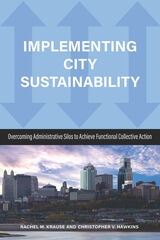
Implementing City Sustainability examines the structures and processes that city governments employ to pursue environmental, social, and economic well-being within their communities. As American cities adopt sustainability objectives, they are faced with the need to overcome fuzzy-boundary, coordination, and collective action challenges to achieve successful implementation.
Sustainability goals often do not fit neatly into traditional city government structures, which tend to be organized around specific functional responsibilities, such as planning, public works, parks and recreation, and community development. The authors advance a theory of Functional Collective Action and apply it to local sustainability to explain how cities can—and in some cases do—organize to successfully administer changes to achieve complex objectives that transcend these organizational separations. Implementing City Sustainability uses a mixed-method research design and original data to provide a national overview of cities’ sustainability arrangements, as well as eight city case studies highlighting different means of organizing to achieve functional collective action.
By focusing not just on what cities are doing to further sustainability, but also on how they are doing it, the authors show how administrative structure enables—or inhibits—cities to overcome functional divides and achieve successful outcomes.



Tragically, Walter's deeply troubled father would launch his family on a perilous journey into darkness. To the outside world, this man is a prominent businessman, a dignified Presbyterian, and a faithful husband; to Walter, he is an overwhelming, handsome monster. Whenever the two are together, young Walter becomes a sexual plaything for his father; father and son outings are turned into soul-obliterating nightmares.
Walter eventually becomes a successful businessman only to be stricken by another catastrophe: his father, at the age of seventy, is caught molesting a young boy. Walter is asked to confront his father. Walter convenes his family, and in a private conference with a psychiatrist, the father agrees to be surgically castrated.
De Milly's portraits of his relationships with his father and mother, and the confrontation that leads to his father's bizarre and irreversible voluntary "cure," are certain to be remembered long after the reader has set aside this powerful contribution to the literature of incest survival.


For children who live with a chronic illness, each day is filled with endless treatments, painful symptoms, confusion, and embarrassment. How can an eight-year old girl understand diabetes let alone explain to her schoolmates why she has to leave class to have her blood tested? How can the father of a child with asthma ever sleep soundly through the night with the fear that his son may suffocate in the next room.
In In Sickness and in Play, Cindy Dell Clark tells the stories of children who suffer from two common illnesses that are often underestimated by those not directly touched by them—asthma and diabetes. She describes how play, humor, and other expressive methods, invented by the kids themselves, allow families to cope with the pain. Clark’s work is one of the few studies to focus on maladies that kids must learn to live with rather than die from. Her interviews with forty-six families give readers an understanding of how children comprehend their illnesses and how parents struggle daily to care for their kids while trying to give them a “normal” childhood. Chronically ill children are at a greater risk of developing mental health or social adjustment problems than their peers, and asthma has been gaining ground in both incidence and fatality in recent years. Clark’s eye-opening work emphasizes the importance of improving the lives of these kids by understanding their perspectives, both imagined and real.
In Sickness and in Play is part of the Rutgers Series in Childhood Studies edited by Myra Bluebond-Langer.


To the press and the police, this secretive Don insisted he was nothing more than a simple man who enjoyed puttering about in his beloved vegetable garden on his Livingston, New Jersey, estate. In reality, the Boot was a confidante and kingmaker of politicians, a friend of such celebrities as Joe DiMaggio and George Raft, an acquaintance of Joseph Valachi—who informed on the Boot in 1963—and a sworn enemy of J. Edgar Hoover.
The Boot prospered for more than half a century, remaining an active boss until the day he died at the age of ninety-three. Although he operated in the shadow of bigger Mafia names across the Hudson River (think Charles "Lucky" Luciano and Louis “Lepke” Buchalter, a cofounder of the Mafia killer squad Murder Inc. with Jacob “Gurrah” Shapiro), the Boot was equally as brutal and efficient. In fact, there was a mysterious place in the gloomy woods behind his lovely garden—a furnace where many thought the Boot took certain people who were never seen again.
Richard Linnett provides an intimate look inside the Boot’s once-powerful Mafia crew, based on the recollections of a grandson of the Boot himself and complemented by never-before-published family photos. Chronicled here are the Prohibition gang wars in New Jersey as well as the murder of Dutch Schultz, a Mafia conspiracy to assassinate Newark mayor Kenneth Gibson, and the mob connections to several prominent state politicians.
Although the Boot never saw the 1972 release of The Godfather, he appreciated the similarities between the character of Vito Corleone and himself, so much so that he hung a sign in his beloved vegetable garden that read “The Godfather Garden.” There’s no doubt he would have relished David Chase’s admission that his muse in creating the HBO series The Sopranos was none other than “Newark’s erstwhile Boiardo crew.”
2024 On The Brinck Book Award and Lecture Series, University of New Mexico
2024 PROSE Award, Architecture–Urban Planning, Association of American Publishers
An on-the-ground account of the design and evolution of West Bank settlements, showing how one of the world’s most contested landscapes was produced by unexpected conflicts and collaborations among widely divergent actors.
Since capturing the West Bank in 1967, Israel has overseen the construction of scores of settlements across the territory’s rocky hilltops. The settlements are part of a fierce political conflict. But they are not just hotly contested political ventures. They are also something more everyday: residential architectural projects.
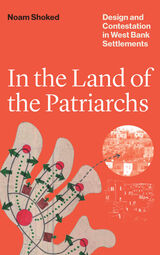
In the Land of the Patriarchs is an on-the-ground account of the design and evolution of West Bank settlements. Noam Shoked shows how settlements have been shaped not only by the decisions of military generals, high-profile politicians, and prominent architects but also by a wide range of actors, including real estate developers, environmental consultants, amateur archeologists, and Israelis who feel unserved by the country’s housing system. The patterns of design and construction they have inspired reflect competing worldviews and aesthetic visions, as well as everyday practices not typically associated with the politics of the Israeli occupation. Revealing the pragmatic choices and contingent circumstances that drive what appears to be a deliberately ideological landscape, Shoked demonstrates how unpredictable the transformation of political passion into brick and mortar can be.

In the mid-twentieth century, American psychiatrists proclaimed homosexuality a mental disorder, one that was treatable and amenable to cure. Drawing on a collection of previously unexamined case files from St. Elizabeths Hospital, In the Shadow of Diagnosis explores the encounter between psychiatry and queer and gender-variant people in the mid- to late-twentieth-century United States. It examines psychiatrists’ investments in understanding homosexuality as a dire psychiatric condition, a judgment that garnered them tremendous power and authority at a time that historians have characterized as psychiatry’s “golden age.” That stigmatizing diagnosis made a deep and lasting impact, too, on queer people, shaping gay life and politics in indelible ways. In the Shadow of Diagnosis helps us understand the adhesive and ongoing connection between queerness and sickness.

Have you ever wondered why some work teams greatly out-perform others within the same organizational settings? Have you questioned whether work teams from very different sectors of the economy and society achieved a high performance level by using similar means? Have you considered what you or others might do to help eams increase their chances of becoming truly high performing? Increasing the Odds for High-Performance Teams is written for the business leader who is inquisitive but busy—who seeks new lessons about high team performance but wants them to be succinct and efficient.
The book is intended to assist professionals in private, public, and not-for-profit organizations who want to use teams to enhance job performance. Also, it is intended to be helpful to the team members, team leaders, mentors, coaches, and administrators across these sectors who want to diagnose their team and organizational conditions, in order to make improvements.

Tekobbe’s methods for analyzing and understanding Indigenous knowledges online center Indigenous storytelling and “thick” (broad, deep, and complex) Indigenous meaning-making. Employing this thickness to interpret Indigenous knowledge ways resists the settler-colonial logics that tend to flatten complex Indigenous concepts into one-note representations of racial stereotypes. Native Americans’ use of social media and digital platforms to support social movements uniquely constructs Indigenous identities as living, producing, and culture-making people, which confronts the commonplace, one-dimensional narrative that Indigenous North Americans either live in isolation or are people of history resigned to the long-forgotten past. Tekobbe’s methods are applicable to additional online research to break through Western paradigms of oppositional critique, the colonial power matrix embedded in hierarchical and taxonomical classification systems, and participant objectification.
Indigenous Voices in Digital Spaces offers new methodological and epistemological opportunities to explore digital communities and technologies, problematizing conventional Western critique. This book is useful to instructors in Indigenous studies, internet studies, digital literacies, cultural studies, and communications, as well as Indigenous and internet studies researchers.

A fascinating tale of seduction, murder, fraud, coercion—and the trial of the “Minneapolis Monster”
On a winter night in 1894, a young woman’s body was found in the middle of a road near Lake Calhoun on the outskirts of Minneapolis. She had been shot through the head. The murder of Kittie Ging, a twenty-nine-year-old dressmaker, was the final act in a melodrama of seduction and betrayal, petty crimes and monstrous deeds that would obsess reporters and their readers across the nation when the man who likely arranged her killing came to trial the following spring. Shawn Francis Peters unravels that sordid, spellbinding story in his account of the trial of Harry Hayward, a serial seducer and schemer whom some deemed a “Svengali,” others a “Machiavelli,” and others a “lunatic” and “man without a soul.”
Dubbed “one of the greatest criminals the world has ever seen” by the famed detective William Pinkerton, Harry Hayward was an inveterate and cunning plotter of crimes large and small, dabbling in arson, insurance fraud, counterfeiting, and illegal gambling. His life story, told in full for the first time here, takes us into shadowy corners of the nineteenth century, including mesmerism, psychopathy, spiritualism, yellow journalism, and capital punishment. From the horrible fate of an independent young businesswoman who challenged Victorian mores to the shocking confession of Hayward on the eve of his execution (which, if true, would have made him a serial killer), The Infamous Harry Hayward unfolds a transfixing tale of one of the most notorious criminals in America during the Gilded Age.

By conducting interviews with seven deaf children, ages seven to ten, Martha Sheridan offers a fresh look at their private thoughts and feelings in this watershed book. Each child possesses a unique cultural background, and Sheridan communicated with each in his or her preferred method of communication. Her procedure remained consistent with each: In addition to standard questions, Sheridan asked each child to draw a picture based on his or her life, then tell a story about it. Next, she showed them magazine pictures and asked them to describe what they saw.
The results proved to be as varied as they were engaging. Angie, an adopted deaf girl who communicates in Signed English, expressed a desire to attend a hearing college when she grows up while also stating she hoped her own children will be deaf. Joe, an African-American, hard of hearing boy, drew pictures of deaf people who are teased in a public school, reflecting his own difficult experiences.
Sheridan calls upon her tenure as a social worker as well as her own experience as a deaf child growing up in a hearing family in analyzing her study’s results. She writes, “These children have strengths, they have positive experiences, and they enjoy positive relationships.” Inner Lives of Deaf Children will prove to be an enlightening read for parents and scholars alike.

Ayella's personal experience fueled her interest in studying the cult phenomenon. This book focuses on her analysis of one community in southern California, The Center for Feeling Therapy, which opened in 1971 as an offshoot of Arthur Janov's Primal Scream approach. The group attracted mostly middle-class, college-educated clients interested in change through intense sessions led by licensed therapists. At the time of the Center's collapse in 1980, there were three hundred individuals living in the therapeutic community and another six hundred outpatients.
Through interviews with twenty-one former patients, the author develops a picture of the positive changes they sought, the pressures of group living, and the allegations of abuse against therapists. Many patients contended that they were beaten, made to strip before the group and to engage in forced sex, forced to have abortions and give up children, and coerced to donate money and to work in business affiliated with the Center.
The close of the Center brought yet more trauma to the patients as they struggled to readjust to mainstream life. Ayella recounts the stories of these individuals, again and again returning to the question of how personal identity is formed and the power of social influences. This book is a key to understanding how "normal" people wind up in cults.
Resident observing takes place across a range of sciences, from anthropology and sociology to primatology, wildlife ecology, and beyond. What makes it special, Kohler argues, is the direct access it affords scientists to the contexts in which their subjects live and act. These scientists understand their subjects not by keeping their distance but by living among them and engaging with them in ways large and small. This approach also demonstrates how science and everyday life—often assumed to be different and separate ways of knowing—are in fact overlapping aspects of the human experience. This story-driven exploration is perfect for historians, sociologists, and philosophers who want to know how scientists go about making robust knowledge of nature and society.
This second edition assesses some of the major refinements, extensions, and useful applications that have developed in neoinstitutionalist thought in recent years. More attention is given to the overlap between the New Institutional Economics and developments in economic history and political science. In addition to updated references, new material includes analysis of parallel developments in the field of economic sociology and its attacks on representatives of the NIE as well as an explanation of the institution-as-an-equilibrium-of-game approach.
Already an international best seller, Institutions and Economic Theory is essential reading for economists and students attracted to the NIE approach. Scholars from such disciplines as political science, sociology, and law will find the work useful as the NIE continues to gain wide academic acceptance. A useful glossary for students is included.
Eirik Furubotn is Honorary Professor of Economics, Co-Director of the Center for New Institutional Economics, University of Saarland, Germany and Research Fellow, Private Enterprise Research Center, Texas A&M University.
Rudolph Richter is Professor Emeritus of Economics and Director of the Center for New Institutional Economics, University of Saarland, Germany.


With International Bankruptcy, Jodie Adams Kirshner explores the issues involved in determining which courts should have jurisdiction and which laws should apply in addressing problems within. Kirshner brings together theory with the discussion of specific cases and legal developments to explore this developing area of law. Looking at the key issues that arise in cross-border proceedings, International Bankruptcy offers a guide to this legal environment. In addition, she explores how globalization has encouraged the creation of new legal practices that bypass national legal systems, such as the European Insolvency Framework and the Model Law on Cross-Border Insolvency of the United Nations Commission on International Trade Law. The traditional comparative law framework misses the nuances of these dynamics. Ultimately, Kirshner draws both positive and negative lessons about regulatory coordination in the hope of finding cleaner and more productive paths to wind down or rehabilitate failing international companies.
Each of the six chapters examines micro data sets of household saving within a particular country and summarizes statistics on patterns of saving by age, income, and other demographic factors. The authors provide age-earning profiles and analyses of the accumulation of wealth over the lifetime in a clear way that allows quick comparisons between earning, consumption, and saving in the six countries.
Designed as a companion to Public Policies and Household Saving (1994), which addresses saving policies in the G-7 nations, this volume offers detailed descriptions of saving behavior in all G-7 nations except France.

Often considered one of the major forces behind economic growth and development, the entrepreneurial firm can accelerate the speed of innovation and dissemination of new technologies, thus increasing a country's competitive edge in the global market. As a result, cultivating a strong culture of entrepreneurial thinking has become a primary goal throughout the world.
Surprisingly, there has been little systematic research or comparative analysis to show how the growth of entrepreneurship differs among countries in various stages of development. International Differences in Entrepreneurship fills this void by explaining how a country's institutional differences, cultural considerations, and personal characteristics can affect the role that entrepreneurs play in its economy. Developing an understanding of the origins of entrepreneurs as well as the choices they make and the complexity of their activities across countries and industries are of central importance to this volume. In addition, contributors consider how environmental factors of individual economies, such as market regulation, government subsidies for banks, and support for entrepreneurial culture affect the industry and the impact that entrepreneurs have on growth in developing nations.

International Political Earthquakes is the masterwork of the preeminent scholar Michael Brecher. Brecher, who came of age before World War II, has witnessed more than seven decades of conflict and has spent his career studying the dynamics of relations among nations throughout the world.
When terrorism, ethnic conflict, military buildup, or other local tensions spark an international crisis, Brecher argues that the structure of global politics determines its potential to develop into open conflict. That conflict, in turn, may then generate worldwide political upheaval. Comparing international crises to earthquakes, Brecher proposes a scale analogous to the Richter scale to measure the severity and scope of the impact of a crisis on the landscape of international politics.
Brecher's conclusions about the causes of international conflict and its consequences for global stability make a convincing case for gradual, nonviolent approaches to crisis resolution.
Michael Brecher is R. B. Angus Professor of Political Science at McGill University.

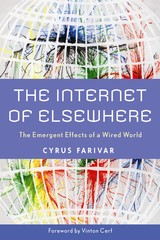
Through the lens of culture, The Internet of Elsewhere looks at the role of the Internet as a catalyst in transforming communications, politics, and economics. Cyrus Farivar explores the Internet's history and effects in four distinct and, to some, surprising societies—Iran, Estonia, South Korea, and Senegal. He profiles Web pioneers in these countries and, at the same time, surveys the environments in which they each work. After all, contends Farivar, despite California's great success in creating the Internet and spawning companies like Apple and Google, in some areas the United States is still years behind other nations.
Surprised? You won't be for long as Farivar proves there are reasons that:
- Skype was invented in Estonia—the same country that developed a digital ID system and e-voting;
- Iran was the first country in the world to arrest a blogger, in 2003;
- South Korea is the most wired country on the planet, with faster and less expensive broadband than anywhere in the United States;
- Senegal may be one of sub-Saharan Africa's best chances for greater Internet access.
The Internet of Elsewhere brings forth a new complex and modern understanding of how the Internet spreads globally, with both good and bad effects.
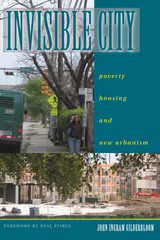

Part memoir, part practical guide, part prescription for change, It Shouldn't Be This Way is a unique look at the problems of long-term care. Robert L. Kane, a highly experienced physician and gerontologist, and his sister, Joan C. West, tell the painful story of what happened to their mother after she suffered a debilitating stroke and spent the last years of her life in rehabilitation, assisted-living facilities, and finally a nursing home. Along the way, her adult children encountered some professionals who were kind and considerate but also many frustrations—inadequate care and the need to hire private duty aides, as well as poor communication and lack of coordination throughout the system. The situation, they found, proved far more difficult than it needed to be.
As the authors recount their mother's story, they impart various lessons they learned from each phase of the experience. They alert those who are confronting such situations for the first time about what they will likely face and how to approach the problems. Closing with a broader look at why long-term care is the way it is, they propose steps to make necessary reforms, including the development of national organizations to work for change. Their message to families, care professionals, and policy-makers could not be more urgent.

--William S. Laufer, Professor, The Wharton School of Business
"This delightful and serious book involves a matter I have long felt of first importance. That is our tendency to make social truth and acceptance conform to personal or larger corporate interests. On this I have written , but gladly yield to this persuasive parallel. No one concerned with literate, informed, and relevant---as distinct from self-serving---truth should miss It's Legal but It Ain't Right."
--John Kenneth Galbraith
"This absorbing and well-written book of essays on the harmful consequences of legal industries skillfully illuminates the ways in which some corporate harms fail to be transformed into criminal law-making and enforcement, and offers cogent suggestions for better regulation in the public interest."
--Dr. Michael Levi, Professor of Criminology, Cardiff University
Many U.S. corporations and the goods they produce negatively impact our society without breaking any laws. We are all too familiar with the tobacco industry's effect on public health and health care costs for smokers and nonsmokers, as well as the role of profit in the pharmaceutical industry's research priorities. It's Legal but It Ain't Right tackles these issues, plus the ethical ambiguities of legalized gambling, the firearms trade, the fast food industry, the pesticide industry, private security companies, and more. Aiming to identify industries and goods that undermine our societal values and to hold them accountable for their actions, this collection makes a valuable contribution to the ongoing discussion of ethics in our time.
This accessible exploration of corporate legitimacy and crime will be important reading for advocates, journalists, students, and anyone interested in the dichotomy between law and legitimacy.
READERS
Browse our collection.
PUBLISHERS
See BiblioVault's publisher services.
STUDENT SERVICES
Files for college accessibility offices.
RECENTLY PUBLISHED





UChicago Accessibility Resources
home | accessibility | search | about | contact us
BiblioVault ® 2001 - 2026
The University of Chicago Press