
 A SCHOLARLY BOOK REPOSITORY
29 start with I start with I
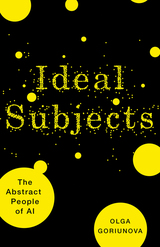
How data and artificial intelligence create a new, abstract digital subject
Ideal Subjects examines how samples of our lives and daily behaviors have come to reside in the world of data and artificial intelligence—and what this means for who we are and what we may become. Detailing how AI-facilitated algorithmic prediction and data modeling make “ideal subjects” of us, Olga Goriunova explores the complex ways we relate to these digital abstractions.
As more and more of our experience is funneled through computational records and models, datafied aspects of our lives are segmented and reconfigured to operate as new entities. Rather than viewing these abstract assemblages as extensions of our selves, Goriunova encourages us to consider these products of computational processes as an entirely new kind of subject, one that is both more and less than a human.
Through close readings of contemporary digital practices and data analytics, Goriunova exposes the profound ethical, aesthetic, and political implications of producing and managing these new digital subjects. Highlighting the distinctive impact of computation on contemporary subject formation while placing the present within a history of shifting conceptions of the subject, she gives us much-needed tools for understanding how our intimate selves are rendered by the abstract entities of big data. Ideal Subjects presents an uncanny and deeply fascinating portrait of modern subjectivity in the technological age.
Retail e-book files for this title are screen-reader friendly with images accompanied by short alt text and/or extended descriptions.

#identity is among the first scholarly books to address the positive and negative effects of Twitter on our contemporary world. Hailing from diverse scholarly fields, all contributors are affiliated with The Color of New Media, a scholarly collective based at the University of California, Berkeley. The Color of New Media explores the intersections of new media studies, critical race theory, gender and women’s studies, and postcolonial studies. The essays in #identity consider topics such as the social justice movements organized through #BlackLivesMatter, #Ferguson, and #SayHerName; the controversies around #WhyIStayed and #CancelColbert; Twitter use in India and Africa; the integration of hashtags such as #nohomo and #onfleek that have become part of everyday online vernacular; and other ways in which Twitter has been used by, for, and against women, people of color, LGBTQ, and Global South communities. Collectively, the essays in this volume offer a critically interdisciplinary view of how and why social media has been at the heart of US and global political discourse for over a decade.



Tracing the cultural history of play—from Fluxus to SimCity
Games and gamified activities have become ubiquitous in many adults’ lives, and play is widely valued for fostering creativity, community, growth, and empathy. But how did we come to our current understanding of what it means to play? The Impossible Reversal charts the transformation of notions of playfulness beginning in the second half of the twentieth century, when a legion of artists, academics, and engineers developed new ways of theorizing, structuring, and designing ludic activity.
Through examples ranging from experimental Fluxus games to corporate role-playing exercises and from the Easy Bake Oven to Tetris, The Impossible Reversal presents four styles of playfulness characteristic of the “era of designed play”: the impossible reversal, which puts a player in a seemingly hopeless scenario they must upend with a tiny gesture; expending the secret, which involves silly rules that gain an obscure power and require players to embrace failure; simulated freedom, a satiric criticism of the ordinary world; and oblique repetition, a way of playing that stumbles toward unimaginable outcomes through simple, meaningless, and endlessly iterated acts.
A unique genealogical account of play as both concept and practice, The Impossible Reversal illuminates how playfulness became essential for understanding cultural, technical, and economic production in the United States.
Retail e-book files for this title are screen-reader friendly with images accompanied by short alt text and/or extended descriptions.

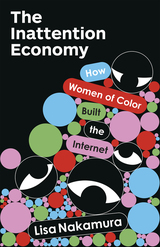
Revealing the unheralded contributions of women of color to the foundation and development of the digital economy
The Inattention Economy challenges the widespread myth that the internet was born from the labor of a handful of white male entrepreneurs, recovering the uncredited and unpaid contributions of women of color. Focusing on three key inflection points in computing—the microchip era of the 1960s and ’70s, the rise of social media in the 2000s, and A.I.-fueled virtual reality in the 2020s—Lisa Nakamura illuminates these women’s instrumental roles in building new technologies and making them coherent to users.
From the Navajo women who manufactured the first semiconductor circuits in New Mexico to Tila Tequila, the queer Vietnamese American refugee who became the first true internet influencer in the MySpace age, to Black virtual reality creators, Nakamura highlights how women’s gendered and racialized identities have uniquely positioned them to mediate the development and proliferation of new technologies. She exposes how these women have been structurally excluded from racial capitalism’s benefits while their labor is considered as exploitable and inexhaustible as that of machines. Confronting this injustice, she focuses our attention on their work, which undergirds and makes possible the platforms ingrained in our daily lives.
Arguing for both recognition and material compensation for these women’s labor, The Inattention Economy is a powerful counterhistory of Silicon Valley and a persuasive call to imagine a different kind of internet.
Retail e-book files for this title are screen-reader friendly with images accompanied by short alt text and/or extended descriptions.


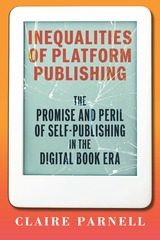
Uncovering race, gender, and sexual biases in popular self-publishing platforms
The average reader need not go far in a bookstore before, knowingly or not, they encounter authors who started their careers by self-publishing prior to achieving commercial success. Examples include Margaret Atwood, Andy Weir, Colleen Hoover, Anna Todd, E. L. James, Scarlett St. Clair, and many more. Such stories of self-made writers are compelling and seem more attainable to others with the accessibility of modern publishing platforms such as Amazon, Apple, Google, Kobo, Wattpad, Webtoon, Radish, Inkitt, Qidian, Tapas, and Swoon Reads. However, as Claire Parnell uncovers in her examination of the two most popular—Amazon and Wattpad—these services in fact perpetuate systemic racial, gender, and sexual bias against authors of color and queer authors through their technological, economic, social, and cultural structures.
At a time when there is a real reckoning with the discrimination that has resulted in publishing opportunities for only relatively few privileged authors—who are often White, upper class, and male—self-publishing presents itself as an equalizer of sorts. Exploring that idea, Parnell shows that these platforms are not just intermediaries for information; they structure content and users in multiple, often inequitable, ways through their ability to set market conditions and apply algorithmic sorting. Combining original interviews, walkthrough method, metadata analysis, and more, Parnell finds that self-publishing platforms reproduce challenges for authors from marginalized communities. Far from equalizing the market, the new platforms instead frequently perpetuate the stubborn barriers to mainstream success for BIPOC and queer authors.

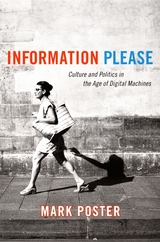
Poster’s critique develops through a series of lively studies. Analyzing the appearance of Sesame Street’s Bert next to Osama Bin Laden in a New York Times news photo, he examines the political repercussions of this Internet “hoax” as well as the unlimited opportunities that Internet technology presents for the appropriation and alteration of information. He considers the implications of open-source licensing agreements, online personas, the sudden rise of and interest in identity theft, peer-to-peer file sharing, and more. Focusing explicitly on theory, he reflects on the limitations of critical concepts developed before the emergence of new media, particularly globally networked digital communications, and he argues that, contrary to the assertions of Michael Hardt and Antonio Negri, new media do not necessarily reproduce neoimperialisms. Urging a rethinking of assumptions ingrained during the dominance of broadcast media, Poster charts new directions for work on politics and digital culture.

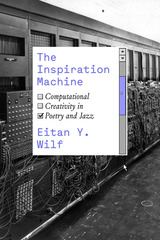
In The Inspiration Machine, Eitan Y. Wilf explores the transformative potentials that digital technology opens up for creative practice through three ethnographic cases, two with jazz musicians and one with a group of poets. At times dissatisfied with the limitations of human creativity, these artists do not turn to computerized algorithms merely to execute their preconceived ideas. Rather, they approach them as creative partners, delegating to them different degrees of agentive control and artistic decision-making in the hopes of finding inspiration in their output and thereby expanding their own creative horizons.
The algorithms these artists develop and use, however, remain rooted in and haunted by the specific social predicaments and human shortfalls that they were intended to overcome. Experiments in the digital thus hold an important lesson: although Wilf’s interlocutors returned from their adventures with computational creativity with modified, novel, and enriched capacities and predilections, they also gained a renewed appreciation for, and at times a desire to re-inhabit, non-digital creativity. In examining the potentials and pitfalls of seemingly autonomous digital technologies in the realm of art, Wilf shows that computational solutions to the real or imagined insufficiencies of human practice are best developed in relation to, rather than away from, the social and cultural contexts that gave rise to those insufficiencies, in the first place.
Institutional Literacies argues that writing and communication teachers and program directors should collaborate more closely and engage more deeply with IT staff as technology projects are planned, implemented, and expanded. Teachers need to both analyze how their institutions approach information technologies and intervene in productive ways as active university citizens with relevant expertise. To help them do so, the book offers a three-part heuristic, reflecting the reality that academic IT units are complex and multilayered, with historical, spatial, and textual dimensions. It discusses six ways teachers can intervene in the academic IT work of their own institutions: maintaining awareness, using systems and services, mediating for audiences, participating as user advocates, working as designers, and partnering as researchers. With these strategies in hand, educators can be proactive in helping institutional IT approaches align with the professional values and practices of writing and communication programs.
When someone faces a difficult intellectual freedom (IF) issue, they usually don’t have time to wade through dense text to find the answers they need. Designed as a real-world reference, OIF’s Intellectual Freedom Manual provides trusted, comprehensive guidance for every library worker, from the volunteer to the director, in plain language. Whether you’re developing or reviewing policies, on-boarding new staff or trustees, responding to challenges and controversies, or studying librarianship, you’ll find this a vital tool, with features such as
- contributions that center the voices of Black, Indigenous, and other People of Color (BIPOC) and LGBTQIA+ people, who are often targeted by censorship efforts;
- chapters that begin with an overview explaining the big ideas and offering reflection questions;
- an introduction to IF and why it matters, drawing on ALA's core IF documents and supported with adaptable policy worksheets;
- information and best practice guidance on key topics such as access, children and youth, censorship and internet filtering, collection development and management, copyright, meeting rooms and exhibit spaces, library programming, politics and religion, privacy, and visits and requests from law enforcement;
- stories from real people whose lives have been impacted by IF, showing how library policies shape culture, protect staff and users, and affect real people;
- concise breakdowns of IF issues from legal experts, helping you understand the laws and how they apply in real situations;
- practical advice on advocating for IF, getting help when challenges arise, lobbying, and working with your elected officials;
- a thorough index to help you quickly find the information you need; and
- a helpful glossary and selected bibliography of additional resources.




A complete history and theory of internet daemons brings these little-known—but very consequential—programs into the spotlight
We’re used to talking about how tech giants like Google, Facebook, and Amazon rule the internet, but what about daemons? Ubiquitous programs that have colonized the Net’s infrastructure—as well as the devices we use to access it—daemons are little known. Fenwick McKelvey weaves together history, theory, and policy to give a full account of where daemons come from and how they influence our lives—including their role in hot-button issues like network neutrality.
Going back to Victorian times and the popular thought experiment Maxwell’s Demon, McKelvey charts how daemons evolved from concept to reality, eventually blossoming into the pandaemonium of code-based creatures that today orchestrates our internet. Digging into real-life examples like sluggish connection speeds, Comcast’s efforts to control peer-to-peer networking, and Pirate Bay’s attempts to elude daemonic control (and skirt copyright), McKelvey shows how daemons have been central to the internet, greatly influencing everyday users.
Internet Daemons asks important questions about how much control is being handed over to these automated, autonomous programs, and the consequences for transparency and oversight.
The Internet is for Cats examines how animal images are employed to create a lighter, more playful mood, uniting users within online spaces that can otherwise easily become fractious and toxic. Placing today’s pet videos, photos, and memes within a longer history of mediated animal images, communication scholar Jessica Maddox also considers the factors that make them unique. She explores the roles that animals play within online economies of cuteness and attention, as well as the ways that animal memes and videos respond to common experiences of life under neoliberalism.
Conducting a rich digital ethnography, Maddox combines observations and textual analysis with extensive interviews of the people who create, post and share animal media, including TikTok influencers seeking to make their pets famous, activists tweeting about wildlife conservation, and Redditors upvoting every cute cat photo. The Internet is for Cats will leave you with a new appreciation for the human social practices behind the animal images you encounter online.
Through the lens of culture, The Internet of Elsewhere looks at the role of the Internet as a catalyst in transforming communications, politics, and economics. Cyrus Farivar explores the Internet's history and effects in four distinct and, to some, surprising societies—Iran, Estonia, South Korea, and Senegal. He profiles Web pioneers in these countries and, at the same time, surveys the environments in which they each work. After all, contends Farivar, despite California's great success in creating the Internet and spawning companies like Apple and Google, in some areas the United States is still years behind other nations.
Surprised? You won't be for long as Farivar proves there are reasons that:
- Skype was invented in Estonia—the same country that developed a digital ID system and e-voting;
- Iran was the first country in the world to arrest a blogger, in 2003;
- South Korea is the most wired country on the planet, with faster and less expensive broadband than anywhere in the United States;
- Senegal may be one of sub-Saharan Africa's best chances for greater Internet access.
The Internet of Elsewhere brings forth a new complex and modern understanding of how the Internet spreads globally, with both good and bad effects.

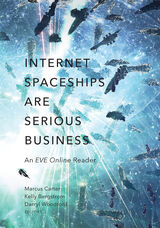
EVE Online is a socially complex, science-fiction-themed universe simulation and massively multiplayer online game (MMOG) first released in 2003. Notorious for its colossal battles and ruthless player culture, it has hundreds of thousands of players today. In this fascinating book, scholars, players, and EVE’s developer (CCP Games) examine the intricate world of EVEOnline--providing authentic accounts of lived experience within a game with more than a decade of history and millions of “real” dollars behind it.
Internet Spaceships Are Serious Business features contributions from outstanding EVE Online players, such as The Mittani, an infamous member of the game’s community, as well as academics from around the globe. They cover a wide range of subjects: the game’s technicalities and its difficulty; its projection of humanity’s future in space; the configuration of its unique, single-server game world; the global nature of warfare in its “nullsec” territory (and how EVE players have formed a global concept of time); stereotypes of Russian players; espionage play; in-game memorials to Vile Rat (aka U.S. State Department official Sean Smith, murdered in the 2012 Benghazi attack); its gendered playing experience; and CCP Games’ relationship with players; and its history and legacy.
Internet Spaceships Are Serious Business is a must for EVE Online players interested in a broad perspective on their all-consuming game. It is also accessible to scholars, game designers seeking to understand and replicate the successful aspects unique to EVE Online, and even those who have never played this notoriously complex game.
Contributors: William Sims Bainbridge, National Science Foundation; Chribba; Jedrzej Czarnota; Kjartan Pierre Emilsson; Dan Erdman; Rebecca Fraimow; Martin R. Gibbs, U of Melbourne; Catherine Goodfellow; Kathryn Gronsbell; Keith Harrison; Kristin MacDonough; Mantou (Zhang Yuzhou); Oskar Milik; The Mittani (Alexander Gianturco); Joji Mori; Richard Page; Christopher Paul, Seattle U; Erica Titkemeyer, U of North Carolina at Chapel Hill; Nick Webber, Birmingham City U.

A feminist perspective on the early history of personal computing, revealing how computers were integrated into the most intimate aspects of family life
The Intimate Life of Computers shows how the widespread introduction of home computers in the 1980s was purposefully geared toward helping sustain heteronormative middle-class families by shaping relationships between users. Moving beyond the story of male-dominated computer culture, this book emphasizes the neglected history of the influence of women’s culture and feminist critique on the development of personal computing despite women’s underrepresentation in the industry.
Proposing the notion of “companionate computing,” Reem Hilu reimagines the spread of computers into American homes as the history of an interpersonal, romantic, and familial medium. She details the integration of computing into family relationships—from helping couples have better sex and offering thoughtful simulations of masculine seduction to animating cute robot companions and giving voice to dolls that could talk to lonely children—underscoring how these computer applications directly responded to the companionate needs of their users as a way to ease growing pressures on home life.
The Intimate Life of Computers is a vital contribution to feminist media history, highlighting how the emergence of personal computing dovetailed with changing gender roles and other social and cultural shifts. Eschewing the emphasis on technologies and institutions typically foregrounded in personal-computer histories, Hilu uncovers the surprising ways that domesticity and family life guided the earlier stages of our all-pervasive digital culture.

- Motivation: In the ocean of mathematical definitions, theorems, and equations, why should we spend our time on this particular topic but not another?
- Intuition: When going through the deviations, is there a geometric interpretation or physics beyond those equations?
- Implication: After we have learned a topic, what new problems can we solve?
READERS
Browse our collection.
PUBLISHERS
See BiblioVault's publisher services.
STUDENT SERVICES
Files for college accessibility offices.
RECENTLY PUBLISHED







UChicago Accessibility Resources
home | accessibility | search | about | contact us
BiblioVault ® 2001 - 2026
The University of Chicago Press