
 A SCHOLARLY BOOK REPOSITORY
8 start with I start with I

Southwest Book Award, Border Regional Library Association, 2011
Although popularly conceived as a relatively recent phenomenon, patterns of immigrant smuggling and undocumented entry across American land borders first emerged in the late nineteenth century. Ingenious smugglers and immigrants, long and remote boundary lines, and strong push-and-pull factors created porous borders then, much as they do now.
Historian Patrick Ettinger offers the first comprehensive historical study of evolving border enforcement efforts on American land borders at the turn of the twentieth century. He traces the origins of widespread immigrant smuggling and illicit entry on the northern and southern United States borders at a time when English, Irish, Chinese, Italian, Russian, Lebanese, Japanese, Greek, and, later, Mexican migrants created various "backdoors" into the United States. No other work looks so closely at the sweeping, if often ineffectual, innovations in federal border enforcement practices designed to stem these flows.
From upstate Maine to Puget Sound, from San Diego to the Lower Rio Grande Valley in Texas, federal officials struggled to adapt national immigration policies to challenging local conditions, all the while battling wits with resourceful smugglers and determined immigrants. In effect, the period saw the simultaneous "drawing" and "erasing" of the official border, and its gradual articulation and elaboration in the midst of consistently successful efforts to undermine it.
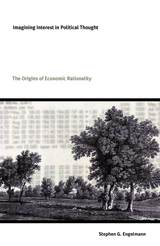
Tracing the development of monistic interest from its origins in Reformation political theory and theology through late-twentieth-century neoliberalism, Engelmann reconceptualizes the history of liberalism as consisting of phases in the history of monistic interest or economic government. He describes how monistic interest, as formulated by Bentham, is made up of the individual’s imagined expectations, which are constructed by the very regime that maximizes them. He asserts that this construction of interests is not the work of a self-serving manipulative state. Rather, the state, which is itself subject to strict economic regulation, is only one cluster of myriad "public" and "private" agencies that produce and coordinate expectations. In place of a liberal vision in which government appears only as a protector of the free pursuit of interest, Engelmann posits that the free pursuit of interest is itself a mode of government, one that deploys individual imagination and choice as its agents.
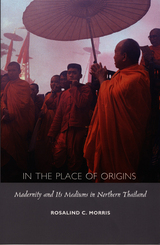
Through her careful examination of the transformations of spirit mediumship wrought by the mass media, Morris takes readers into the world of the northern Thai past to discover the anticipations of future histories. In this process, she finds new objects for anthropological inquiry, including romantic love and epistolary poetry. She then turns her eye toward the relationships between commodification and prosaic form and photography and the discourses of gendered and national identity. Attending to these issues as they manifest themselves in the practices of mediums, Morris describes both the mundane activities of spirit mediums and the grand ambitions to political authority that are embodied in the increasingly spectacular forms of possession that are becoming so popular with both tourists and local culture brokers. In the Place of Origins traverses this ground with accounts of right-wing militarism and ritual revival during the 70s, and of the democracy movement of 1992, when a global mass media was galvanized by images of military repression and the spectacle of traditional ritual power in cursing. Finally, considering the claims that mediums make to magical power in the face of both AIDS and the Asian economic crisis, Morris reveals the potency of extrajudicial forms of power and violence in the late modern era.
This provocative study will interest anthropologists, historians, Asianists, and those involved in gender, performance, media, and literary studies.
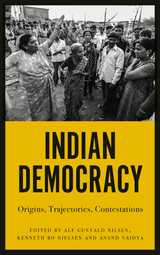
India’s pluralism has always posed a formidable challenge to its democracy, with many believing that a clash of identities based on region, language, caste, religion, ethnicity, and tribe would bring about its demise. With the meteoric rise to power of the Bharatiya Janata Party, the nation’s solidity is once again called into question: is Modi’s Hindu majoritarianism an anti-democratic attempt to transform India into a monolithic Hindu nation from which minorities and dissidents are forcibly excluded?
With examinations of the way that class and caste power shaped the making of India’s postcolonial democracy, the role of feminism, the media, and the public sphere in sustaining and challenging democracy, this book interrogates the contradictions at the heart of the Indian democratic project, examining its origins, trajectories, and contestations.

On March 4, 1789, New York City's church bells pealed, cannons fired, and flags snapped in the wind to celebrate the date set for the opening of the First Federal Congress. In many ways the establishment of Congress marked the culmination of the American Revolution as the ship of state was launched from the foundation of the legislative system outlined in Article I of the Constitution.
Inventing Congress presents the latest scholarship on the interrelated intellectual, institutional, cultural, and political antecedents of the formation of the First Federal Congress. The first section covers the origins of the body, ranging in discussion from the question of how the founders' understanding of classical Greek and Roman republican precedent shaped their thinking, to the political lessons learned during the Continental and Confederation Congresses.
The second section concerns itself with the establishment of the First Federal Congress, examining several heretofore little-treated aspects of the most important Congress in history, including its relationship to the press, morality, the arts and sciences, and economic philosophy.
Inventing Congress represents the papers from the first two conferences sponsored by the United States Capitol Historical Society in its series, “Perspectives on the History of Congress, 1789-1801.”

Inventing the Alphabet provides the first account of two-and-a-half millennia of scholarship on the alphabet. Drawing on decades of research, Johanna Drucker dives into sometimes obscure and esoteric references, dispelling myths and identifying a pantheon of little-known scholars who contributed to our modern understandings of the alphabet, one of the most important inventions in human history.
Beginning with Biblical tales and accounts from antiquity, Drucker traces the transmission of ancient Greek thinking about the alphabet’s origin and debates about how Moses learned to read. The book moves through the centuries, finishing with contemporary concepts of the letters in alpha-numeric code used for global communication systems. Along the way, we learn about magical and angelic alphabets, antique inscriptions on coins and artifacts, and the comparative tables of scripts that continue through the development of modern fields of archaeology and paleography.
This is the first book to chronicle the story of the intellectual history through which the alphabet has been “invented” as an object of scholarship.
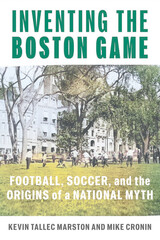
Honorable Mention, 2025 North American Society for Sport History Book Award
On Boston Common stands a monument dedicated to the Oneida Football Club. It honors the site where, in the 1860s, sixteen boys played what was then called the “Boston game”—an early version of football in the United States. The boys were largely the sons of upper-class Boston Brahmins, and they lived through the transformative periods of the Civil War, Reconstruction, and the Gilded Age. Later as they grew old, in the 1920s, a handful of them orchestrated a series of commemorative events about their boyhood game. Benefitting from elite networks developed through the city’s social and educational institutions, including Harvard University, they donated artifacts (such as an oddly shaped, battered black ball) to museums, deposited self-penned histories into libraries and archives, and erected bronze and stone memorials, all to elevate themselves as the inventors of American football (and later, by extension, soccer). But was this origin story of what, by then, had become one of America’s favorite games as straightforward as they made it seem or a myth-making hoax?
In Inventing the Boston Game, Kevin Tallec Marston and Mike Cronin investigate the history of the Oneida Football Club and reveal what really happened. In a compelling, well told narrative that is informed by sports history, Boston history, and the study of memory, they posit that these men engaged in self-memorialization to reinforce their elite cultural status during a period of tremendous social and economic change, and particularly increased immigration. This exploration of the Club’s history provides fascinating insight into how and why origin stories are created in the first place.
READERS
Browse our collection.
PUBLISHERS
See BiblioVault's publisher services.
STUDENT SERVICES
Files for college accessibility offices.
RECENTLY PUBLISHED






UChicago Accessibility Resources
home | accessibility | search | about | contact us
BiblioVault ® 2001 - 2026
The University of Chicago Press