
 A SCHOLARLY BOOK REPOSITORY
8 start with K start with K
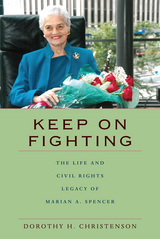
Marian Alexander Spencer was born in 1920 in the Ohio River town of Gallipolis, Ohio, one year after the “Red Summer” of 1919 that saw an upsurge in race riots and lynchings. Following the example of her grandfather, an ex-slave and community leader, Marian joined the NAACP at thirteen and grew up to achieve not only a number of civic leadership firsts in her adopted home city of Cincinnati, but a legacy of lasting civil rights victories.
Of these, the best known is the desegregation of Cincinnati’s Coney Island amusement park. She also fought to desegregate Cincinnati schools and to stop the introduction of observers in black voting precincts in Ohio. Her campaign to raise awareness of industrial toxic-waste practices in minority neighborhoods was later adapted into national Superfund legislation.
In 2012, Marian’s friend and colleague Dot Christenson sat down with her to record her memories. The resulting biography not only gives us the life story of remarkable leader but encapsulates many of the twentieth century’s greatest struggles and advances. Spencer’s story will prove inspirational and instructive to citizens and students alike.
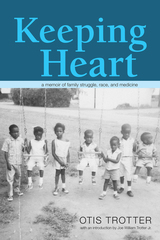
“After saying our good-byes to friends and neighbors, we all got in the cars and headed up the hill and down the road toward a future in Ohio that we hoped would be brighter,” Otis Trotter writes in his affecting memoir, Keeping Heart: A Memoir of Family Struggle, Race, and Medicine.
Organized around the life histories, medical struggles, and recollections of Trotter and his thirteen siblings, the story begins in 1914 with his parents, Joe William Trotter Sr. and Thelma Odell Foster Trotter, in rural Alabama. By telling his story alongside the experiences of his parents as well as his siblings, Otis reveals cohesion and tensions in twentieth-century African American family and community life in Alabama, West Virginia, and Ohio.
This engaging chronicle illuminates the journeys not only of a black man born with heart disease in the southern Appalachian coalfields, but of his family and community. It fills an important gap in the literature on an underexamined aspect of American experience: the lives of blacks in rural Appalachia and in the nonurban endpoints of the Great Migration. Its emotional power is a testament to the importance of ordinary lives.
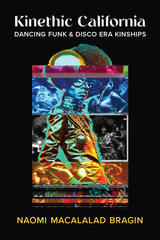
Kinethic California: Dancing Funk and Disco Era Kinships documents the emergence of new forms of black social and vernacular dance invented by youth living in 1970s California, who helped build the foundations of contemporary hip hop/streetdance culture. Naomi Macalalad Bragin weaves interviews and ethnographies of first-generation (1960s-70s) dancers of strutting, boogaloo, robotting, popping, locking, waacking, and punking styles, as it advances a theory of dance as kinetic kinship formation through a focus on techniques and practices of the dancers themselves. She offers that the term given to these collective movement practices is kinethic to bring attention to motion at the core of black aesthetics that generate dances as forms of kinship beyond blood relation. Kinethics reorient dancers toward kinetic kinship in ways that give continuity to black dance lineages under persistent conditions of disappearance and loss. As dancers engage kinethics, they reinvent gestural vocabularies that describe worlds they imagine into knowing-being.
The stories in Kinethic California attend to the aesthetics of everyday movement, seen through the lens of young artists who, from childhood, listened to their family’s soul and funk records, observed the bent-leg strolls and rhythmic handshakes of people moving through their neighborhoods, and watched each other move at house parties, school gyms, and around-the-way social clubs. Their aesthetic sociality and geographic movement provided materials for collective study and creative play. Bragin attends to such multidirectional conversations between dancer, community, and tradition, by which California dance lineages emerge and take flight.
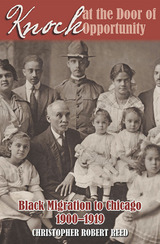
Disputing the so-called ghetto studies that depicted the early part of the twentieth century as the nadir of African American society, this thoughtful volume by Christopher Robert Reed investigates black life in turn-of-the-century Chicago, revealing a vibrant community that grew and developed on Chicago’s South Side in the early 1900s. Reed also explores the impact of the fifty thousand black southerners who streamed into the city during the Great Migration of 1916–1918, effectively doubling Chicago’s African American population. Those already residing in Chicago’s black neighborhoods had a lot in common with those who migrated, Reed demonstrates, and the two groups became unified, building a broad community base able to face discrimination and prejudice while contributing to Chicago’s growth and development.
Reed not only explains how Chicago’s African Americans openly competed with white people for jobs, housing and an independent political voice but also examines the structure of the society migrants entered and helped shape. Other topics include South Side housing, black politics and protest, the role of institutionalized religion, the economic aspects of African American life, the push for citizenship rights and political power for African Americans, and the impact of World War I and the race riot of 1919. The first comprehensive exploration of black life in turn-of-the-century Chicago beyond the mold of a ghetto perspective, this revealing work demonstrates how the melding of migrants and residents allowed for the building of a Black Metropolis in the 1920s.
2015 ISHS Superior Achievement Award
Recipient, 2007 Hyde Park Historical Society Paul Cornell Award
Sixty years ago, when Truman Gibson reported for duty at the War Department, Washington, D.C. was a southern city in its unbending segregation as well as in its steamy summers. Gibson had no illusions, but as someone who'd enjoyed the best of the vibrant black culture of prewar America, he was shocked to find the worst of the Jim Crow South in the nation's capital. What Gibson accomplished as an advocate for African American soldiers-first as a lawyer working for the Secretary of War, then as a member of President Truman's "Black Cabinet"--is a large part of the history of the struggle for civil rights in the American military; and it is a compelling part of the story that Gibson tells in this book, a memoir of a life spent making a difference in the world one step at a time.
A graduate of the University of Chicago Law School, Gibson took his fight for racial justice to the corridors of powers, arguing against restrictive real estate covenants before the U.S. Supreme Court, opposing such iconic figures as Generals Dwight Eisenhower and George C. Marshall in campaigning for the integration of the armed forces, and challenging white control of professional sports by creating a boxing promotion empire that made television history. A firsthand account of the nitty-gritty of twentieth-century race relations in the worlds of law, the military, sports, and entertainment, Gibson's memoir is also an engaging recollection of encounters with the likes of Thurgood Marshall, W. E. B. DuBois, Eleanor Roosevelt, George Patton, Jackie Robinson, and Joe Louis, among others. As a historical record and as an intimate look at a bygone era with all its charms and hardships, the book is an essential chapter in our nation's story.
Winner of an Abraham Lincoln Institute Book Award
Though not blind to Abraham Lincoln's imperfections, Black Americans long ago laid a heartfelt claim to his legacy. At the same time, they have consciously reshaped the sixteenth president's image for their own social and political ends. Frederick Hord and Matthew D. Norman's anthology explores the complex nature of views on Lincoln through the writings and thought of Frederick Douglass, Ida B. Wells-Barnett, Mary McLeod Bethune, Thurgood Marshall, Malcolm X, Gwendolyn Brooks, Barbara Jeanne Fields, Barack Obama, and dozens of others. The selections move from speeches to letters to book excerpts, mapping the changing contours of the bond--emotional and intellectual--between Lincoln and Black Americans over the span of one hundred and fifty years.
A comprehensive and valuable reader, Knowing Him by Heart examines Lincoln’s still-evolving place in Black American thought.
READERS
Browse our collection.
PUBLISHERS
See BiblioVault's publisher services.
STUDENT SERVICES
Files for college accessibility offices.
RECENTLY PUBLISHED


UChicago Accessibility Resources
home | accessibility | search | about | contact us
BiblioVault ® 2001 - 2026
The University of Chicago Press