
 A SCHOLARLY BOOK REPOSITORY
20 start with K start with K
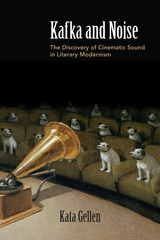
Kafka and Noise offers a method for pursuing intermedial research in the humanities—namely, via the productive "misapplication" of theoretical tools, which exposes the contours, conditions, and expressive possibilities of the media in question. This book will be of interest to scholars of modernism, literature, cinema, and sound, as well as to anyone wishing to explore how artistic and technological media shape our experience of the world and the possibilities for representing it.
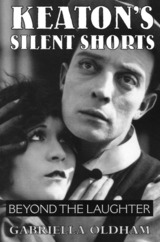
Filling a major gap in the critical canon, Keaton’s Classic Shorts: Beyond the Laughter chronicles the rapid growth in the filmmaker’s understanding of what makes both comedy and film successful. Keaton developed his major themes in these nineteen silent short films shot between 1920 and 1923, creating his persona “Buster” with his trademark stone face. These short films clearly indicate Keaton’s love of the camera and his concern for composition, symmetry, and images that delight the eye and startle the mind.
Oldham reconstructs each of these rarely seen films to enable the reader to “watch” Keaton’s performance, devoting a separate chapter to each. She analyzes each film’s strengths, weaknesses, and prevalent themes and threads. She also enables readers to plumb the depths of what seems to be surface comedy through philosophical, biographical, historical, and critical commentary, thus linking the shorts together into a cohesive study of Buster Keaton’s growth through his three-year independent venture as a filmmaker. Beyond the laughter and beyond the great stone face, Oldham presents a treasure of cinema comedy and a unique philosophy of life as captured by a great filmmaker.
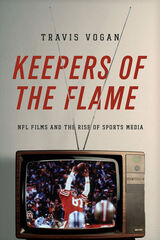
Drawing on research at the NFL Films Archive and the Pro Football Hall of Fame and interviews with media pioneer Steve Sabol and others, Travis Vogan shows how NFL Films has constructed a consistent, romanticized, and remarkably visible mythology for the National Football League. The company packages football as a visceral and dramatic sequence of violent, beautiful, graceful, and heroic gridiron battles. Historically proven formulas for presentation--such as the dramatic voiceovers once provided by John Facenda's baritone, the soaring scores of Sam Spence's rousing background music, and the epic poetry found in Steve Sabol's scripts--are still used today.
From the Vincent Price-narrated Strange but True Football Stories to the currently running series Hard Knocks, NFL Films distinguishes the NFL from other sports organizations and from other media and entertainment. Vogan tells the larger story of the company's relationship with and vast influence on our culture's representations of sport, the expansion of sports television beyond live game broadcasts, and the emergence of cable television and Internet sports media.
Keepers of the Flame: NFL Films and the Rise of Sports Media presents sports media as an integral facet of American popular culture and NFL Films as key to the transformation of professional football into the national obsession commonly known as America's Game.

Banet-Weiser draws on interviews with nearly fifty children as well as with network professionals; coverage of Nickelodeon in both trade and mass media publications; and analysis of the network’s programs. She provides an overview of the media industry within which Nickelodeon emerged in the early 1980s as well as a detailed investigation of its brand-development strategies. She also explores Nickelodeon’s commitment to “girl power,” its ambivalent stance on multiculturalism and diversity, and its oft-remarked appeal to adult viewers. Banet-Weiser does not condemn commercial culture nor dismiss the opportunities for community and belonging it can facilitate. Rather she contends that in the contemporary media environment, the discourses of political citizenship and commercial citizenship so thoroughly inform one another that they must be analyzed in tandem. Together they play a fundamental role in structuring children’s interactions with television.

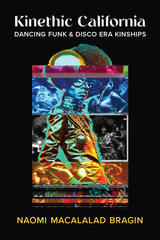
Kinethic California: Dancing Funk and Disco Era Kinships documents the emergence of new forms of black social and vernacular dance invented by youth living in 1970s California, who helped build the foundations of contemporary hip hop/streetdance culture. Naomi Macalalad Bragin weaves interviews and ethnographies of first-generation (1960s-70s) dancers of strutting, boogaloo, robotting, popping, locking, waacking, and punking styles, as it advances a theory of dance as kinetic kinship formation through a focus on techniques and practices of the dancers themselves. She offers that the term given to these collective movement practices is kinethic to bring attention to motion at the core of black aesthetics that generate dances as forms of kinship beyond blood relation. Kinethics reorient dancers toward kinetic kinship in ways that give continuity to black dance lineages under persistent conditions of disappearance and loss. As dancers engage kinethics, they reinvent gestural vocabularies that describe worlds they imagine into knowing-being.
The stories in Kinethic California attend to the aesthetics of everyday movement, seen through the lens of young artists who, from childhood, listened to their family’s soul and funk records, observed the bent-leg strolls and rhythmic handshakes of people moving through their neighborhoods, and watched each other move at house parties, school gyms, and around-the-way social clubs. Their aesthetic sociality and geographic movement provided materials for collective study and creative play. Bragin attends to such multidirectional conversations between dancer, community, and tradition, by which California dance lineages emerge and take flight.

King of Hearts shows how drag king performers are thriving in an unlikely location: Southern Bible Belt states like Tennessee, Georgia, and South Carolina. Based on observations and interviews with sixty Southern drag kings, this study reveals how they are challenging the region’s gender norms while creating a unique community with its own distinctive Southern flair. Reflecting the region’s racial diversity, it profiles not only white drag kings, but also those who are African American, multiracial, and Hispanic.
Queer scholar Baker A. Rogers—who has also performed as drag king Macon Love—takes you on an insider’s tour of Southern drag king culture, exploring its history, the communal bonds that unite it, and the controversies that have divided it. King of Hearts offers a groundbreaking look at a subculture that presents a subversion of gender norms while also providing a vital lifeline for non-gender-conforming Southerners.


Kinyras, in Greco-Roman sources, is the central culture-hero of early Cyprus: legendary king, metallurge, Agamemnon’s (faithless) ally, Aphrodite’s priest, father of Myrrha and Adonis, rival of Apollo, ancestor of the Paphian priest-kings, and much more. Kinyras increased in depth and complexity with the demonstration in 1968 that Kinnaru—the divinized temple-lyre—was venerated at Ugarit, an important Late Bronze Age city just opposite Cyprus on the Syrian coast. John Curtis Franklin seeks to harmonize Kinyras as a mythological symbol of pre-Greek Cyprus with what is known of ritual music and deified instruments in the Bronze Age Near East, using evidence going back to early Mesopotamia. Franklin addresses issues of ethnicity and identity; migration and colonization, especially the Aegean diaspora to Cyprus, Cilicia, and Philistia in the Early Iron Age; cultural interface of Hellenic, Eteocypriot, and Levantine groups on Cyprus; early Greek poetics, epic memory, and myth-making; performance traditions and music archaeology; royal ideology and ritual poetics; and a host of specific philological and historical issues arising from the collation of classical and Near Eastern sources.
Kinyras includes a vital background study of divinized balang-harps in Mesopotamia by Wolfgang Heimpel. This paperback edition contains minor corrections, while retaining the foldout maps of the original hardback edition as spreads, alongside illustrations and artwork by Glynnis Fawkes.
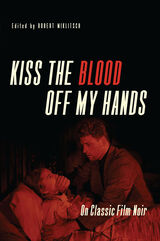
But a new generation of writers is pushing aside the fog of cigarette smoke surrounding classic noir scholarship. In Kiss the Blood Off My Hands: On Classic Film Noir, Robert Miklitsch curates a bold collection of essays that reassesses the genre's iconic style, history, and themes. Contributors analyze the oft-overlooked female detective and little-examined aspects of filmmaking like love songs and radio aesthetics, discuss the significance of the producer and women's pulp fiction, and investigate topics as disparate as Disney noir and the Fifties heist film, B-movie back projection and blacklisted British directors. At the same time the writers' collective reconsideration shows the impact of race and gender, history and sexuality, technology and transnationality on the genre.
As bracing as a stiff drink, Kiss the Blood Off My Hands writes the future of noir scholarship in lipstick and chalk lines for film fans and scholars alike.
Contributors: Krin Gabbard, Philippa Gates, Julie Grossman, Robert Miklitsch, Robert Murphy, Mark Osteen, Vivian Sobchack, Andrew Spicer, J. P. Telotte, and Neil Verma.
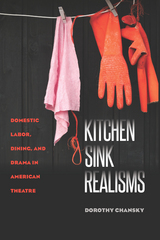
In analyzing kitchen sink realisms, Dorothy Chansky reveals the ways that food preparation, domestic labor, dining, serving, entertaining, and cleanup saturate the lives of dramatic characters and situations even when they do not take center stage. Offering resistant readings that rely on close attention to the particular cultural and semiotic environments in which plays and their audiences operated, she sheds compelling light on the changing debates about women’s roles and the importance of their household labor across lines of class and race in the twentieth century.
The story begins just after World War I, as more households were electrified and fewer middle-class housewives could afford to hire maids. In the 1920s, popular mainstream plays staged the plight of women seeking escape from the daily grind; African American playwrights, meanwhile, argued that housework was the least of women’s worries. Plays of the 1930s recognized housework as work to a greater degree than ever before, while during the war years domestic labor was predictably recruited to the war effort—sometimes with gender-bending results. In the famously quiescent and anxious 1950s, critiques of domestic normalcy became common, and African American maids gained a complexity previously reserved for white leading ladies. These critiques proliferated with the re-emergence of feminism as a political movement from the 1960s on. After the turn of the century, the problems and comforts of domestic labor in black and white took center stage. In highlighting these shifts, Chansky brings the real home.
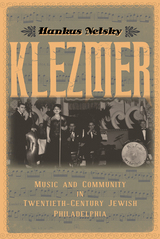
Netsky defines what klezmer music is, how it helped define Jewish immigrant culture in Philadelphia, and how its current revival has changed klezmer’s meaning historically. Klezmer also addresses the place of musicians and celebratory music in Jewish society, the nature of klezmer culture, the tensions between sacred and secular in Jewish music, and the development of Philadelphia's distinctive “Russian Sher” medley, a unique and masterfully crafted composition.
Including a significant amount of musical transcriptions, Klezmer chronicles this special musical genre from its heyday in the immigrant era, through the mid-century period of its decline through its revitalization from the 1980s to today.
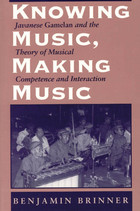
Using illustrative examples from a variety of traditions, Benjamin Brinner first examines the elements and characteristics of musical competence, the different kinds of competence in a musical community, the development of multiple competences, and the acquisition and transformation of competence through time. He then shows how these factors come into play in musical interaction, establishing four intersecting theoretical perspectives based on ensemble roles, systems of communication, sound structures, and individual motivations. These perspectives are applied to the dynamics of gamelan performance to explain the social, musical, and contextual factors that affect the negotiation of consensus in musical interaction. The discussion ranges from sociocultural norms of interpersonal conduct to links between music, dance, theater, and ritual, and from issues of authority and deference to musicians' self-perceptions and mutual assessments.
Much more than a portrait of artists making music together, this book brings together a variety of cognitive approaches and a wide range of examples from many cultures to suggest ways of integrating our knowledge of music making both in individual cultures and crossculturally.
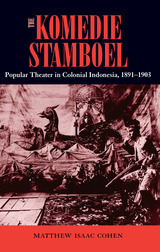
Originating in 1891 in the port city of Surabaya, the Komedie Stamboel, or Istanbul-style theater, toured colonial Indonesia, Singapore, and Malaysia by rail and steamship. The company performed musical versions of the Arabian Nights, European fairy tales and operas such as Sleeping Beauty and Aida, as well as Indian and Persian romances, Southeast Asian chronicles, true crime stories, and political allegories. The actors were primarily Eurasians, the original backers were Chinese, and audiences were made up of all races and classes. The Komedie Stamboel explores how this new hybrid theater pointed toward possibilities for the transformation of self in a colonial society and sparked debates on moral behavior and mixed-race politics.
While audiences marveled at spectacles involving white-skinned actors, there were also racial frictions between actors and financiers, sexual scandals, fights among actors and patrons, bankruptcies, imprisonments, and a murder.
Matthew Isaac Cohen's evocative social history situates the Komedie Stamboel in the culture of empire and in late nineteenth-century itinerant entertainment. He shows how the theater was used as a symbol of cross-ethnic integration in postcolonial Indonesia and as an emblem of Eurasian cultural accomplishment by Indische Nederlanders. A pioneering study of nineteenth-century Southeast Asian popular culture, The Komedie Stamboel gives a new picture of the region's arts and culture and explores the interplay of currents in global culture, theatrical innovation, and movement in colonial Indonesia.ABOUT THE AUTHOR---Matthew Isaac Cohen is senior lecturer in Drama and Theatre Studies at Royal Holloway University of London. His articles on Southeast Asian performance have appeared in New Theatre Quarterly, Asian Theatre Journal, Journal of the Royal Asiatic Society, and Archipel. As a practicing shadow puppeteer, he has performed in the United States, Europe, and Asia.
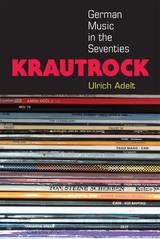
Among other topics, individual chapters of the book focus on the redefinition of German identity in the music of Kraftwerk, Can, and Neu!; on community and conflict in the music of Amon Düül, Faust, and Ton Steine Scherben; on “cosmic music” and New Age; and on Donna Summer’s and David Bowie’s connections to Germany. Rather than providing a purely musicological or historical account, Krautrock discusses the music as being constructed through performance and articulated through various forms of expressive culture, including communal living, spirituality, and sound.

Arguing that Kurosawa’s films arouse anxiety in Japanese and Western critics because the films problematize Japan’s self-image and the West’s image of Japan, Yoshimoto challenges widely circulating clichés about the films and shows how these works constitute narrative answers to sociocultural contradictions and institutional dilemmas. While fully acknowledging the achievement of Kurosawa as a filmmaker, Yoshimoto uses the director’s work to reflect on and rethink a variety of larger issues, from Japanese film history, modern Japanese history, and cultural production to national identity and the global circulation of cultural capital. He examines how Japanese cinema has been “invented” in the discipline of film studies for specific ideological purposes and analyzes Kurosawa’s role in that process of invention. Demonstrating the richness of both this director’s work and Japanese cinema in general, Yoshimoto’s nuanced study illuminates an array of thematic and stylistic aspects of the films in addition to their social and historical contexts.
Beyond aficionados of Kurosawa and Japanese film, this book will interest those engaged with cultural studies, postcolonial studies, cultural globalization, film studies, Asian studies, and the formation of academic disciplines.
READERS
Browse our collection.
PUBLISHERS
See BiblioVault's publisher services.
STUDENT SERVICES
Files for college accessibility offices.
RECENTLY PUBLISHED





UChicago Accessibility Resources
home | accessibility | search | about | contact us
BiblioVault ® 2001 - 2025
The University of Chicago Press