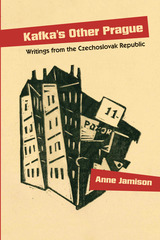
front cover of Kafka’s Other Prague
Kafka’s Other Prague
Writings from the Czechoslovak Republic
Anne Jamison
Northwestern University Press, 2018
Kafka’s Other Prague: Writings from the Czechoslovak Republic examines Kafka’s late writings from the perspective of the author’s changing relationship with Czech language, culture, and literature—the least understood facet of his meticulously researched life and work.
 
Franz Kafka was born in Prague, a bilingual city in the Habsburg Empire. He died a citizen of Czechoslovakia. Yet Kafka was not Czech in any way he himself would have understood. He could speak Czech, but, like many Prague Jews, he was raised and educated and wrote in German. Kafka critics to date have had little to say about the majority language of his native city or its “minor literature,” as he referred to it in a 1913 journal entry. Kafka’s Other Prague explains why Kafka’s later experience of Czech language and culture matters.
 
Bringing to light newly available archival material, Anne Jamison’s innovative study demonstrates how Czechoslovakia’s founding and Kafka’s own dramatic political, professional, and personal upheavals altered his relationship to this “other Prague.” It destabilized Kafka’s understanding of nationality, language, gender, and sex—and how all these issues related to his own writing.
 
Kafka’s Other Prague juxtaposes Kafka’s German-language work with Czechoslovak Prague’s language politics, intellectual currents, and print culture—including the influence of his lover and translator, the journalist Milena Jesenská—and shows how this changed cultural and linguistic landscape transformed one of the great literary minds of the last century.
 
[more]

front cover of Kafu the Scribbler
Kafu the Scribbler
The Life and Writings of Nagai Kafu, 1897–1959
Edward Seidensticker
University of Michigan Press, 1990
Kafū the Scribbler is neither pure biography nor pure criticism nor yet a pure anthology, but a blending of the three. It is an introduction to Nagai Kafū and his city, accompanied by a fairly generous sampling from his works. Marleigh Ryan writes:
“In this book Edward Seidensticker presents a unique combination of biography and literary criticism by skillfully interweaving details of the life of Nagai Kafū with studies of his writing. With quotations of from Kafū’s fiction and nonfiction alike, Seidensticker is able to reconstruct many incidents in the author’s life which had previously been little understood. The latter half of the book is given over to translations of short stories and to selections from two novels and a journal. Seidensticker has thoughtfully given cross references to the material in both parts of the book which enable the reader to handle this wealth of material with some dexterity.
“Seidensticker’s skill as a translator is so well established that it seems almost unnecessary to comment on it further here but one cannot help being impressed by his rendering of Kafū’s lyrical style. As we realize when reading the critical material, there is remarkably little plot or character development in Kafū’s fiction. His position as leading modern writer is dependent to a considerable degree upon the beauty and grace of his style, and we are fortunate indeed to have such masterful translations as these to convey that style.”*
*Ryan, Marleigh. Journal of the American Oriental Society 88, no. 3 (1968): 624. doi:10.2307/596924.

[more]


Send via email Share on Facebook Share on Twitter