
 A SCHOLARLY BOOK REPOSITORY
137 start with L start with L
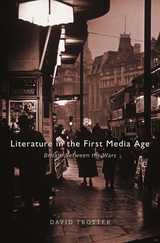
The period between the World Wars was one of the richest and most inventive in the long history of British literature. Interwar literature, David Trotter argues, stood apart by virtue of the sheer intelligence of the enquiries it undertook into the technological mediation of experience. After around 1925, literary works began to portray communication by telephone, television, radio, and sound cinema—and to examine the sorts of behavior made possible for the first time by virtual interaction. And they filled up, too, with the look, sound, smell, taste, and feel of the new synthetic and semi-synthetic materials that were reshaping everyday modern life.
New media and new materials gave writers a fresh opportunity to reimagine both how lives might be lived and how literature might be written. Today, Trotter observes, such material and immaterial mediations have become even more decisive. Communications technology is an attitude before it is a machine or a set of codes. It is an idea about the prosthetic enhancement of our capacity to communicate. The writers who first woke up to this fact were not postwar, postmodern, or post-anything else: some of the best of them lived and wrote in the British Isles in the period between the World Wars. In defining what they achieved, this book creates a new literary canon of works distinguished formally and thematically by their alertness to the implications of new media and new materials.
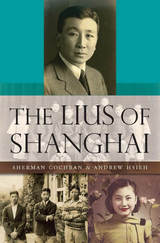
From the Sino-Japanese War to the Communist Revolution, the onrushing narrative of modern China can drown out the stories of the people who lived it. Yet a remarkable cache of letters from one of China’s most prominent and influential families, the Lius of Shanghai, sheds new light on this tumultuous era. Sherman Cochran and Andrew Hsieh take us inside the Lius’ world to explore how the family laid the foundation for a business dynasty before the war and then confronted the challenges of war, civil unrest, and social upheaval.
Cochran and Hsieh gained access to a rare collection containing a lifetime of letters exchanged by the patriarch, Liu Hongsheng, his wife, Ye Suzhen, and their twelve children. Their correspondence offers a fascinating look at how a powerful family navigated the treacherous politics of the period. They discuss sensitive issues—should the family collaborate with the Japanese occupiers? should it flee after the communist takeover?—as well as intimate domestic matters like marital infidelity. They also describe the agonies of wartime separation, protracted battles for control of the family firm, and the parents’ struggle to maintain authority in the face of swiftly changing values.
Through it all, the distinctive voices of the Lius shine through. Cochran and Hsieh’s engaging prose reveals how each member of the family felt the ties that bound them together. More than simply a portrait of a memorable family, The Lius of Shanghai tells the saga of modern China from the inside out.

Living the High Life in Minsk looks at the sources of stability and instability in post-Soviet authoritarian states through the case study of President Lukashenka’s firm hold on power in Belarus. In particular, it seeks to understand the role of energy relations, policies, and discourses in the maintenance of this power. The central empirical question Balmaceda seeks to answer is what has been the role of energy policies in the maintenance of Lukashenka’s power in Belarus? In particular, it analyzes the role of energy policies in the management of Lukashenka’s relationship with three constituencies crucial to his hold on power: Russian actors, the Belarusian nomenklatura, and the Belarusian electorate.
In terms of foreign relations, the book focuses on the factors explaining Lukashenka’s ability to project Belarus’ power in its relationship with Russia in such a way as to compensate for its objective high level of dependency, assuring high levels of energy subsidies and rents continuing well beyond the initial worsening of the relationship in c. 2004. In terms of domestic relations, Balmaceda examines Lukashenka’s specific use of those energy rents in such a way as to assure the continuing support of both the Belarusian nomenklatura and the Belarusian electorate.
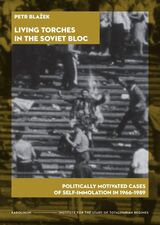
Living Torches in the Soviet Bloc presents the lives of those who chose self-immolation as a radical form of protest against the political oppression of Communist regimes in the Soviet Bloc between 1966–1989. While more than fifty such cases were identified during the relevant period, Petr Blažek focuses here on the twenty-one cases in which at least partial political motivation is apparent from historical sources.
Many of the cases of the “living torches” were a radical response to the August 1968 occupation of Czechoslovakia by the armies of five Warsaw Pact member states and the suppression of the Prague Spring. After January 1969, the self-immolation of Jan Palach evoked a large wave of followers not only in Czechoslovakia, but also abroad, and greatly influenced other cases of “living torches” which continued to appear in the Soviet Bloc until the end of the 1980s.
Although the conditions in the Soviet Bloc states were sometimes fundamentally different, these cases of self-immolation across states share a common disapproval of the totalitarian form of rule. They were often drastic responses from members of occupied nations, most of whom were Czechs, Lithuanians, Ukrainians, and Poles, who rejected the enforced Communist regime and Soviet military presence. Some decided to sacrifice their lives to wake others from indifference and resignation. Even several decades later, their shocking acts not only provoke, but also lead us to reflect on fundamental questions of human life.
Living Translation offers a powerful perspective on the work of distinguished thinker and writer Gayatri Chakravorty Spivak, revealing how, throughout her long career, she has made translation a central concern of the comparative humanities.
Starting with her landmark “Translator’s Preface” to Jacques Derrida’s Of Grammatology in 1976, and continuing with her foreword to Mahasweta Devi’s Draupadi and afterword to Devi’s Chotti MundaandHis Arrow, Spivak has tackled questions of translatability. She has been interested in interrogating the act of translation from the ground up and at the political limit. She sees at play at border checkpoints, at sites of colonial pedagogy, in acts of resistance to monolingual regimes of national language, at the borders of minor literature and schizo-analysis, in the deficits of cultural debt and linguistic expropriation, and, more generally, at theory’s edge, which is to say, where practical criticism yields to theorizing in untranslatables. This volume also addresses how Spivak’s institution-building as director of comparative literature at the University of Iowa—and in her subsequent places of employment—began at the same time. From this perspective, Spivak takes her place within a distinguished line-up of translator-theorists who have been particularly attuned to the processes of cognizing in languages, all of them alive to the coproductivity of thinking, translating, writing.

A visitor to Beijing in 1900, Chinese or foreign, would have been struck by the great number of native-place lodges serving the needs of scholars and officials from the provinces. What were these native-place lodges? How did they develop over time? How did they fit into and shape Beijing's urban ecology? How did they further native-place ties?
In answering these questions, the author considers how native-place ties functioned as channels of communication between China's provinces and the political center; how sojourners to the capital used native-place ties to create solidarity within their communities of fellow provincials and within the class of scholar-officials as a whole; how the state co-opted these ties as a means of maintaining order within the city and controlling the imperial bureaucracy; how native-place ties transformed the urban landscape and social structure of the city; and how these functions were refashioned in the decades of political innovation that closed the Qing period. Native-place lodges are often cited as an example of the particularistic ties that characterized traditional China and worked against the emergence of a modern state based on loyalty to the nation. The author argues that by fostering awareness of membership in an elite group, the native-place lodges generated a sense of belonging to a nation that furthered the reforms undertaken in the early twentieth century.
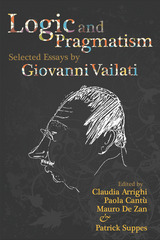
Logic and Pragmatism features a number of the key writings of Giovanni Vailati (1863–1909), the Italian mathematician and philosopher renowned for his work in mechanics, geometry, logic, and epistemology. The selections in this book—many of which are available here for the first time in English—focus on Vailati’s significant contributions to the field of pragmatism. Accompanying these pieces are introductory essays by the volume’s editors that outline the traits of Vailati’s pragmatism and provide insights into the scholar’s life.

"Shields argues that the appearance throughout Wittgenstein's writings of such concepts as ritual, limit, transgression, a change of will, pride, temptation, and judgment implies a relation between religion and the logical aspects of Wittgenstein's philosophy."—Choice
"Of the many recent books about Wittgenstein, Logic and Sin is one of the very few that are well worth having"—Fergus Kerr, Modern Theology
"What Shields has uncovered in Wittgenstein's religious sensibility is something genuine and profound. . . . Shields has not just written an important book on Wittgenstein but an enlightening work that invites further reflection."—Eric O. Springsted, Cross Currents

A New York Times Book Review Editors’ Choice
A Telegraph Editor’s Choice
An Evening Standard “Best Books about London” Selection
In popular imagination, London is a city of fog. The classic London fogs, the thick yellow “pea-soupers,” were born in the industrial age of the early nineteenth century. Christine L. Corton tells the story of these epic London fogs, their dangers and beauty, and their lasting effects on our culture and imagination.
“Engrossing and magnificently researched…Corton’s book combines meticulous social history with a wealth of eccentric detail. Thus we learn that London’s ubiquitous plane trees were chosen for their shiny, fog-resistant foliage. And since Jack the Ripper actually went out to stalk his victims on fog-free nights, filmmakers had to fake the sort of dank, smoke-wreathed London scenes audiences craved. It’s discoveries like these that make reading London Fog such an unusual, enthralling and enlightening experience.”
—Miranda Seymour, New York Times Book Review
“Corton, clad in an overcoat, with a linklighter before her, takes us into the gloomier, long 19th century, where she revels in its Gothic grasp. Beautifully illustrated, London Fog delves fascinatingly into that swirling miasma.”
—Philip Hoare, New Statesman
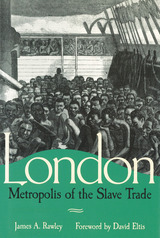
"The recognition that ordinary people could and did trade in slaves, as well as the fact that ordinary people became slaves, is, indeed, the beginning of comprehending the enormity of the forced migration of eleven million people and the attendant deaths of many more."
Rawley draws on material from the year 1700 to the American Civil War as he explores the role of London in the trade. He covers its activity as a port of departure for ships bound for Africa; its continuing large volume after the trade extended to Bristol and Liverpool; and the controversy between London’s parliamentary representatives, who defended the trade, and the abolitionist movement that was quartered there.
Sweeping in scope and thorough in its analysis, this collection of essays from a seasoned scholar will be welcomed by historians concerned with slavery and the slave trade, as well as by students just beginning their exploration of this subject.

For decades, Rachel Blau DuPlessis has shown readers how genres, forms, and the literal acts of writing and reception can be understood as sites of struggle. In her own words, “writing is . . . a praxis . . . in which the author disappears into a process, into a community, into discontinuities, and into a desire for discovery.” It is cause for celebration, then, that we have another work of warm, incisive, exploratory writing from DuPlessis in A Long Essay on the Long Poem.
Long poems, DuPlessis notes, are elusive, particularly in the slippery forms that have emerged in the postmodern mode. She cites both Nathaniel Mackey and Anne Waldman in thinking of the poem as a “box,” both in the sense of a vessel that contains and as a machine that processes, an instrument on which language is played. This study’s central attention is on the long poem as a sociocultural Book, distinctively envisioned by a range of authors.
To reckon with these shifting and evolving forms, DuPlessis works in a polyvalent mode, a hybrid of critical analysis and speculative essay. She divides the long poem and the long poets into three genres: epics, quests, and a composite she terms “assemblages.” The poets she surveys include T. S. Eliot, Ezra Pound, H.D., Louis Zukofsky, Gwendolyn Brooks, Charles Olson, Alice Notley, Nathaniel Mackey, Ron Silliman, Robert Duncan, Kamau Brathwaite, and, finally, Mallarmé and Dante. Instead of a traditional lineage, she deliberately seeks intersecting patterns of connection between poems and projects, a nexus rather than a family tree. In doing so she navigates both some challenges of long poems and her own attempt to “essay” them. The result is a fascinating and generous work that defies categorization as anything other than essential.
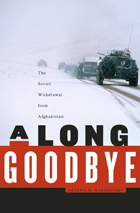
The conflict in Afghanistan looms large in the collective consciousness of Americans. What has the United States achieved, and how will it withdraw without sacrificing those gains? The Soviet Union confronted these same questions in the 1980s, and Artemy Kalinovsky’s history of the USSR’s nine-year struggle to extricate itself from Afghanistan and bring its troops home provides a sobering perspective on exit options in the region.
What makes Kalinovsky’s intense account both timely and important is its focus not on motives for initiating the conflict but on the factors that prevented the Soviet leadership from ending a demoralizing war. Why did the USSR linger for so long, given that key elites recognized the blunder of the mission shortly after the initial deployment?
Newly available archival material, supplemented by interviews with major actors, allows Kalinovsky to reconstruct the fierce debates among Soviet diplomats, KGB officials, the Red Army, and top Politburo figures. The fear that withdrawal would diminish the USSR’s status as leader of the Third World is palpable in these disagreements, as are the competing interests of Afghan factions and the Soviet Union’s superpower rival in the West. This book challenges many widely held views about the actual costs of the conflict to the Soviet leadership, and its findings illuminate the Cold War context of a military engagement that went very wrong, for much too long.

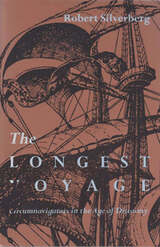
From the intense and brooding Magellan and the glamorous and dashing Sir Francis Drake; to Thomas Cavendish, who set off to plunder Spain’s American gold and the Dutch circumnavigators, whose numbers included pirates as well as explorers and merchants, Robert Silverberg captures the adventures and seafaring exploits of a bygone era.
Over the course of a century, European circumnavigators in small ships charted the coast of the New World and explored the Pacific Ocean. Characterized by fierce nationalism, competitiveness, and bloodshed, The Longest Voyage: Circumnavigators in the Age of Discovery captures the drama, danger, and personalities in the colorful story of the first voyages around the world. These accounts begin with Magellan’s unprecedented 1519–22 circumnavigation, providing an immediate, exciting, and intimate glimpse into that historic venture. The story includes frequent threats of mutiny; the nearly unendurable extremes of heat, cold, hunger, thirst, and fatigue; the fear, tedium, and moments of despair; the discoveries of exotic new peoples and strange new lands; and, finally, Magellan’s own dramatic death during a fanatical attempt to convert native Philippine islanders to Christianity.
Capturing the total context of political climate and historical change that made the Age of Discovery one of excitement and drama, Silverberg brings a motley crew of early ocean explorers vividly to life.
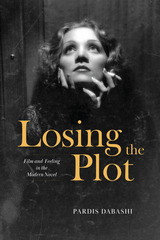
The modernist novel sought to escape what Virginia Woolf called the “tyranny” of plot. Yet even as twentieth-century writers pushed against the constraints of plot-driven Victorian novels, plot kept its hold on them through the influence of another medium: the cinema. Focusing on the novels of Nella Larsen, Djuna Barnes, and William Faulkner—writers known for their affinities and connections to classical Hollywood—Pardis Dabashi links the moviegoing practices of these writers to the tensions between the formal properties of their novels and the characters in them. Even when they did not feature outright happy endings, classical Hollywood films often provided satisfying formal resolutions and promoted normative social and political values. Watching these films, modernist authors were reminded of what they were leaving behind—both formally and in the name of aesthetic experimentalism—by losing the plot.

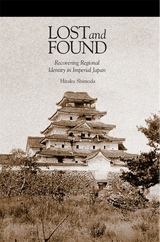
Lost and Found offers a new understanding of modern Japanese regionalism by revealing the tense and volatile historical relationship between region and nation in the late nineteenth and early twentieth centuries. Aizu, a star-crossed region in present-day Fukushima prefecture, becomes a case study for how one locale was estranged from nationhood for its treasonous blunder in the Meiji Restoration, yet eventually found a useful place within the imperial landscape. Local mythmakers—historians, memoirists, war veterans, and others—harmonized their rebel homeland with imperial Japan so as to affirm, ironically, the ultimate integrity of the Japanese polity. What was once “lost” and then “found” again was not simply Aizu’s sense of place and identity, but the larger value of regionalism in a rapidly modernizing society.
In this study, Hiraku Shimoda suggests that “region,” which is often regarded as a hard, natural place that impedes national unity, is in fact a supple and contingent spatial category that can be made to reinforce nationalist sensibilities just as much as internal diversity.
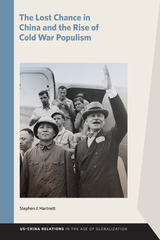

During the Second World War, an unprecedented number of families were torn apart. As the Nazi empire crumbled, millions roamed the continent in search of their loved ones. The Lost Children tells the story of these families, and of the struggle to determine their fate. We see how the reconstruction of families quickly became synonymous with the survival of European civilization itself.
Even as Allied officials and humanitarian organizations proclaimed a new era of individualist and internationalist values, Tara Zahra demonstrates that they defined the “best interests” of children in nationalist terms. Sovereign nations and families were seen as the key to the psychological rehabilitation of traumatized individuals and the peace and stability of Europe.
Based on original research in German, French, Czech, Polish, and American archives, The Lost Children is a heartbreaking and mesmerizing story. It brings together the histories of eastern and western Europe, and traces the efforts of everyone—from Jewish Holocaust survivors to German refugees, from Communist officials to American social workers—to rebuild the lives of displaced children. It reveals that many seemingly timeless ideals of the family were actually conceived in the concentration camps, orphanages, and refugee camps of the Second World War, and shows how the process of reconstruction shaped Cold War ideologies and ideas about childhood and national identity. This riveting tale of families destroyed by war reverberates in the lost children of today’s wars and in the compelling issues of international adoption, human rights and humanitarianism, and refugee policies.
Scholars of modernism have long addressed how literature, painting, and music reflected the radical reconceptualization of space and time in the early twentieth century—a veritable revolution in both physics and philosophy that has been characterized as precipitating an “epistemic trauma” around the world. In this wide-ranging study, Benjamin Paloff contends that writers in Central and Eastern Europe felt this impact quite distinctly from their counterparts in Western Europe. For the latter, the destabilization of traditional notions of space and time inspired works that saw in it a new kind of freedom. However, for many Central and Eastern European authors, who were writing from within public discourses about how to construct new social realities, the need for escape met the realization that there was both nowhere to escape to and no stable delineation of what to escape from. In reading the prose and poetry of Czech, Polish, and Russian writers, Paloff imbues the term “Kafkaesque” with a complexity so far missing from our understanding of this moment in literary history.
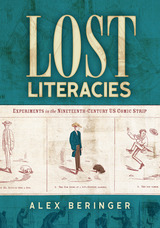
Lost Literacies is the first full-length study of US comic strips from the period prior to the rise of Sunday newspaper comics. Where current histories assume that nineteenth-century US comics consisted solely of single-panel political cartoons or simple “proto-comics,” Lost Literacies introduces readers to an ambitious group of artists and editors who were intent on experimenting with the storytelling possibilities of the sequential strip, resulting in playful comics whose existence upends prevailing narratives about the evolution of comic strips.
Over the course of the nineteenth century, figures such as artist Frank Bellew and editor T. W. Strong introduced sequential comic strips into humor magazines and precursors to graphic novels known as “graphic albums.” These early works reached audiences in the tens of thousands. Their influences ranged from Walt Whitman’s poetry to Mark Twain’s travel writings to the bawdy stage comedies of the Bowery Theatre. Most importantly, they featured new approaches to graphic storytelling that went far beyond the speech bubbles and panel grids familiar to us today. As readers of Lost Literacies will see, these little-known early US comic strips rival even the most innovative modern comics for their diversity and ambition.

Tracing how shuttered mission schools became contested commemorative landscapes
During the Early Republic and Jacksonian eras, Euro-American colonists and Native nations in the South and Old Northwest established mission schools intended to Christianize Indigenous peoples. In Lost Missions, Sean T. Jacobson recovers the histories and afterlives of these institutions, arguing that they played a far more consequential role in Native–settler relations than scholars have previously acknowledged. Mission schools advanced a spiritual vision of a multiethnic Christian America—one that ultimately collapsed amid the federally sponsored Indian Removal campaigns of the 1830s and 1840s.
Following the closure of these schools, their physical and symbolic landscapes became powerful sites of memory. Euro-American Christians later transformed former missions into commemorative spaces that celebrated “frontier” piety and national expansion. Through monuments, pageantry, and local histories, Protestant and Catholic Americans alike recast missionary labor as a foundational component of American nation-building. In doing so, these narratives framed the Christianization of Native peoples as a benevolent civilizing project, one that implicitly—and sometimes explicitly—sanitized the coercion, dispossession, and violence that accompanied westward expansion and the forced removal of Indigenous nations.
By the late twentieth century, however, these commemorative narratives faded. Suburban development, commercialization, and shifting cultural priorities rendered many mission sites once again “lost,” stripped of the civic meaning they once held. Yet Jacobson shows that these landscapes still speak, especially when viewed from Indigenous perspectives. Reinterpreted through Native histories of endurance and survival, former missions reveal counternarratives of persistence amid profound loss. As tribal nations increasingly engage with these sites today, Lost Missions probes their contested status as places of memory and conscience, illuminating how public history continues to shape and challenge understandings of America’s colonial past.
"The volume is too subtle, too rich in ideas for anyone to do justice to it in brief summary, too heavily documented and too carefully wrought for anyone to dismiss its thesis. . . . It is a major contribution not only to Jefferson studies but to American intellectual history. . . . All who work in the history of ideas will find themselves in Mr. Boorstin's debt."—Richard Hofstadter, South Atlantic Monthly
Published by Bucknell University Press. Distributed worldwide by Rutgers University Press.
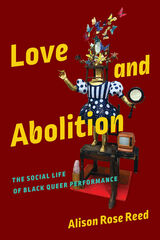
Reed identifies abolition literature as an emergent field of inquiry that emphasizes social relationships in the ongoing struggle to dismantle systems of coercion, criminalization, and control. Focusing on love as an affective modality and organizing tool rooted in the Black radical tradition’s insistence on collective sociality amidst unrelenting state violence, Reed provides fresh readings of visionaries such as James Baldwin, Ntozake Shange, Sharon Bridgforth, and vanessa german. Both abolitionist manifesto and examination of how Black queer performance offers affective modulations of tough and tender love, Love and Abolition ultimately calls for a critical reconsideration of the genre of prison literature—and the role of the humanities—during an age of mass incarceration.
In Love and Saint Augustine, Joanna Vecchiarelli Scott and Judith Chelius Stark make this important early work accessible for the first time. Here is a completely corrected and revised English translation that incorporates Arendt's own substantial revisions and provides additional notes based on letters, contracts, and other documents as well as the recollections of Arendt's friends and colleagues during her later years.
No one is better equipped to tell this story than novelist and historian Elizabeth Wilson. With a penchant for tennis’s inherent drama, she finds its core: a psychological face off between flamboyant personalities navigating the ebbs and flows of fortune in the confines of a 78 x 36–foot box—whether of clay, grass, or DecoTurf. Walking the finely kempt lawns of Victorian England, she shows how tennis’s early role as a social pastime that included both men and women—and thus, lots of sexual tension—set it apart from most other sports and their dominant masculine appeal. Even today, when power and endurance are more important than ever, tennis still demands that the body behave gracefully and with finesse. In this way, Wilson shows, tennis has retained the vibrant spectacle of human drama and beauty that have always made it special, not just to sports fans but to popular culture.
Telling the stories of all the greats, from the Renshaw brothers to Novak Djokovic, and of all the advances, from wooden racquets to network television schedules, Wilson offers a tennis book like no other, keeping the court square in our sights as history is illuminated around it.
The scholars featured in this collection—Etienne Balibar, Peter Bürger, Terry Eagleton, Fredric Jameson, Jacques Leenhardt, Michael Löwy, Roberto Schwarz, George Steiner, Susan Suleiman, and Cornel West—discuss a broad array of literary and political topics and present provocative views on gender, race, and economic relations. Corredor’s introduction provides a biographical synopsis of Lukács and discusses a number of his most important theoretical concepts. Maintaining the ongoing vitality of Lukács’s work, these interviews yield insights into Lukács as a philosopher and theorist, while offering anecdotes that capture him in his role as a teacher-mentor.


After World War II, Europe witnessed the massive redrawing of national borders and the efforts to make the population fit those new borders. As a consequence of these forced changes, both Lviv and Wrocław went through cataclysmic changes in population and culture. Assertively Polish prewar Lwów became Soviet Lvov, and then, after 1991, it became assertively Ukrainian Lviv. Breslau, the third largest city in Germany before 1945, was in turn "recovered" by communist Poland as Wrocław. Practically the entire population of Breslau was replaced, and Lwów's demography too was dramatically restructured: many Polish inhabitants migrated to Wrocław and most Jews perished or went into exile. The forced migration of these groups incorporated new myths and the construction of official memory projects.
The chapters in this edited book compare the two cities by focusing on lived experiences and "bottom-up" historical processes. Their sources and methods are those of micro-history and include oral testimonies, memoirs, direct observation and questionnaires, examples of popular culture, and media pieces. The essays explore many manifestations of the two sides of the same coin—loss on the one hand, gain on the other—in two cities that, as a result of the political reality of the time, are complementary.

Exploration of our inner life—perception, thought, memory, feeling—once seemed a privileged domain of lyric poetry. Scientific discoveries, however, have recently supplied physiological explanations for what was once believed to be transcendental; the past sixty years have brought wide recognition that the euphoria of love is both a felt condition and a chemical phenomenon, that memories are both representations of lived experience and dynamic networks of activation in the brain. Caught between a powerful but reductive scientific view of the mind and traditional literary metaphors for consciousness that have come to seem ever more naive, American poets since the sixties have struggled to articulate a vision of human consciousness that is both scientifically informed and poetically truthful.
The Lyric in the Age of the Brain examines several contemporary poets—Robert Lowell, A. R. Ammons, Robert Creeley, James Merrill, John Ashbery, Jorie Graham, and experimentalists such as Harryette Mullen and Tan Lin—to discern what new language, poetic forms, and depictions of selfhood this perplexity forces into being. Nikki Skillman shows that under the sway of physiological conceptions of mind, poets ascribe ever less agency to the self, ever less transformative potential to the imagination. But in readings that unravel factional oppositions in contemporary American poetry, Skillman argues that the lyric—a genre accustomed to revealing expansive aesthetic possibilities within narrow formal limits—proves uniquely positioned to register and redeem the dispersals of human mystery that loom in the age of the brain.
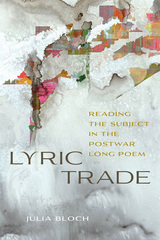
Engaging with poets such as Gwendolyn Brooks, H.D., Lorine Niedecker, Alice Notley, and Myung Mi Kim, this book asks: What does lyric mean, and why should it matter to poets and readers? Lyric Trade argues that lyric in the postwar long poem not only registers the ideological contradictions of modernism’s insistence on new forms, but that it also maps spaces for formal reimaginings of the subject.
READERS
Browse our collection.
PUBLISHERS
See BiblioVault's publisher services.
STUDENT SERVICES
Files for college accessibility offices.
RECENTLY PUBLISHED


UChicago Accessibility Resources
home | accessibility | search | about | contact us
BiblioVault ® 2001 - 2026
The University of Chicago Press