
 A SCHOLARLY BOOK REPOSITORY
12 start with L start with L
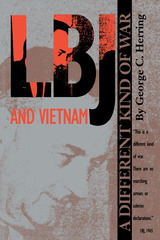
Decades later, the Vietnam War remains a divisive memory for American society. Partisans on all sides still debate why the war was fought, how it could have been better fought, and whether it could have been won at all.
In this major study, a noted expert on the war brings a needed objectivity to these debates by examining dispassionately how and why President Lyndon Johnson and his administration conducted the war as they did. Drawing on a wealth of newly released documents from the LBJ Library, including the Tom Johnson notes from the influential Tuesday Lunch Group, George Herring discusses the concept of limited war and how it affected President Johnson's decision making, Johnson's relations with his military commanders, the administration's pacification program of 1965-1967, the management of public opinion, and the "fighting while negotiating" strategy pursued after the Tet Offensive in 1968.
The author's in-depth analysis exposes numerous flaws in Johnson's management of the war. In Herring's view, the Johnson administration lacked any overall strategy for conducting the war. No change in approach was ever discussed, despite popular and even administration dissatisfaction with the progress of the war, and no oversight committee coordinated the activities of the military services and various governmental agencies, which were left to follow their own, often conflicting, agendas.
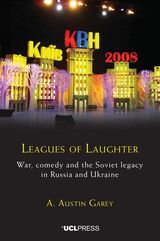
Leagues of Laughter traces the evolution of a Soviet-created youth game called KVN (Klub veselykh i nakhodchivykh or Club of the Cheerful and Clever) over sixty years as students’ nation-states collapsed, competed, and eventually went to war. Through cross-border narratives, the book shows how humor persists—and transforms—amid authoritarianism, censorship, and conflict. With insight and compassion, author A. Austin Garey reveals how laughter became a mode of resistance, identity, and cultural continuity in the long cultural context of the war in Ukraine. In addition to introducing a novel theory of “tradition as stance” to explain how traditions are reproduced and reinterpreted over time, the book offers a compelling comparative analysis of cultural production under political pressure.
A Czech man in Ukraine in search of his alter ego. A gang of homeless kids driven from a cellar by tenants using it as a shelter from the war. A German couple who ‘rented a womb’ in Ukraine, whose child is now stuck in Kyiv. A teenager partnered with a Valkyrie for the distribution of lavash in besieged Mariupol delays his flight until it is too late. A Russian academic mounting a protest in the center of Moscow dressed in a costume from Swan Lake. They may not be soldiers at the front, but for the characters in these stories, life will never again be as it was before the Russian invasion of Ukraine. In this collection of short stories—two set in Ukraine, two in the West, and one in Russia—Czech author Jan Nemec has produced a work of remarkable immediacy.
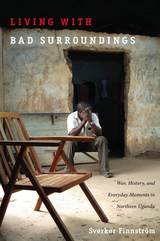
Finnström draws on fieldwork conducted in northern Uganda between 1997 and 2006 to describe how the Acholi—especially the younger generation, those born into the era of civil strife—understand and attempt to control their moral universe and material circumstances. Structuring his argument around indigenous metaphors and images, notably the Acholi concepts of good and bad surroundings, he vividly renders struggles in war and the related ills of impoverishment, sickness, and marginalization. In this rich ethnography, Finnström provides a clear-eyed assessment of the historical, cultural, and political underpinnings of the civil war while maintaining his focus on Acholi efforts to achieve “good surroundings,” viable futures for themselves and their families.
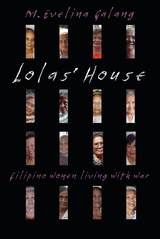
During World War II more than one thousand Filipinas were kidnapped by the Imperial Japanese Army. Lolas’ House tells the stories of sixteen surviving Filipino “comfort women.”
M. Evelina Galang enters into the lives of the women at Lolas’ House, a community center in metro Manila. She accompanies them to the sites of their abduction and protests with them at the gates of the Japanese embassy. Each woman gives her testimony, and even though the women relive their horror at each telling, they offer their stories so that no woman anywhere should suffer wartime rape and torture.
Lolas’ House is a book of testimony, but it is also a book of witness, of survival, and of the female body. Intensely personal and globally political, it is the legacy of Lolas’ House to the world.
Describing the artists, songs, and concerts that most influenced him, Vulliamy brings together the two largest threads of his life—music and war. Louder Than Bombs covers some of the most important musical milestones of the past fifty years, from Jimi Hendrix playing “Machine Gun” at the Isle of Wight Festival in 1970 to the Bataclan in Paris under siege in 2015. Vulliamy was present for many of these historic moments, and with him as our guide, we see them afresh, along the way meeting musicians like B. B. King, Graham Nash, Patti Smith, Daniel Barenboim, Gustavo Dudamel, and Bob Dylan. Vulliamy peppers the book with short vignettes—which he dubs 7" singles—recounting some of his happiest memories from a lifetime with music. Whether he’s working as an extra in the Vienna State Opera’s production of Aida, buying blues records in Chicago, or drinking coffee with Joan Baez, music is never far from his mind. As Vulliamy discovers, when horror is unspeakable, when words seem to fail us, we can turn to music for expression and comfort, or for rage and pain. Poignant and sensitively told, Louder Than Bombs is an unforgettable record of a life bursting with music.
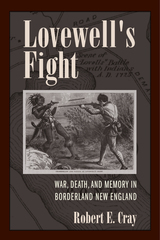
In May 1725, during a three-year conflict between English colonists and the Eastern Abenaki Nation, a thirty-four-man expedition led by Captain John Lovewell set out to ambush their adversaries, acquire some scalp bounties, and hasten the end of the war. Instead, the Abenakis staged a surprise attack of their own at Pigwacket, Maine, that left more than a third of the New Englanders dead or severely wounded. Although Lovewell himself was slain in the fighting, he emerged a martyred hero, celebrated in popular memory for standing his ground against a superior enemy force.
In this book, Robert E. Cray revisits the clash known as “Lovewell's Fight” and uses it to illuminate the themes of war, death, and memory in early New England. He shows how a military operation plagued from the outset by poor decision-making, and further marred by less-than-heroic battlefield behavior, came to be remembered as early America's version of the Alamo. The government of Massachusetts bestowed payouts, pensions, and land on survivors and widows of the battle, while early chroniclers drafted a master narrative for later generations to emboss. William Henry Longfellow, Nathaniel Hawthorne, and Henry David Thoreau kept the story alive for later generations. Although some nineteenth-century New Englanders disapproved of Lovewell's notoriety as a scalp hunter, it did not prevent the dedication of a monument in his honor at the Fryeburg, Maine, battlesite in 1904.
Even as the actual story of “Lovewell's Fight” receded into obscurity—a bloody skirmish in a largely forgotten war—it remained part of New England lore, one of those rare military encounters in which defeat transcends an opponent's victory to assume the mantle of legend.
READERS
Browse our collection.
PUBLISHERS
See BiblioVault's publisher services.
STUDENT SERVICES
Files for college accessibility offices.
RECENTLY PUBLISHED



UChicago Accessibility Resources
home | accessibility | search | about | contact us
BiblioVault ® 2001 - 2026
The University of Chicago Press