
 A SCHOLARLY BOOK REPOSITORY
216 start with M start with M

On the 150th anniversary of the death of the English historian and politician Thomas Babington Macaulay, Robert Sullivan offers a portrait of a Victorian life that probes the cost of power, the practice of empire, and the impact of ideas.
His Macaulay is a Janus-faced master of the universe: a prominent spokesman for abolishing slavery in the British Empire who cared little for the cause, a forceful advocate for reforming Whig politics but a Machiavellian realist, a soaring parliamentary orator who avoided debate, a self-declared Christian, yet a skeptic and a secularizer of English history and culture, and a stern public moralist who was in love with his two youngest sisters.
Perhaps best known in the West for his classic History of England, Macaulay left his most permanent mark on South Asia, where his penal code remains the law. His father ensured that ancient Greek and Latin literature shaped Macaulay’s mind, but he crippled his heir emotionally. Self-defense taught Macaulay that power, calculation, and duplicity rule politics and human relations. In Macaulay’s writings, Sullivan unearths a sinister vision of progress that prophesied twentieth-century genocide. That the reverent portrait fashioned by Macaulay’s distinguished extended family eclipsed his insistent rhetoric about race, subjugation, and civilizing slaughter testifies to the grip of moral obliviousness.
Devoting his huge talents to gaining power—above all for England and its empire—made Macaulay’s life a tragedy. Sullivan offers an unsurpassed study of an afflicted genius and a thoughtful meditation on the modern ethics of power.
Published by Bucknell University Press. Distributed worldwide by Rutgers University Press.
Perceiving an enigmatic relationship between madness, language, and literature, French philosopher Michel Foucault developed ideas during the 1960s that are less explicit in his later, more well-known writings. Collected here, these previously unpublished texts reveal a Foucault who undertakes an analysis of language and experience detached from their historical constraints. Three issues predominate: the experience of madness across societies; madness and language in Artaud, Roussel, and Baroque theater; and structuralist literary criticism. Not only do these texts pursue concepts unique to this period such as the “extra-linguistic,” but they also reveal a far more complex relationship between structuralism and Foucault than has typically been acknowledged.

No one expressed the heart and soul of the Sixties as powerfully as the Beatles did through the words, images, and rhythms of their music. In Magic Circles, Devin McKinney uncovers the secret history of a generation and a pivotal moment in twentieth-century culture. He reveals how the Beatles enacted the dream life of their time and shows how they embodied a kaleidoscope of desire and anguish for all who listened—hippies or reactionaries, teenage fans or harried parents, Bob Dylan or Charles Manson. The reader who dares to re-enter the vortex that was the Sixties will appreciate, perhaps for the first time, much of what lay beneath the social trauma of the day.
Delving into concerts and interviews, films and music, outtakes and bootlegs, Devin McKinney brings to bear the insights of history, aesthetics, sociology, psychology, and mythology to account for the depth and resonance of the Beatles’ impact. His book is also a uniquely multifaceted appreciation of the group’s artistic achievement, exploring their music as both timeless expression and visceral response to their historical moment. Starting in the cellars of Liverpool and Hamburg, and continuing through the triumph of Beatlemania, the groundbreaking studio albums, and the last brutal, sorrowful thrust of the White Album, Magic Circles captures both the dream and the reality of four extraordinary musicians and their substance as artists. At once an entrancing narrative and an analytical montage, the book follows the drama, comedy, mystery, irony, and curious off-ramps of investigation and inquiry that contributed to one of the most amazing odysseys in pop culture.

In the mid-eighteenth century, colonial Americans became enamored with the rich colors and silky surface of mahogany. This exotic wood, imported from the West Indies and Central America, quickly displaced local furniture woods as the height of fashion. Over the next century, consumer demand for mahogany set in motion elaborate schemes to secure the trees and transform their rough-hewn logs into exquisite objects. But beneath the polished gleam of this furniture lies a darker, hidden story of human and environmental exploitation.
Mahogany traces the path of this wood through many hands, from source to sale: from the enslaved African woodcutters, including skilled “huntsmen” who located the elusive trees amidst dense rainforest, to the ship captains, merchants, and timber dealers who scrambled after the best logs, to the skilled cabinetmakers who crafted the wood, and with it the tastes and aspirations of their diverse clientele. As the trees became scarce, however, the search for new sources led to expanded slave labor, vicious competition, and intense international conflicts over this diminishing natural resource. When nineteenth-century American furniture makers turned to other materials, surviving mahogany objects were revalued as antiques evocative of the nation's past.
Jennifer Anderson offers a dynamic portrait of the many players, locales, and motivations that drove the voracious quest for mahogany to adorn American parlors and dining rooms. This complex story reveals the cultural, economic, and environmental costs of America’s growing self-confidence and prosperity, and how desire shaped not just people’s lives but the natural world.
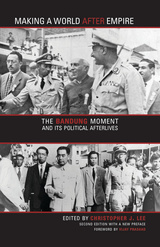
With a new foreword by Vijay Prashad
In April 1955, twenty-nine countries from Africa, Asia, and the Middle East came together for a diplomatic conference in Bandung, Indonesia, intending to define the direction of the postcolonial world. Ostensibly representing two-thirds of the world’s population, the Bandung conference occurred during a key moment of transition in the mid-twentieth century—amid the global wave of decolonization that took place after the Second World War and the nascent establishment of a new Cold War world order in its wake. Participants such as Jawaharlal Nehru of India, Gamal Abdel Nasser of Egypt, Zhou Enlai of China, and Sukarno of Indonesia seized this occasion to attempt the creation of a political alternative to the dual threats of Western neocolonialism and the Cold War interventionism of the United States and the Soviet Union.
The essays collected here explore the diverse repercussions of this event, tracing diplomatic, intellectual, and sociocultural histories that ensued as well as addressing the broader intersection of postcolonial and Cold War history. With a new foreword by Vijay Prashad and a new preface by the editor, Making a World after Empire speaks to contemporary discussions of decolonization, Third Worldism, and the emergence of the Global South, thus reestablishing the conference’s importance in twentieth-century global history.
Contributors: Michael Adas, Laura Bier, James R. Brennan, G. Thomas Burgess, Antoinette Burton, Dipesh Chakrabarty, Julian Go, Christopher J. Lee, Jamie Monson, Jeremy Prestholdt, and Denis M. Tull.
In April 1955, twenty-nine countries from Africa, Asia, and the Middle East came together for a diplomatic conference in Bandung, Indonesia, intending to define the direction of the postcolonial world. Representing approximately two-thirds of the world’s population, the Bandung conference occurred during a key moment of transition in the mid-twentieth century—amid the global wave of decolonization that took place after the Second World War and the nascent establishment of a new cold war world order in its wake. Participants such as Jawaharlal Nehru of India, Gamal Abdel Nasser of Egypt, Zhou Enlai of China, and Ahmed Sukarno of Indonesia seized this occasion to attempt the creation of a political alternative to the dual threats of Western neocolonialism and the cold war interventionism of the United States and the Soviet Union.
The essays in this volume explore the diverse repercussions of this event, tracing the diplomatic, intellectual, and sociocultural histories that have emanated from it. Making a World after Empire consequently addresses the complex intersection of postcolonial history and cold war history and speaks to contemporary discussions of Afro-Asianism, empire, and decolonization, thus reestablishing the conference’s importance in twentieth-century global history.
Contributors: Michael Adas, Laura Bier, James R. Brennan, G. Thomas Burgess, Antoinette Burton, Dipesh Chakrabarty, Julian Go, Christopher J. Lee, Jamie Monson, Jeremy Prestholdt, Denis M. Tull
Workers' self-management was one of the unique features of communist Yugoslavia. Goran Musić has investigated the changing ways in which blue-collar workers perceived the recurring crises of the regime. Two self-managed metal enterprises, one in Serbia another in Slovenia, provide the frame of the analysis in the time span between 1945 and 1989. These two factories became famous for strikes in 1988 that evoked echoes in popular discourses in former Yugoslavia. Drawing on interviews, factory publications and other media, local archives, and secondary literature, Musić analyzes the two cases, going beyond the clichés of political manipulation from the top and workers' intrinsic attraction to nationalism.
The author explains how, in the later phase of communist Yugoslavia, growing social inequalities among the workers and undemocratic practices inside the self-managed enterprises facilitated the spread of a nationalist and pro-market ideology on the shop floors. Yet rather than being a mass taken advantage of by populist leaders, the working class Musić presents is one with agency and voice, a force that played an important role in shaping the fate of the country. The book thus seeks to open a debate on the social processes leading up to the dissolution of Yugoslavia.

A study of literature written by Jewish authors while interned in Nazi ghettos emphasizes how authors processed their horrific experiences through poetry and prose.
Published in Association with the United States Holocaust Memorial Museum
This is the first study devoted to how little known but essential authors grappled with the destitution of ghetto existence by writing within, at the limits of, and against an array of literary scenarios, tropes, plot lines, and generic conventions, including those of nature lyric, modernist interior monologue, the realist social novel, the detective story, and the gothic horror tale. Contending with starvation, disease, desperate housing conditions and the looming threat of being murdered, inhabitants of ghettos in Poland nonetheless made them sites of rich Jewish cultural production. Rose’s readings of these literary works reveal how authors asserted their humanity by insisting on writing works of literature. In such radically dehumanizing circumstances, however, their recourse to established literary genres was not naive. Rather, ghetto authors brilliantly meditated on the grotesque incongruities between established literary models and the extreme conditions of ghetto existence.

Making History Matter explores the role history and historians played in imperial Japan’s nation and empire building from the 1890s to the 1930s. As ideological architects of this process, leading historians wrote and rewrote narratives that justified the expanding realm. Learning from their Prussian counterparts, they highlighted their empiricist methodology and their scholarly standpoint, to authenticate their perspective and to distinguish themselves from competing discourses. Simultaneously, historians affirmed imperial myths that helped bolster statist authoritarianism domestically and aggressive expansionism abroad. In so doing, they aligned politically with illiberal national leaders who provided funding and other support necessary to nurture the modern discipline of history. By the 1930s, the field was thriving and historians were crucial actors in nationwide commemorations and historical enterprises.
Through a close reading of vast, multilingual sources, with a focus on Kuroita Katsumi, Yoshikawa argues that scholarship and politics were inseparable as Japan’s historical profession developed. In the process of making history matter, historians constructed a national past to counter growing interwar liberalism. This outlook—which continues as the historical perspective that the Liberal Democratic Party leadership embraces—ultimately justified the Japanese aggressions during the Asia-Pacific Wars.
The greatest bibliographer of our time, was how historian Robert Darnton described D. F. McKenzie. Yet until now many of McKenzie's major essays, scattered in specialist journals and inaccessible publications, have circulated mainly in tattered photocopies. This volume, edited by two of McKenzie's former students, brings together for the first time a wide range of his writings on bibliography, the book trade, and the “sociology of texts.” Selected by the author himself before his sudden death in 1999, the essays range from the material transmission of Shakespeare's plays in the seventeenth century to the connections among oral, manuscript, and print cultures.
Making Meaning reflects McKenzie's virtuosity as a traditional bibliographer and reveals how his thought-provoking scholarship made him a driving force in the genesis and development of the new interdisciplinary field of book history. His refusal to recognize the traditional boundary between bibliography and literary history re-energized the study of the social, political, economic, and cultural aspects of book production and reception.
The editors' introduction and headnotes situate McKenzie's innovative and controversial thinking in the debates of his time.
After the Great War, British men and women grappled with their ignorance about sexuality and desire. Seeking advice and information from doctors, magazines, and each other, they wrote tens of thousands of letters about themselves as sexual subjects. In these letters, they disclosed their uncertainties, their behaviors, and the role of sexuality in their lives. Their fascinating narratives tell how people sought to unleash their imaginations and fashion new identities.
Making Modern Love shows how readers embraced popular media—self-help books, fetish magazines, and advice columns—as a source of information about sexuality and a means for telling their own stories. From longings for transcendent marital union to fantasies of fetish-wear, cross-dressing, and whipping, men and women revealed a surprising range of desires and behaviors (queer and otherwise) that have been largely disregarded until now.
Lisa Sigel mines these provocative narratives to understand how they contributed to new subjectivities and the development of modern sexualities.
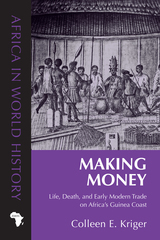
A new era in world history began when Atlantic maritime trade among Africa, Asia, Europe, and the Americas opened up in the fifteenth century, setting the stage for massive economic and cultural change. In Making Money, Colleen Kriger examines the influence of the global trade on the Upper Guinea Coast two hundred years later—a place and time whose study, in her hands, imparts profound insights into Anglo-African commerce and its wider milieu.
A stunning variety of people lived in this coastal society, struggling to work together across deep cultural divides and in the process creating a dynamic creole culture. Kriger digs further than any previous historian of Africa into the records of England’s Royal African Company to illuminate global trade patterns, the interconnectedness of Asian, African, and European markets, and—most remarkably—the individual lives that give Making Money its human scale.
By inviting readers into the day-to-day workings of early modern trade in the Atlantic basin, Kriger masterfully reveals the rich social relations at its core. Ultimately, this accessible book affirms Africa’s crucial place in world history during a transitional period, the early modern era.
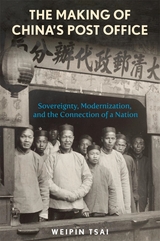
The Making of China’s Post Office traces the origins and early development of the country’s modern postal system. Sweeping in perspective, it goes beyond the bounds of institutional history to explore the political maneuverings, economic imperatives, and societal pressures both inhibiting and driving forward postal development. Although its prime mover was Robert Hart, Inspector General of the Chinese Maritime Customs Service, the wider cast of characters includes foreign and native staff, Qing officials, local administrations, commercial interests, and foreign governments.
Drawing extensively on archival material from the Second Historical Archives of China in Nanjing, the Tianjin Municipal Archives, and the Archive of Queen’s University Belfast, Weipin Tsai contextualizes the making of the post office within the country’s long and contested path of modernization, bringing Chinese voices to the fore. Tsai illustrates the extent to which local agency shaped the design and development of the service as it expanded from experimental coastal operation into China’s interior and on to its border periphery, the first nationwide modernization project to directly impact people’s daily lives. Ultimately, the grand spatial reach of the Post Office carried significant symbolic meaning in relation to sovereignty for the Qing government and for later Republican administrations.

Europe became a land of cities during the last millennium. The story told in this book begins with North Sea and Mediterranean traders sailing away from Dorestad and Amalfi, and with warrior kings building castles to fortify their conquests. It tells of the dynamism of textile towns in Flanders and Ireland. While London and Hamburg flourished by reaching out to the world and once vibrant Spanish cities slid into somnlence, a Russian urban network slowly grew to rival that of the West. Later as the tide of industrialization swept over Europe, the most intense urban striving and then settled back into the merchant cities and baroque capitals of an earlier era.
By tracing the large-scale precesses of social, economic, and political change within cities, as well as the evolving relationships between town and country and between city and city, the authors present an original synthsis of European urbanization within a global context. They divide their study into three time periods, making the early modern era much more than a mere transition from preindustrial to industrial economies. Through both general analyzes and incisive case studies, Hohenberg and Lees show how cities originated and what conditioned their early development and later growth. How did urban activity respond to demographic and techological changes? Did the social consequences of urban life begin degradation or inspire integration and cultural renewal? New analytical tools suggested by a systems view of urban relations yield a vivid dual picture of cities both as elements in a regional and national heirarchy of central places and also as junctions in a transnational network for the exchange of goods, information, and influence.
A lucid text is supplemented by numerous maps, illustrations, figures, and tables, and by substantial bibliography. Both a general and a scholarly audience will find this book engrossing reading.
Europe became a land of cities during the last millennium. The story told in this book begins with North Sea and Mediterranean traders sailing away from Dorestad and Amalfi, and with warrior kings building castles to fortify their conquests. It tells of the dynamism of textile towns in Flanders and Ireland. While London and Hamburg flourished by reaching out to the world and once vibrant Spanish cities slid into somnolence, a Russian urban network slowly grew to rival that of the West. Later, as the tide of industrialization swept over Europe, the most intense urban striving settled back into the merchant cities and baroque capitals of an earlier era.
By tracing the large-scale processes of social, economic, and political change within cities, as well as the evolving relationships between town and country and between city and city, the authors present an original synthesis of European urbanization within a global context. They divide their study into three time periods, making the early modern era much more than a mere transition from preindustrial to industrial economies. Through both general analyses and incisive case studies, Paul M. Hohenberg and Lynn Hollen Lees show how cities originated and what conditioned their early development and later growth. How did urban activity respond to demographic and technological changes? Did the social consequences of urban life begin degradation or inspire integration and cultural renewal? New analytical tools suggested by a systems view of urban relations yield a vivid dual picture of cities both as elements in a regional and national hierarchy of central places and also as junctions in a transnational network for the exchange of goods, information, and influence.
A lucid text is supplemented by numerous maps, illustrations, figures, and tables, and by a substantial bibliography. Both a general and a scholarly audience will find this book engrossing reading.
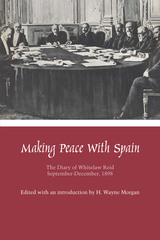
Whitelaw Reid, according to H. Wayne Morgan, was a “leading newspaperman, more than an occasional diplomat, a power in his party’s politics, a supporter of some of the best in his era’s culture . . . Of all his legacy, perhaps the record he left of his part in the Peace of Paris is the most significant and most interesting. It not only reveals the workings of his mind and of the peace conference, but also suggests the complex currents that carried his country into the realities of world power in the twentieth century.”
In editing Reid’s diary, Morgan used much material pertinent to the Paris Peace Conference of 1898, employed here for the first time. This material is a rich assortment of archival matter: the Reid Papers, the John Hay Papers, the John Bassett Moore Papers, and the McKinley Papers, in the Library of Congress; the Peace Commission records, in the National Archives; and unpublished materials in the Central Files of the Department of State.
Whitelaw Reid, as a war correspondent during the Civil War, as clerk of the House Military Affairs Committee, and later as a successor to Horace Greeley on the Tribune, gained access to the leaders of his times and insight into their actions. In 1889 he was appointed U.S. Minister to France by Harrison, and in 1892 he had the dubious honor of being chosen as Harrison’s running mate on the losing presidential ticket. An influential friend and supporter of President McKinley and an occasional advisor to him, Reid was no stranger to politics and to international diplomacy when McKinley appointed him to the Peace Commission that wrote the treaty concluding the Spanish-American War. As a matter of fact, Reid’s opinion reflected the administration’s attitude of expansionism, the policy of Manifest Destiny—or “imperialism,” as it was later called.
Reid’s diary records the details of the sessions of the Joint Peace Commission of Paris from September through a large part of December of 1898. His day-by-day entries reveal the complexity of issues to be considered, the tactics of both the Spanish and the American Commissions in attempting to gain advantage for their respective governments, the interplay of the personalities of the once-proud Spaniards and the brash Americans, the political objectives influencing the points of view of the various members, and the maneuverings that brought about the final resolution of debated issues.
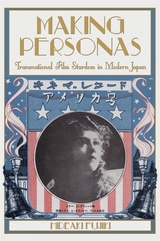
The film star is not simply an actor but a historical phenomenon that derives from the production of an actor's attractiveness, the circulation of his or her name and likeness, and the support of media consumers. This book analyzes the establishment and transformation of the transnational film star system and the formations of historically important film stars—Japanese and non-Japanese—and casts new light on Japanese modernity as it unfolded between the 1910s and 1930s.
Hideaki Fujiki illustrates how film stardom and the star system emerged and evolved, touching on such facets as the production, representation, circulation, and reception of performers' images in films and other media. Examining several individual performers—particularly benshi narrators, Onoe Matsunosuke, Tachibana Teijiro, Kurishima Sumiko, Clara Bow, and Natsukawa Shizue—as well as certain aspects of different star systems that bolstered individual stardom, this study foregrounds the associations of contradictory, multivalent social factors that constituted modernity in Japan, such as industrialization, capitalism, colonialism, nationalism, and consumerism. Through its nuanced treatment of the production and consumption of film stars, this book shows that modernity is not a simple concept, but an intricate, contested, and paradoxical nexus of diverse social elements emerging in their historical contexts.
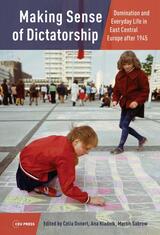
How did political power function in the communist regimes of East Central Europe after 1945? Making Sense of Dictatorship addresses this question with a particular focus on the acquiescent behavior of the majority of the population until, at the end of the 1980s, their rejection of state socialism and its authoritarian world.
The authors refer to the concept of Sinnwelt, the way in which groups and individuals made sense of the world around them. The essays focus on the dynamics of everyday life and the extent to which the relationship between citizens and the state was collaborative or antagonistic. Each chapter addresses a different aspect of life in this period, including modernization, consumption and leisure, and the everyday experiences of “ordinary people,” single mothers, or those adopting alternative lifestyles.
Empirically rich and conceptually original, the essays in this volume suggest new ways to understand how people make sense of everyday life under dictatorial regimes.
Urged forward by these silences, Linden, a feminist and sociologist, began to interview Jewish Holocaust survivors in 1983. As Linden interprets survivors' accounts of the death camps and the resistance, she reveals complex ways in which selves are constructed through storytelling. The stories that unfold are continuously fashioned and refashioned—never stripped of context or frozen in time. What emerges is an unexpectedly elegant montage in which interviewee, interviewer, and author are intertwined.
Linden's meetings with survivors and her encounters with their stories transformed her as a feminist, a Jew, and a social scientist. Her analysis reveals the intimate connections between an ethnographer's lived experience and her interpretations of others'. Linden's reflections on the process of ethnography belie the rhetoric of positivism in the social sciences. They will inspire other scholars to break free of research and writing practices in their own disciplines that efface the ineluctable bond between knower and known. All readers will be challenged to reexamine the Holocaust in an intensely personal light and to reconsider the meanings of survival in our own time.
Cutting across the boundaries of ethnography and autobiography to create a new kind of text, Making Stories, Making Selves offers a significant contribution to interpretive social science and the literature of the Holocaust. Linden's original and courageous work is vital reading for Holocaust scholars, students of modern Jewish life, sociologists, feminist theorists, and all readers seeking to understand their own relationship to the Holocaust.
By the end of the 19th century it had become possible for American women to identify themselves as serious Artists. This was a relatively new phenomenon, one that became possible only after American women writers had dismantled the conceptual frameworks that had authorized their artistic production since the early days of the Republic.
Making the “America of Art” demonstrates that beginning in the 1850s, women writers challenged the terms of the Scottish Common Sense philosophy, which had made artistic endeavors acceptable in the new Republic by subordinating aesthetic motivation to moral and educational goals. Harriet Beecher Stowe and Augusta Jane Evans drew on Ruskin to argue for the creation of a religiously based national aesthetic. In the postbellum years Louisa May Alcott, Rebecca Harding Davis, Elizabeth Stuart Phelps, and Constance Fenimore Woolson continued the process in a series of writings that revolved around three central areas of concern: the place of the popular in the realm of high art; the role of the genius; and the legacy of the Civil War.
Sofer significantly revises the history of 19th-century American women’s authorship by detailing the gradual process that produced women writers wholly identified with literary high culture at the century’s end. Sofer argues that, counter to conventional wisdom, American women writers produced a large body of theoretical writing on the central aesthetic questions of the day. Although the writers Sofer studies were finally unable to construct viable new models for women’s artistic production, their attempts to do so are an essential piece of American literary history.
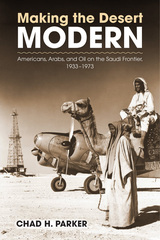
In 1933 American oilmen representing what later became the Arabian American Oil Company (Aramco) signed a concession agreement with the Saudi Arabian king granting the company sole proprietorship over the oil reserves in the country's largest province. As drilling commenced and wells proliferated, Aramco soon became a major presence in the region. In this book Chad H. Parker tells Aramco's story, showing how an American company seeking resources and profits not only contributed to Saudi “nation building” but helped define U.S. foreign policy during the early Cold War.
In the years following World War II, as Aramco expanded its role in Saudi Arabia, the idea of “modernization” emerged as a central component of American foreign policy toward newly independent states. Although the company engaged in practices supportive of U.S. goals, its own modernizing efforts tended to be pragmatic rather than policy-driven, more consistent with furthering its business interests than with validating abstract theories. Aramco built the infrastructure necessary to extract oil and also carved an American suburb out of the Arabian desert, with all the air-conditioned comforts of Western modern life. At the same time, executives cultivated powerful relationships with Saudi government officials and, to the annoyance of U.S. officials, even served the monarchy in diplomatic disputes. Before long the company became the principal American diplomatic, political, and cultural agent in the country, a role it would continue to play until 1973, when the Saudi government took over its operation.
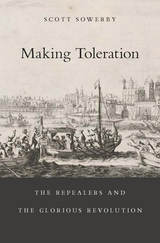
In the reign of James II, minority groups from across the religious spectrum, led by the Quaker William Penn, rallied together under the Catholic King James in an effort to bring religious toleration to England. Known as repealers, these reformers aimed to convince Parliament to repeal laws that penalized worshippers who failed to conform to the doctrines of the Church of England. Although the movement was destroyed by the Glorious Revolution, it profoundly influenced the post-revolutionary settlement, helping to develop the ideals of tolerance that would define the European Enlightenment.
Based on a rich array of newly discovered archival sources, Scott Sowerby’s groundbreaking history rescues the repealers from undeserved obscurity, telling the forgotten story of men and women who stood up for their beliefs at a formative moment in British history. By restoring the repealer movement to its rightful prominence, Making Toleration also overturns traditional interpretations of King James II’s reign and the origins of the Glorious Revolution. Though often depicted as a despot who sought to impose his own Catholic faith on a Protestant people, James is revealed as a man ahead of his time, a king who pressed for religious toleration at the expense of his throne. The Glorious Revolution, Sowerby finds, was not primarily a crisis provoked by political repression. It was, in fact, a conservative counter-revolution against the movement for enlightened reform that James himself encouraged and sustained.

What if the modern person were defined not by reason or sentiment, as Enlightenment thinkers hoped, but by will? Western modernity rests on the ideal of the autonomous subject, charting a path toward self-determination. Yet novelists have portrayed the will as prone to insufficiency or excess—from indecision to obsession, wild impulse to melancholic inertia. Jennifer Fleissner’s ambitious book shows how the novel’s attention to the will’s maladies enables an ongoing interrogation of modern premises from within.
Maladies of the Will reveals the nineteenth-century American novel’s relation to a wide-ranging philosophical tradition, highly relevant to our own tumultuous present. In works from Moby-Dick and The Scarlet Letter to Elizabeth Stoddard’s The Morgesons and Charles W. Chesnutt’s The Marrow of Tradition, the will’s grandeur and its perversity emerge as it alternately aligns itself with and pits itself against a bigger Will—whether of God, the state, society, history, or life itself. Today, when invocations of autonomy appear beside the medicalization of many behaviors, and democracy’s tenet of popular will has come into doubt, Maladies of the Will provides a map to how we got here, and how we might think these vital dilemmas anew.

Man in a Hurry explores the latest available archival materials and re-examines MacLehose’s pivotal governorship in Hong Kong (1971–1982). MacLehose arrived in the challenging 1970s, when there were expectations for social reforms, uneasiness in the relationship between Hong Kong and London, and the 1997 factor looming large. The governor successfully carried out various social reforms and he also handled various major issues, including the anti-corruption campaign, the Vietnamese refugee crisis, and the granting of land lease of the New Territories beyond 1997. Yep unveils the tension and bargaining between the British government and explains how interest of the colony could be asserted, defended, and negotiated. This book is an important study of Hong Kong’s "golden years" when the city’s economy took off. It is a significant contribution to our understanding of how local autonomy was defined.
Robert Francis (1901–1987), the author of eight volumes of poetry, an autobiography, a book of fiction, essays on poetry, and a reminiscence of Robert Frost, lived for most of his career on the outskirts of Amherst, Massachusetts, devoting himself to Yankee simplicity and self-renunciation derived from his reading of Thoreau. His preference for solitude and disinclination to write about or promote himself account for the elusiveness of his persona in his prose and poetry.
This book charts how Francis developed and elaborated this persona through distanced self-portraits in prose and through poems that both reveal and conceal the self of the poet. Folded into the study are discussions of Francis's pastoralism, his affinities with Emerson and Thoreau, his experimentation with new poetic forms, his protest against the Vietnam War and environmental despoliation, his homoeroticism, and a comparison of his poetry with that of Robert Frost. The book also explores Francis's characteristic attitude, figured as “hovering,” where his speaker is both subject and object, writing about himself while inhabiting the role of detached observer.
Complementing the emphasis on Francis's elusiveness, Andrew Stambuk offers readings of his poems attentive to aesthetic qualities that give them their particular reticence. Stambuk's sensitive evaluations underscore that Francis is a craftsman of intricate precisions whose work speaks to contemporary political and global concerns.


The life of Töhötöm Nagy (1908–1979), Jesuit, Mason, and secret service agent, offers fascinating insights into interwar Hungary, the Catholic Church and Vatican diplomacy, Freemasonry, and the activities of communist state security service.
As a young Jesuit Nagy was one of the leaders of a successful Catholic youth movement in interwar Hungary. After World War II he played an important role acting as an intermediary between the Vatican, the Red Army, and the Hungarian Catholic Church. After being sent to South America, he was attracted by liberation theology, but left the Society of Jesus, joined the Freemasons, and did social and philanthropic work in the slums of Buenos Aires. However, in the late 1960s he agreed to work for the Hungarian state security service in return for his repatriation. This latter period is reconstructed from the files of the Historical Archives of State Security in Budapest. Éva Petrás writes with empathy but with a sense of distance of the courage and restless energy of her subject. Her discussion of the limits of free choice and Nagy’s intense struggle to live a meaningful life make this biography breathtaking.
What sort of society could bind together Jacques Roubaud, Italo Calvino, Marcel Duchamp, and Raymond Queneau—and Daniel Levin Becker, a young American obsessed with language play? Only the Oulipo, the Paris-based experimental collective founded in 1960 and fated to become one of literature’s quirkiest movements.
An international organization of writers, artists, and scientists who embrace formal and procedural constraints to achieve literature’s possibilities, the Oulipo (the French acronym stands for “workshop for potential literature”) is perhaps best known as the cradle of Georges Perec’s novel A Void, which does not contain the letter e. Drawn to the Oulipo’s mystique, Levin Becker secured a Fulbright grant to study the organization and traveled to Paris. He was eventually offered membership, becoming only the second American to be admitted to the group. From the perspective of a young initiate, the Oulipians and their projects are at once bizarre and utterly compelling. Levin Becker’s love for games, puzzles, and language play is infectious, calling to mind Elif Batuman’s delight in Russian literature in The Possessed.
In recent years, the Oulipo has inspired the creation of numerous other collectives: the OuMuPo (a collective of DJs), the OuMaPo (marionette players), the OuBaPo (comic strip artists), the OuFlarfPo (poets who generate poetry with the aid of search engines), and a menagerie of other Ou-X-Pos (workshops for potential something). Levin Becker discusses these and other intriguing developments in this history and personal appreciation of an iconic—and iconoclastic—group.
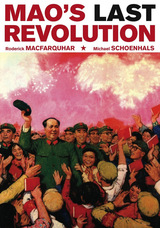
The Cultural Revolution was a watershed event in the history of the People’s Republic of China, the defining decade of half a century of communist rule. Before 1966, China was a typical communist state, with a command economy and a powerful party able to keep the population under control. But during the Cultural Revolution, in a move unprecedented in any communist country, Mao unleashed the Red Guards against the party. Tens of thousands of officials were humiliated, tortured, and even killed. Order had to be restored by the military, whose methods were often equally brutal.
In a masterly book, Roderick MacFarquhar and Michael Schoenhals explain why Mao launched the Cultural Revolution, and show his Machiavellian role in masterminding it (which Chinese publications conceal). In often horrifying detail, they document the Hobbesian state that ensued. The movement veered out of control and terror paralyzed the country. Power struggles raged among Lin Biao, Zhou Enlai, Deng Xiaoping, and Jiang Qing—Mao’s wife and leader of the Gang of Four—while Mao often played one against the other.
After Mao’s death, in reaction to the killing and the chaos, Deng Xiaoping led China into a reform era in which capitalism flourishes and the party has lost its former authority. In its invaluable critical analysis of Chairman Mao and its brilliant portrait of a culture in turmoil, Mao’s Last Revolution offers the most authoritative and compelling account to date of this seminal event in the history of China.
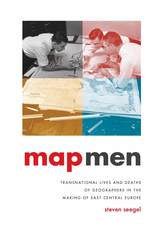
Taking us deep into cartographical archives, Seegel re-creates the public and private worlds of these five mapmakers, who interacted with and influenced one another even as they played key roles in defining and redefining borders, territories, nations—and, ultimately, the interconnection of the world through two world wars. Throughout, he examines the transnational nature of these processes and addresses weighty questions about the causes and consequences of the world wars, the rise of Nazism and Stalinism, and the reasons East Central Europe became the fault line of these world-changing developments.
At a time when East Central Europe has surged back into geopolitical consciousness, Map Men offers a timely and important look at the historical origins of how the region was defined—and the key people who helped define it.
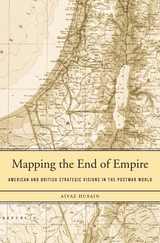
By the end of World War II, strategists in Washington and London looked ahead to a new era in which the United States shouldered global responsibilities and Britain concentrated its regional interests more narrowly. The two powers also viewed the Muslim world through very different lenses. Mapping the End of Empire reveals how Anglo–American perceptions of geography shaped postcolonial futures from the Middle East to South Asia.
Aiyaz Husain shows that American and British postwar strategy drew on popular notions of geography as well as academic and military knowledge. Once codified in maps and memoranda, these perspectives became foundations of foreign policy. In South Asia, American officials envisioned an independent Pakistan blocking Soviet influence, an objective that outweighed other considerations in the contested Kashmir region. Shoring up Pakistan meshed perfectly with British hopes for a quiescent Indian subcontinent once partition became inevitable. But serious differences with Britain arose over America’s support for the new state of Israel. Viewing the Mediterranean as a European lake of sorts, U.S. officials—even in parts of the State Department—linked Palestine with Europe, deeming it a perfectly logical destination for Jewish refugees. But British strategists feared that the installation of a Jewish state in Palestine could incite Muslim ire from one corner of the Islamic world to the other.
As Husain makes clear, these perspectives also influenced the Dumbarton Oaks Conference and blueprints for the UN Security Council and shaped French and Dutch colonial fortunes in the Levant and the East Indies.

The 1832 Reform Act was a landmark moment in the development of modern British politics. By overhauling the country’s ancient representative system, the legislation reshaped constitutional arrangements at Westminster, reinvigorated political relationships between the center and the provinces, and established the political structures and precedents that both shaped and hindered Britain’s slow lurch towards democracy by 1928.
Mapping the State leads to a fundamental rethinking of the 1832 Reform Act by demonstrating how boundary reform and the reconstruction of England’s electoral map by the little-known 1831–1832 boundary commission underpinned this turning point in the development of the British political nation. Eschewing traditional approaches to the 1832 Reform Act, it draws from a significant new archival discovery—the working papers of the boundary commission—and a range of innovative quantitative techniques to provide a major reassessment of why and how the 1832 Reform Act passed, its impact on reformed politics both at Westminster and in the constituencies, and its significance to the expansion of the modern British state.
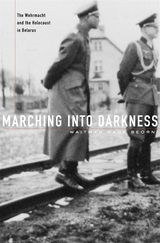
On October 10, 1941, the entire Jewish population of the Belarusian village of Krucha was rounded up and shot. While Nazi death squads routinely carried out mass executions on the Eastern Front, this particular atrocity was not the work of the SS but was committed by a regular German army unit acting on its own initiative. Marching into Darkness is a bone-chilling exposé of the ordinary footsoldiers who participated in the Final Solution on a daily basis.
Although scholars have exploded the myth that the Wehrmacht played no significant part in the Holocaust, a concrete picture of its involvement at the local level has been lacking. Among the crimes Waitman Wade Beorn unearths are forced labor, sexual violence, and graverobbing, though a few soldiers refused to participate and even helped Jews. By meticulously reconstructing the German army's activities in Belarus in 1941, Marching into Darkness reveals in stark detail how the army willingly fulfilled its role as an agent of murder on a massive scale. Early efforts at improvised extermination progressively became much more methodical, with some army units going so far as to organize "Jew hunts." Beorn also demonstrates how the Wehrmacht used the pretense of anti-partisan warfare as a subterfuge by reporting murdered Jews as partisans.
Through archival research into military and legal records, survivor testimonies, and eyewitness interviews, Beorn paints a searing portrait of a professional army's descent into ever more intimate participation in genocide.
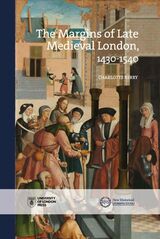
The Margins of Late Medieval London seeks to unpack the complexity of urban life in the medieval age, offering a detailed and novel approach to understanding London beyond its grand institutions and social bodies. Using a combination of experimental digital, quantitative, and qualitative methodologies, the volume casts new light on urban life at the level of the neighborhood and considers the differences in economy, society, and sociability which existed in different areas of a vibrant premodern city. This book focuses on the dynamism and mobility that shaped city life, integrating the experiences of London’s poor and migrant communities and how they found their place within urban life. It describes how people found themselves marginalized in the city, and the strategies they would employ to mitigate that precarious position.
Published by the University of Cincinnati Press
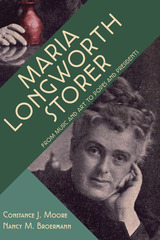
While the adage may go, “Behind every great man is a great woman,” the story of Maria Longworth Storer necessitates a new adage—at the front of every great city is a great woman. After being shunted into the biographies and history books of other people, Longworth Storer is now finally given center stage on the one hundred and seventieth anniversary of her birth.
Maria Longworth Storer: From Music and Art to Popes and Presidents is the most comprehensive biography of this one of a kind Cincinnatian. Known as the founder of the first female-run manufacturing company in the United States, Rookwood Pottery, Longworth Storer was passionate about women’s rights, her city, and issues of poverty and the arts. She owned Rookwood pottery for nine years, and then transferred ownership after earning recognition at the Exhibition of American Art Industry in Philadelphia and receiving a gold medal at the Exposition Universelle in Paris. Aside from her success with Rookwood, Longworth Storer was central to making the Queen City the major cultural landmark it is today. Although the rest of her life was no less remarkable as the wife of notorious diplomat Bellamy Storer, later embroiled in the famous Roosevelt-Storer scandal, little has been written about her contributions and exploits in diplomatic relations and her powerful influence on turn-of-the-twentieth-century political leaders.
Featuring new archival research, and never before seen photos of the Storer family, authors Constance J. Moore and Nancy M. Broermann have compiled a portrait of Maria Longworth Storer that is rich in detail, fitting to both the wide, often eclectic, breadth of Longworth Storer’s projects, and to the depth of her impact on leaders from Washington D.C. to Europe.
Moving through major moments in both American and Cincinnati history, and intersecting with significant historical figures including Teddy Roosevelt and William Howard Taft, Moore and Broermann expose the broader historical narrative of Longworth Storer’s life without letting her unique spirit and individual accomplishments become overshadowed by them.
Through thoughtful, balanced narrative, readers get to know a remarkable woman whose fascinating and dramatic life as a political figure, women’s rights advocate, and patron of the arts has had a long lasting legacy on the Queen City and the Shaping of our nation’s diplomatic policies.

The Marikana Massacre of August 16, 2012, was the single most lethal use of force by South African security forces against civilians since the end of apartheid. Those killed were mineworkers in support of a pay raise. Through a series of interviews conducted with workers who survived the attack, this account documents and examines the controversial shootings in great detail, beginning with a valuable history of the events leading up to the killing of workers, and including eyewitness accounts of the violence and interviews with family members of those who perished.
While the official Farlam Commission investigation of the massacre is still ongoing, many South Africans do not hold much confidence in the government’s ability to examine its own complicity in these events. Marikana, on the other hand, examines the various roles played by the African National Congress, the mine company, and the National Union of Mineworkers in creating the conditions that led to the massacre. While the commission’s investigations take place in a courtroom setting tilted toward those in power, Marikana documents testimony from the mineworkers in the days before official statements were even gathered, offering an unusually immediate and unfiltered look at the reality from the perspective of those most directly affected. Enhanced by vivid maps that make clear the setting and situation of the events, Marikana is an invaluable work of history, journalism, sociology, and activism.

The chapters in this book represent successive phases of one story – that of Mariupol, formerly Ukraine’s tenth largest city, and the second largest in the Donbas region. The author, a young Slovak academic, conducted her ethnographic fieldwork in this coastal town between November 2018 and August 2021. She was one of the last academics to do research in Mariupol before its invasion and eventual occupation by Russia.
During these years, Hana Jošticová was overwhelmed by acts of mobilization and resistance that went in opposite directions: support for a Western direction of Ukraine’s future, and support for the status quo that the victory of the Euromaidan seemed to threaten.
She noted the sequence of events presented in the media and through the lens of individual frames and narratives. Her book is a collection and interpretation of memories and testimonies from both sides: those who actively resisted Russian influence; and those who sparked their own revolution, the ‘Russian Spring.’ Her focus is on self-mobilized individuals who resorted to action outside of established organizational structures spontaneously, autonomously, without resources and guarantees of safety. Her evidence indicates that popular support for the Russian Spring had less to do with Russia than with the social, economic, or cultural characteristics of the Donetsk region.
Years of immersive research convinced the author that individuals are as important as masses, ideas are as powerful as material resources, and beliefs and emotions are as critical as weapons.
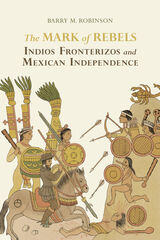
In The Mark of Rebels Barry Robinson offers a new look at Mexican Independence from the perspective of an indigenous population caught in the heart of the struggle. During the conquest and settlement of Mexico’s Western Sierra Madre, Spain’s indigenous allies constructed an indio fronterizo identity for their ethnically diverse descendants. These communities used their special status to maintain a measure of autonomy during the colonial era, but the cultural shifts of the late colonial period radically transformed the relationship between these indios fronterizos and their neighbors.
Marshalling an extensive array of archival material from Mexico, the United States, and Spain, Robinson shows that indio fronterizo participation in the Mexican wars of independence grafted into the larger Hidalgo Revolt through alignment with creole commanders. Still, a considerable gulf existed between the aims of indigenous rebels and the creole leadership. Consequently, the privileges that the indios fronterizos sought to preserve continued to diminish, unable to survive either the late colonial reforms of the Spanish regime or creole conceptions of race and property in the formation of the new nation-state.
This story suggests that Mexico’s transition from colony to nation can only be understood by revisiting the origins of the colonial system and by recognizing the role of Spain’s indigenous allies in both its construction and demolition. The study relates events in the region to broader patterns of identity, loyalty, and subversion throughout the Americas, providing insight into the process of mestizaje that is commonly understood to have shaped Latin America. It also foreshadows the popular conservatism of the nineteenth century and identifies the roots of post-colonial social unrest.
This book provides new context for scholars, historians, ethnographers, anthropologists, and anyone interested in the history of Mexico, colonization, Native Americans, and the Age of Revolutions.
With the publication of The Innocents Abroad (1869), Mark Twain embarked on a long and successful career as the 19th century's best-selling travel writer. Jeffrey Melton treats Twain's travel narratives in depth, and in the context of his contemporary travel writers and a burgeoning tourism culture. As Melton shows, Twain's five major travel narratives--The Innocents Abroad, Roughing It, Life on the Mississippi, A Tramp Abroad, and Following the Equator--demonstrate Twain's mastery and reinvention of the genre.
In 1884, Twain stood at the height of his powers as a writer and enjoyed one of the happiest years in his domestic family life. During the course of the year he was readying his greatest work, Adventures of Huckleberry Finn, for publication, which occurred in England near the end of the year; he was launching his own publishing house, Charles L. Webster and Company, after becoming disillusioned with his previous publishers; and he publicly embroiled himself in presidential politics in a way that presaged his later involvement with American and international politics. Finally, Twain’s 1884 ended with a great deal more public exposure thanks to an extensive multi-city lecture tour he undertook with Geroge Washington Cable, as well as the beginnings of his ultimately successful attempt to secure publishing rights for Ulysses S. Grant’s memoirs.
The level of detail provided by a day-to-day narrative gives the reader a chance to imaginatively live that year in Twain’s life: his work, his family life, his correspondence, his business dealings, his travels, his recreational pursuits, and his political involvement. Bird enlarges upon a great many moments in and aspects of Twain’s life that other biographies barely touch on or ignore completely.
In this new approach to biography, Bird gives readers a broader appreciation not only of Mark Twain the author but of Mark Twain the husband, father, uncle, and friend, and national celebrity and persona.
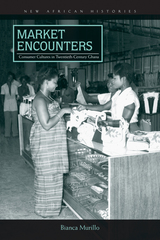
In Market Encounters, Bianca Murillo explores the shifting social terrains that made the buying and selling of goods in modern Ghana possible. Fusing economic and business history with social and cultural history, she traces the evolution of consumerism in the colonial Gold Coast and independent Ghana from the late nineteenth century through to the political turmoil of the 1970s.
Murillo brings sales clerks, market women, and everyday consumers in Ghana to the center of a story that is all too often told in sweeping metanarratives about what happens when African businesses are incorporated into global markets. By emphasizing the centrality of human relationships to Ghana’s economic past, Murillo introduces a radical rethinking of consumption studies from an Africa-centered perspective. The result is a keen look at colonial capitalism in all of its intricacies, legacies, and contradictions, including its entanglement with gender and race.

When István Hont died in 2013, the world lost a giant of intellectual history. A leader of the Cambridge School of Political Thought, Hont argued passionately for a global-historical approach to political ideas. To better understand the development of liberalism, he looked not only to the works of great thinkers but also to their reception and use amid revolution and interstate competition. His innovative program of study culminated in the landmark 2005 book Jealousy of Trade, which explores the birth of economic nationalism and other social effects of expanding eighteenth-century markets. Markets, Morals, Politics brings together a celebrated cast of Hont’s contemporaries to assess his influence, ideas, and methods.
Richard Tuck, John Pocock, John Dunn, Raymond Geuss, Gareth Stedman Jones, Michael Sonenscher, John Robertson, Keith Tribe, Pasquale Pasquino, and Peter N. Miller contribute original essays on themes Hont treated with penetrating insight: the politics of commerce, debt, and luxury; the morality of markets; and economic limits on state power. The authors delve into questions about the relationship between states and markets, politics and economics, through examinations of key Enlightenment and pre-Enlightenment figures in context—Hobbes, Rousseau, Spinoza, and many others. The contributors also add depth to Hont’s lifelong, if sometimes veiled, engagement with Marx.
The result is a work of interpretation that does justice to Hont’s influence while developing its own provocative and illuminating arguments. Markets, Morals, Politics will be a valuable companion to readers of Hont and anyone concerned with political economy and the history of ideas.
Acquaintance with the work of Martin Heidegger is indispensable to an understanding of contemporary thought and culture. His work has had a profound influence on a number of disciplines, including theology, Sartrean existentialism, linguistics, Hellenic studies, the structuralist and hermeneutic schools of textual interpretation, literary theory, and literature itself. With characterisitc lucidity and style, George Steiner makes this philosopher’s immensely difficult body of work accessible to the general reader. The breadth of Steiner’s learning and interests also allows him to place Heidegger in a broader Continental literary-cultural context. In a new Introduction, Steiner addresses language and philosophy and the rise of Nazism

How does one explain the presence of educated recruits in movements that were overwhelmingly working class in composition? How did intellectuals function within the movements? In the first in-depth exploration of this question, Stanley Pierson examines the rise, development, and ultimate failure of the German Social Democrats, the largest of the European socialist parties, from 1887 to 1912. Prominent figures, such as Karl Kautsky, August Bebel, Rosa Luxemburg, and Eduard Bernstein are discussed, but the book focuses primarily on the younger generation. These forgotten intellectuals—Max Schippel, Paul Kampffmeyer, Conrad Schmidt, Paul Ernst, and others—struggled most directly with the dilemmas arising out of the attempt to translate Marxist doctrines into practical and personal terms.
These young writers, speakers, and politicians set out to supplant old ways of thinking with a Marxist understanding of history and society. Pierson weaves together over thirty intellectual biographies to explore the relationship between ideology and politics in Germany. He examines the conflict within Social Democracy between the “revisionist” intellectuals, who sought to adapt Marxist theory to changing economic and social realities, and those “orthodox” and “radical” intellectuals who attempted to remain faithful to the Marxist vision. By examining the struggles of the socialist intellectuals in Germany, Pierson brings out the special features of German cultural, social, and political life before World War I. His study of this critical time in the development of the German Social Democratic party also illuminates the wider development of Marxism in Europe during the twentieth century.
Examining the legal lives of early modern women through Milton’s literary works
In his History of Britain, John Milton writes, “Laws are Masculin Births . . . nothing [is] more awry from the Law of God and Nature, then that a Woman should give Laws to Men.” In this interdisciplinary study, Lynne Greenberg explores the normative and nonnormative legal lives of early modern women as depicted in Milton’s works—unmarried and married women, mothers, heiresses, widows, and queens—providing cogent overviews of the laws of multiple jurisdictions to offer critical context for each case study. Greenberg explores a wide range of legal-juridical materials and previously unexplored archival and private family documents. As she demonstrates, while Milton’s narratives are at times enmeshed in existing jural paradigms, they also offer resistant responses to marital, custodial, property, inheritance, and criminal laws and even imagine alternative jural paradigms for women. Through Masculine Births: Milton, Women and the Law, Greenberg deftly reveals that Milton both reproduces seventeenth-century legal constructs and gives birth to laws that move us toward greater equality for women.
Goldsmith demonstrates that the Grand Tour was a means of constructing Britain’s next generation of leaders. Influenced by aristocratic concepts of honor and inspired by military-style leadership, elite society viewed experiences of danger and hardship as powerfully transformative and therefore as central to constructing masculinity. Scaling mountains, volcanoes, and glaciers, and even encountering war and disease, Grand Tourists willingly tackled a variety of perils. Through her study of these dangers, Goldsmith offers a bold revision of eighteenth-century elite masculine culture and the critical role the Grand Tour played within it.
When Moniek (Morris) Goldner and his family were uprooted from their Polish farming village during a German action, the child-sized sixteen-year-old fled into the forests. He eventually met up with his father, who had also escaped, and together they managed to survive until a former friend betrayed the pair. Wounded and left for dead beneath his father’s murdered body, Goldner was rescued by the enigmatic outlaw Jan Kopec, who was also in hiding, looking for ways to profit from his criminal expertise.
For eighteen months Kopec hid the boy with him, moving from one area to another, often staying in hideouts he had fashioned years earlier. At first Kopec trained Goldner simply to serve as his accomplice in robberies and black market activities. But before long he pushed the training to a whole new level, making it possible for him to sell Goldner’s services to a shadowy resistance group which was becoming interested in the daring young saboteur.
And through it all, these two disparate personalities—the quiet, small-framed boy and the stocky, callous mercenary—forged an remarkable friendship and co-dependency born of need and desperation in a hellish time and place.
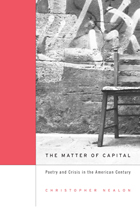
In this highly original reexamination of North American poetry in English from Ezra Pound to the present day, Christopher Nealon demonstrates that the most vital writing of the period is deeply concerned with capitalism. This focus is not exclusive to the work of left-wing poets: the problem of capitalism’s effect on individuals, communities, and cultures is central to a wide variety of poetry, across a range of political and aesthetic orientations. Indeed, Nealon asserts, capitalism is the material out of which poetry in English has been created over the last century.
Much as poets of previous ages continually examined topics such as the deeds of King Arthur or the history of Troy, poets as diverse as Jack Spicer, John Ashbery, and Claudia Rankine have taken as their “matter” the dynamics and impact of capitalism—not least its tendency to generate economic and political turmoil. Nealon argues persuasively that poets’ attention to the matter of capital has created a corresponding notion of poetry as a kind of textual matter, capable of dispersal, retrieval, and disguise in times of crisis. Offering fresh readings of canonical poets from W. H. Auden to Adrienne Rich, as well as interpretations of younger writers like Kevin Davies, The Matter of Capital reorients our understanding of the central poetic project of the last century.
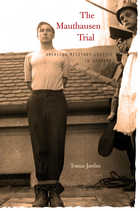
Shortly after 9:00 a.m. on May 27, 1947, the first of forty-nine men condemned to death for war crimes at Mauthausen concentration camp mounted the gallows at Landsberg prison near Munich. The mass execution that followed resulted from an American military trial conducted at Dachau in the spring of 1946—a trial that lasted only thirty-six days and yet produced more death sentences than any other in American history.
The Mauthausen trial was part of a massive series of proceedings designed to judge and punish Nazi war criminals in the most expedient manner the law would allow. There was no doubt that the crimes had been monstrous. Yet despite meting out punishment to a group of incontestably guilty men, the Mauthausen trial reveals a troubling and seldom-recognized face of American postwar justice—one characterized by rapid proceedings, lax rules of evidence, and questionable interrogations.
Although the better-known Nuremberg trials are often regarded as epitomizing American judicial ideals, these trials were in fact the exception to the rule. Instead, as Tomaz Jardim convincingly demonstrates, the rough justice of the Mauthausen trial remains indicative of the most common—and yet least understood—American approach to war crimes prosecution. The Mauthausen Trial forces reflection on the implications of compromising legal standards in order to guarantee that guilty people do not walk free.

At the same time, Reinhardt soon longed for an international range: guest performances throughout Europe and to the US soon made him into a global star – and even a brand. He represents a metropolitan culture that roots in the late nineteenth century but comes to an end when Fasicsm in Europe ended any hopes for an international culture. As a Jew, Reinhardt himself had to flee the Nazis but when he eventually arrived in the US, he could not follow up with his earlier successes. Marx provides a broad panorama of Reinhardt's work, portraying not only his work method and some of his best known productions, but also the cultural conditions of his visionary enterprise.

Contributors: Ludivine Bantigny, Françoise Blum, Tony Côme, Boris Gobille, Bethany Keenan, Salar Mohandesi, Donald Reid, Sandrine Sanos, Daniel Sherman
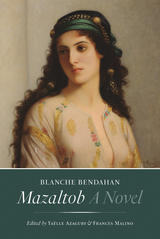
Raised in the Judería or Jewish quarter of Tetouan, Morocco, at the turn of the 20th-century, sixteen-year-old Mazaltob finds herself betrothed to José, an uncouth man from her own community who has returned from Argentina to take a wife. Mazaltob, however, is in love with Jean, who is French, half-Jewish, and a free spirit. In this classic of North African Jewish fiction, Blanche Bendahan evokes the two compelling forces tearing Mazaltob apart in her body and soul: her loyalty to the Judería and her powerful desire to follow her own voice and find true love. Bendahan’s nuanced and moving novel is a masterly exploration of the language, religion, and quotidian customs constraining North African Jewish women on the cusp of emancipation and decolonization. Yaëlle Azagury and Frances Malino provide the first English translation of this modern coming-of-age tale, awarded a prize by the Académie Française in 1930, and analyze the ways in which Mazaltob, with its disconcerting blend of ethnographic details and modernist experimentation, is the first of its genre—that of the feminist Sephardi novel. A historical introduction, a literary analysis, and annotations elucidate historical and cultural terms for readers, supplementing the author’s original notes.
In a provocative study, Paul Sonnino examines the diplomatic negotiations that took place in Westphalia from 1643 to 1648, which brought an end to the agonizing civil and religious conflict of the Thirty Years’ War.
Sonnino steps back from myriad historical readings of Westphalia to take the diplomats’ intentions and interactions strictly on their own terms. He places the reader alongside the pivotal figure of French minister Jules Cardinal Mazarin as he maneuvers for gain. The narrative thus offers a firsthand experience of the negotiations as they played out, as well as a penetrating look into the character, personality, and ideas of the crafty cardinal. Although Mazarin acquired the province of Alsace—making him a hero to French nationalists—he had a much more successful peace within his grasp, but lost it when he insisted on annexing the Spanish Low Countries. Sonnino also offers a new interpretation of the origins of the Fronde, linking the French domestic revolt to foreign policy, in Mazarin’s failure to secure peace with Spain.
Based on unprecedented archival documentation, Mazarin’s Quest provides an original and illuminating look at one of the most complicated diplomatic gatherings of all time.
The authors of the eleven papers here expound their versions of this position and go on to critique Burge's version. Together with Burge's replies, this volume offers a major contribution to contemporary philosophy.
“[A] lucid and thoughtful book… In a spirit of reconciliation, Crane proposes to paint a more accurate picture of religion for his fellow unbelievers.” —James Ryerson, New York Times Book Review
Contemporary debate about religion seems to be going nowhere. Atheists persist with their arguments, many plausible and some unanswerable, but these make no impact on religious believers. Defenders of religion find atheists equally unwilling to cede ground. The Meaning of Belief offers a way out of this stalemate.
An atheist himself, Tim Crane writes that there is a fundamental flaw with most atheists’ basic approach: religion is not what they think it is. Atheists tend to treat religion as a kind of primitive cosmology, as the sort of explanation of the universe that science offers. They conclude that religious believers are irrational, superstitious, and bigoted. But this view of religion is almost entirely inaccurate. Crane offers an alternative account based on two ideas. The first is the idea of a religious impulse: the sense people have of something transcending the world of ordinary experience, even if it cannot be explicitly articulated. The second is the idea of identification: the fact that religion involves belonging to a specific social group and participating in practices that reinforce the bonds of belonging. Once these ideas are properly understood, the inadequacy of atheists’ conventional conception of religion emerges.
The Meaning of Belief does not assess the truth or falsehood of religion. Rather, it looks at the meaning of religious belief and offers a way of understanding it that both makes sense of current debate and also suggests what more intellectually responsible and practically effective attitudes atheists might take to the phenomenon of religion.
Centuries after they were originally performed, the plays of Shakespeare continue to inspire, entertain, and awe audiences and readers today. At the same time, however, there's no question that even the most sophisticated reader can sometimes benefit from the insight and guidance of an expert when entering Shakespeare's long-gone world and complicated figurative language.
William Goddard is here to help. He taught Shakespeare for decades as much-loved professor at Swarthmore College, and here he distills that experience into an accessible, engaging companion to the plays. Across two volumes, Goddard covers all of Shakespeare's plays and brings fresh insight to familiar characters, scenes, and verses. Goddard writes, "The greatest poetry has always depicted the world as a little citadel of nobility threatened by an immense barbarism, a flickering candle surrounded by infinite night" Shakespeare's candle still burns, and with Goddard's help we can all see it brighter than ever.

Published by Bucknell University Press. Distributed worldwide by Rutgers University Press.

“The Meddlers is an eye-opening, essential new history that places our international financial institutions in the transition from a world defined by empire to one of nation states enmeshed in the world economy.”
—Adam Tooze, Columbia University
An award-winning history traces the origins of global economic governance—and the political conflicts it generates—to the aftermath of World War I.
International economic institutions like the International Monetary Fund and World Bank exert incredible influence over the domestic policies of many states. These institutions date from the end of World War II and amassed power during the neoliberal era of the late twentieth century. But as Jamie Martin shows, if we want to understand their deeper origins and the ideas and dynamics that shaped their controversial powers, we must turn back to the explosive political struggles that attended the birth of global economic governance in the early twentieth century.
The Meddlers tells the story of the first international institutions to govern the world economy, including the League of Nations and Bank for International Settlements, created after World War I. These institutions endowed civil servants, bankers, and colonial authorities from Europe and the United States with extraordinary powers: to enforce austerity, coordinate the policies of independent central banks, oversee development programs, and regulate commodity prices. In a highly unequal world, they faced a new political challenge: was it possible to reach into sovereign states and empires to intervene in domestic economic policies without generating a backlash?
Martin follows the intense political conflicts provoked by the earliest international efforts to govern capitalism—from Weimar Germany to the Balkans, Nationalist China to colonial Malaya, and the Chilean desert to Wall Street. The Meddlers shows how the fraught problems of sovereignty and democracy posed by institutions like the IMF are not unique to late twentieth-century globalization, but instead first emerged during an earlier period of imperial competition, world war, and economic crisis.

“Martin’s impressive new book, The Meddlers, considers the League of Nations and other interwar precursors of ‘neutral’ institutions of doux commerce to show how closely the ‘birth of global economic governance’ was entangled with empire.” —David Priestland, London Review of Books
“Few standard accounts of international economic history hold up to scrutiny in Jamie Martin’s bold history of economic governance.” —Dina Gusejnova, Times Literary Supplement
“The Meddlers is an eye-opening, essential new history that places our international financial institutions in the transition from a world defined by empire to one of nation states enmeshed in the world economy.”
—Adam Tooze, Columbia University
Institutions like the International Monetary Fund and World Bank exert enormous influence over the domestic policies of many states. While they were created in the aftermath of World War II, if we want to understand their deeper origins and the ideas and dynamics that shaped their controversial powers, we must turn back to the explosive political struggles that attended the birth of global economic governance in the early twentieth century.
The Meddlers tells the story of the first international institutions to preside over the world economy, including the League of Nations and Bank for International Settlements, created after World War I. These institutions endowed European and American bankers, colonial authorities, and civil servants with extraordinary powers: to enforce austerity, coordinate the policies of independent central banks, oversee development programs, and regulate commodity prices. Martin shows how the challenges that institutions like the IMF pose to democracy today first emerged during a period of imperial competition and war at the beginning of the twentieth century.

We often think of reason as a fixed entity, as a definitive body of facts that do not change over time. But during the Enlightenment, reason also was seen as a process, as a set of skills enacted on a daily basis. How, why, and where were these skills learned? Concentrating on Scottish students living during the long eighteenth century, this book argues that notebooks were paper machines and that notekeeping was a capability-building exercise that enabled young notekeepers to mobilize everyday handwritten and printed forms of material and visual media in a way that empowered them to judge and enact the enlightened principles they encountered in the classroom. Covering a rich selection of material ranging from simple scribbles to intricate watercolor diagrams, the book reinterprets John Locke’s comparison of the mind to a blank piece of paper, the tabula rasa. Although one of the most recognizable metaphors of the British Enlightenment, scholars seldom consider why it was so successful for those who used it. Each chapter uses one core notekeeping skill to reveal the fascinating world of material culture that enabled students in the arts, sciences, and humanities to transform the tabula rasa metaphor into a dynamic cognitive model. Starting in the home, moving to schools, and ending with universities, the book reconstructs the relationship between media and the mind from the bottom up. It reveals that the cognitive skills required to make and use notebooks were not simply aids to reason; rather, they were part of reason itself.

Media Laboratories explores a pivotal time for South American literature of the 1930s and ’40s. Cinema, radio, and the typewriter, once seen as promising catalysts for new kinds of writing, began to be challenged by authors, workers, and the public. What happens when media no longer seem novel and potentially democratic but rather consolidated and dominant? Moving among authors from Brazil, Argentina, and Uruguay, and among the genres of fiction, the essay, popular journalism, and experimental little magazines, Sarah Ann Wells shows how writers on the periphery of global modernity were fashioning alternative approaches to these media. Analyzing authors such as Clarice Lispector, Jorge Luis Borges, and Felisberto Hernández, along with their lesser-known contemporaries, Media Laboratories casts a wide net: from spectators of Hollywood and Soviet montage films, to inventors of imaginary media, to proletarian typists who embodied the machine-human encounters of the period. The text navigates contemporary scholarly and popular debates about the relationship of literature to technological innovation, media archaeology, sound studies, populism, and global modernisms. Ultimately, Wells underscores a question that remains relevant: what possibilities emerge when the enthusiasm for new media has been replaced by anxiety over their potentially pernicious effects in a globalizing, yet vastly unequal, world?
Happel primarily lived and worked in the vigorous port city of Hamburg, which was a “media center” in terms of the access it offered to a wide library of books in public and private collections. Hamburg’s port status meant it buzzed with news and information, and Happel drew on this flow of data in his novels. His books deal with many topics of current interest—national identity formation, gender and sexualities, Western European encounters with neighbors to the East, confrontations with non-European and non-Western powers and cultures—and they feature multiple media, including news reports, news collections, and travel writings. As a result, Happel’s use of contemporary source material in his novels feeds our current interest in the impact of the production of knowledge on seventeenth-century narrative. Mediating Culture in the Seventeenth-Century German Novel explores the narrative wealth and multiversity of Happel’s work, examines Happel’s novels as illustrative of seventeenth-century novel writing in Germany, and investigates the synergistic relationship in Happel’s writings between the booming print media industry and the evolution of the German novel.
Medical Misinformation in Early Modern Germany examines how doctors, writers, and printers in sixteenth-century Germany responded to the rapid expansion of print and its implications for medical knowledge. The spread of printed texts generated widespread suspicion about print’s reliability as a conduit of information and led writers to reflect on questions of audience, vernacularity, and medical authority in their responses to disease. The book investigates literary texts alongside popular vernacular medical pamphlets on the major epidemic diseases of the period––plague, syphilis, and the English sweating sickness––to reveal a widespread concern with the impact of printed texts on public health. During the 1529 outbreak of the English sweating sickness, this concern culminated in writers’ use of a “rhetoric of virality,” explicitly comparing the circulation of texts to the spread of disease, as they confronted the parallel contagions of disease and information.

Readers love to sink into Gaiman’s medieval worlds—but what makes them “medieval”? Shiloh Carroll offers an introduction to the idea of medievalism, how the literature and culture of the Middle Ages have been reinterpreted and repurposed over the centuries, and how the layers of interpretation have impacted Gaiman’s own use of medieval material. She examines influences from Norse mythology and Beowulf to medieval romances and fairy tales in order to expand readers’ understanding and appreciation of Gaiman’s work, as well as the rest of the medievalist films, TV shows, and books that are so popular today.
Canada has a deep layer of medievalism embedded in its architecture, governance structures, and sociocultural bedrock. This volume distinguishes between Canadian medievalism and its closest neighbours, British and American medievalism, and argues that the ignored or unnoticed medievalism of English Canada derives from its foundation by United Empire Loyalists escaping to the north in the late eighteenth century.
The book considers particular literary and cultural expressions of medievalism—including Gothic architecture, heraldry, ice hockey, and Samuel de Champlain’s lost astrolabe; and the work of Guy Gavriel Kay, Earle Birney, Robertson Davies, Louise Penny, Alice Munro, Margaret Atwood, and George Longmore—arguing that medievalism remains a potent force in Canadian national identity.

The Hong Kong Cemetery in Happy Valley is home to over 470 graves connected to the city’s Japanese population. Most of these graves belong to individuals who died during the Meiji era (1868–1912), a remarkable period of modernization and opening up of Japan that saw thousands of its inhabitants travel to other parts of the world to study, work, and settle. Who were these people? What were they doing in Hong Kong? And why were unbaptized Japanese buried in what was called at one time the "Protestant Cemetery"?
Hong Kong’s Meiji-era Japanese community was one of two halves. Company executives sat atop the social ladder and karayuki-san, or prostitutes, occupied the lower echelons, with tradespeople and professionals somewhere in between. By revealing the personal journeys of these mostly forgotten Japanese, the authors aim to add to transnational perspectives on Hong Kong and Japan during the late nineteenth and early twentieth centuries, as well as increase recognition of this fragmented community’s place in the development of this diverse city.

This scathing, at times humorous, and always insightful memoir by exiled Hungarian novelist Sándor Márai, provides one of the most poignant and human portraits of life in Hungary between the German occupation in 1944 and the solidification of communist power in 1948. Both a fervent anti-fascist and anti-communist, Márai draws a vivid portrait of the Hungarian peasantry and middle-class during this period, while delivering a telling indictment of the communist system from which he fled. Witty, aphoristic and psychologically clear-sighted, this memoir depicts the tragedy and pathos of a crucial period in the post-war history of a nation which has been 'central' to both the communists and the post-communist history of our times.
Spaniard Josep Conangla was conscripted at the age of twenty and sent to Cuba. In the course of his time there, he reaffirmed his pacifism and support of Cuban independence. The young man was a believer who unfailingly connected his view of events to the Christian humanitarianism on which he prided himself. Conangla’s advanced education and the influence of well-placed friends facilitated his assignment to safe bureaucratic positions during the war, ensuring that he would not see combat. From his privileged position, he was a keen observer of his surroundings. He described some of the decisions he made—which at times put him at odds with the military bureaucracy he served—along with what he saw as the consequences of General Valeriano Weyler’s decree mandating the reconcentración, an early version of concentration camps. What Conangla saw fueled his revulsion at the collusion of the Spanish state and its state-sponsored religion in that policy. “Red Mass,” published six years after the War of Independence and included in his memoir, is a vivid expression in verse of his abhorrence.
Conangla’s recollections of the contacts between Spaniards and Cubans in the areas to which he was assigned reveal his ability to forge friendships even with Creole opponents of the insurrection. As an aspiring poet and writer, Conangla included material on fellow writers, Cuban and Spanish, who managed to meet and exchange ideas despite their circumstances. His accounts of the Spanish defeat, the scene in Havana around the end of the war, along with his return to Spain, are stirring.
Faber traces the curious trajectories of iconic Spanish Civil War photographs by Robert Capa, Gerda Taro, and David Seymour; critically reads a dozen recent Spanish novels and essays; interrogates basic scholarly assumptions about history, memory, and literature; and interviews nine scholars, activists, and documentarians who in the past decade and a half have helped redefine Spain's relationship to its past. In this book Faber argues that recent political developments in Spain--from the grassroots call for the recovery of historical memory to the indignados movement and the foundation of Podemos--provide an opportunity for scholars in the humanities to engage in a more activist, public, and democratic practice.
Picture your twenty-first birthday. Did you have a party? If so, do you remember who was there? Now step back: how clear are those memories? Should we trust them to be accurate, or is there a chance that you’re remembering incorrectly? And where have the many details you can no longer recall gone? Are they hidden somewhere in your brain, or are they gone forever?
Such questions have fascinated scientists for hundreds of years, and, as Alison Winter shows in Memory: Fragments of a Modern History, the answers have changed dramatically in just the past century. Tracing the cultural and scientific history of our understanding of memory, Winter explores early metaphors that likened memory to a filing cabinet; later, she shows, that cabinet was replaced by the image of a reel of film, ever available for playback. That model, too, was eventually superseded, replaced by the current understanding of memory as the result of an extremely complicated, brain-wide web of cells and systems that together assemble our pasts. Winter introduces us to innovative scientists and sensationalistic seekers, and, drawing on evidence ranging from scientific papers to diaries to movies, explores the way that new understandings from the laboratory have seeped out into psychiatrists' offices, courtrooms, and the culture at large. Along the way, she investigates the sensational battles over the validity of repressed memories that raged through the 1980s and shows us how changes in technology—such as the emergence of recording devices and computers—have again and again altered the way we conceptualize, and even try to study, the ways we remember.
Packed with fascinating details and curious episodes from the convoluted history of memory science, Memory is a book you'll remember long after you close its cover.

For decades, artists and architects have struggled to relate to the Holocaust in visual form, resulting in memorials that feature a diversity of aesthetic strategies. In Memory Passages, Natasha Goldman analyzes both previously-overlooked and internationally-recognized Holocaust memorials in the United States and Germany from the postwar period to the present, drawing on many historical documents for the first time. From the perspectives of visual culture and art history, the book examines changing attitudes toward the Holocaust and the artistic choices that respond to it.
The book introduces lesser-known sculptures, such as Nathan Rapoport’s Monument to the Six Million Jewish Martyrs in Philadelphia, as well as internationally-acclaimed works, such as Peter Eisenman’s Memorial to the Murdered Jews of Europe in Berlin. Other artists examined include Will Lammert, Richard Serra, Joel Shapiro, Gerson Fehrenbach, Margit Kahl, and Andy Goldsworthy.Archival documents and interviews with commissioners, survivors, and artists reveal the conversations and decisions that have shaped Holocaust memorials.
Memory Passages suggests that memorial designers challenge visitors to navigate and activate spaces to engage with history and memory by virtue of walking or meandering. This book will be valuable for anyone teaching—or seeking to better understand—the Holocaust.
The Japanese Army committed numerous atrocities during its pitiless campaigns in China from 1931 to 1945. When the Chinese emerged victorious with the Allies at the end of World War II, many seemed ready to exact retribution for these crimes. Rather than resort to violence, however, they chose to deal with their former enemy through legal and diplomatic means. Focusing on the trials of, and policies toward, Japanese war criminals in the postwar period, Men to Devils, Devils to Men analyzes the complex political maneuvering between China and Japan that shaped East Asian realpolitik during the Cold War.
Barak Kushner examines how factions of Nationalists and Communists within China structured the war crimes trials in ways meant to strengthen their competing claims to political rule. On the international stage, both China and Japan propagandized the tribunals, promoting or blocking them for their own advantage. Both nations vied to prove their justness to the world: competing groups in China by emphasizing their magnanimous policy toward the Japanese; Japan by openly cooperating with postwar democratization initiatives. At home, however, Japan allowed the legitimacy of the war crimes trials to be questioned in intense debates that became a formidable force in postwar Japanese politics.
In uncovering the different ways the pursuit of justice for Japanese war crimes influenced Sino-Japanese relations in the postwar years, Men to Devils, Devils to Men reveals a Cold War dynamic that still roils East Asian relations today.

In The Men Who Lost Singapore, McCrum closely examines the role and responsibilities of the colonial authorities before and during the war. He argues that the poor and occasionally hostile relations that developed between the local government and the British military hierarchy prevented the development and implementation of a strategic and unified plan of defense against the growing threat of the Japanese. Consequently, this indecisive and ineffective leadership led to significant losses and civilian casualties that could have been prevented.
A survey of the far-reaching measures the U.S. government brought to bear against the CPUSA, from poison-pen letters to the Red Scare and beyond.
Beginning at the turn of the twentieth century and ending only with the Soviet Union’s collapse in 1991, the U.S. government and major elements in the wider society waged an unrelenting campaign to suppress and criminalize domestic communism. This long-overdue book details the longest and most extensive repressive operation ever undertaken by U.S. authorities against a domestic political organization that, however problematic, was largely operating within the scope of constitutionally mandated freedoms. Beyond that, this is the story of how systemic measures against U.S. communists—in contrast to the vaunted claims of American political freedom—defined the political landscape of the last century.
Menace of Our Time tracks the suppression efforts aimed at the group, including the state laws of the twenties that imprisoned the fledgling communist leadership; the tactics used by police and local authorities against communists as they fought for unions, racial equality, and the unemployed; the trials and imprisonment of communist leaders mid-century; the extra-legal efforts of the Counterintelligence Program (COINTELPRO) in the sixties; and the ongoing, relentless surveillance by the FBI that followed. In examining the far-reaching measures the government brought to bear against the Communist Party USA, Aaron J. Leonard provides a clearer picture of the mechanics of social and political repression that abound in the society we still inhabit.
Examining a rich and previously unseen archive that includes photographs, film footage, and unpublished writing by Cunningham, Noland counters prior understandings of Cunningham’s influential embrace of the unintended, demonstrating that Cunningham in fact set limits on the role chance played in his dances. Drawing on Cunningham’s written and performed work, Noland reveals that Cunningham introduced variables before the chance procedure was applied and later shaped and modified the chance results. Chapters explore his relation not only to Cage, but also Marcel Duchamp, Robert Rauschenberg, James Joyce, and Bill T. Jones. Ultimately, Noland shows that Cunningham approached movement as more than “movement in itself,” and that his work enacted archetypal human dramas. This remarkable book will forever change our appreciation of the choreographer’s work and legacy.
"Dazzling. . . . This splendid book . . . gives us a new form of historical understanding and a model for open and imaginative reading."—James R. Kinkaid, Boston Globe
"A landmark in the history of science scholarship."—John Sutherland, The Independent
"It is difficult to imagine the documentary side of the story being better done than by Winter's well-researched and generously illustrated study. . . . She is a lively and keen observer; and her book is a pleasure to read purely for its range of material and wealth of detail. . . . Fruitful and suggestive."—Daniel Karlin, Times Literary Supplement
"An ambitious, sweeping and fascinating historical study. . . . Beautifully written, thoroughly researched, and well-illustrated."—Bernard Lightman, Washington Times
Messengers of Disaster draws upon little-known texts from an array of archives, including the International Committee of the Red Cross in Geneva and the International Tracing Service in Bad Arolsen. Carrying the knowledge of disaster took a toll on Lemkin and Karski, but their work prepared the way for the United Nations to unanimously adopt the first human rights convention in 1948 and influenced the language we use to talk about genocide today. Annette Becker's detailed study of these two important figures illuminates how distortions of fact can lead people to deny knowledge of what is happening in front of their own eyes.
Relativism is a hotly contested doctrine among philosophers, some of whom regard it as neither true nor false but simply incoherent. As Carol Rovane demonstrates in this analytical tour-de-force, the way to defend relativism is not initially by establishing its truth but by clarifying its content. The Metaphysics and Ethics of Relativism elaborates a doctrine of relativism that has a consistent logical, metaphysical, and practical significance. Relativism is worth debating, Rovane contends, because it bears directly on the moral choices we make in our lives.
Three intuitive conceptions of relativism have been influential in philosophical discourse. These include the idea that certain unavoidable disagreements are irresolvable, leading to the conclusion that "both sides are right," and the idea that truth is always relative to context. But the most compelling, Rovane maintains, is the "alternatives intuition." Alternatives are truths that cannot be embraced together because they are not universal. Something other than logical contradiction excludes them. When this is so, logical relations no longer hold among all truth-value-bearers. Some truths will be irreconcilable between individuals even though they are valid in themselves.
The practical consequence is that some forms of interpersonal engagement are confined within definite boundaries, and one has no choice but to view what lies beyond those boundaries with what Rovane calls "epistemic indifference." In a very real sense, some people inhabit different worlds--true in themselves, but closed off to belief from those who hold irreducibly incompatible truths.

A compelling new biography that recasts the most important European statesman of the first half of the nineteenth century, famous for his alleged archconservatism, as a friend of realpolitik and reform, pursuing international peace.
Metternich has a reputation as the epitome of reactionary conservatism. Historians treat him as the archenemy of progress, a ruthless aristocrat who used his power as the dominant European statesman of the first half of the nineteenth century to stifle liberalism, suppress national independence, and oppose the dreams of social change that inspired the revolutionaries of 1848. Wolfram Siemann paints a fundamentally new image of the man who shaped Europe for over four decades. He reveals Metternich as more modern and his career much more forward-looking than we have ever recognized.
Clemens von Metternich emerged from the horrors of the Revolutionary and Napoleonic wars, Siemann shows, committed above all to the preservation of peace. That often required him, as the Austrian Empire’s foreign minister and chancellor, to back authority. He was, as Henry Kissinger has observed, the father of realpolitik. But short of compromising on his overarching goal Metternich aimed to accommodate liberalism and nationalism as much as possible. Siemann draws on previously unexamined archives to bring this multilayered and dazzling man to life. We meet him as a tradition-conscious imperial count, an early industrial entrepreneur, an admirer of Britain’s liberal constitution, a failing reformer in a fragile multiethnic state, and a man prone to sometimes scandalous relations with glamorous women.
Hailed on its German publication as a masterpiece of historical writing, Metternich will endure as an essential guide to nineteenth-century Europe, indispensable for understanding the forces of revolution, reaction, and moderation that shaped the modern world.
READERS
Browse our collection.
PUBLISHERS
See BiblioVault's publisher services.
STUDENT SERVICES
Files for college accessibility offices.
RECENTLY PUBLISHED




UChicago Accessibility Resources
home | accessibility | search | about | contact us
BiblioVault ® 2001 - 2026
The University of Chicago Press