
 A SCHOLARLY BOOK REPOSITORY
7 start with M start with M

New essays in this expanded volume include a reflection by former President Jimmy Carter on the causes of war and their links to human suffering, a prophetic analysis of the post-Cold War environment in the Mediterranean by former U.N. Secretary General Boutros-Boutros Ghali, an essay on the strategic significance of Turkey in the eastern Mediterranean by the former Turkish ambassador to the United States, and, in light of recent events in Kosovo and elsewhere in the former Yugoslavia, a piece on the issue of Balkan security by the editor. Introducing the volume is a foreword by former U.S. Secretary of State George P. Schultz and an essay focusing on NATO in the Mediterranean by Javier Solana, the Secretary General of NATO. Central to the Mediterranean debate is the question of NATO’s role in its future. Some contributors suggest that the southward expansion of NATO could be an important first step toward stability, while others argue that the Mediterranean should be treated as an integrated geostrategic region, with a central place in Western security considerations. Other essays discuss the comparative experience of UNPROFOR and IFOR in the former Yugoslavia; the role of Italy in the future of the Mediterranean; the economic challenges facing the Middle East; and the role of Israel and its relationship to its neighbors.
Mediterranean Security at the Crossroads is one of the first in-depth looks at this region from a strictly post-Cold War perspective.
Contributors. Hanan Bar-On, Ted Galen Carpenter, Jimmy Carter, Charles G. Cogan, Gregorios Demestichas, Boutros-Boutros Ghali, Carlo Jean, Nuzhet Kandemir, Nicolai A. Kovalsky, William H. Lewis, Peter H. Liotta, John A. MacInnis, Phebe Marr, Matthew Nimetz, George P. Schultz, Javier Solana, Richard F. Staar, Nikolaos A. Stavrou, George Vella, W. Bruce Weinrod
Military Intervention After the Cold War explores how and why this change took place, looking at how both ideas and actions changed in the post-Cold War period to make military intervention a tool of international security and a defining characteristic of the international system. Although it is often touted as a strategy to rebuild collapsed states, the examples of success are few and far between. Andrea Kathryn Talentino argues that standards of human rights and responsible governance have become part of the definition of international security. She addresses questions that are vital in the post-9/11 world, where weak and collapsed states are recognized as permissive and at times supportive environments for criminal actors.
The specter of terrorism has placed even greater emphasis on the need to understand why military intervention happens and how it could be more effective. With the news full of stories on intervention and nation-building, scholars, graduate and undergraduate students, and readers interested in understanding global interdependence will find Military Intervention After the Cold War an indispensable book.Andrea Kathryn Talentino is an assistant professor of international relations at Tulane University, New Orleans.The author of numerous articles on military intervention and post- conflict rebuilding, she is currently focusing on the link between nation-building and political violence.
In Mobility, Mobilization, and Counter/Insurgency, Daniel Agbiboa takes African insurgencies back to their routes by providing a transdisciplinary perspective on the centrality of mobility to the strategies of insurgents, state security forces, and civilian populations caught in conflict. Drawing on one of the world’s deadliest insurgencies, the Boko Haram insurgency in northeast Nigeria and the Lake Chad region, this well-crafted and richly nuanced intervention offers fresh insights into how violent extremist organizations exploit forms of local immobility and border porosity to mobilize new recruits, how the state’s “war on terror” mobilizes against so-called subversive mobilities, and how civilian populations in transit are treated as could-be terrorists and subjected to extortion and state-sanctioned violence en route. The multiple and intersecting flows analyzed here upend Eurocentric representations of movement in Africa as one-sided, anarchic, and dangerous. Instead, this book underscores the contradictions of mobility in conflict zones as simultaneously a resource and a burden. Intellectually rigorous yet clear, engaging, and accessible, Mobility, Mobilization, and Counter/Insurgency is a seminal contribution that lays bare the neglected linkages between conflict and mobility.
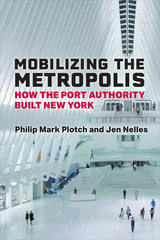
The Port Authority of New York and New Jersey has morphed in ways that would be unrecognizable to its founders. Its mission evolved from improving rail freight to building motor vehicle crossings, airports, office towers, and industrial parks and taking control of a failing commuter rail line. In its early years, the agency was often viewed with admiration; however as it drew up plans, negotiated to take control of airfields and marine terminals, and constructed large bridges and tunnels, the Port Authority became the object of less favorable attention. It was attacked as a “super-government” that must be reined in, while the mayors of New York and Newark argued that it should be broken up with its pieces given to local governments for their own use.
Despite its criticisms and travails, for over half a century the Port Authority overcame hurdles that had frustrated other public and private efforts, built the world's longest suspension bridge, and took a leading role in creating an organization to reduce traffic delays in the New York-New Jersey region. How did the Port Authority achieve these successes? And what lessons does its history offer to other cities and regions in the United States and beyond? In a time when public agencies are often condemned as inefficient and corrupt, this history should provide some positive lessons for governmental officials and social reformers.
In 2021, the Port Authority marked its 100th birthday. Its history reveals a struggle between the public and private sectors, the challenges of balancing democratic accountability and efficiency, and the tension between regional and local needs. From selected Port Authority successes and failures, Philip Mark Plotch and Jen Nelles produce a significant and engaging account of a powerful governmental entity that offers durable lessons on collaboration, leadership, and the challenge of overcoming complex political challenges in modern America.
Throughout the twentieth century, the United States did not experience national security domestically; it defended its borders by conducting military, foreign policy, and intelligence operations internationally, and then separated these activities from domestic law enforcement with bright legal lines. In the twenty-first century, U.S. national security no longer occurs exclusively outside of the nation. The U.S. government is beginning to respond to this change, and the establishment of the Department of Homeland Security is merely the first step in an organizational and strategic realignment that will be a long, difficult, and mistake-filled process. More or Less Afraid of Nearly Everything is an accessible and engaging guide to homeland security, particularly migration and border security, that makes innovative arguments about the American government and keeping citizens safe, and provides practical solutions to real-world problems.
READERS
Browse our collection.
PUBLISHERS
See BiblioVault's publisher services.
STUDENT SERVICES
Files for college accessibility offices.
RECENTLY PUBLISHED



UChicago Accessibility Resources
home | accessibility | search | about | contact us
BiblioVault ® 2001 - 2026
The University of Chicago Press