
 A SCHOLARLY BOOK REPOSITORY
9 start with O start with O
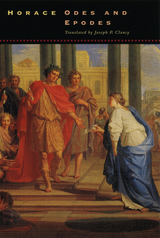
In 23 B.C., when he published the first three books of his lyrics, Horace was 42 years old, secure in the favor of the emperor Augustus, and living in ease and comfort as a country gentleman on his Sabine farm. Serenity is reflected in these lyrics, certainly, but so are other experiences, for Horace had lived through three major political crises in a society that was the center of the world, that was sophisticated, refined—and beginning to decay. A worldly, high-spirited, cultivated man, Horace responds in his poetry to the myriad elements of Roman life he knew so well.
The Odes and Epodes of Horace collects the entirety of his lyric poetry, comprising all 103 odes, the Carmen Saeculare ("Festival Hymn"), and the earlier epodes. Joseph P. Clancy has achieved a mirroring of the originals that is worthy in its own right as English verse, and his introductions to each book of lyrics are both lively and informed.
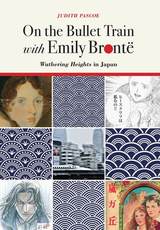
In this and in her previous book, The Sarah Siddons Audio Files, Pascoe’s engaging narrative innovates a new scholarly form involving immersive research practice to attempt a cross-cultural version of reader-response criticism. On the Bullet Train with Emily Brontë will appeal to scholars in the fields of 19th-century British literature, adaptation studies, and Japanese literary history.
Hideko was ten years old when the atomic bomb devastated her home in Hiroshima. In this eloquent and moving narrative, Hideko recalls her life before the bomb, the explosion itself, and the influence of that trauma upon her subsequent life in Japan and the United States. Her years in America have given her unusual insights into the relationship between Japanese and American cultures and the impact of Hiroshima on our lives.
This new edition includes two expanded chapters and revisions throughout. A new epilogue brings the story up to date. This poignant story of courage and resilience remains deeply relevant today, offering a profoundly personal testament against the ongoing threat of nuclear warfare.
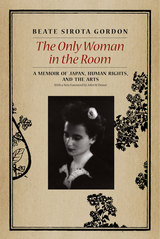
Sirota was born in Vienna, but in 1929 her family moved to Japan so that her father, a noted pianist, could teach, and she grew up speaking German, English, and Japanese. Russian, French, Italian, Latin, and Hebrew followed, and at fifteen Sirota was sent to complete her education at Mills College in California. The formal declaration of World War II cut Gordon off from her parents, and she supported herself by working for a CBS listening post in San Francisco that would eventually become part of the FCC. Translating was one of Sirota’s many talents, and when the war ended, she was sent to Japan as a language expert to help the American occupation forces. When General MacArthur suddenly created a team that included Sirota to draft the new Japanese Constitution, he gave them just eight days to accomplish the task. Colonel Roest said to Beate Sirota, “You’re a woman, why don’t you write the women’s rights section?”; and she seized the opportunity to write into law guarantees of equality unparalleled in the US Constitution to this day.
But this was only one episode in an extraordinary life, and when Gordon died in December 2012, words of grief and praise poured from artists, humanitarians, and thinkers the world over. Illustrated with forty-seven photographs, The Only Woman in the Room captures two cultures at a critical moment in history and recounts, after a fifty-year silence, a life lived with purpose and courage. This edition contains a new afterword by Nicole A. Gordon and an elegy by Geoffrey Paul Gordon.
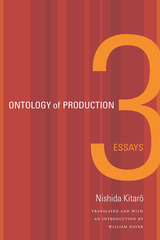
Agreeing with Marx that ontology is production and production is ontology, Nishida in these three essays—"Expressive Activity" (1925), "The Standpoint of Active Intuition" (1935), and "Human Being" (1938)—addresses sense and reason, language and thought, intuition and appropriation, ultimately arguing that in this concept of production, ideality and materiality are neither mutually exclusive nor oppositional but, rather, coimmanent. Nishida's forceful articulation of the radical nature of Marx's theory of production is, Haver contends, particularly timely in today's speculation-driven global economy. Nishida's reading of Marx, which points to the inseparability of immaterial intellectual labor and material manual labor, provokes a reconsideration of Marxism's utility for making sense of—and resisting—the logic of contemporary capitalism.
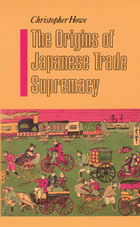
"Thoughtful, well-organized, and lucidly written and reflects many years of painstaking research in different literatures."—Business Horizons
"The best analysis yet in English of the role of technology in Japan's emergence as a global economic power."—David J. Jeremy, Technology and Culture
"An important addition to Japanese economic history and the concept of creating relative advantage in trade."—Richard Rice, Journal of Asian Studies
"No other work in English approaches Christopher Howe's combination of a sweeping historical perspective with a comprehensive yet in-depth analysis of factors underlying Japan's pre-1940 economic 'miracle.' . . . [An] illuminating study."—Steven J. Ericson, American Historical Review
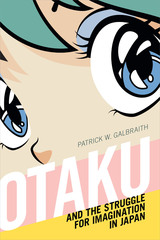

Hiroki Azuma’s Otaku offers a critical, philosophical, and historical inquiry into the characteristics and consequences of this consumer subculture. For Azuma, one of Japan’s leading public intellectuals, otaku culture mirrors the transformations of postwar Japanese society and the nature of human behavior in the postmodern era. He traces otaku’s ascendancy to the distorted conditions created in Japan by the country’s phenomenal postwar modernization, its inability to come to terms with its defeat in the Second World War, and America’s subsequent cultural invasion. More broadly, Azuma argues that the consumption behavior of otaku is representative of the postmodern consumption of culture in general, which sacrifices the search for greater significance to almost animalistic instant gratification. In this context, culture becomes simply a database of plots and characters and its consumers mere “database animals.”
A vital non-Western intervention in postmodern culture and theory, Otaku is also an appealing and perceptive account of Japanese popular culture.
READERS
Browse our collection.
PUBLISHERS
See BiblioVault's publisher services.
STUDENT SERVICES
Files for college accessibility offices.
RECENTLY PUBLISHED



UChicago Accessibility Resources
home | accessibility | search | about | contact us
BiblioVault ® 2001 - 2026
The University of Chicago Press