
 A SCHOLARLY BOOK REPOSITORY
13 start with O start with O

When David Bordwell died in 2024, he left behind a legacy of film scholarship and criticism whose influence is unmatched. Co-author of a pair of textbooks adopted across the globe and the main force behind a blog read by thousands, Bordwell has influenced generations of film students, filmmakers, and film critics. Observing Film Art examines the breadth of Bordwell’s work through the perspectives of those who knew him best, collaborators, former students, and critics among them. This is the first collection devoted to the work of Bordwell, and it gives equal attention to each facet of his prodigious scholarship, structured to highlight his interest in theory, history, and analysis and criticism. The cornerstones of his approach to film study, including formalism, cognitivism, and historical poetics, are all examined in detail, as are key works, including The Classical Hollywood Cinema (coauthored with Kristin Thompson and Janet Staiger) and Narration in the Fiction Film.
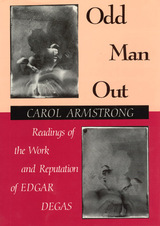
By reading several groups of the artist's images through the lens of a sequence of critical texts, Armstrong shows how our critical and popular expectations of Degas are overturned and subverted. Each of these groups of images is matched to different interpretive moves, each highlighting distinct themes: economics and vocation; narrative and semiotics; gender and corporeality; and the author and self. Armstrong's provocative analysis celebrates the tantalizing qualities of the artist's elusive career: the pluralism of his work, its conflation of positivistic and negational tactics, the modern and the traditional, the abstract and the representational.
"A lucid and searching study. . . . Armstrong has produced one of the most elegant and persuasive examples of the historian's use of 19th-century art criticism. In the process, she has achieved a reading of the artist which makes a difference to the way we understand the difference of Degas himself."—Neil McWilliam, Times Higher Education Supplement
"This is a brilliant, original, and beautifully articulated study. Carol Armstrong's scholarship is impressive in its richness, ambition, and sophistication: Degas's works have rarely been given such detailed, penetrating, and suggestive readings as those offered in this book."—Linda Nochlin, Yale University
"With brilliant insight and incisive analytical intelligence, Carol Armstrong introduces new ways to conceptualize the structural ambiguities of Degas's work. Her subtle and probing readings clarify the fundamental contrariness of Degas's images—their disturbing negativity, their anti-modern modernism. Odd Man Out catapults the criticism of Degas from the hinterlands of traditional art history to the foreground of contemporary critical theory in both literature and the visual arts."—Charles Bernheimer, University of Pennsylvania
Honorable Mention, 2025 PCA Emily Toth Award For Best Single Work In Women’s Studies
Finalist, 2025 Mystery Writers of America's Edgar Awards, Best Critical/Biographical Category
Finalist, Bouchercon New Orleans 2025 Anthony Awards, Best Critical/Non-Fiction
Nominated for the 2025 Macavity Awards, Best Mystery-related Nonfiction/Critical
Ashley Lawson’s On Edge presents a new picture of postwar American literature, arguing that biases against genre fiction have unfairly disadvantaged the legacies of authors like Shirley Jackson, Patricia Highsmith, and Leigh Brackett. Each of these women navigated a male-dominated postwar publishing world without compromising their values. Their category-defying treatment of gender roles and genre classifications created suspense in their work that spoke to the tensions of the “Age of Anxiety.” Lawson engages with foundational voices in American literature, genre theory, and feminism to argue that, by merging the dominant mode of literary realism with fantastical or heightened elements, Brackett, Jackson, and Highsmith responded to the big questions of their era with startling and unnerving answers. By elevating genre play to a marker of literary skill, Lawson contends, we can secure these writers a more prominent place within the canon of midcentury American literature and open the door for the recovery of their similarly innovative peers.

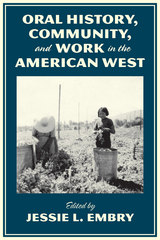
In many cases occupations brought people together in myriad ways. The Latino workers who picked lemons together in Southern California report that it was baseball and Cinco de Mayo Queen contests that united them. Mormons in Fort Collins, Colorado, say that building a church together bonded them together. In separate essays, African Americans and women describe how they fostered a sense of community in Las Vegas. Native Americans detail the “Indian economy” in Northern California.
As these essays demonstrate, the history of the American West is the story of small towns and big cities, places both isolated and heavily populated. It includes groups whose history has often been neglected. Sometimes, western history has mirrored the history of the nation; at other times, it has diverged in unique ways. Oral history adds a dimension that has often been missing in writing a comprehensive history of the West. Here an array of oral historians—including folklorists, librarians, and public historians—record what they have learned from people who have, in their own ways, made history.
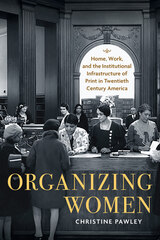
In the first decades of the twentieth century, print-centered organizations spread rapidly across the United States, providing more women than ever before with opportunities to participate in public life. While most organizations at the time were run by and for white men, women—both Black and white—were able to reshape their lives and their social worlds through their participation in these institutions.
Organizing Women traces the histories of middle-class women—rural and urban, white and Black, married and unmarried—who used public and private institutions of print to tell their stories, expand their horizons, and further their ambitions. Drawing from a diverse range of examples, Christine Pawley introduces readers to women who ran branch libraries and library schools in Chicago and Madison, built radio empires from their midwestern farms, formed reading clubs, and published newsletters. In the process, we learn about the organizations themselves, from libraries and universities to the USDA extension service and the YWCA, and the ways in which women confronted gender discrimination and racial segregation in the course of their work.
Women workers and the revolutionary origins of the modern welfare state
In May 1790, the French National Assembly created spinning workshops (ateliers de filature) for thousands of unemployed women in Paris. These ateliers disclose new aspects of the process which transformed Old Regime charity into revolutionary welfare initiatives characterized by secularization, centralization, and entitlements based on citizenship. This study is the first to examine women and the welfare state in its formative period at a time when modern concepts of human rights were elaborated.
In The Origins of the Welfare State, Lisa DiCaprio reveals how the women working in the ateliers, municipal welfare officials, and the national government vied to define the meaning of revolutionary welfare throughout the Revolution. Presenting demands for improved wages and working conditions to a wide array of revolutionary officials, the women workers exercised their rights as "passive citizens" capaciously and shaped the meanings of work, welfare, and citizenship. Looking backward to the Old Regime and forward to the nineteenth century, this study explores the interventionist spirit that characterized liberalism in the eighteenth century and serves as a bridge to the history of entitlements in the nineteenth and twentieth centuries.

By constantly seeking higher yields of capital, today’s global economy changes how people around the world relate to time and productivity. Labor demands within the bounds of wage work accelerate, while people outside of wage work often remain marginalized and with too much unproductive time on their hands. In this ethnography of global labor, Gregor Dobler accompanies different groups of people in their attempts to find time autonomy and meaning in their everyday lives. He shows how moments of otium—moments when we feel free from the external constraints of work and capitalist definitions of productivity—can become productive in new ways. Otium leads individuals to new ideas and dreams, and becomes a source for critique and political renewal. Chapters focus on peasant work and unemployment in Northern Namibia; the pitfalls of free time on a Breton island shaped by early retirement; the gendered effects of combining care work and wage work in Swiss middle-class families; and the elasticity of the academic labor of writing and research in the US. Weaving together these ethnographies of work, leisure, and care, Otium presents a political anthropology of the possibilities for human freedom under capitalism, and advances post-work debates from a global perspective.
Open exchanges enable complex and nuanced conversations about intersectionality and how racism, sexism, classism, and ableism (among other “isms”) create systems of power. Contributors examine how these conversations are framed around work, practices, policies, and research and identify ways to create inclusive, embodied practices in writing programs and classrooms. The collection is organized to maximize representation in the areas of race, gender, identity, ability, and class by featuring scholarly chapters followed by narratively focused interchapters that respond to and engage with the scholarly work.
The honest and emotionally powerful stories in Our Body of Work expose problematic and normalizing policies, practices, and procedures and offer diverse theories and methodologies that provide multiple paths for individuals to follow to make the academy more inclusive and welcoming for all bodies. It will be an important resource for researchers, as well a valuable addition to graduate and undergraduate syllabi on embodiment, writing instruction/pedagogy, and WPA work.
Contributors: Dena Arendall, Janel Atlas, Hayat Bedaiwi, Elizabeth Boquet, Lauren Brentnell, Triauna Carey, Denise Comer, Joshua Daniel, Michael Faris, Rebecca Gerdes-McClain, Morgan Gross, Nabila Hijazi, Jacquelyn Hoermann-Elliott, Maureen Johnson, Jasmine Kar Tang, Elitza Kotzeva, Michelle LaFrance, Jasmine Lee, Lynn C. Lewis, Mary Lourdes Silva, Rita Malenczyk, Anna Rita Napoleone, Julie Prebel, Rebecca Rodriguez Carey, Ryan Skinnell, Trixie Smith, Stacey Waite, Kelsey Walker, Shannon Walters, Isaac Wang, Jennie Young
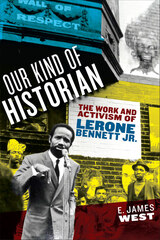
Journalist, activist, popular historian, and public intellectual, Lerone Bennett Jr. left an indelible mark on twentieth-century American history and culture. Rooted in his role as senior editor of Ebony magazine, but stretching far beyond the boundaries of the Johnson Publishing headquarters in Chicago, Bennett’s work and activism positioned him as a prominent advocate for Black America and a scholar whose writing reached an unparalleled number of African American readers.
This critical biography—the first in-depth study of Bennett’s life—travels with him from his childhood experiences in Jim Crow Mississippi and his time at Morehouse College in Atlanta to his later participation in a dizzying range of Black intellectual and activist endeavors. Drawing extensively on Bennett’s previously inaccessible archival collections at Emory University and Chicago State, as well as interviews with close relatives, colleagues, and confidantes, Our Kind of Historian celebrates his enormous influence within and unique connection to African American communities across more than half a century of struggle.
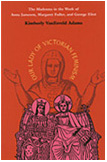
Our Lady of Victorian Feminism is about three nineteenth-century women, Protestants by background and feminists by conviction, who are curiously and crucially linked by their extensive use of the Madonna in arguments designed to empower women.
In the field of Victorian studies, few scholars have looked beyond the customary identification of the Christian Madonna with the Victorian feminine ideal—the domestic Madonna or the Angel in the House. Kimberly VanEsveld Adams shows, however, that these three Victorian writers made extensive use of the Madonna in feminist arguments. They were able to see this figure in new ways, freely appropriating the images of independent, powerful, and wise Virgin Mothers.
In addition to contributions in the fields of literary criticism, art history, and religious studies, Our Lady of Victorian Feminism places a needed emphasis on the connections between the intellectuals and the activists of the nineteenth-century women's movement. It also draws attention to an often neglected strain of feminist thought, essentialist feminism, which proclaimed sexual equality as well as difference, enabling the three writers to make one of their most radical arguments, that women and men are made in the image of the Virgin Mother and the Son, the two faces of the divine.
READERS
Browse our collection.
PUBLISHERS
See BiblioVault's publisher services.
STUDENT SERVICES
Files for college accessibility offices.
RECENTLY PUBLISHED


UChicago Accessibility Resources
home | accessibility | search | about | contact us
BiblioVault ® 2001 - 2026
The University of Chicago Press