
 A SCHOLARLY BOOK REPOSITORY
17 start with P start with P
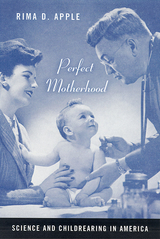
Parenting today is virtually synonymous with worry. We want to ensure that our children are healthy, that they get a good education, and that they grow up to be able to cope with the challenges of modern life. In our anxiety, we are keenly aware of our inability to know what is best for our children. When should we toilet train? What is the best way to encourage a fussy child to eat? How should we protect our children from disease and injury?
Before the nineteenth century, maternal instinct—a mother’s “natural know-how”—was considered the only tool necessary for effective childrearing. Over the past two hundred years, however, science has entered the realm of motherhood in increasingly significant ways. In Perfect Motherhood, Rima D. Apple shows how the growing belief that mothers need to be savvy about the latest scientific directives has shifted the role of expert away from the mother and toward the professional establishment. Apple, however, argues that most women today are finding ways to negotiate among the abundance of scientific recommendations, their own knowledge, and the reality of their daily lives.
Despite efforts to abolish slavery throughout Africa in the nineteenth century, the coercive labor systems that constitute “modern slavery” have continued to the present day. To understand why, Robin Phylisia Chapdelaine explores child trafficking, pawning, and marriages in Nigeria's Bight of Biafra, and the ways in which British colonial authorities and Igbo, Ibibio, Efik, and Ijaw populations mobilized children's labor during the early twentieth century. Drawing on a wealth of primary sources that include oral interviews, British and Nigerian archival materials, newspaper holdings, and missionary and anthropological accounts, Chapdelaine argues that slavery's endurance can only be understood when we fully examine “the social economy of a child”—the broader commercial, domestic, and reproductive contexts in which children are economic vehicles.
The Persistence of Slavery provides an invaluable investigation into the origins of modern slavery and early efforts to combat it, locating this practice in the political, social, and economic changes that occurred as a result of British colonialism and its lingering effects, which perpetuate child trafficking in Nigeria today.
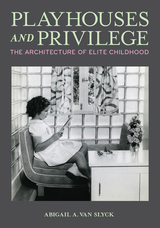
Examining playhouses of the super-rich to understand how architecture contributed to the construction of elite identity and modern childhood
Playhouses and Privilege explores children’s playhouses built on British and American estates between the 1850s and the mid-1930s. Different from the prefabricated buildings that later populated suburban backyards, these playhouses were often fully functional cottages designed by well-known architects for British royalty, American industrialists, and Hollywood stars. As Abigail A. Van Slyck shows, these buildings were more than extravagant spaces to cultivate children’s imaginations and fantasy lives.
Reviewing a rich archive that includes extant buildings, site plans, family photographs, baby books, and intimate household correspondence, Van Slyck demonstrates that these structures were tools of social reproduction shaped by elite parents’ attitudes toward child-rearing, education, and class privilege. Recognizing playhouses as stages for the purposeful performance of upper-class identity, she illuminates their importance in influencing children to internalize gendered codes of conduct as they enacted rituals of hospitality and learned how to supervise servants.
From Queen Victoria and Prince Albert’s Swiss Cottage, built on their Osborne estate in 1853, to the children’s cottage constructed on the grounds of Cornelius Vanderbilt’s Newport mansion in 1886, and from the miniature bungalow commissioned in 1926 for the Dodge Brothers Motor Company heiress to the corporate-sponsored glass-block playhouse given to Shirley Temple in 1936, Van Slyck surveys a variety of playhouses and their milieus to trace the evolution of elite childhood and the broader social practices of wealth. Playhouses and Privilege makes clear that, far from being frivolous, playhouses were carefully planned architectural manifestations of adult concerns, integral to the reproduction of class privilege.
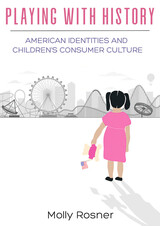

There is an inherent contradiction in play: it is universal, a basic part of human nature, but it also takes radically different forms, shaped by the design sense, technology, and values of its particular time and place. This volume explores this contradiction through a wealth of engaging examples that bring play, emotions, and the ludic into dialogue with material culture, affect theory, psychoanalysis, childhood studies, and other fields. Topics range from playground architecture, plastic toys, and children’s magazines to the complexities of children’s play in a post-digital world.
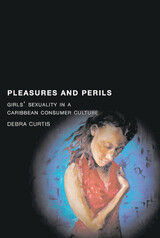
Curtis shows that girls are often caught between conflicting discourses of Christian teachings about chastity, public health cautions about safe sex, and media enticements about consumer delights. Sexuality's contradictions are exposed: power and powerless¡ness, self-determination and cultural control, violence and pleasure. Pleasures and Perils illuminates the methodological and ethical issues anthropologists face when they conduct research on sex, especially among girls. The sexually explicit narratives conveyed in this book challenge not only the reader's own thoughts on sexuality but also the broader limits and possibilities of ethnography.
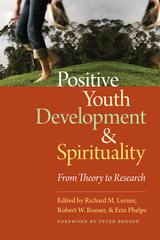
<p>Bringing together a never-before-assembled network of biologists, psychologists, and sociologists, <em>Positive Youth Development and Spirituality</em> scientifically examines how spirituality and its cultivation may affect the positive development of adolescents. </p>
<p>Chapters provide groundbreaking new discussions of conceptual, theoretical, definitional, and methodological issues that need to be addressed when exploring the relationships between spirituality and development. Throughout the book, contributors recommend ways in which the research on the spirituality/positive youth development connection may be integral in building the larger field of spiritual development as a legitimate and active domain of developmental science. This volume, which is sure to be seen as a seminal contribution to a field in need of theoretical underpinnings, will be of interest to scholars and scientists in the fields of biology and the social and behavioral sciences.</p>
<p>Contributors include: Mona Abo-Zena, Jeffrey Jensen Arnnett, Peter L. Benson, Marina Umaschi Bers, Aerika Brittian, William Damon, Angela M. DeSilva, Jacquelynne S. Eccles, David Henry Feldman, Simon Gächter, Elena L. Grigorenko, Sonia S. Isaac, Lene Arnett Jensen, Carl N. Johnson, Linda Juang, Pamela Ebstyne King, Richard M. Lerner, Jennifer Menon, Na'ilah Sued Nasir, Guerda Nicolas, Toma´š Paus, Stephen C. Peck, Erin Phelps, Alan P. Poey, Robert W. Roeser, W. George Scarlett, Lonnie R. Sherrod, Gabriel S. Spiewak, Chris Starmer, Moin Syed, Janice L. Templeton, Heather L. Urry, and Richard Wilkinson.</p>
This book is part of a concentrated series of books that examines child maltreatment across minoritized, cultural groups.Specifically, this volume addresses American Indian and Alaska Native populations. However, in an effort to contextualize the experiences of 574 federally recognized tribes and 50+ state recognized tribes, as well as villages, the authors focus on populations within rural and remote regions and discuss the experiences of some tribal communities throughout US history. It should be noted that established research has primarily drawn attention to the pervasive problems impacting Indigenous individuals, families, and communities. Aligned with an attempt to adhere to a decolonizing praxis, the authors share information in a strength-based framework for the Indigenous communities discussed within the text. The authors review federally funded programs (prevention, intervention, and treatment) that have been adapted for tribal communities (e.g., Safecare) and include cultural teachings that address child maltreatment. The intention of this book is to inform researchers, practitioners, policy makers, and advocates about the current state of child maltreatment from an Indigenous perspective.

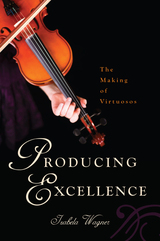
A musician and a parent of a young violinist, sociologist Izabela Wagner offers an inside look at how her young subjects set out on the long road to becoming a soloist. The remarkable research she conducted—at rehearsals, lessons, and in other educational settings—enabled her to gain deep insight into what distinguishes these talented prodigies and their training. She notes, for instance, the importance of a family culture steeped in the values of the musical world. Indeed, more than half of these students come from a family of professional musicians and were raised in an atmosphere marked by the importance of instrumental practice, the vitality of music as a vocation, and especially the veneration of famous artists. Wagner also highlights the highly structured, rigorous training system of identifying, nurturing, and rewarding talent, even as she underscores the social, economic, and cultural factors that make success in this system possible.
Offering an intimate portrait of the students, their parents, and their instructors, Producing Excellence sheds new light on the development of exceptional musical talent, as well as draw much larger conclusions as to “producing prodigy” in other competition-prone areas, such as sports, sciences, the professions, and other arts. Wagner’s insights make this book valuable for academics interested in the study of occupations, and her clear, lively writing is perfect for general readers curious about the ins and outs of training to be a violin soloist.
When inclusion into the fold of citizenship is conditioned by a social group’s conceit to ritual violence, humiliation, and exploitation, what can anti-citizenship offer us?
The Promise of Youth Anti-citizenship argues that Black youth and youth of color have been cast as anti-citizens, disenfranchised from the social, political, and economic mainstream of American life. Instead of asking youth to conform to a larger societal structure undergirded by racial capitalism and antiblackness, the volume’s contributors propose that the collective practice of anti-citizenship opens up a liberatory space for youth to challenge the social order.
The chapters cover an array of topics, including Black youth in the charter school experiment in post-Katrina New Orleans; racial capitalism, the queering of ethnicity, and the 1980s Salvadoran migration to South Central Los Angeles; the notion of decolonizing classrooms through Palestinian liberation narratives; and more. Through a range of methodological approaches and conceptual interventions, this collection illuminates how youth negotiate and exercise anti-citizenship as forms of either resistance or refusal in response to coercive patriotism, cultural imperialism, and predatory capitalism.
Contributors: Karlyn Adams-Wiggins, Portland State U; Ariana Brazier; Julio Cammarota, U of Arizona; Michael Davis, U of Wisconsin–Madison; Damaris C. Dunn, U of Georgia; Diana Gamez, U of California, Irvine; Rachel F. Gómez, Virginia Commonwealth U; Luma Hasan; Gabriel Rodriguez, Iowa State U; Christopher R. Rogers, U of Pennsylvania; Damien M. Sojoyner, U of California, Irvine.
READERS
Browse our collection.
PUBLISHERS
See BiblioVault's publisher services.
STUDENT SERVICES
Files for college accessibility offices.
RECENTLY PUBLISHED



UChicago Accessibility Resources
home | accessibility | search | about | contact us
BiblioVault ® 2001 - 2025
The University of Chicago Press