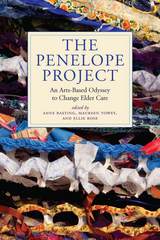
front cover of The Penelope Project
The Penelope Project
An Arts-Based Odyssey to Change Elder Care
Anne Basting, Maureen Towey, and Ellie Rose
University of Iowa Press, 2016
Of the 15,000 nursing homes in the United States, how many are places you’d want to visit, much less live in? Now that people are living longer and more of the population are elderly, this question is more important than ever, particularly for people with disabilities. We must transform long-term care into an experience we and our loved ones can face without dread. It can be done. The Penelope Project shows how by taking readers on an ambitious journey to create a long-term care community that engages its residents in challenging, meaningful art-making.

At Milwaukee’s Luther Manor, a team of artists from the University of Wisconsin’s theatre department and Sojourn Theatre Company, university students, staff, residents, and volunteers traded their bingo cards for copies of The Odyssey. They embarked on a two-year project to examine this ancient story from the perspective of the hero who never left home: Penelope, wife of Odysseus. Together, the team staged a play that engaged everyone and transcended the limits not just of old age and disability but also youth, institutional regulations, and disciplinary boundaries.

Inviting readers to see through the eyes of residents, students, artists, staff, family members, and experts in the fields of education, long-term care, and civically engaged arts practice, this book underscores the essential role of the arts and humanities in living richly. Waiting, as Penelope waited, need not be a time of loss and neglect. The Penelope Project boldly dreams of how to make late life a time of growth and learning. If you dream of improving people’s lives through creative endeavors, this book provides practical advice. 

[more]

front cover of Perspectives on the Economics of Aging
Perspectives on the Economics of Aging
Edited by David A. Wise
University of Chicago Press, 2004
This book investigates several important issues in the economics of aging, including the accumulation of wealth and the relationship between health and financial prosperity.

Examining the changes in savings behavior and investment priorities in the United States over the past few decades, contributors to the volume point to a dramatic shift from employer-managed, defined benefit pensions to employee-controlled retirement savings plans. Further, the legislative reforms of the 1980s and the booming stock market of the 1990s did their share to influence individual wealth accumulation patterns of Americans.

These studies also explore the relationship between health status and economic status. Considering issues like pension income and health, mortality, and medical care, contributors present evidence from the United States, Britain, South Africa, and Russia. The volume culminates with wide-ranging discussions on a number of key topics in the field including the innovations that have contributed to a decline in mortality rates; the various medical advances that have benefited populations over time; and the determinants of expenditures on health. The findings with regard to cross-sectional differences in health outcomes and health care utilization also pose troubling questions for policymakers seeking to democratize health care across regions and races.
[more]


Send via email Share on Facebook Share on Twitter