
 A SCHOLARLY BOOK REPOSITORY
19 start with P start with P

Geared to the needs of the pediatrician, this book is designed to orient him to the background of psychiatric knowledge so essential in his daily practice. Using his observation of 1,000 children brought to the Stanford University Pediatric-Psychiatric Unit as a guide, Dr. Shirley illustrates his discussion of physical, mental, and emotional disturbances with case histories, thus presenting the relationships between physician and parent, and physician and child in dynamic form, and stressing the individual nature of each case.
Yet, despite the unique character of each behavior problem, there are common denominators in childhood development. Dr. Shirley sets forth the generally accepted norms of physical and mental growth and evaluates the usefulness of psychometric procedures, such as intelligence and performance tests, in determining the limits of the child's intellectual and physical capacities. Grade placement, discipline, eating and sleeping are universal trouble spots. Dr. Shirley suggests specific leads for the pediatrician to follow in the treatment of these problems, cautioning that success depends upon relieving parents of anxiety concerning themselves and their children in order that an atmosphere conducive to cooperation may exist in the home.
Dr. Shirley's experience and training in both pediatrics and psychiatry doubly qualify him to discuss the basic elements of child psychiatry with authority and insight. Parents as well as physicians can profit by Dr. Shirley's wise, articulate, and practical interpretation of psychological concepts as they relate to the prevention and treatment of behavior problems in children.
This is the compelling story of an experiment begun in 1961 that eventually affected the lives of almost all of the residents of the island of Martha's Vineyard. The author writes engagingly of the island and its year-round inhabitants, a community of some seven thousand persons of diverse ethnic and social backgrounds.
With sympathy and insight Milton Mazer analyzes the stresses that are peculiar to the conditions of life on the island, and he describes the kinds of psychological disorders that are precipitated by those stresses. He reports, without technical jargon, the results of a five-year study of a great variety of psychosocial predicaments experienced by the people of the island. Finally he examines the catalytic effect the mental health center and its research findings have had on the development of other supportive agencies and how the community established a network of human services to meet its needs.
The work clearly demonstrates that striking advances can be made by a mental health program that is informed by an understanding of the community served. The book will stand as a model for future studies in this area.

Phenomenology in Psychology and Psychiatry is a historical introduction to phenomenology in psychology working from the general to the details of the subject.
This volume heralds the appearance, for the first time in many years, of a totally new document by Sigmund Freud. It is the draft of a lost metapsychological paper, one of twelve essays written during World War I at the peak of the master's powers. Freud intended to publish all twelve in book form, under the title Preliminaries to a Metapsychology, and thereby set out the theoretical foundations of psychoanalysis. Scholars have long lamented the disappearance without a trace of seven of these important essays.
Only in 1983 did Ilse Grubrich-Simitis happen upon this draft, in Freud's handwriting, in an old trunk containing papers and documents of his Hungarian collaborator Sándor Ferenczi. With the help of a brief letter Freud had written on the back of the last page, she soon realized that the manuscript she had found was the draft of the final paper in the series. That draft is published here in facsimile, together with a transcription in German of the facsimile and the English translation.
In the first part of the draft, which is written in a kind of shorthand, Freud contrasts the three classic transference neuroses: anxiety hysteria, conversion hysteria, and obsessional neurosis. In the second part, which is written in complete sentences, Freud undertakes a daringly speculative "phylogenetic fantasy" He explores whether the debilitating illnesses of the neurotic and the psychotic today might have originated long ago as adaptive responses of the entire species to threatening environmental changes or to traumatic events in the prehistory of mankind.
In the draft "Fantasy" Freud modifies and expands the line of reasoning he began in Totem and Taboo (1912-13) after an intensely productive exchange with Ferenczi about Lamarckian concepts, making this recovered draft of major significance to students not only of psychoanalysis but also of the social sciences, humanities, and natural sciences.
Ilse Grubrich-Simitis has contributed a detailed essay, setting the overview in the context of Freud's life, his work, and his historical and scientific prominence. She quotes from relevant letters of Freud and Ferenczi, some published here for the first time.
The great Swiss psychologist and theorist Jean Piaget (1896–1980) had much to say about the developing mind. He also had plenty to say about his own development, much of it, as Fernando Vidal shows, plainly inaccurate. In the first truly historical biography of Piaget, Vidal tells the story of the psychologist’s intellectual and personal development up to 1918. By exploring the philosophical, religious, political, and social influences on the psychologist’s early life, Vidal alters our basic assumptions about the origins of Piaget’s thinking and his later psychology.
The resulting profile is strikingly dissimilar to Piaget’s own retrospective version. In Piaget’s own account, as an adolescent he was a precocious scientist dedicated to questions of epistemology. Here we find him also—and increasingly—concerned with the foundations of religious faith and knowledge, immersed in social and political matters, and actively involved in Christian and socialist groups. Far from being devoted solely to the classification of mollusks, the young Piaget was a vocal champion of Henri Bergson’s philosophy of creative evolution, an interest that figured much more prominently in his later thinking than did his early work in natural history. We see him during World War I chastising conservatism and nationalism, espousing equality and women’s rights, and advocating the role of youth in the birth of a new Christianity.
In his detailed account of Jean Piaget’s childhood and adolescence—enriched by the intellectual and cultural landscape of turn-of-the-century Neuchâtel—Vidal reveals a little-known Piaget, a youth whose struggle to reconcile science and faith adds a new dimension to our understanding of the great psychologist’s life, thought, and work.
"One is continuously aware that here is a truly human being at work, human in the sense of exquisite awareness, on a profoundly intuitive level, of the workings of the human totality. . . . Because of this she can bridge the vast divide that separates us from the psychotic . . . thereby gaining access to the process of recalling the patient to his lost domain."—Louise E. DeRosis, M.D., American Journal of Psychoanalysis
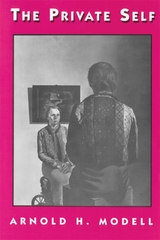
In The Private Self, Arnold Modell contributes an interdisciplinary perspective in formulating a theory of the private self. A leading thinker in American psychoanalysis, Modell here studies selfhood by examining variations on the theme of the self in Freud and in the work of object relations theorists, self psychologists, and neuroscientists. Modell contends that the self is fundamentally paradoxical, in that it is at once dependent upon social affirmation and autonomous in generating itself from within. We create ourselves, he suggests, by selecting values that are endowed with private meanings.
By thinking of the unconscious as a neurophysiological process, and the self as the subject and object of its own experience, Modell is able to explain how identity can persist in the flux of consciousness. He thus offers an exciting and original perspective for our understanding of the mind and the brain.
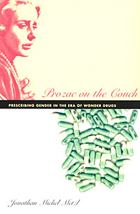
Prozac on the Couch traces the notion of “pills for everyday worries” from the 1950s to the early twenty-first century, through psychiatric and medical journals, popular magazine articles, pharmaceutical advertisements, and popular autobiographical "Prozac narratives.” Metzl shows how clinical and popular talk about these medications often reproduces all the cultural and social baggage associated with psychoanalytic paradigms—whether in a 1956 Cosmopolitan article about research into tranquilizers to “cure” frigid women; a 1970s American Journal of Psychiatry ad introducing Jan, a lesbian who “needs” Valium to find a man; or Peter Kramer’s description of how his patient “Mrs. Prozac” meets her husband after beginning treatment.
Prozac on the Couch locates the origins of psychiatry’s “biological revolution” not in the Valiumania of the 1970s but in American popular culture of the 1950s. It was in the 1950s, Metzl points out, that traditional psychoanalysis had the most sway over the American imagination. As the number of Miltown prescriptions soared (reaching 35 million, or nearly one per second, in 1957), advertisements featuring uncertain brides and unfaithful wives miraculously cured by the “new” psychiatric medicines filled popular magazines. Metzl writes without nostalgia for the bygone days of Freudian psychoanalysis and without contempt for psychotropic drugs, which he himself regularly prescribes to his patients. What he urges is an increased self-awareness within the psychiatric community of the ways that Freudian ideas about gender are entangled in Prozac and each new generation of wonder drugs. He encourages, too, an understanding of how ideas about psychotropic medications have suffused popular culture and profoundly altered the relationship between doctors and patients.
The Psyche and Schizophrenia offers a remarkably clear and comprehensive treatment of biopsychosocial development and psychotic processes. This extraordinary work lays the theoretical foundation for understanding the relationships between feeling and thinking (affect and logic) in normal as well as in pathological conditions, especially schizophrenia. Ciompi's affective-cognitive theory integrates interpersonal, familial, and social interactions with intrapsychic mental structures and yields startling new insights into the origins of "schizophrenic alienation." While Ciompi acknowledges the important role that genetic and biological models play in schizophrenia, he maintains that it is largely the psychosocial factors that determine long-term prognosis. Thus, The Psyche and Schizophrenia elaborates a number of new therapeutic approaches to the management of biological as well as environmental influences.
Drawing upon Piaget, Freud, and systems theory, as well as advanced current research, Ciompi develops a new model of the normal and pathological functioning of the psyche. This model presents cognition and emotion, the structure of logic and the dynamics of affects, as a complementary system governed by "ubiquitous laws of equilibrium."
In this brilliant synthesis of theoretical and empirical research, Ciompi proposes his novel theory of an "affectlogic" that probes the affective structures of logic as well as the logical structures of the emotions. Original in its conception and elegantly written, The Psyche and Schizophrenia is a major contribution to research on schizophrenia, and its penetrating insights and thorough analysis are sure to enrich the field of psychiatry for years to come.
Contributors. Hubertus Büschel, Raphaël Gallien, Matthew M. Heaton, Richard Hölzl, Nancy Rose Hunt, Richard C. Keller, Sloan Mahone, Nana Osei Quarshie, Jonathan Sadowsky, Romain Tiquet

This book--first published in 1958, and designed for courses on abnormal psychology and psychiatry--is intended to supplement the usual textbook material in abnormal psychology. Papers have been selected to introduce the student to the active and complex enterprise of investigation and hypothesis in this wide field. Conflicting evidence and allegiances, riddles and ingenuity, are displayed in order to stimulate an appreciation of the task of discovery in behavioral science.
Five general areas are represented in the selections: (i) the problem of the effects of early experience on psychological development; (2) psychosomatic disorders and neurosis; (3) schizophrenic psychosis; (4) somatic factors in psychopathology; and (5) the social context and its effects on the phenomena of behavior. Against a background of systematic study, the graduate or undergraduate student will find in the forty-six papers included here an instructive sampling of the periodical literature.
Says Robert W. White in his introduction to the book: "There is no longer an air that the problem of schizophrenia, or of neurosis, or of psychosomatic disorder is going to be solved by a stroke of insight and a simple theory. Where once it was hoped to unlock the secret of a disorder, we now know that we must creep up slowly upon its many secrets and that we must use to the utmost the help provided by scientific method. In this new climate the present book is an indispensable teaching aid."

Psychopathology: An Empathic Representational Approach retraces the foundations of classical phenomenological psychopathology and integrates them with modern ideas drawn from anthropology, cognitive neuroscience, computational science, and evolutionary biology to synthesize a comprehensive framework and provide fresh insights. It explores key issues in clinical psychopathology coherently and systematically, illustrates advanced topics in an accessible manner using clinical case examples, metaphors, and clarifying diagrams, and directly links advanced conceptual frameworks with pragmatic skills in the clinical dialogue process.
This volume is aimed at a broad audience of mental health professionals, researchers, and students in psychiatry, psychology, and social work. Its interdisciplinary treatment of the subject will also interest biologists, anthropologists, cognitive psychologists, neuroscientists, and philosophers.

Psychosis and Schizophrenia in Hong Kong covers some of the most serious mental health conditions that top the global disease burden and affect three percent of the general population. However, most research on psychotic disorders is undertaken in the West, and few studies have been systematically carried out in Asia despite global interest in regional differences. This work offers a unique and coherent account of these disorders and their treatment in Hong Kong over the last thirty years.
Chen and his research program’s pioneering work has ranged from the impact of early intervention on outcomes and relapse prevention to the renaming of psychosis to reduce stigma. The studies have contributed to wider international debates on the optimal management of the condition. Their investigations in semantics and cognition, as well as cognition-enhancing exercise interventions, have provided novel insights into deficits encountered in the treatment of psychotic disorders and how they might be ameliorated. The research has also explored subjective experiences of psychosis and elicited unique perspectives in patients of Asian origin.
Each topic is divided into three sections: a global background of the challenges encountered; research findings from Hong Kong; and reflections that place the data in scientific and clinical contexts and offer future directions.
Salvador Minuchin is widely recognized as one of the preeminent family therapists in the world. He has been described, in the American Journal of Psychotherapy, as “a most original innovator, a superb clinician, and an outstanding teacher.” Now, in this pioneering work, he and his co-authors apply the effectiveness of family therapy techniques to an illness that has long resisted treatment—anorexia nervosa.
The purpose of their book is threefold: to develop a new theory of psychosomatic disease, to confirm it with scientific data, and to show it unfolding in actual therapeutic situations with anorectic patients. Drawing upon their own clinical experience and illustrating their views with case studies, they advance a new approach that places the locus of the illness not in the individual but in the family. Their method, which has been highly successful, requires the active involvement of the therapist as an agent of change within the family, stimulating crises that are severe enough to shake up the system and allow it to reform in new and healthier patterns.
This book has revolutionary implications, not just for anorectic patients but for those suffering from all other psychosomatic disease. Whereas such illnesses to date have often eluded treatment, the approach through family therapy holds out the promise of future successes.
Morton Prince, a debonair Boston neurologist, established the modern American tradition of psychopathology and psychotherapy in the closing decade of the nineteenth century. Born in 1854, two years before Sigmund Freud and five years before Pierre Janet, he criticized and adapted their work to his own particular interests, which were primarily the exploration of hypnosis, multiple personality, and the unconscious. Prince informally headed the most sophisticated group of psychopathologists in the English-speaking world, which flourished in Boston and Cambridge beginning around 1890. He founded the Journal of Abnormal Psychology in 1906 and the American Psychopathological Association in 1910.
The essays in this volume have been chosen by Nathan G. Hale, Jr., to illustrate four major stages in Prince’s career. The first, from 1885 to 1898, saw his development of a dynamic psychotherapy, based on the existence of unconscious mental processes. During the second period, from 1898 through 1911, he made intensive studies of multiple personality. In the third, from 1909 through 1924, he confronted psychoanalysis and behaviorism. During the last period, from about 1914 through 1927, he published his final views of the unconscious, hypnotism, and personality.
Morton Prince’s observations remain important partly because they are so richly detailed, partly because of their dramatic and human interest, but chiefly because they shed light on phenomena that still defy final explanation.
READERS
Browse our collection.
PUBLISHERS
See BiblioVault's publisher services.
STUDENT SERVICES
Files for college accessibility offices.
RECENTLY PUBLISHED






UChicago Accessibility Resources
home | accessibility | search | about | contact us
BiblioVault ® 2001 - 2026
The University of Chicago Press