
 A SCHOLARLY BOOK REPOSITORY
19 start with P start with P

Not since Marx identified the manufacturing plants of Manchester as the blueprint for the new capitalist society has there been a more profound transformation of the fundamentals of our social life. As capitalism faces a series of structural crises, a new social, political and economic dynamic is emerging: peer to peer.
What is peer to peer? Why is it essential for building a commons-centric future? How could this happen? These are the questions this book tries to answer. Peer to peer is a type of social relations in human networks, as well as a technological infrastructure that makes the generalization and scaling up of such relations possible. Thus, peer to peer enables a new mode of production and creates the potential for a transition to a commons-oriented economy.

The land of the United States is defined by vast distances encouraging human movement and migration on a grand scale. Consequently, American stories are filled with descriptions of human bodies walking through the land.
In Peregrinations, Amy T. Hamilton examines stories told by and about Indigenous American, Euroamerican, and Mexican walkers. Walking as a central experience that ties these texts together—never simply a metaphor or allegory—offers storytellers and authors an elastic figure through which to engage diverse cultural practices and beliefs including Puritan and Catholic teachings, Diné and Anishinaabe oral traditions, Chicanx histories, and European literary traditions.
Hamilton argues that walking bodies alert readers to the ways the physical world—more-than-human animals, trees, rocks, wind, sunlight, and human bodies—has a hand in creating experience and meaning. Through material ecocriticism, a reading practice attentive to historical and ongoing oppressions, exclusions, and displacements, she reveals complex layerings of narrative and materiality in stories of walking human bodies.
This powerful and pioneering methodology for understanding place and identity, clarifies the wide variety of American stories about human relationships with the land and the ethical implications of the embeddedness of humans in the more-than-human world.
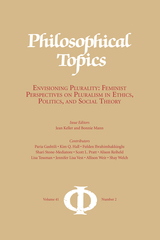
Contents:
Why a Feminist Volume on Pluralism? – Bonnie Mann and Jean Keller
PLURALISM ’S FAILURES AND CERTAIN CONDITIONS FOR THE POSSIBILITY OF SUCCESS
Indigenous Agencies and the Pluralism of Empire – Scott L. Pratt
What Would Philosophic Pluralism Look Like?: True Dialogue, Epistemic Credibility, Rational Parity, and Death in the University – Jennifer Lisa Vest
Asking Too Much? Civility vs. Pluralism – Alison Reiheld
Attending to Others: Simone Weil and Epistemic Pluralism – Shari Stone-Mediatore
FEMINIST PLURALISM AND RELIGIOUS WORLDVIEWS
Islamic Feminisms and Freedom – Allison Weir
Is an “Islamic Feminism” Possible?: Gender Politics in the Contemporary Islamic Republic of Iran – Paria Gashtili
Beyond the Modern/Religious Dichotomy: The Veil and Feminist Solidarity in Contemporary Turkey – Fulden Ibrahimhakkioglu
Philosophy, Religion, Race, and Queerness: A Question of Accommodation or Access – Kim Q. Hall
FEMINIST PLURALISM AND FUNDAMENTAL VALUES
Value Pluralism, Intuitions, and Reflective Equilibrium – Lisa Tessman
Radical-cum-Relation: Bridging Feminist Ethics and Native Individual Autonomy – Shay Welch

Understanding the significance of adult play in the life of modern societies
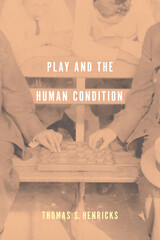
Within the social sciences, few matters are as significant as the study of human play--or as neglected. In Play Reconsidered, rather than viewing play simply as a preoccupation of the young and a vehicle for skill development, Thomas S. Henricks argues that it’s a social and cultural phenomenon of adult life, enveloped by wider structures and processes of society. In that context, he argues that a truly sociological approach to play should begin with a consideration of the largely overlooked writings on play and play-related topics by some of the classic sociological thinkers of the twentieth century.
Henricks explores Karl Marx’s analysis of creativity in human labor, examines Emile Durkheim’s observations on the role of ritual and the formation of collective consciousness, extends Max Weber’s ideas about the process of rationalization to the realm of expressive culture and play, surveys Georg Simmel’s distinctive approach to sociology and sociability, and discusses Erving Goffman’s focus on human conduct as process and play as “encounter.” These and other discussions of the contributions of more recent sociologists are framed by an initial consideration of Johan Huizinga’s famous challenge to understand the nature and significance of play. In a closing synthesis, Henricks distinguishes play from other forms of human social expression, particularly ritual, communitas, and work.



Drawing on intellectual discourses from 2013 onwards, this book maps those collisions, reconstructing Ukraine’s “noumenal parliament” — the constellation of voices that have vied to define the nation’s future. Bogdan Kolesnyk explains why Ukraine’s is not a single story but a composite of many, why neither liberal consolidation nor national stories alone provide a sufficient answer, and suggests how justice, reason and republican institutions might be the anchors for plural polity to endure.
In attempting to understand Ukrainian socio-political reality on its own terms from beyond its borders, this book urgently enquires what kind of future is worth fighting for?
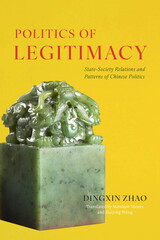
The Chinese communist state has survived massive social changes, including the introduction of capitalist markets, an ongoing explosion of technological innovation, and an unprecedented jump in wealth and education, accompanied by a major cultural transformation. How has China managed to maintain its power even as the ground has so profoundly shifted? In Politics of Legitimacy, Dingxin Zhao argues that state power can be legitimized in three ideal-typical ways: a set of values upheld by the state (ideological legitimacy), recognized political processes such as regular competitive elections (procedural legitimacy), and the state’s capacity to provide public goods (performance legitimacy).
Building on this theoretical framework, Zhao analyzes different aspects of Chinese politics, including the tragic ending of the 1989 pro-democracy movement, the weak development of mass-based nationalism in post-Mao China, the reasons behind China’s economic success, the anti-establishment tendency of the Chinese mass media and social media, and the sources of political tension in China, despite a superb economy. Moreover, Zhao’s innovative framework is widely applicable beyond China, shifting our attention from regime-type categories to the tools and relationships that determine their survival or collapse, and illuminating the current global emergence of conservatism and religious nationalism.
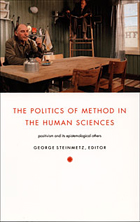
Contributors explore and contrast some of the major alternatives to positivist epistemologies, including Marxism, psychoanalysis, poststructuralism, narrative theory, and actor-network theory. Almost all the essays are written by well-known practitioners of the fields discussed. Some essayists approach positivism and anti-positivism via close readings of texts influential in their respective disciplines. Some engage in ethnographies of the present-day human sciences; others are more historical in method. All of them critique contemporary social scientific practice. Together, they trace a trajectory of thought and method running from the past through the present and pointing toward possible futures.
Contributors. Andrew Abbott, Daniel Breslau, Michael Burawoy, Andrew Collier , Michael Dutton, Geoff Eley, Anthony Elliott, Stephen Engelmann, Sandra Harding, Emily Hauptmann, Webb Keane, Tony Lawson, Sophia Mihic, Philip Mirowski, Timothy Mitchell, William H. Sewell Jr., Margaret R. Somers, George Steinmetz, Elizabeth Wingrove
Along with pragmatism's impact on American sociology and social research from 1895 to the 1940s, Joas traces its reception by French and German traditions during this century. He explores the influences of pragmatism—often misunderstood—on Emile Durkheim's sociology of knowledge, and on German thought, with particularly enlightening references to its appropriation by Nazism and its rejection by neo-Marxism. He also explores new currents of social theory in the work of Habermas, Castoriadis, Giddens, and Alexander, fashioning a bridge between Continental thought, American philosophy, and contemporary sociology; he shows how the misapprehension and neglect of pragmatism has led to systematic deficiencies in contemporary social theory.
From this skillful historical and theoretical analysis, Joas creates a powerful case for the enduring legacy of Peirce, James, Dewey, and Mead for social theorists today.

Kawashima draws on previously unseen archival materials from interwar Japan as he describes how Korean migrants struggled against various recruitment practices, unfair and discriminatory wages, sudden firings, racist housing practices, and excessive bureaucratic red tape. Demonstrating that there was no single Korean “minority,” he reveals how Koreans exploited fellow Koreans and how the stratification of their communities worked to the advantage of state and capital. However, Kawashima also describes how, when migrant workers did organize—as when they became involved in Rōsō (the largest Korean communist labor union in Japan) and in Zenkyō (the Japanese communist labor union)—their diverse struggles were united toward a common goal. In The Proletarian Gamble, his analysis of the Korean migrant workers' experiences opens into a much broader rethinking of the fundamental nature of capitalist commodity economies and the analytical categories of the proletariat, surplus populations, commodification, and state power.


Offering models of care beyond capitalist constraints
For too long, questions of care provision and inclusion have been shaped by economic justifications. This has led to the deprivation of care to individuals and communities based on capitalist assumptions about what and who can be cared for. Proposals for a Caring Economy takes these assumptions to task. Moving between examples focused on immigration and agriculture, patients and art audiences, green energy transitions and unhoused people, prison abolitionists and clients of domestic violence services, the contributors here argue that we need new ways to conceptualize care and its applications.
Proposals for a Caring Economy articulates an economy that situates care at the forefront; sees the preservation of individual, community, and environmental wellbeing as the primary good; and focuses attention on building a sustainable economy of caring that will radically transform social connections and possibilities.
Contributors: Chelsey R. Carter, Yale U; David McDermott Hughes, Rutgers U; Stephanie Delise Jones, U of California, Riverside; Sameena Mulla, Emory U; Katy Overstreet, Saxo Institute, U of Copenhagen; Michelle Parsons, Northern Arizona U; Adair Rounthwaite, U of Washington; Damien M. Sojoyner, U of California, Irvine; Emily Yates-Doerr, Oregon State U.

"Punishment and Modern Society is an outstanding delineation of the sociology of punishment. At last the process that is surely the heart and soul of criminology, and perhaps of sociology as well—punishment—has been rescued from the fringes of these 'disciplines'. . . . This book is a first-class piece of scholarship."—Graeme Newman, Contemporary Sociology
"Garland's treatment of the theorists he draws upon is erudite, faithful and constructive. . . . Punishment and Modern Society is a magnificent example of working social theory."—John R. Sutton, American Journal of Sociology
"Punishment and Modern Society lifts contemporary penal issues from the mundane and narrow contours within which they are so often discussed and relocates them at the forefront of public policy. . . . This book will become a landmark study."—Andrew Rutherford, Legal Studies
"This is a superbly intelligent study. Its comprehensive coverage makes it a genuine review of the field. Its scholarship and incisiveness of judgment will make it a constant reference work for the initiated, and its concluding theoretical synthesis will make it a challenge and inspiration for those undertaking research and writing on the subject. As a state-of-the-art account it is unlikely to be bettered for many a year."—Rod Morgan, British Journal of Criminology
Winner of both the Outstanding Scholarship Award of the Crime and Delinquency Division of the Society for the Study of Social Problems and the Distinguished Scholar Award from the American Sociological Association's Crime, Law, and Deviance Section
READERS
Browse our collection.
PUBLISHERS
See BiblioVault's publisher services.
STUDENT SERVICES
Files for college accessibility offices.
RECENTLY PUBLISHED







UChicago Accessibility Resources
home | accessibility | search | about | contact us
BiblioVault ® 2001 - 2026
The University of Chicago Press