
 A SCHOLARLY BOOK REPOSITORY
9 start with Q start with Q
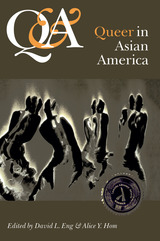
Q & A approaches matters of identity from a variety of points of view and academic disciplines in order to explore the multiple crossings of race and ethnicity with sexuality and gender. Drawing together the work of visual artists, fiction writers, community organizers, scholars, and participants in roundtable discussions, the collection gathers an array of voices and experiences that represent the emerging communities of a queer Asian America. Collectively, these contributors contend that Asian American studies needs to be more attentive to issues of sexuality and that queer studies needs to be more attentive to other aspects of difference, especially race and ethnicity. Vigorously rejecting the notion that a symmetrical relationship between race and homosexuality would weaken lesbian/gay and queer movements, the editors refuse to "believe that a desirably queer world is one in which we remain perpetual aliens -- queer houseguests -- in a queer nation."
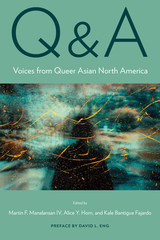
First published in 1998, Q & A: Queer in Asian America, edited by David L. Eng and Alice Y. Hom, became a canonical work in Asian American studies and queer studies. This new edition of Q & A is neither a sequel nor an update, but an entirely new work borne out of the progressive political and cultural advances of the queer experiences of Asian North American communities.
The artists, activists, community organizers, creative writers, poets, scholars, and visual artists that contribute to this exciting new volume make visible the complicated intertwining of sexuality with race, class, gender, and ethnicity. Sections address activism, radicalism, and social justice; transformations in the meaning of Asian-ness and queerness in various mass media issues of queerness in relation to settler colonialism and diaspora; and issues of bodies, health, disability, gender transitions, death, healing, and resilience.
The visual art, autobiographical writings, poetry, scholarly essays, meditations, and analyses of histories and popular culture in the new Q & Agesture to enduring everyday racial-gender-sexual experiences of mis-recognition, micro-aggressions, loss, and trauma when racialized Asian bodies are questioned, pathologized, marginalized, or violated. This anthology seeks to expand the idea of Asian and American in LGBTQ studies.
Contributors: Marsha Aizumi, Kimberly Alidio, Paul Michael (Mike) Leonardo Atienza, Long T. Bui, John Paul (JP) Catungal, Ching-In Chen, Jih-Fei Cheng, Kim Compoc, Sony Coráñez Bolton, D’Lo, Patti Duncan, Chris A. Eng, May Farrales, Joyce Gabiola, C. Winter Han, Douglas S. Ishii, traci kato-kiriyama, Jennifer Lynn Kelly, Mimi Khúc, Anthony Yooshin Kim, Việt Lê, Danni Lin, Glenn D. Magpantay, Leslie Mah, Casey Mecija, Maiana Minahal, Sung Won Park, Thea Quiray Tagle, Emily Raymundo, Vanita Reddy, Eric Estuar Reyes, Margaret Rhee, Thomas Xavier Sarmiento, Pahole Sookkasikon, Amy Sueyoshi, Karen Tongson, Kim Tran, Kay Ulanday Barrett, Reid Uratani, Eric C. Wat, Sasha Wijeyeratne, Syd Yang, Xine Yao, and the editors

If a creative individual identifies as queer or trans, does that fact belong solely to the realm of biography, or does it pertain to their artistic achievement? In Queer and Trans Aesthetics, Lloyd Whitesell discusses literature, visual culture, audio-visual media, music, and performance from the 19th to the 21st century. Through this analysis, Whitesell develops a systematic framework to enrich our understanding of LGBTQ aesthetics and cultural production. He traces the history of queer aesthetic inquiry, develops a justification for a synthetic approach, identifies a fund of expressive strategies motivated by queer subjectivity, and highlights how such strategies create affinity across differences of gender, race, local context, and artistic media.
Rooted in a gender-inclusive theory of queer/trans subjectivity, the book draws on testimony from people of diverse backgrounds, genders, and races. Whitesell engages with debates in the existing scholarly literature while making connections between a wide range of artists: some from mainstream canons, some established subcultural figures, and others only now emerging as notable contributors to queer culture. The book explores five expressive archetypes or poses which have had profound significance in queer art traditions: the Monster, the Victim, the Trickster, the Dandy, and the Dreamer. Each offers a repertoire of creative responses to social oppression and configures queer subjective experience in a unique way. With its unique systematic approach, Queer and Trans Aesthetics enhances our knowledge of queer aesthetic traditions across genres and time.
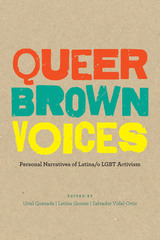
In the last three decades of the twentieth century, LGBT Latinas/os faced several forms of discrimination. The greater Latino community did not often accept sexual minorities, and the mainstream LGBT movement expected everyone, regardless of their ethnic and racial background, to adhere to a specific set of priorities so as to accommodate a “unified” agenda. To disrupt the cycle of sexism, racism, and homophobia that they experienced, LGBT Latinas/os organized themselves on local, state, and national levels, forming communities in which they could fight for equal rights while simultaneously staying true to both their ethnic and sexual identities. Yet histories of LGBT activism in the 1970s, 1980s, and 1990s often reduce the role that Latinas/os played, resulting in misinformation, or ignore their work entirely, erasing them from history.
Queer Brown Voices is the first book published to counter this trend, documenting the efforts of some of these LGBT Latina/o activists. Comprising essays and oral history interviews that present the experiences of fourteen activists across the United States and in Puerto Rico, the book offers a new perspective on the history of LGBT mobilization and activism. The activists discuss subjects that shed light not only on the organizations they helped to create and operate, but also on their broad-ranging experiences of being racialized and discriminated against, fighting for access to health care during the HIV/AIDS epidemic, and struggling for awareness.

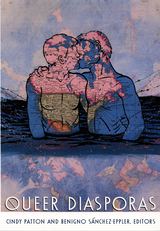
Incorporating literary analysis, ethnographic research, and theories of diaspora, migration, and transnationalism, the essays in this volume address an impressive range of topics, from the divergent medical and epidemiological understandings of the AIDS pandemic to 1950s lesbian pulp fiction. While one chapter focuses on the appropriation of religious ceremony by gay Filipino immigrants in New York City, another investigates the implicit connection between Jewishness and homosexuality in the work of Freud. The gendering of domestic roles in food preparation and consumption in Japanese society gives way to a discussion of Cuban and Jamaican homoeroticism as seen in the works of Reinaldo Arenas and Claude McKay. Chilean author D’Halmar’s orientalization of Spain as queer space and the hybrid nature of queer ‘zine culture in Quebec are the subject of others. The collection concludes with a monologue by “Walid,” a young gay Arab living in the occupied territory, whose sexual and national identities change according to his sexual and social needs.
Illuminating the complex nature of queerness in the postmodern world, Queer Diasporas contributes to the advancement of gay and lesbian studies. It will be important to those working in cultural, literary, and postcolonial studies.
Contributors. Michele Aina Barale, Daniel Boyarin, Sandra Buckley, Rhonda Cobham, Amir Sumaka’i Fink, Marcie Frank, Martin F. Manalansan IV, Sylvia Molloy, Cindy Patton, Jacob Press, Jennifer Robertson, Benigno Sánchez-Eppler
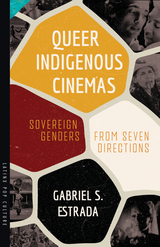
The seven Indigenous directions—east, south, west, north, down, up, and center—provide a map of understanding gender in media history.
In Queer Indigenous Cinemas, scholar Gabriel S. Estrada offers an analysis of queer Indigenous media from the Americas, the Pacific, and the Caribbean. This groundbreaking work uses Indigenous directional space and sovereign mapping methods to uncover the emotional, spiritual, and cultural dimensions of queer Indigenous lives. The book’s seven chapters—each one of the directions—look closely at media such as cinema and streaming videos that draw on Indigenous concepts from diverse nations such as Diné, Caxcan, Kanaka Maoli, and Nehiyawak. Estrada discusses how the cinema brings into focus the ways that many Indigenous genders do not conform with the male/female binary, genders and sexualities that may or may not overlap with contemporary constructions of gay, lesbian, bisexual, transgender, intersex, and two-spirit (LGBTQI2+) identities.
Highlighting the struggles and resistances of two-spirit peoples, Estrada’s analysis engages with films that represent the diverse and sovereign identities of queer Indigenous peoples. Estrada provides a framework for understanding how queer Indigenous media producers confront colonial trauma and reclaims space for the spiritual and bodily sovereignty of LGBTQI2+ peoples.
The creators of Superman (Jerry Siegel and Joe Shuster), Batman (Bob Kane and Bill Finger), and the Marvel superheroes (Stan Lee and Jack Kirby), were Jewish, as was the founding editor of Mad magazine (Harvey Kurtzman). They often adapted Jewish folktales (like the Golem) or religious stories (such as the origin of Moses) for their comics, depicting characters wrestling with supernatural people and events. Likewise, some of the most significant graphic novels by Jews or about Jewish subject matter deal with questions of religious belief and Jewish identity. Their characters wrestle with belief—or nonbelief—in God, as well as with their own relationship to the Jews, the historical role of the Jewish people, the politics of Israel, and other issues related to Jewish identity.
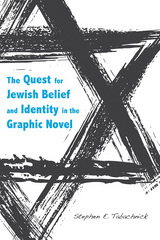
In The Quest for Jewish Belief and Identity in the Graphic Novel, Stephen E. Tabachnick delves into the vivid kaleidoscope of Jewish beliefs and identities, ranging from Orthodox belief to complete atheism, and a spectrum of feelings about identification with other Jews. He explores graphic novels at the highest echelon of the genre by more than thirty artists and writers, among them Harvey Pekar (American Splendor), Will Eisner (A Contract with God), Joann Sfar (The Rabbi’s Cat), Miriam Katin (We Are On Our Own), Art Spiegelman (Maus), J. T. Waldman (Megillat Esther), Aline Kominsky Crumb (Need More Love), James Sturm (The Golem’s Mighty Swing), Leela Corman (Unterzakhn), Ari Folman and David Polonsky (Waltz with Bashir), David Mairowitz and Robert Crumb’s biography of Kafka, and many more. He also examines the work of a select few non-Jewish artists, such as Robert Crumb and Basil Wolverton, both of whom have created graphic adaptations of parts of the Hebrew Bible.
Among the topics he discusses are graphic novel adaptations of the Bible; the Holocaust graphic novel; graphic novels about the Jews in Eastern and Western Europe and Africa, and the American Jewish immigrant experience; graphic novels about the lives of Jewish women; the Israel-centered graphic novel; and the Orthodox graphic novel. The book concludes with an extensive bibliography.
No study of Jewish literature and art today can be complete without a survey of the graphic novel, and scholars, students, and graphic novel fans alike will delight in Tabachnick’s guide to this world of thought, sensibility, and artfulness.

READERS
Browse our collection.
PUBLISHERS
See BiblioVault's publisher services.
STUDENT SERVICES
Files for college accessibility offices.
RECENTLY PUBLISHED






UChicago Accessibility Resources
home | accessibility | search | about | contact us
BiblioVault ® 2001 - 2026
The University of Chicago Press