
 A SCHOLARLY BOOK REPOSITORY
158 start with R start with R
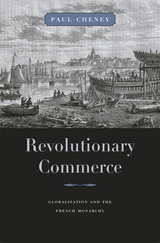
Combining the intellectual history of the Enlightenment, Atlantic history, and the history of the French Revolution, Paul Cheney explores the political economy of globalization in eighteenth-century France.
The discovery of the New World and the rise of Europe's Atlantic economy brought unprecedented wealth. It also reordered the political balance among European states and threatened age-old social hierarchies within them. In this charged context, the French developed a "science of commerce" that aimed to benefit from this new wealth while containing its revolutionary effects. Montesquieu became a towering authority among reformist economic and political thinkers by developing a politics of fusion intended to reconcile France's aristocratic society and monarchical state with the needs and risks of international commerce. The Seven Years' War proved the weakness of this model, and after this watershed reforms that could guarantee shared prosperity at home and in the colonies remained elusive. Once the Revolution broke out in 1789, the contradictions that attended the growth of France's Atlantic economy helped to bring down the constitutional monarchy.
Drawing upon the writings of philosophes, diplomats, consuls of commerce, and merchants, Cheney rewrites the history of political economy in the Enlightenment era and provides a new interpretation of the relationship between capitalism and the French Revolution.
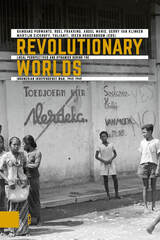
Bringing together two national historiographical traditions which have long remained largely separate, Revolutionary Worlds is the result of a collaboration between the Indonesian research project Proklamasi Kemerdekaan, Revolusi dan Perang di Indonesia ('Proclamation of Independence, Revolution and War in Indonesia', Universitas Gadjah Mada, Yogyakarta) and the Dutch research group of the Regional Studies project, under the umbrella of the research programme Independence, Decolonization, Violence and War in Indonesia, 1945-1950.
The authors of this book – Taufik Ahmad, Galuh Ambar Sasi, Maarten van der Bent, Martijn Eickhoff, Farabi Fakih, Roel Frakking, Apriani Harahap, Anne-Lot Hoek, Sarkawi B. Husain, Julianto Ibrahim, Gerry van Klinken, Erniwati, Mawardi Umar, Anne van der Veer, Abdul Wahid, Tri Wahyuning M. Irsyam, and Muhammad Yuanda Zara – work with various universities and research institutes in Indonesia and the Netherlands.
Published by Bucknell University Press. Distributed worldwide by Rutgers University Press.
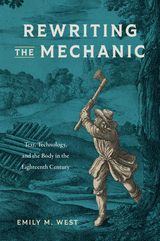
In the eighteenth century, “technology” didn’t name a particular device or a process. It referred instead to written accounts of the mechanical arts, a now-obsolete category encompassing the wide range of work done by hand, from baking bread to building ships. Rewriting the Mechanic examines how these written descriptions, circulating across genres in eighteenth-century Britain, transformed certain mechanical arts by imagining them as newly innovative, authoritative, and able to make speculative possibilities real—as what we now call technological. Reversing the familiar story in which literature simply reflects technological change, West draws on the work of Robert Hooke, Aphra Behn, Daniel Defoe, Maria Edgeworth, and Jane Austen to demonstrate the influence of literary techniques on ideas about masculinity, power, and the body, and how these texts helped to bring the very idea of technological modernity into being.
Published by Bucknell University Press. Distributed worldwide by Rutgers University Press.
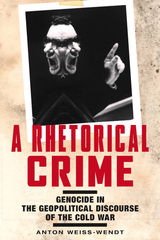
A Rhetorical Crime shows how genocide morphed from a legal concept into a political discourse used in propaganda battles between the United States and the Soviet Union. Over the course of the Cold War era, nearly eighty countries were accused of genocide, and yet there were few real-time interventions to stop the atrocities committed by genocidal regimes like the Cambodian Khmer Rouge.
Renowned genocide scholar Anton Weiss-Wendt employs a unique comparative approach, analyzing the statements of Soviet and American politicians, historians, and legal scholars in order to deduce why their moral posturing far exceeded their humanitarian action.
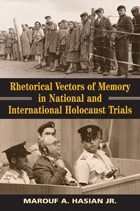
During the past several decades, the twentieth century Holocaust has become a defining event in many histories. This newfound respect for the Judeocide has been cathartic for both individuals and communities, in that it provides evidence that audiences around the world are rethinking the significance of the World War II narratives of bystanders, perpetrators, and victims. Given the complexities of these issues, scholars who are interested in studying Holocaust memory make choices about the questions on which they focus, the artifacts they select for analysis, and the perspectives they want to present.
Hasian reviews how national and international courts have used Holocaust trials as forums for debates about individuated justice, historical record keeping, and pedagogical memory work. He concludes that the trials involving Auschwitz, Demjanjuk, Eichmann, Finta, Nuremberg, Irving, Kastner, Keegstra, Sawoniuk, and Zündel are highly problematic. The author provides a rhetorical analysis of holocaust trials as a way of looking into the question of what role court proceedings play in the creation of Holocaust collective memories.
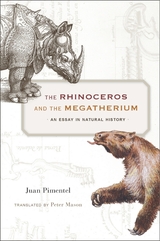
One animal left India in 1515, caged in the hold of a Portuguese ship, and sailed around Africa to Lisbon—the first of its species to see Europe for more than a thousand years. The other crossed the Atlantic from South America to Madrid in 1789, its huge fossilized bones packed in crates, its species unknown. How did Europeans three centuries apart respond to these two mysterious beasts—a rhinoceros, known only from ancient texts, and a nameless monster? As Juan Pimentel explains, the reactions reflect deep intellectual changes but also the enduring power of image and imagination to shape our understanding of the natural world.
We know the rhinoceros today as “Dürer’s Rhinoceros,” after the German artist’s iconic woodcut. His portrait was inaccurate—Dürer never saw the beast and relied on conjecture, aided by a sketch from Lisbon. But the influence of his extraordinary work reflected a steady move away from ancient authority to the dissemination in print of new ideas and images. By the time the megatherium arrived in Spain, that movement had transformed science. When published drawings found their way to Paris, the great zoologist Georges Cuvier correctly deduced that the massive bones must have belonged to an extinct giant sloth. It was a pivotal moment in the discovery of the prehistoric world.
The Rhinoceros and the Megatherium offers a penetrating account of two remarkable episodes in the cultural history of science and is itself a vivid example of the scientific imagination at work.
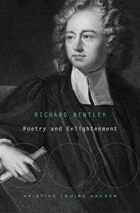
What made the classical scholar Richard Bentley deserve to be so viciously skewered by two of the literary giants of his day—Jonathan Swift in the Battle of the Books and Alexander Pope in the Dunciad? The answer: he had the temerity to bring classical study out of the scholar's closet and into the drawing rooms of polite society. Kristine Haugen’s highly engaging biography of a man whom Rhodri Lewis characterized as “perhaps the most notable—and notorious—scholar ever to have English as a mother tongue” affords a fascinating portrait of Bentley and the intellectual turmoil he set in motion.
Aiming at a convergence between scholarship and literary culture, the brilliant, caustic, and imperious Bentley revealed to polite readers the doings of professional scholars and induced them to pay attention to classical study. At the same time, Europe's most famous classical scholar adapted his own publications to the deficiencies of non-expert readers. Abandoning the church-oriented historical study of his peers, he worked on texts that interested a wider public, with spectacular and—in the case of his interventionist edition of Paradise Lost—sometimes lamentable results.
If the union of worlds Bentley craved was not to be achieved in his lifetime, his provocations show that professional humanism left a deep imprint on the literary world of England's Enlightenment.
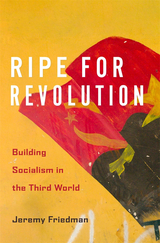
A historical account of ideology in the Global South as the postwar laboratory of socialism, its legacy following the Cold War, and the continuing influence of socialist ideas worldwide.
In the first decades after World War II, many newly independent Asian and African countries and established Latin American states pursued a socialist development model. Jeremy Friedman traces the socialist experiment over forty years through the experience of five countries: Indonesia, Chile, Tanzania, Angola, and Iran.
These states sought paths to socialism without formal adherence to the Soviet bloc or the programs that Soviets, East Germans, Cubans, Chinese, and other outsiders tried to promote. Instead, they attempted to forge new models of socialist development through their own trial and error, together with the help of existing socialist countries, demonstrating the flexibility and adaptability of socialism. All five countries would become Cold War battlegrounds and regional models, as new policies in one shaped evolving conceptions of development in another. Lessons from the collapse of democracy in Indonesia were later applied in Chile, just as the challenge of political Islam in Indonesia informed the policies of the left in Iran. Efforts to build agrarian economies in West Africa influenced Tanzania’s approach to socialism, which in turn influenced the trajectory of the Angolan model.
Ripe for Revolution shows socialism as more adaptable and pragmatic than often supposed. When we view it through the prism of a Stalinist orthodoxy, we miss its real effects and legacies, both good and bad. To understand how socialism succeeds and fails, and to grasp its evolution and potential horizons, we must do more than read manifestos. We must attend to history.

Once the pride of interwar Czechoslovakia, and key during the forced industrialization of the Stalinist period, during the 1970s and 1980s the Czechoslovak railway sector showed the symptoms of the political tiredness and economic exhaustion of the Soviet Bloc. This book examines the failure of central economic planning through the lens of this national transport system.
Based on the presentation of its history and on the detailed scrutiny of the actors, institutions, internal mechanisms, and conditions of the railway sector, the analysis reveals the identities of the real stakeholders in the state administration. This case shows how the country was governed by Communist Party institutions and government ministries, and how developments in the transportation sector—like in every sector—reflected their priorities. Numerous tables with selected statistics underscore the economic analysis and black and white photos offer a glimpse on the technical base of the railway sector.
The book is filled with enlightening comparisons of the Czechoslovak transportation industry with its counterparts in the whole Eastern Bloc. Integration into the Council for Mutual Economic Assistance (Comecon) of the Bloc could have been an asset, yet the records have more to say about conflicts than cooperation.
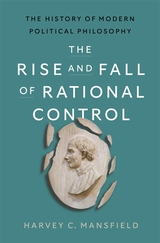
A renowned scholar traces the evolution of modern political philosophy.
The Rise and Fall of Rational Control is a bold interpretation of centuries of intellectual revolutions. Based on Harvey C. Mansfield’s legendary Harvard course, taught for decades to rapt classrooms, this volume is both a grand work of ideas and an elucidating reflection on liberalism, its eclipse, and the possibility of renewal.
Mansfield locates the birth of modern political philosophy in the work of Niccolò Machiavelli, the first to assert that the objective of politics is not to achieve wishful ideals of justice or virtue—as the ancients had it—but to manipulate the brute facts of the world in service of interests. Here rational control, free from the order of gods or God, is the key to achieving the modern order, which can liberate humans from slavery and conflict. Hobbes and Locke later develop Machiavelli’s modern idea, laying foundations for liberalism. Then comes the first crisis in the form of Rousseau, who introduces historical change into the very idea of reason, which itself is said to evolve. After Rousseau, history takes center stage, as witnessed in Kant, Marx, and Hegel. The second crisis of modernity arrives with Nietzsche, who casts doubt on reason itself. Ever since, political thought has been stranded in the desert of postmodernism, where Machiavelli’s necessities are replaced by faded subjectivity.
Tracing the rise and fall of rational control, Mansfield asks where we go from here. Can we progress beyond our unease with what is modern, or should we aim to return somehow to what came before?
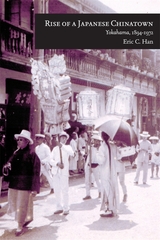
Rise of a Japanese Chinatown is the first English-language monograph on the history of a Chinese immigrant community in Japan. It focuses on the transformations of that population in the Japanese port city of Yokohama from the Sino-Japanese War of 1894–1895 to the normalization of Sino-Japanese ties in 1972 and beyond. Eric C. Han narrates the paradoxical story of how, during periods of war and peace, Chinese immigrants found an enduring place within a monoethnic state.
This study makes a significant contribution to scholarship on the construction of Chinese and Japanese identities and on Chinese migration and settlement. Using local newspapers, Chinese and Japanese government records, memoirs, and conversations with Yokohama residents, it retells the familiar story of Chinese nation building in the context of Sino-Japanese relations. But it builds on existing works by directing attention as well to non-elite Yokohama Chinese, those who sheltered revolutionary activists and served as an audience for their nationalist messages. Han also highlights contradictions between national and local identifications of these Chinese, who self-identified as Yokohama-ites (hamakko) without claiming Japaneseness or denying their Chineseness. Their historical role in Yokohama’s richly diverse cosmopolitan past can offer insight into a future, more inclusive Japan.

This first comprehensive and thoroughly documented study of the political development of two of the newly formed nations of Central Africa presents the full story of the successful efforts of the people of Malawi and Zambia to achieve self-government. Following a detailed examination of the impact of British colonial rule, the author provides a new interpretation of the earliest demonstrations of native discontent and he explains how the forces of protest found expression through proto-political parties and the formation of religious sects and millennial movements. He also interprets the objectives and tactics of the ruling white settlers in their abortive effort to establish the Federation of Rhodesia and Nyasaland.
Basing his analysis on archival and other primary sources, including interviews with leading figures, Robert Rotberg traces the origins of the full-fledged political parties in both countries and describes the early congresses which were to become the dominant movements during the struggle for independence in Central Africa. He ends with an analysis of that struggle, bringing the story to its successful conclusion in late 1964. A postscript discusses the important changes of 1965.
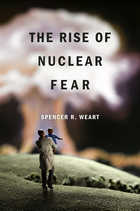
After a tsunami destroyed the cooling system at Japan’s Fukushima Nuclear Power Plant, triggering a meltdown, protesters around the world challenged the use of nuclear power. Germany announced it would close its plants by 2022. Although the ills of fossil fuels are better understood than ever, the threat of climate change has never aroused the same visceral dread or swift action. Spencer Weart dissects this paradox, demonstrating that a powerful web of images surrounding nuclear energy holds us captive, allowing fear, rather than facts, to drive our thinking and public policy.
Building on his classic, Nuclear Fear, Weart follows nuclear imagery from its origins in the symbolism of medieval alchemy to its appearance in film and fiction. Long before nuclear fission was discovered, fantasies of the destroyed planet, the transforming ray, and the white city of the future took root in the popular imagination. At the turn of the twentieth century when limited facts about radioactivity became known, they produced a blurred picture upon which scientists and the public projected their hopes and fears. These fears were magnified during the Cold War, when mushroom clouds no longer needed to be imagined; they appeared on the evening news. Weart examines nuclear anxiety in sources as diverse as Alain Resnais’s film Hiroshima Mon Amour, Cormac McCarthy’s novel The Road, and the television show The Simpsons.
Recognizing how much we remain in thrall to these setpieces of the imagination, Weart hopes, will help us resist manipulation from both sides of the nuclear debate.

One of England’s grand masters of history provides a clear and persuasive interpretation of the creation of “respectable society” in Victorian Britain. Integrating a vast amount of research previously hidden in obscure or academic journals, he covers not only the economy, social structure, and patterns of authority, but also marriage and the family, childhood, homes and houses, work and play.
By 1900 the structure of British society had become more orderly and well-defined than it had been in the 1830s and 1840s, but the result, F. M. L. Thompson shows, was fragmentation into a multiplicity of sections or classes with differing standards and notions of respectability. Each group operated its own social controls, based on what it considered acceptable or unacceptable conduct. This “internalized and diversified” respectability was not the cohesive force its middle-class and evangelical proponents had envisioned. The Victorian experience thus bequeathed structural problems, identity problems, and authority problems to the twentieth century, with which Britain is grappling.
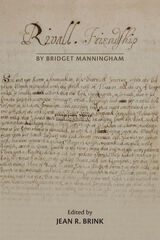
The manuscript for Rivall Friendship was first acquired by the Newberry Library in 1937. At the time of the acquisition, the author of this seventeenth-century romance was anonymous. Scholar Jean R. Brink now suggests, based on dating of the manuscript and her analysis of its feminist themes, that the author was a woman. Specifically, Brink attributes the text to Bridget Manningham, who was the older sister of Thomas Manningham, a Jacobean and Caroline bishop, and the granddaughter of John Manningham, a diarist who recorded performances of Shakespeare’s plays.
Rivall Friendship is a post–English Civil War romance that examines proto-feminist issues, such as patriarchal dominance in the family and marriage. Manningham is scrupulous about maintaining verisimilitude, and unlike more fantastical romances of the period that feature monsters, giants, and magic, this text aspires to a level of probability in its historical and geographical details. The text of Rivall Friendship is accessible to most modern readers, particularly to students and scholars accustomed to working with seventeenth-century texts.
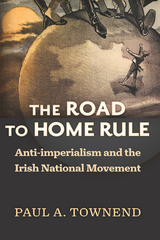
Paul Townend shows that a growing critique of British imperialism shaped a rapidly evolving Irish political consciousness and was a crucial factor giving momentum to the Home Rule and Land League campaigns. Examining newspaper accounts, the rich political cartoons of the era, and the rhetoric and actions of Irish nationalists, he argues that anti-imperialism was a far more important factor in the formation of the independence movement than has been previously recognized in historical scholarship.
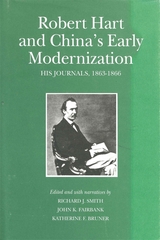
As the Ch’ing government’s Inspector General of the Maritime Customs Service, Robert Hart was the most influential Westerner in China for half a century. These journal entries continue the sequence begun in Entering China’s Service and cover the years when Hart was setting up Customs procedures, establishing a modus operandi with the Ch’ing bureaucracy, and inspecting the treaty ports. They culminate in Hart’s return visit to Europe with the Pin-ch’un Mission and his marriage in Northern Ireland.
Richard Smith, John King Fairbank, and Katherine Bruner interleave the segments of Hart’s journals with lively narratives describing the contemporary Chinese scene and recounting Hart’s responses to the many challenges of establishing a Western-style organization within a Chinese milieu.
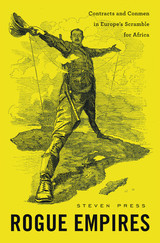
In the 1880s, Europeans descended on Africa and grabbed vast swaths of the continent, using documents, not guns, as their weapon of choice. Rogue Empires follows a paper trail of questionable contracts to discover the confidence men whose actions touched off the Scramble for Africa. Many of them were would-be kings who sought to establish their own autonomous empires across the African continent—often at odds with traditional European governments which competed for control.
From 1882 to 1885, independent European businessmen and firms (many of doubtful legitimacy) produced hundreds of deeds purporting to buy political rights from indigenous African leaders whose understanding of these agreements was usually deemed irrelevant. A system of privately governed empires, some spanning hundreds of thousands of square miles, promptly sprang up in the heart of Africa. Steven Press traces the notion of empire by purchase to an unlikely place: the Southeast Asian island of Borneo, where the English adventurer James Brooke bought his own kingdom in the 1840s. Brooke’s example inspired imitators in Africa, as speculators exploited a loophole in international law in order to assert sovereignty and legal ownership of lands which they then plundered for profit.
The success of these experiments in governance attracted notice in European capitals. Press shows how the whole dubious enterprise came to a head at the Berlin Conference of 1884–1885, when King Leopold of Belgium and the German Chancellor Bismarck embraced rogue empires as legal precedents for new colonial agendas in the Congo, Namibia, and Cameroon.

Utilizing a new and original framework for examining the role of intellectuals in countries transitioning to democracy, Bozóki analyses the rise and fall of dissident intellectuals in Hungary in the late 20th century. He shows how that framework is applicable to other countries too as he forensically examines their activities.
Bozóki argues that the Hungarian intellectuals did not become a ‘New Class’. By rolling transition, he means an incremental, non-violent, elite driven political transformation which is based on the rotation of agency, and it results in a new regime. This is led mainly by different groups of intellectuals who do not construct a vanguard movement but create an open network which might transform itself into different political parties. Their roles changed from dissidents to reformers, to movement organizers and negotiators through the periods of dissidence, open network building, roundtable negotiations, parliamentary activities, and new movement politics.
Through the prism of political sociology, the author focuses on the following questions: Who were the dissident intellectuals and what did they want? Under what conditions do intellectuals rebel and what are the patterns of their protest? This book will be of interest to students, researchers, and public intellectuals around the world aiming to promote human rights and democracy.

The great American thinker Ralph Waldo Emerson and the influential German philosopher Friedrich Nietzsche, though writing in different eras and ultimately developing significantly different philosophies, both praised the individual’s wish to be transformed, to be fully created for the first time. Emerson and Nietzsche challenge us to undertake the task of identity on our own, in order to see (in Nietzsche’s phrase) “how one becomes what one is.”
David Mikics’s The Romance of Individualism in Emerson and Nietzsche examines the argument, as well as the affinity, between these two philosophers. Nietzsche was an enthusiastic reader of Emerson and inherited from him an interest in provocation as a means of instruction, an understanding of the permanent importance of moods and transitory moments in our lives, and a sense of the revolutionary character of impulse. Both were deliberately outrageous thinkers, striving to shake us out of our complacency.
Rather than choosing between Emerson and Nietzsche, Professor Mikics attends to Nietzsche’s struggle with Emerson’s example and influence. Elegant in its delivery, The Romance of Individualism in Emerson and Nietzsche offers a significant commentary on the visions of several contemporary theorists whose interests intersect with those of Emerson and Nietzsche, especially Stanley Cavell, Jacques Lacan, Slavoj Zizek, and Harold Bloom.

In the development of modernist fiction, perhaps no artistic product has had as vaunted a place as the novel, a genre theorized primarily with recourse to Western authors. Here, Łukasz Wodzyński challenges the primacy of the novel as the organizing principle of modernist prose in Eastern and Central Europe, particularly in Polish and Russian culture. By carefully studying some of the most innovative texts from these cultures, Wodzyński posits that the “novel” genre has hindered our understanding of long modernist narratives and proposes to read these pathbreaking works as an early twentieth-century reclamation of the romance. Specifically, he argues that these latter-day romances channel early modernist apocalyptic and utopian ideals through popular genres like science fiction and adventure narratives—and thus imagine a human future freed from modern fixations on control, efficiency, and utility. The romance form, he suggests, was uniquely poised to address the deep civilizational anxieties underwriting modernist literary publications in East-Central Europe. Understanding these works and the ways in which they spoke to these anxieties thus informs not only the study of Polish and Russian literature but also the development of modernism itself.

Scholars today interpret philosophical romanticism along two competing lines: one emphasizes the romantics’ concern with epistemology, the other their concern with metaphysics. Through careful textual analysis and systematic reconstruction of the work of three major romantics—Novalis, Friedrich Schlegel, and Friedrich Schelling—Nassar shows that neither interpretation is fully satisfying. Rather, she argues, one needs to approach the absolute from both perspectives. Rescuing these philosophers from frequent misunderstanding, and even dismissal, she articulates not only a new angle on the philosophical foundations of romanticism but on the meaning and significance of the notion of the absolute itself.
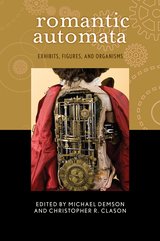
Recent scholarship in post-humanism, post-colonialism, disability studies, post-modern feminism, eco-criticism, and radical Orientalism has significantly affected the critical discourse on this topic. In engaging with the work and thought of Coleridge, Poe, Hoffmann, Mary Shelley, and other Romantic luminaries, the contributors to this collection open new methodological approaches to understanding human interaction with technology that strives to simulate, supplement, or supplant organic life.
Published by Bucknell University Press. Distributed worldwide by Rutgers University Press.

“A magnum opus.”—George Steiner, New Yorker
“Grippingly, even excitingly, readable.”—Edward Said, London Review of Books
What Charles Rosen’s National Book Award–winning The Classical Style did for the music of the Classical period, this volume brilliantly does for the Romantic Era. An exhilarating exploration of the musical language, forms, and styles of the Romantic period, it captures the spirit that enlivened a generation of composers and musicians, and in doing so it conveys the very sense of Romantic music. In readings uniquely informed by his performing experience, Rosen offers consistently acute and thoroughly engaging analyses of works by Schubert, Schumann, Mendelssohn, Bellini, Liszt, and Berlioz, and he presents a new view of Chopin as a master of polyphony and large-scale form. He adeptly integrates his observations on the music with reflections on the art, literature, drama, and philosophy of the time, and thus shows us the major figures of Romantic music within their intellectual and cultural context.
Rosen covers a remarkably broad range of music history and considers the importance to nineteenth-century music of other cultural developments: the art of landscape, a changed approach to the sacred, the literary fragment as a Romantic art form. He sheds new light on the musical sensibilities of each composer, studies the important genres from nocturnes and songs to symphonies and operas, explains musical principles such as the relation between a musical idea and its realization in sound and the interplay between music and text, and traces the origins of musical ideas prevalent in the Romantic period. Rich with striking descriptions and telling analogies, Rosen's overview of Romantic music is an accomplishment without parallel in the literature, a consummate performance by a master pianist and music historian.

The Early Romantics met resistance from artists and academics alike in part because they defied the conventional wisdom that philosophy and the arts must be kept separate. Indeed, as the literary component of Romanticism has been studied and celebrated in recent years, its philosophical aspect has receded from view. This book, by one of the most respected scholars of the Romantic era, offers an explanation of Romanticism that not only restores but enhances understanding of the movement's origins, development, aims, and accomplishments--and of its continuing relevance.
Poetry is in fact the general ideal of the Romantics, Frederick Beiser tells us, but only if poetry is understood not just narrowly as poems but more broadly as things made by humans. Seen in this way, poetry becomes a revolutionary ideal that demanded--and still demands--that we transform not only literature and criticism but all the arts and sciences, that we break down the barriers between art and life, so that the world itself becomes "romanticized." Romanticism, in the view Beiser opens to us, does not conform to the contemporary division of labor in our universities and colleges; it requires a multifaceted approach of just the sort outlined in this book.
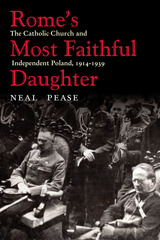
When an independent Poland reappeared on the map of Europe after World War I, it was widely regarded as the most Catholic country on the continent, as “Rome’s Most Faithful Daughter.” All the same, the relations of the Second Polish Republic with the Church—both its representatives inside the country and the Holy See itself—proved far more difficult than expected.
Based on original research in the libraries and depositories of four countries, including recently opened collections in the Vatican Secret Archives, Rome’s Most Faithful Daughter: The Catholic Church and Independent Poland, 1914–1939 presents the first scholarly history of the close but complex political relationship of Poland with the Catholic Church during the interwar period. Neal Pease addresses, for example, the centrality of Poland in the Vatican’s plans to convert the Soviet Union to Catholicism and the curious reluctance of each successive Polish government to play the role assigned to it. He also reveals the complicated story of the relations of Polish Catholicism with Jews, Freemasons, and other minorities within the country and what the response of Pope Pius XII to the Nazi German invasion of Poland in 1939 can tell us about his controversial policies during World War II.
Both authoritative and lively, Rome’s Most Faithful Daughter shows that the tensions generated by the interplay of church and state in Polish public life exerted great influence not only on the history of Poland but also on the wider Catholic world in the era between the wars.

Ronald Harwood’s Tragic Vision offers the first critical analysis of prolific and award-winning British author Ronald Harwood (1934–2020). Though he received an Oscar for The Pianist, a knighthood, and numerous other awards and nominations, Harwood worked as a ghostwriter, script doctor, and veritable unknown for many years. As he became successful, many critics still misread his works and positioned him as a less-fashionable counterpart to his lifelong friend Harold Pinter. This study proposes a conceptual framework to approach his, and others’, work based on the genre of tragedy, offering a greater appreciation for and understanding of the Harwood canon.
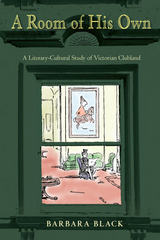
In nineteenth-century London, a clubbable man was a fortunate man, indeed. The Reform, the Athenaeum, the Travellers, the Carlton, the United Service are just a few of the gentlemen’s clubs that formed the exclusive preserve known as “clubland” in Victorian London—the City of Clubs that arose during the Golden Age of Clubs. Why were these associations for men only such a powerful emergent institution in nineteenth-century London? Distinctly British, how did these single-sex clubs help fashion men, foster a culture of manliness, and assist in the project of nation building? What can elite male affiliative culture tell us about nineteenth-century Britishness?
A Room of His Own sheds light on the mysterious ways of male associational culture as it examines such topics as fraternity, sophistication, nostalgia, social capital, celebrity, gossip, and male professionalism. The story of clubland (and the literature it generated) begins with Britain’s military heroes home from the Napoleonic campaign and quickly turns to Dickens’s and Thackeray’s acrimonious Garrick Club Affair. It takes us to Richard Burton’s curious Cannibal Club and Winston Churchill’s The Other Club; it goes underground to consider Uranian desire and Oscar Wilde’s clubbing and resurfaces to examine the problematics of belonging in Trollope’s novels. The trespass of French socialist Flora Tristan, who cross-dressed her way into the clubs of Pall Mall, provides a brief interlude. London’s clubland—this all-important room of his own—comes to life as Barbara Black explores the literary representations of clubland and the important social and cultural work that this urban site enacts. Our present-day culture of connectivity owes much to nineteenth-century sociability and Victorian networks; clubland reveals to us our own enduring desire to belong, to construct imagined communities, and to affiliate with like-minded comrades.
A Room of His Own sheds light on the mysterious ways of male associational culture as it examines such topics as fraternity, sophistication, nostalgia, social capital, celebrity, gossip, and male professionalism. The story of clubland (and the literature it generated) begins with Britain’s military heroes home from the Napoleonic campaign and quickly turns to Dickens’s and Thackeray’s acrimonious Garrick Club Affair. It takes us to Richard Burton’s curious Cannibal Club and Winston Churchill’s The Other Club; it goes underground to consider Uranian desire and Oscar Wilde’s clubbing and resurfaces to examine the problematics of belonging in Trollope’s novels. The trespass of French socialist Flora Tristan, who cross-dressed her way into the clubs of Pall Mall, provides a brief interlude. London’s clubland—this all-important room of his own—comes to life as Barbara Black explores the literary representations of clubland and the important social and cultural work that this urban site enacts. Our present-day culture of connectivity owes much to nineteenth-century sociability and Victorian networks; clubland reveals to us our own enduring desire to belong, to construct imagined communities, and to affiliate with like-minded comrades.
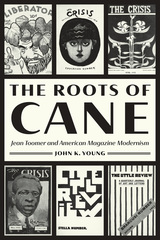
Young interweaves a periodical-studies approach to modernism with book history and critical race theory, resituating Toomer’s uneasy place within Black modernism by asking how original readers would have encountered his work. The different contexts in which those audiences were engaging with Toomer’s portraits of racialized identity in the Jim Crow United States, yield often surprising results.
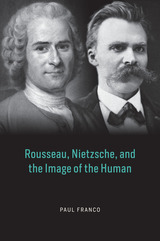
In Rousseau, Nietzsche, and the Image of the Human, Paul Franco examines the relationship between Jean-Jacques Rousseau and Friedrich Nietzsche, arguably the two most influential shapers and explorers of the moral and cultural imagination of late modernity. Both thinkers leveled radical critiques of modern life, but those critiques differed in important respects. Whereas Rousseau focused on the growing inequality of modern society and the hypocrisy, self-division, and loss of civic virtue it spawned, Nietzsche decried the democratic equality he identified with Rousseau and the loss of individual and cultural greatness it entailed. Franco argues, however, that Rousseau and Nietzsche are more than mere critics; they both put forward powerful alternative visions of how we ought to live. Franco focuses specifically on their views of the self and its realization, their understandings of women and the relation between the sexes, and their speculative conceptions of politics. While there are many similarities in their positive visions, Franco argues that it is the differences between them from which we have most to learn.

Beginning its narrative in 1961, when Albanian King Zog I died in a Paris hospital after 22 years in exile, this book tells the colourful story of this Balkan country's first and only monarch. The road to becoming Europe's youngest president in 1925 and then king of Albania in 1928 was paved with feuds and assassinations, a political career-path common in the region. He craved the throne for several reasons; the Balkans were mostly run by kings, and Zog wanted to impress his mother and also give his six sisters an easy social rise.
Once king, his accomplishments were decidedly meagre. He spent most of his time keeping up appearances as a monarch despite the obvious fraud he had imposed on an illiterate and uninterested population. His one great success was that he had almost all his opponents assassinated, usually in broad daylight abroad.
Zog retained his power until his "friend" Mussolini ousted him in 1939. On the surface a Westernizer, this self-proclaimed ruler left Albania almost as he found it, with almost no roads or trains, thoroughly uneducated and utterly impoverished.
In his book, Robert Austin combines Zog’s adventurous life story with a studious analysis of Albania's political history from the fall of the Ottoman Empire to the threshold of Euro-Atlantic integration.
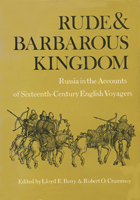
Lloyd E. Berry and Robert O. Crummey offer edited accounts of six English voyagers and their experiences in Muscovy Russia between 1553 and 1600. With modernized spelling and presentation, these accounts are accompanied by a glossary of Russian terms, introductions of their authors, and annotations that help put the travelers’ narratives into perspective.
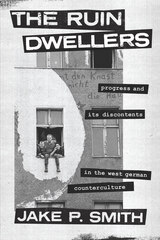
The Ruin Dwellers takes readers into the urban spaces of youth revolts during the 1970s and ’80s in West Germany and elsewhere in western and central Europe. Whereas earlier generations of leftist activists were primarily oriented toward the utopian future, participants in the youth movements of the 1970s and ’80s developed a more complex set of temporal practices that sought to scramble the borders between the past, present, and future.
Examining a rich corpus of radical texts and practices, historian Jake P. Smith shows that squatters and their leftist allies in this period engaged in social, cultural, and aesthetic experiments with modes of autonomous living. Smith brings to life the real and imagined landscapes conjured in squatted houses and street protests; in art, dress, music, graffiti, and film; and in philosophical, poetic, and political texts. In so doing, he offers an eye-opening look at anarchic world-making practices that found new ways of imagining an emancipated future through inhabiting the fractured past.

Many westerners used to call the Soviet Union "Russia." Russians too regarded it as their country, but that did not mean they were entirely happy with it. In the end, in fact, Russia actually destroyed the Soviet Union. How did this happen, and what kind of Russia emerged?
In this illuminating book, Geoffrey Hosking explores what the Soviet experience meant for Russians. One of the keys lies in messianism--the idea rooted in Russian Orthodoxy that the Russians were a "chosen people." The communists reshaped this notion into messianic socialism, in which the Soviet order would lead the world in a new direction. Neither vision, however, fit the "community spirit" of the Russian people, and the resulting clash defined the Soviet world.
Hosking analyzes how the Soviet state molded Russian identity, beginning with the impact of the Bolshevik Revolution and civil war. He discusses the severe dislocations resulting from collectivization and industrialization; the relationship between ethnic Russians and other Soviet peoples; the dramatic effects of World War II on ideas of homeland and patriotism; the separation of "Russian" and "Soviet" culture; leadership and the cult of personality; and the importance of technology in the Soviet world view.
At the heart of this penetrating work is the fundamental question of what happens to a people who place their nationhood at the service of empire. There is no surer guide than Geoffrey Hosking to reveal the historical forces forging Russian identity in the post-communist world.

The explosion of the industrial revolution and the rise of imperialism in the second half of the nineteenth century served to dramatically increase the supply and demand for weapons on a global scale. No longer could arms manufacturers in industrialized nations subsist by supplying their own states' arsenals, causing them to seek markets beyond their own borders.
Challenging the traditional view of arms dealers as agents of their own countries, Jonathan Grant asserts that these firms pursued their own economic interests while convincing their homeland governments that weapons sales delivered national prestige and could influence foreign countries. Industrial and banking interests often worked counter to diplomatic interests as arms sales could potentially provide nonindustrial states with the means to resist imperialism or pursue their own imperial ambitions. It was not mere coincidence that the only African country not conquered by Europeans, Ethiopia, purchased weapons from Italy prior to an attempted Italian invasion.
From the rise of Remington and Winchester during the American Civil War, to the German firm Krupp's negotiations with the Russian government, to an intense military modernization contest between Chile and Argentina, Grant vividly chronicles how an arms trade led to an all-out arms race, and ultimately to war.
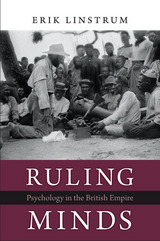
At its zenith in the early twentieth century, the British Empire ruled nearly one-quarter of the world’s inhabitants. As they worked to exercise power in diverse and distant cultures, British authorities relied to a surprising degree on the science of mind. Ruling Minds explores how psychology opened up new possibilities for governing the empire. From the mental testing of workers and soldiers to the use of psychoanalysis in development plans and counterinsurgency strategy, psychology provided tools for measuring and managing the minds of imperial subjects. But it also led to unintended consequences.
Following researchers, missionaries, and officials to the far corners of the globe, Erik Linstrum examines how they used intelligence tests, laboratory studies, and even dream analysis to chart abilities and emotions. Psychology seemed to offer portable and standardized forms of knowledge that could be applied to people everywhere. Yet it also unsettled basic assumptions of imperial rule. Some experiments undercut the racial hierarchies that propped up British dominance. Others failed to realize the orderly transformation of colonized societies that experts promised and officials hoped for. Challenging our assumptions about scientific knowledge and empire, Linstrum shows that psychology did more to expose the limits of imperial authority than to strengthen it.

A provocative case that “failed states” along the periphery of today’s international system are the intended result of nineteenth-century colonial design.
From the Afghan frontier with British India to the pampas of Argentina to the deserts of Arizona, nineteenth-century empires drew borders with an eye toward placing indigenous people just on the edge of the interior. They were too nomadic and communal to incorporate in the state, yet their labor was too valuable to displace entirely. Benjamin Hopkins argues that empires sought to keep the “savage” just close enough to take advantage of, with lasting ramifications for the global nation-state order.
Hopkins theorizes and explores frontier governmentality, a distinctive kind of administrative rule that spread from empire to empire. Colonial powers did not just create ad hoc methods or alight independently on similar techniques of domination: they learned from each other. Although the indigenous peoples inhabiting newly conquered and demarcated spaces were subjugated in a variety of ways, Ruling the Savage Periphery isolates continuities across regimes and locates the patterns of transmission that made frontier governmentality a world-spanning phenomenon.
Today, the supposedly failed states along the margins of the international system—states riven by terrorism and violence—are not dysfunctional anomalies. Rather, they work as imperial statecraft intended, harboring the outsiders whom stable states simultaneously encapsulate and exploit. “Civilization” continues to deny responsibility for border dwellers while keeping them close enough to work, buy goods across state lines, and justify national-security agendas. The present global order is thus the tragic legacy of a colonial design, sustaining frontier governmentality and its objectives for a new age.

Long before Rumania existed as a sovereign state, Rumanians struggled for national identity in Transylvania, an area in Eastern Europe of great ethnic and cultural diversity. The growth of their national consciousness between 1780 and 1849 affords an intriguing case study in nationalism. Keith Hitchins gives us in this book the first systematic survey and analysis of the movement—its leadership, techniques, and literary and political manifestations.
Transylvania at that time was a principality in the Habsburg domain inhabited by four groups: Magyars, Szeklers, Saxons, and Rumanians. Through the centuries the region had frequently changed status—at times independent, more often dominated by either Hungary or Austria. In 1867 it became an integral part of Hungary. After the First World War it was annexed by Rumania (which had won its independence in 1878) and is Rumanian soil today.
Hitchins finds that in the late eighteenth and early nineteenth centuries, the national movement in Transylvania was led by Western-oriented Rumanian intellectuals, the majority of whom were Uniate and Orthodox priests or the sons of priests. Their principal weapons were their writings, the schools, and the church. Influenced by the Enlightenment, these men fashioned the goals of the movement and gave it its characteristic dimensions—its moderation, rationalism, and Western orientation. Through their emphasis on education and their own personal labors in the fields of Rumanian history and linguistics, they succeeded in creating a national ethos, without which political activity of any kind would have been fruitless and on which, later, more secularly-oriented national leaders could base their specific political demands.
Chronicling the changing course of the Rumanian struggle, the author shows that the nationalists began with a demand for the feudal rights enjoyed by their neighbors the Magyars, Szeklers, and Saxons, who were represented in the provincial diet and organized according to estates, or noble nations. Still reasoning within the context of a feudal constitution and thinking in terms of the historic principality, the Rumanians, who constituted a majority of the population of Transylvania, did not yet dare dream of a separate Rumanian nation in which they would be the dominant element. By 1849, however, they had come to regard the recognition of Rumanian autonomy within the Austrian Empire as the paramount issue and even looked toward the accretion of Rumanian-inhabited areas outside Transylvania to the grand duchy they hoped to see established. Ultimately, their goal became a union of all Rumanians, including the Kingdom of Rumania, in a modern national state.
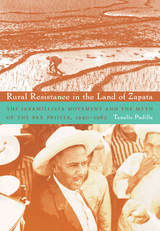
The peasants known in popular memory as Jaramillistas were led by Rubén Jaramillo (1900–1962). An agrarian leader from Morelos who participated in the Mexican Revolution and fought under Zapata, Jaramillo later became an outspoken defender of the rural poor. The Jaramillistas were inspired by the legacy of the Zapatistas, the peasant army that fought for land and community autonomy with particular tenacity during the Revolution. Padilla examines the way that the Jaramillistas used the legacy of Zapatismo but also transformed, expanded, and updated it in dialogue with other national and international political movements.
The Jaramillistas fought persistently through legal channels for access to land, the means to work it, and sustainable prices for their products, but the Mexican government increasingly closed its doors to rural reform. The government ultimately responded with repression, pushing the Jaramillistas into armed struggle, and transforming their calls for local reform into a broader critique of capitalism. With Rural Resistance in the Land of Zapata, Padilla sheds new light on the decision to initiate armed struggle, women’s challenges to patriarchal norms, and the ways that campesinos framed their demands in relation to national and international political developments.


Russia and Iran, 1780–1828 was first published in 1980. Minnesota Archive Editions uses digital technology to make long-unavailable books once again accessible, and are published unaltered from the original University of Minnesota Press editions.
Modern Russo-Iranian relations date from the late eighteenth century, when after several centuries of commercial and diplomatic contact, the two nations entered a period of extended warfare for possession of the Caucasian borderlands, disputed territory that eventually fell to Russia. In her history of that struggle, Muriel Atkin reasseses the motives of major figures on both sides and views the Iranians with more sympathy than Western and Russian historians have usually accorded them. Russia embarked on her course in the Caucasus for reasons connected with defense or trade, and with a longterm imperial goal based on uncritical acceptance of prevailing European doctrines of empire. The new dynasty in Iran, on the other hand, had to fend off Russian attack and secure the borderlands in order to justify its basic claim to power. In the end, the wars brought major disruption to the already unstable borderlands, and left Iran with a discredited government and a controversy over reforms and relations with the West that would continue to cause turmoil in subsequent generations.
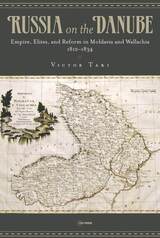
One of the goals of Russia’s Eastern policy was to turn Moldavia and Wallachia, the two Romanian principalities north of the Danube, from Ottoman vassals into a controllable buffer zone and a springboard for future military operations against Constantinople. Russia on the Danube describes the divergent interests and uneasy cooperation between the Russian officials and the Moldavian and Wallachian nobility in a key period between 1812 and 1834. Victor Taki’s meticulous examination of the plans and memoranda composed by Russian administrators and the Romanian elite underlines the crucial consequences of this encounter. The Moldavian and Wallachian nobility used the Russian-Ottoman rivalry in order to preserve and expand their traditional autonomy. The comprehensive institutional reforms born out of their interaction with the tsar’s officials consolidated territorial statehood on the lower Danube, providing the building blocks of a nation state.
The main conclusion of the book is that although Russian policy was driven by self-interest, and despite the Russophobia among a great part of the Romanian intellectuals, this turbulent period significantly contributed to the emergence, several decades later, of modern Romania.
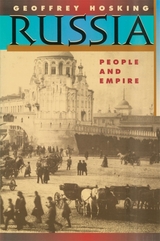
The Soviet Union crumbles and Russia rises from the rubble, once again the great nation--a perfect scenario, but for one point: Russia was never a nation. And this, says the eminent historian Geoffrey Hosking, is at the heart of the Russians' dilemma today, as they grapple with the rudiments of nationhood. His book is about the Russia that never was, a three-hundred-year history of empire building at the expense of national identity.
Russia begins in the sixteenth century, with the inception of one of the most extensive and diverse empires in history. Hosking shows how this undertaking, the effort of conquering, defending, and administering such a huge mixture of territories and peoples, exhausted the productive powers of the common people and enfeebled their civic institutions. Neither church nor state was able to project an image of "Russian-ness" that could unite elites and masses in a consciousness of belonging to the same nation. Hosking depicts two Russias, that of the gentry and of the peasantry, and reveals how the gap between them, widened by the Tsarist state's repudiation of the Orthodox messianic myth, continued to grow throughout the eighteenth and nineteenth centuries. Here we see how this myth, on which the empire was originally based, returned centuries later in the form of the revolutionary movement, which eventually swept away the Tsarist Empire but replaced it with an even more universalist one. Hosking concludes his story in 1917, but shows how the conflict he describes continues to affect Russia right up to the present day.
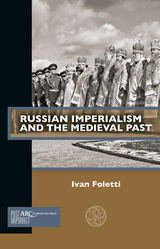
Vladimir Putin justifies his imperialist policy by use of the past. For him, Russia has always been an Empire and must remain so. The story of Russian imperialism has deep historical roots, and this book shows how Byzantium, the most powerful medieval and Christian empire, is repeatedly presented in Russian history as the source of the empire’s imperial legitimacy.
The author reflects on the role of art and the humanities (especially history and art history) within the power ambitions of regimes and political parties over the last two centuries as tools for the repeated reinvention of an empire’s identity; an identity built on a multitude of invented pasts. Within this self-referential narrative, Byzantium becomes the ultimate authority justifying the aggression of the Russian state, and Orthodox belief becomes the bridge linking the medieval past with the present. One of the paradoxes of this narrative is the use of the same past by regimes as different as those of the last Romanovs, Stalin, and Putin, leading to a fundamental question: does this propaganda image really underlie the core identity of Russia?
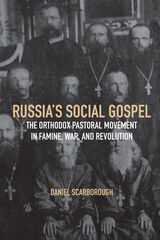
This volume draws upon extensive archival research to examine the effects of the pastoral movement on Russian society and the Orthodox Church. Scarborough argues that the social work of parish clergymen shifted the focus of Orthodox practice in Russia toward cooperative social activism as a devotional activity. He furthers our understanding of Russian Orthodoxy by illuminating the difficult position of parish priests, who were charged with both spiritual and secular responsibilities but were supported by neither church nor state. His nuanced look at the pastorate shows how social and historical traumas shifted perceptions of what being religious meant, in turn affecting how the Orthodox Church organized itself, and contributed to Russia’s modernization.
READERS
Browse our collection.
PUBLISHERS
See BiblioVault's publisher services.
STUDENT SERVICES
Files for college accessibility offices.
RECENTLY PUBLISHED



UChicago Accessibility Resources
home | accessibility | search | about | contact us
BiblioVault ® 2001 - 2026
The University of Chicago Press