front cover of Sabbatian Heresy
Sabbatian Heresy
Writings on Mysticism, Messianism, and the Origins of Jewish Modernity
Edited by Pawel Maciejko
Brandeis University Press, 2017
The pronouncements of Sabbatai Tsevi (1626–76) gave rise to Sabbatianism, a key messianic movement in Judaism that spread across Jewish communities in Europe, Asia, and North Africa. The movement, which featured a set of theological doctrines in which Jewish Kabbalistic tradition merged with Muslim and later Christian elements, suffered a setback with Tsevi’s conversion to Islam in 1666. Nonetheless, for another hundred and fifty years, Sabbatianism continued to exist as a heretical underground movement. It provoked intense opposition from rabbinic authorities for another century and had a significant impact on central developments of later Judaism, such as the Haskalah, the Reform movement, Hasidism, and the secularization of Jewish society. This volume provides a selection of the most original and influential texts composed by Sabbatai Tsevi and his followers, complemented by fragments of the works of their rabbinic opponents and contemporary observers and some literary works inspired by Sabbatianism. An introduction and annotations by Pawel Maciejko provide historical, political, and social context for the documents.
[more]

front cover of Scandinavians in Chicago
Scandinavians in Chicago
The Origins of White Privilege in Modern America
Erika K. Jackson
University of Illinois Press, 2019
Scandinavian immigrants encountered a strange paradox in 1890s Chicago. Though undoubtedly foreign, these newcomers were seen as Nordics--the "race" proclaimed by the scientific racism of the era as the very embodiment of white superiority. As such, Scandinavians from the beginning enjoyed racial privilege and the success it brought without the prejudice, nativism, and stereotyping endured by other immigrant groups. Erika K. Jackson examines how native-born Chicagoans used ideological and gendered concepts of Nordic whiteness and Scandinavian ethnicity to construct social hegemony. Placing the Scandinavian-American experience within the context of historical whiteness, Jackson delves into the processes that created the Nordic ideal. She also details how the city's Scandinavian immigrants repeated and mirrored the racial and ethnic perceptions disseminated by American media. An insightful look at the immigrant experience in reverse, Scandinavians in Chicago bridges a gap in our understanding of how whites constructed racial identity in America.
[more]

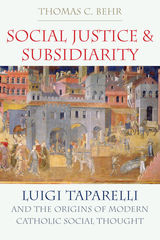
front cover of Social Justice and Subsidiarity
Social Justice and Subsidiarity
Luigi Taparelli and the Origins of Modern Catholic Social Thought
Thomas C. Behr
Catholic University of America Press, 2020
Luigi Taparelli, SJ, 1793-1862, in his Theoretical Treatise of Natural Right Based on Fact, 1840-43, presents a neo-Thomistic approach to social, economic, and political sciences grounded in an integral conception of the human person as social animal but also as rational truth seeker. His conceptions of social justice and of subsidiarity are fundamental to modern Catholic social teaching (CST). His work moves away from traditionalist-conservative reaction in favor of an authentically human, moderately liberal, modernity built on the harmony of faith and reason. He zealously deconstructs laissez-faire liberal ideology and its socialist progeny in scores of articles in the Civiltà Cattolica, the journal that he co-founded in 1850. His arguments figure prominently in the Syllabus of Errors (1864) of Pius IX. Though a moderate liberal himself, his reputation as anti-liberal reactionary and defender of Papal temporal sovereignty is the chief reason why Pope Leo XIII later sought to quiet Taparelli’s contribution to the foundations and pillars of modern CST that began with the restoration of Thomistic philosophy in Aeterni Patris (1879), and the “magna carta” of modern Catholic social teaching, Rerum Novarum (1891). Pius XI relies heavily on Taparelli’s concept of subsidiarity in Quadragesimo Anno (1931), and sought to advance interest in Taparelli studies. However, Taparelli’s eclectic philosophical orientation and writing style have been a considerable stumbling block. In this present book, Taparelli’s ideas are evaluated both for their philosophical character but also in their historical context. Taparelli’s theories of the just society and ordered liberty, are as timely nowadays for reasoned political and ethical discourse as ever. The book includes an appendix of translated portions of the Theoretical Treatise of Natural Right Based on Fact that relate to subsidiarity.
[more]

front cover of The Spice Ports
The Spice Ports
Mapping the Origins of Global Sea Trade
Nicholas Nugent
Brandeis University Press, 2024
A first-class narrative writer blends his unique cartographic and topographic understanding of the key ports of early seaborne commerce.
 
We may think of “globalism” as a recent development but its origins date back to the fifteenth century and beyond, when seafarers pioneered routes across the oceans with the objectives of exploration, trade, and profit.
 
These voyages only became possible after certain technical innovations—improvements in ship design, compasses, and mapping—enabled navigation across unprecedented distances. The mariners’ embarkation points were the vibrant ports of the West—Venice, Amsterdam, Lisbon—and their destinations the exotic ports of the East—Malacca, Goa, Bombay—where they tracked down the elusive spices, so much in demand by Western palates.
 
This development of maritime communication brought benefits apart from culinary delights: the spread of ideas on art, literature, and science. But it was not necessarily beneficial for everyone concerned: colonial ambitions were often disastrous for local populations, who were frequently exploited as slave plantation labor.
 
This wide-ranging account of a fascinating period of global history uses original maps and contemporary artists’ views to tell the story of how each port developed individually while also encouraging us to consider contrasting points of view of the benefits and the damages of the maritime spice trade.

[more]

logo for University of Chicago Press
Street Dog
On the Origins and Future of Our Best Friendship
Lee Alan Dugatkin and Anindita Bhadra
University of Chicago Press

A fascinating look at the lives of the world’s largest dog population—street dogs—offering essential insights into your dog’s behavior and the mysterious origins of human-dog cooperation. 

Today, there are close to a billion dogs on the planet. Some twenty thousand years ago, there were none. How did dogs originate from wolves? And how did we begin our best friendship? Although we can’t go back in time, we can study modern dogs for clues. Of today’s dogs, about eighty percent are street dogs, which don’t live in human homes, but near them, existing in a space between wild and domesticated.

This fascinating and eye-opening book offers us a chance to meet these street dogs and, through them, to imagine the earliest stages of human-canine companionship and collaboration. Award-winning author and animal behaviorist Lee Alan Dugatkin and world canine expert Anindita Bhadra take us from the hallways of Bhadra’s Dog Lab onto the bustling streets of Kolkata, India, where we encounter the intelligent, resourceful, and sometimes mischievous street dogs that have lived alongside humans for hundreds of dog generations. By observing these street dogs’ social structures, survival strategies, and personalities—and comparing them to foxes, wolves, and house dogs, among other species—we learn a lot about canine behavior. Take, for example, Bhadra’s discovery that, no matter how vital food is to a street dog, when given a choice between a meal and a gentle carress, dogs choose love over the food. We also learn that many dogs prefer yellow to other colors; that dog grandmoms may adopt unrelated puppies; and that dog genes harbor a mutation that, in humans, is associated with extreme friendliness. We even begin to understand why dogs pee on, well, everything—particularly on other dog pee.

Watching dogs live independent lives alongside humans, we also start to wonder, as Bhadra does, about the origins of human-dog cooperation. She persuades us that early dogs and humans likely protected each other, as many still do today, and that street dogs may help us to imagine our ancestors’ interactions with the earliest proto-dogs. In their engaging exploration, Dugatkin and Bhadra show that getting to know street dogs may help us understand the past, present, and future of our unique interspecies relationship.

[more]

front cover of The Sympathetic State
The Sympathetic State
Disaster Relief and the Origins of the American Welfare State
Michele Landis Dauber
University of Chicago Press, 2012
Even as unemployment rates soared during the Great Depression, FDR’s relief and social security programs faced attacks in Congress and the courts on the legitimacy of federal aid to the growing population of poor. In response, New Dealers pointed to a long tradition—dating back to 1790 and now largely forgotten—of federal aid to victims of disaster. In The Sympathetic State, Michele Landis Dauber recovers this crucial aspect of American history, tracing the roots of the modern American welfare state beyond the New Deal and the Progressive Era back to the earliest days of the republic when relief was forthcoming for the victims of wars, fires, floods, hurricanes, and earthquakes.
 
Drawing on a variety of materials, including newspapers, legal briefs, political speeches, the art and literature of the time, and letters from thousands of ordinary Americans, Dauber shows that while this long history of government disaster relief has faded from our memory today, it was extremely well known to advocates for an expanded role for the national government in the 1930s, including the Social Security Act. Making this connection required framing the Great Depression as a disaster afflicting citizens though no fault of their own. Dauber argues that the disaster paradigm, though successful in defending the New Deal, would ultimately come back to haunt advocates for social welfare. By not making a more radical case for relief, proponents of the New Deal helped create the weak, uniquely American welfare state we have today—one torn between the desire to come to the aid of those suffering and the deeply rooted suspicion that those in need are responsible for their own deprivation.
 
Contrary to conventional thought, the history of federal disaster relief is one of remarkable consistency, despite significant political and ideological change. Dauber’s pathbreaking and highly readable book uncovers the historical origins of the modern American welfare state.
[more]


Send via email Share on Facebook Share on Twitter