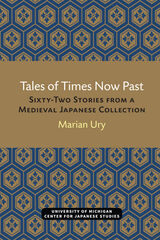
front cover of Tales of Times Now Past
Tales of Times Now Past
Sixty-Two Stories from a Medieval Japanese Collection
Marian Ury
University of Michigan Press, 1993
Tales of Times Now Past is a translation of 62 outstanding tales freshly selected from Konjaku monogatari shu, a Japanese anthology dating from the early twelfth century. The original work, unique in world literature, contains more than one thousand systematically arranged tales from India, China, and Japan. It is the most important example of a genre of collections of brief tales which, because of their informality and unpretentious style, were neglected by Japanese critics until recent years but which are now acknowledged to be among the most significant prose literature of premodern Japan. “Konjaku” in particular has aroused the enthusiasm of such leading 20th-century writers as Akutagawa Ryunosuke and Tanizaki Jun’ichiro.
The stories, with sources in both traditional lore and contemporary gossip, cover an astonishing range—homiletic, sentimental, terrifying, practical-minded, humorous, ribald. Their topics include the life of the Buddha, descriptions of Heaven and Hell, feats of warriors, craftsmen, and musicians, unsuspected vice, virtue, and ingenuity, and the ways and wiles of bandits, ogres, and proverbially greedy provincial governors, to name just a few. Composed perhaps a century after the refined, allusive, aristocratic Tale of Genji, Konjaku represents a masculine outlook and comparatively plebeian social orientation, standing in piquant contrast to the earlier masterpiece. The unknown compiler was interested less in exploring psychological subtleties than in presenting vivid portraits of human foibles and eccentricities. The stories in the present selection have been chosen to provide an idea of the scope and structure of the book as a whole, and also for their appeal to the modern reader. And the translation is based on the premise that the most faithful rendering is also the liveliest.
[more]

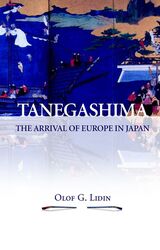
front cover of Tanegashima
Tanegashima
The Arrival of Europe in Japan
Olof Lidin
National University of Singapore Press, 2002
The year 1543 marked the beginning of a new global consciousness in Japan with the arrival of storm-blown Portuguese merchants in Tanegashima Island in southern Japan. Other Portuguese rapidly followed and Japan became aware of a world beyond India. The Portuguese brought with them the musket, which was quickly copied and began to change Japanese warfare. Francis Xavier arrived in 1549 and other Christian missionaries soon after. This is not a new story but it is the first time that Japanese, Portuguese and other European accounts have been brought together and presented in English.
[more]

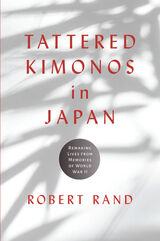
front cover of Tattered Kimonos in Japan
Tattered Kimonos in Japan
Remaking Lives from Memories of World War II
Robert Rand
University of Alabama Press, 2024

Examines Japan’s war generation—Japanese men and women who survived World War Two and rebuilt their lives from memories of that conflict.

Since John Hersey’s Hiroshima—the classic account, published in 1946, of the aftermath of the atomic bombing of that city—very few books have examined the meaning and impact of World War II through the eyes of Japanese men and women who survived that conflict. Tattered Kimonos in Japan does just that: It is an intimate journey into contemporary Japan from the perspective of the generation of Japanese soldiers and civilians who survived World War II, by a writer whose American father and Japanese father-in-law fought on opposite sides of the conflict.

The author, a former NPR senior editor, is Jewish, and he approaches the subject with the sensibilities of having grown up in a community of Holocaust survivors. Mindful of the power of victimhood, memory, and shared suffering, he travels across Japan, including Hiroshima and Nagasaki, meeting a compelling group of men and women whose lives, even now, are defined by the trauma of war, and by lingering questions of responsibility and repentance for Japan’s wartime aggression.

The image of a tattered kimono from Hiroshima is the thread that drives the narrative arc of this emotional story about a writer’s encounter with history, inside the Japan of his father’s generation, on the other side of his father’s war. This is a book about history with elements of family memoir. It offers a fresh and truly unique perspective for readers interested in World War II, Japan, or Judaica; readers seeking cross-cultural journeys; and readers intrigued by Japanese culture, particularly the kimono.
 

[more]

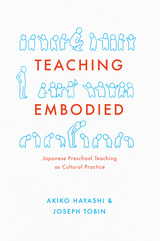
front cover of Teaching Embodied
Teaching Embodied
Cultural Practice in Japanese Preschools
Akiko Hayashi and Joseph Tobin
University of Chicago Press, 2015
When we look beyond lesson planning and curricula—those explicit facets that comprise so much of our discussion about education—we remember that teaching is an inherently social activity, shaped by a rich array of implicit habits, comportments, and ways of communicating. This is as true in the United States as it is in Japan, where Akiko Hayashi and Joseph Tobin have long studied early education from a cross-cultural perspective. Taking readers inside the classrooms of Japanese preschools, Teaching Embodied explores the everyday, implicit behaviors that form a crucially important—but grossly understudied—aspect of educational practice.
           
Akiko Hayashi and Joseph Tobin embed themselves in the classrooms of three different teachers at three different schools to examine how teachers act, think, and talk. Drawing on extended interviews, their own real-time observations, and hours of video footage, they focus on how teachers embody their lessons: how they use their hands to gesture, comfort, or discipline; how they direct their posture, gaze, or physical location to indicate degrees of attention; and how they use the tone of their voice to communicate empathy, frustration, disapproval, or enthusiasm. Comparing teachers across schools and over time, they offer an illuminating analysis of the gestures that comprise a total body language, something that, while hardly ever explicitly discussed, the teachers all share to a remarkable degree. Showcasing the tremendous importance of—and dearth of attention to—this body language, they offer a powerful new inroad into educational study and practice, a deeper understanding of how teaching actually works, no matter what culture or country it is being practiced in. 
[more]

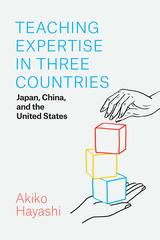
front cover of Teaching Expertise in Three Countries
Teaching Expertise in Three Countries
Japan, China, and the United States
Akiko Hayashi
University of Chicago Press, 2022
A comparison of the development of expertise in preschool teaching in China, Japan, and the United States.

In Teaching Expertise in Three Countries, Akiko Hayashi shows how teachers from  Japan, China, and the United States think about what it means to be an expert teacher. Based on interviews with teachers conducted over the span of fifteen years and videos taken in their classrooms, Hayashi gives us a valuable portrait of expert teachers in the making. While Hayashi’s research uncovered cultural variations in the different national contexts, her analysis of how teachers adapted their pedagogy throughout their careers also revealed many cross-national similarities. Younger teachers often describe themselves as being in a rush, following scripts, and “talking too much,” while experienced teachers describe themselves as being quieter, knowing children better, and being more present.
 
Including a foreword by scholar of early childhood education Joseph Tobin, Teaching Expertise in Three Countries provides a foundation for understanding the sequence and pathways of development over the first decade of teaching in three national contexts, demonstrating the value of the field of comparative education in the process.  
 
[more]

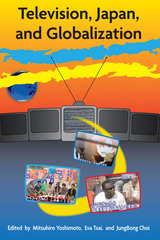
front cover of Television, Japan, and Globalization
Television, Japan, and Globalization
Mitsuhiro Yoshimoto, Eva Tsai, and JungBong Choi, Editors
University of Michigan Press, 2010
Television, Japan, and Globalization makes a monumental contribution to the literature of television studies, which has increasingly recognized its problematic focus on US and Western European media, and a compelling intervention in discussions of globalization, through its careful attention to contradictory and complex phenomena on Japanese TV. Case studies include talent and stars, romance, anime, telops, game and talk shows, and live-action nostalgia shows. The book also looks at Japanese television from a political and economic perspective, with attention to Sky TV, production trends, and Fuji TV as an architectural presence in Tokyo.
The combination of textual analysis, clear argument, and historical and economic context makes this book ideal for media studies audiences. Its most important contribution may be moving the study of Japanese popular culture beyond the tired truisms about postmodernism and opening up new lines of thinking about television and popular culture within and between nations.
[more]

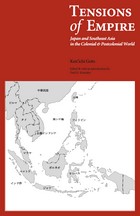
front cover of Tensions Of Empire
Tensions Of Empire
Japan and Southeast Asia in the Colonial and Postcolonial World
Ken’ichi Goto
Ohio University Press, 2003

Beginning with the closing decade of European colonial rule in Southeast Asia and covering the wartime Japanese empire and its postwar disintegration, Tensions of Empire focuses on the Japanese in Southeast Asia, Indonesians in Japan, and the legacy of the war in Southeast Asia. It also examines Japanese perceptions of Southeast Asia and the lingering ambivalence toward Japanese involvement in Asia and toward the war in particular.

Drawing on extensive multilingual archival research and interviews, Ken‘ichi Goto has produced a factually rich and balanced view of this region’s historical events of the last century.

Tensions of Empire features detailed discussions of Portuguese Timor in the 1930s and 1940s, the decolonization of Malaya, and twentieth-century Indonesia. This extended inquiry yields a unique view of the complicated network within and beyond the colonial and imperial relationships between a one-time nonwestern colonial power and an entire region.

Of great interest to students of Japan-Southeast Asia relations and to specialists in the modern history of both Southeast Asia and Japan, Professor Goto’s Tensions of Empire is a fascinating account of Japan’s recent past from the inside.

[more]

front cover of Territorial Natures
Territorial Natures
Imperial Japan and the Mongolian Question
Sakura Christmas
University of Chicago Press, 2026

A critical account of the Japanese occupation in Inner Mongolia.
 
Early in the twentieth century, the steppe borderlands between China and Mongolia erupted in violence. As imperial Japan expanded into the area, this crisis between nomadic and settler communities posed fundamental problems in governance. In response, Japanese and Mongol leaders together proposed a radical solution: demarcating an autonomous region in Manchukuo for minority peoples, a new kind of political space that would later define the territorial structure of Communist China. 
 
In Territorial Natures, Sakura Christmas explores how the fraught partition of this autonomous region warped the ethnic and environmental boundaries of Manchukuo. She challenges its origin story as a socialist invention by the Chinese state, instead seeing it as also a fascist extension of the Japanese occupation. By reading Chinese and Mongolian sources against Japanese archives, Christmas reveals how this contested history seeded the volatile landscape of autonomous regions in the People’s Republic of China today.
 

[more]

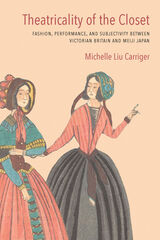
front cover of Theatricality of the Closet
Theatricality of the Closet
Fashion, Performance, and Subjectivity between Victorian Britain and Meiji Japan
Michelle Liu Carriger
Northwestern University Press, 2023
A richly illustrated exploration of fashion and its capacity for generating controversy and constructing social and individual identities

Clothing matters. This basic axiom is both common sense and, in another way, radical. It is from this starting point that Michelle Liu Carriger elucidates the interconnected ways in which gender, sexuality, class, and race are created by the everyday act of getting dressed. Theatricality of the Closet: Fashion, Performance, and Subjectivity between Victorian Britain and Meiji Japan examines fashion and clothing controversies of the nineteenth century, drawing on performance theory to reveal how the apparently superficial or frivolous deeply affects the creation of identity.

By interrogating a set of seemingly disparate examples from the same period but widely distant settings—Victorian Britain and Meiji-era Japan—Carriger disentangles how small, local, ordinary practices became enmeshed in a global fabric of cultural and material surfaces following the opening of trade between these nations in 1850. This richly illustrated book presents an array of media, from conservative newspapers and tabloids to ukiyo-e and early photography, that locate dress as a site where the individual and the social are interwoven, whether in the 1860s and 1870s or the twenty-first century.
 

[more]

front cover of They Came to Japan
They Came to Japan
An Anthology of European Reports on Japan, 1543-1640
Michael Cooper, Editor
University of Michigan Press, 1995
The Japan accidentally discovered by the Europeans in 1543 was a country torn by internecene wars waged by independent barons who recognised no effective central government and were free to appropriate as many neighbouring fiefs as force of arms and treachery would permit. The Japan which deported the Europeans a century later was a stable, highly centralised bureaucracy under the firm control of a usurping family which was to continue to rule the country until well into the Victorian age. Europeans living in Japan at the time have not only recorded the events of this fascinating period but also provided a picture of sixteenth- and seventeenth-century Japanese life. Apart from a few lacunae, a remarkably full description of the country in this century—its history, people, traditions, culture, and religion—can be pieced together.
They Came to Japan collects and translates excerpts from more than thirty early European accounts of Japan, many previously unpublished and extremely rare. Arranged into thematic chapters on aspects of Japanese society, these commentaries are most interesting not for what they say about the Japan but about the European writers themselves. Their attitude towards the newly discovered country and its inhabitants is clearly reflected in their letters and reports, especially when implicit comparisons are made between Japan and Europe. During the course of their discovery of the East, the Europeans had generally adopted the role of representatives of a superior race. They had taken for granted that Europe was synonymous with the civilised world, and thus the discovery of the highly developed Japanese culture and civilisation, which had grown up quite independently of Europe, came as a salutary shock. Because they could not aggressively assert themselves by force of arms in such a remote place, as was their norm, this was to be the first confrontation between East and West on equal terms.
[more]

front cover of Things Seen and Unseen
Things Seen and Unseen
Discourse and Ideology in Tokugawa Nativism
Harry D. Harootunian
University of Chicago Press, 1988
This long-awaited work explores the place of kokugaku (rendered here as "nativism") during Japan's Tokugawa period. Kokugaku, the sense of a distinct and sacred Japanese identity, appeared in the eighteenth century in reaction to the pervasive influence of Chinese culture on Japan. Against this influence, nativists sought a Japanese sense of difference grounded in folk tradition, agricultural values, and ancient Japanese religion. H. D. Harootunian treats nativism as a discourse and shows how it functioned ideologically in Tokugawa Japan.
[more]

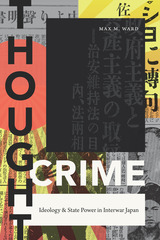
front cover of Thought Crime
Thought Crime
Ideology and State Power in Interwar Japan
Max M. Ward
Duke University Press, 2019
In Thought Crime Max M. Ward explores the Japanese state's efforts to suppress political radicalism in the 1920s and 1930s. Ward traces the evolution of an antiradical law called the Peace Preservation Law, from its initial application to suppress communism and anticolonial nationalism—what authorities deemed thought crime—to its expansion into an elaborate system to reform and ideologically convert thousands of thought criminals throughout the Japanese Empire. To enforce the law, the government enlisted a number of nonstate actors, who included monks, family members, and community leaders. Throughout, Ward illuminates the complex processes through which the law articulated imperial ideology and how this ideology was transformed and disseminated through the law's application over its twenty-year history. In so doing, he shows how the Peace Preservation Law provides a window into understanding how modern states develop ideological apparatuses to subject their respective populations.
[more]

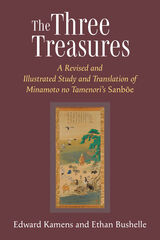
front cover of The Three Treasures
The Three Treasures
A Revised and Illustrated Study and Translation of Minamoto no Tamenori's Sanboe
Edward Kamens and Ethan Bushelle
University of Michigan Press, 2023

When the young Princess Sonshi became a Buddhist nun in the year 984, a scholar-official of the royal court was commissioned to create a guide to the Buddhist religion that would be accessible for her. He did so in the form of the illustrated works of fiction (monogatari) that appealed to women readers of her time and class. The text has survived in later manuscripts; the illustrations, if they ever existed, have not. This revised translation recreates Sonshi’s experience of receiving this multimedia presentation, with illustrations selected to help contemporary readers visualize its content and essays that provide context on the religious and cultural experience of the author. The Three Jewels is a unique document that opens a window onto the world of Buddhist religious experience—especially for women—in high classical Japan, the time of Sei Shōnagon’s Pillow Book and Murasaki Shikibu’s Tale of Genji.
[more]

front cover of Through Japanese Eyes
Through Japanese Eyes
Thirty Years of Studying Aging in America
Yohko Tsuji
Rutgers University Press, 2021
In Through Japanese Eyes, based on her thirty-year research at a senior center in upstate New York, anthropologist Yohko Tsuji describes old age in America from a cross-cultural perspective. Comparing aging in America and in her native Japan, she discovers that notable differences in the panhuman experience of aging are rooted in cultural differences between these two countries, and that Americans have strongly negative attitudes toward aging because it represents the antithesis of cherished American values, especially independence. Tsuji reveals that American culture, despite its seeming lack of guidance for those aging, plays a pivotal role in elders’ lives, simultaneously assisting and constraining them. Furthermore, the author’s lengthy period of research illustrates major changes in her interlocutors’ lives, incorporating their declines and death, and significant shifts in the culture of aging in American society as Tsuji herself gets to know American culture and grows into senescence herself.

Through Japanese Eyes offers an ethnography of aging in America from a cross-cultural perspective based on a lengthy period of research. It illustrates how older Americans cope with the gap between the ideal (e.g., independence) and the real (e.g., needing assistance) of growing older, and the changes the author observed over thirty years of research.
 
[more]

front cover of Time Frames
Time Frames
Japanese Cinema and the Unfolding of History
Scott Nygren
University of Minnesota Press, 2007
Until 1951, when Kurosawa’s Rashomon won the Golden Lion award for best film at the Venice Film Festival, Japanese cinema was isolated from world distribution and the international discourse on film. After this historic event, however, Japanese cinema could no longer be ignored.In Time Frames, Scott Nygren explores how Japanese film criticism and history has been written both within and beyond Japan, before and after Rashomon. He takes up the central question of which, and whose, Japan do critics and historians mean when reviewing the country’s cinema—an issue complicated by assumptions about cultural purity, Japan’s appropriation of Western ideas and technologies, and the very existence of a West and an Orientalist non-West.Deftly moving backward and forward from the pivotal 1951 festival, Nygren traces the invention of Japanese film history as a disciplinary mode of knowledge. His analysis includes such topics as the reconfiguration of prewar films in light of postwar recognition, the application of psychoanalytic theory to Japanese art and culture, and the intersection of kanji and cinema. He considers the historical inscription of 1950s Japan as “the golden age of the humanist film,” the identification of a Japanese New Wave and the implications of categorizing Japanese film through analogy to other national cinemas. Bringing the discussion to Japan’s reception of postmodernism, Nygren looks at the emergence of video art and anime and the end of Japanese film history as a meaningful concept in the rise of the Internet and globalization.Nygren highlights the creative exchange among North American, European, and Asian media, places Japanese film at the center of this discourse, and, ultimately, reveals its global role as a cultural medium, capable of transforming theory.Scott Nygren is associate professor of film and media studies at the University of Florida.
[more]

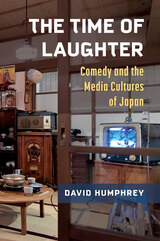
front cover of The Time of Laughter
The Time of Laughter
Comedy and the Media Cultures of Japan
David Humphrey
University of Michigan Press, 2023
From broadcast to social media, comedy plays a prominent role in Japan’s cultural landscape and political landscape. The Time of Laughter explores how comedy grew out of the early days of television to become a central force in shaping Japanese media over the past half-century. Comedy and its impact, David Humphrey argues, established a “time of laughter” in the media of the late twentieth and early twenty-first centuries in Japan. Through masterful interrogation of Japanese televisual archives and media discourse, Humphrey demonstrates that the unique temporality of laughter has had a profound role in the cultural atmosphere of Japan’s recent past. Laughter both complemented and absorbed the profound tensions and contradictions that emerged in Japanese television. Joyous and cacophonous, reaffirming and subverting, laughter simultaneously alienated and unified viewers. Through its exploration of the influence of comedy and the culture of laughter, The Time of Laughter presents a vibrant new take on Japan’s recent media history.
[more]

front cover of To My Dearest Wife, Lide
To My Dearest Wife, Lide
Letters from George B. Gideon Jr. during Commodore Perry’s Expedition to Japan, 1853–1855
Edited by M. Patrick Sauer and David A. Ranzan
University of Alabama Press, 2019
A personal account of Commodore Perry’s landmark expedition to Japan and life in the antebellum navy
 
George B. Gideon Jr. served as second assistant engineer aboard the  USS Powhatan from 1852 to 1856. From his position on the steam  frigate, Gideon traveled to Singapore, Labuan, Borneo, Hong Kong, and many other Asian lands. During his time at sea, Gideon penned dozens of letters to his wife, Lide, back home in Philadelphia. Recently  discovered in the attic of his great-great-grandniece, were fifty-one letters penned by Gideon providing thorough and insightful commentary  throughout the voyage.

Through these correspondences, Gideon laboriously documents the details of his daily life on board, from the food they ate to the technical aspects of his work, as well as observations concerning the historical events unfolding around him, such as Chinese piracy, the Taiping Rebellion, the Crimean War, and the devastation of Shimoda.  To My Dearest Wife, Lide: Letters from George B. Gideon Jr. during  Commodore Perry’s Expedition to Japan, 1853–1855 is a rare first-person account of the landmark American naval expedition to Japan to establish commercial relations between the two countries. Gideon’s letters have been meticulously transcribed and annotated by the editors and are an invaluable primary historical source.

Gideon’s letters are candid and revealing, delving into the rampant dysfunction in the navy of the 1850s—sickness and disease, alcohol abuse, and poor leadership, among other challenges. Gideon also unabashedly shares his own cynical views of the navy’s role in supporting American economic interests in Japan. This firsthand account of the political mission of the Perry expedition is a unique contribution to naval and military history and gives readers a better view of life aboard a navy ship.
[more]

front cover of Tokyo Boogie-woogie and D.T. Suzuki
Tokyo Boogie-woogie and D.T. Suzuki
Shoji Yamada
University of Michigan Press, 2022
Tokyo Boogie-woogie and D.T. Suzuki seeks to understand the tensions between competing cultures, generations, and beliefs in Japan during the years following World War II, through the lens of one of its best-known figures and one of its most forgotten. Daisetsu Teitaro Suzuki (D.T. Suzuki) was a prolific scholar and translator of Buddhism, Zen, and Chinese and Japanese philosophy and religious history. In the postwar years, he was a central figure in the introduction of Buddhism to the United States and other English-language countries, frequently traveling and speaking to this end. His works helped define much of these interpretations of ‘Eastern Religion’ in English, as well as shape views of modern Japanese Buddhism.

Against this famous figure, however, is a largely unknown or forgotten shape: Suzuki Alan Masaru. Alan was D.T. Suzuki’s adopted son and, though he remained within his father’s shadow, is mostly known as the lyricist of the iconic pop hit “Tokyo Boogie-woogie.” Perhaps due to his frequent scandals and the fraught nature of the relationship, Alan remains unmentioned and unstudied by scholars and historians. Yet by exploring the nature of the relationship between these two, Shoji Yamada digs into the conflicting memories and experiences of these generations in Japan.
[more]

front cover of Toward a Gameic World
Toward a Gameic World
New Rules of Engagement from Japanese Video Games
Ben Whaley
University of Michigan Press, 2023
Toward a Gameic World bridges the gap between Japanese popular culture studies and game studies by encouraging a dialogue centered around Japanese-designed video games and social issues. It examines four contemporary Japanese video games in terms of how they engage with some of Japan’s biggest social and personal issues, including traumas: natural disasters (Disaster Report), a declining birthrate and aging population (Catherine), nuclear proliferation (Metal Gear Solid V); and youth social withdrawal (The World Ends with You). This book asks what some of the positive benefits are of working through a site of trauma from within a video game, and how games might teach us about Japanese culture and society through new kinds of interactive narratives, different from literature and film. The book proposes four new strategies of engagement with video games to explore the productive tensions that emerge at the boundaries of virtual reality, augmented reality, and gamification in contemporary Japan.
[more]

logo for University of Chicago Press
Trade and Investment Relations among the United States, Canada, and Japan
Edited by Robert M. Stern
University of Chicago Press, 1989
The economic futures of the United States, Canada, and Japan are tightly linked by the extremely powerful trade network these nations share. Yet because of trade and domestic policies aimed at preserving economic and, some argue, cultural integrity, there has at times been considerable friction among the three nations. Much of the recent trade animus of the U.S. has been aimed Japan, the country with the largest trade surplus with the United States. Canada, the largest trade partner of the U.S., maintains fiscal policies which resemble those of Japan, but has not been the focus of similar concern. Since the actions of each nation reverberate throughout the network, a full and accurate understanding of these complex relations will be essential if ongoing trade negotiations, policymaking, and international relations are to be constructive.

 The papers in this volume were developed from a conference that addressed the need to discover which structural determinants and policies shape the close economic ties among these nations. Leading experts on trade and macroeconomics from all three countries examine disproportionate saving rates, exchange rate volatility, varying industrial policies and levels of financial innovation, the effects of present tax policies and proposed reforms, and the dynamism of major Pacific nations and the leadership role Japan may play in U.S. relations with that region. Several important conclusions are reached by the contributors. They assert that Japan's trade barriers are relatively low overall and are comparable to those maintained by the United States and Canada, and that divergent fiscal policies have been the major source of macroeconomic imbalances between the United States and other major countries in the 1980s. They also conclude that current trade imbalances may persist for some time. The analyses offered here are likely to prove influential in future policymaking and will be of interest to a wide audience, including academic economists, government officials, and students of theoretical and policy issues of international trade, investment, and finance.

[more]

front cover of Trade with Japan
Trade with Japan
Has the Door Opened Wider?
Edited by Paul Krugman
University of Chicago Press, 1991
The realities of Japanese-U.S. trade and investment relations are clouded by mistrust, misinformation, and myth. In what way is the Japanese economic system different, and is it to be emulated or challenged? The contributors, from both the United States and Japan, explore Japanese trade patterns, market structure and trade, financial markets, and industrial and trade policy. Offering analysis of the issues, Trade with Japan is a valuable resource for economists, policymakers, and the business community.
[more]

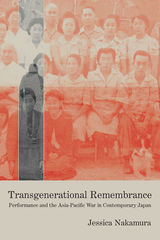
front cover of Transgenerational Remembrance
Transgenerational Remembrance
Performance and the Asia-Pacific War in Contemporary Japan
Jessica Nakamura
Northwestern University Press, 2020

In Transgenerational Remembrance, Jessica Nakamura investigates the role of artistic production in the commemoration and memorialization of the Asia-Pacific War (1931–1945) in Japan since 1989. During this time, survivors of Japanese aggression and imperialism, previously silent about their experiences, have sparked contentious public debates about the form and content of war memories.

The book opens with an analysis of the performance of space at Yasukuni Shinto Shrine, which continues to promote an anachronistic veneration of the war. After identifying the centrality of performance in long-standing dominant narratives, Transgenerational Remembrance offers close readings of artistic performances that tackle subject matter largely obscured before 1989: the kamikaze pilot, Japanese imperialism, comfort women, the Battle of Okinawa, and Japanese American internment. These case studies range from Hirata Oriza’s play series about Japanese colonial settlers in Korea and Shimada Yoshiko’s durational performance about comfort women to Kondo Aisuke’s videos and gallery installations about Japanese American internment.

Working from theoretical frameworks of haunting and ethics, Nakamura develops an analytical lens based on the Noh theater ghost. Noh emphasizes the agency of the ghost and the dialogue between the dead and the living. Integrating her Noh-inflected analysis into ethical and transnational feminist queries, Nakamura shows that performances move remembrance beyond current evidentiary and historiographical debates.
 
[more]

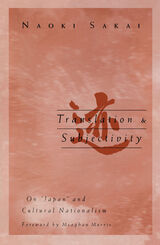
front cover of Translation and Subjectivity
Translation and Subjectivity
On Japan and cultural nationalism
Naoki Sakai
University of Minnesota Press, 1997

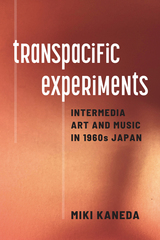
front cover of Transpacific Experiments
Transpacific Experiments
Intermedia Art and Music in 1960s Japan
Miki Kaneda
University of Michigan Press, 2026

Intermedia art—an avant-garde multimedia practice that combines sound and moving images—took root in Japan alongside other places in the 1960s. In Transpacific Experiments, Miki Kaneda analyzes intermedia as a practice that gives form to errant possibilities, unfolding in spaces of the everyday, to offer nuanced insights into the global flow of ideas, influence, and discourses of appropriation. The stories of intermedia art throughout the study offer feminist and transnational perspectives on experimental music and art that disorient existing narratives about the experimental and political in unexpected ways.

Transpacific Experiments contends that social, cultural, and political arrangements local to Japan had a greater influence on the transnational experimental music scene than previously acknowledged. Kaneda’s perspective extends, exceeds, and at times unsettles frameworks for experimental practices, revealing the limitations of any single political or aesthetic lens. 
[more]

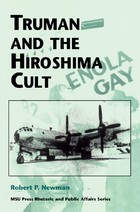
front cover of Truman and the Hiroshima Cult
Truman and the Hiroshima Cult
Robert P. Newman
Michigan State University Press, 1995

The United States dropped atomic bombs on Japan in 1945 to end World War II as quickly and with as few casualties as possible. That is the compelling and elegantly simple argument Newman puts forward in his new study of World War II's end, Truman and the Hiroshima Cult. According to Newman: (1) The U.S. Strategic Bombing Survey conclusions that Japan was ready to surrender without "the Bomb" are fraudulent; (2) America’s "unconditional surrender" doctrine did not significantly prolong the war; and (3) President Harry S. Truman’s decision to use atomic weapons on Japanese cities was not a "racist act," nor was it a calculated political maneuver to threaten Joseph Stalin’s Eastern hegemony. Simply stated, Newman argues that Truman made a sensible military decision. As commander in chief, he was concerned with ending a devastating and costly war as quickly as possible and with saving millions of lives. 
     Yet, Newman goes further in his discussion, seeking the reasons why so much hostility has been generated by what happened in the skies over Hiroshima and Nagasaki in early August, 1945. The source of discontent, he concludes, is a "cult" that has grown up in the United States since the 1960s. It was weaned on the disillusionment spawned by concerns about a military industrial complex, American duplicity and failure in the Vietnam War, and a mistrust of government following Watergate. The cult has a shrine, a holy day, a distinctive rhetoric of victimization, various items of scripture, and, in Japan, support from a powerful Marxist constituency. "As with other cults, it is ahistorical," Newman declares. "Its devotees elevate fugitive and unrepresentative events to cosmic status. And most of all, they believe." Newman’s analysis goes to the heart of the process by which scholars interpret historical events and raises disturbing issues about the way historians select and distort evidence about the past to suit special political agendas.

[more]

logo for University of Minnesota Press
Twelve Views from the Distance
Mutsuo Takahashi
University of Minnesota Press, 2012

From one of the foremost poets in contemporary Japan comes this entrancing memoir that traces a boy’s childhood and its intersection with the rise of the Japanese empire and World War II. Originally published in 1970, this translation is the first available in English.

In twelve chapters that visit and revisit critical points in his boyhood, Twelve Views from the Distance presents a vanished time and place through the eyes of an accomplished poet. Recounting memories from his youth, Mutsuo Takahashi captures the full range of his internal life as a boy, shifting between his experiences and descriptions of childhood friendships, games, songs, and school. With great candor, he also discusses the budding awareness of his sexual preference for men, providing a rich exploration of one man’s early queer life in a place where modern, Western-influenced models of gay identity were still unknown.

Growing up poor in rural southwestern Japan, far from the urban life that many of his contemporaries have written about, Takahashi experienced a reality rarely portrayed in literature. In addition to his personal remembrances, the book paints a vivid portrait of rural Japan, full of oral tradition, superstition, and remnants of customs that have quickly disappeared in postwar Japan. With profuse local color and detail, he re-creates the lost world that was the setting for his beginnings as a gay man and poet.

[more]


Send via email Share on Facebook Share on Twitter