
 A SCHOLARLY BOOK REPOSITORY
22 start with T start with T
The Fascinating History of the Rapid Expansion of Roads, Canals, and Railways in the First Decades of the United States
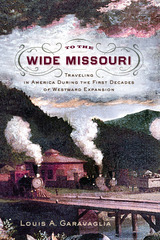
While the great overland migration routes to America’s far west are well known and documented—the California, Oregon, Mormon, and Santa Fe Trails, the Central Overland and Pony Express—less attention has been given to how Americans in the first decades of the republic traveled across the western frontiers of the original colonies. Following the revolution, Americans began to seek their fortunes to the west in greater numbers. Land grants to veterans inspired others to move, including tradesmen, merchants, and tavern owners. With the Louisiana Purchase in 1803, the country doubled in size, and the rate of migration became extraordinary, with wider and more durable roads built, ferries installed at river crossings, canals cut to move goods, regular stage routes established, and ultimately the first railroad tracks laid down. Entire regions that supported few communities in the 1790s exploded in population, and as a result seven new states were admitted to the Union in the decade following the War of 1812. John Bradbury, who traveled through the United States between 1809 and 1811, wrote that “In passing through the upper parts of Virginia, I observed a great number of farms that had been abandoned, on many of which good houses had been erected, and fine apple and peach orchards had been planted. On enquiring the reason, I was always informed that the owners had gone to the western country.” In Maryland, a newspaper reporter wrote, “The time is close at hand when the region west of the Allegheny mountains will sway the destinies of the nation.” By 1839, the National Road extended more than 700 miles from Washington, DC, to central Illinois, New York’s Erie Canal operated from Albany to Buffalo, and the Baltimore and Ohio Railroad carried passengers briskly west, ultimately to the Ohio River.


Shipwreck stories from along Minnesota’s north shore of Lake Superior and Isle Royale
Against the backdrop of the extraordinary history of Great Lakes shipping, Too Much Sea for Their Decks chronicles shipwrecked schooners, wooden freighters, early steel-hulled steamers, whalebacks, and bulk carriers—some well-known, some unknown or forgotten—all lost in the frigid waters of Lake Superior.
Included are compelling accounts of vessels destined for infamy, such as that of the Stranger, a slender wooden schooner swallowed by the lake in 1875, the sailors’ bodies never recovered nor the wreckage ever found; an account of the whaleback Wilson, rammed by a large commercial freighter in broad daylight and in calm seas, sinking before many on board could escape; and the mysterious loss of the Kamloops, a package freighter that went down in a storm and whose sailors were found on the Isle Royale the following spring, having escaped the wreck only to die of exposure on the island. Then there is the ill-fated Steinbrenner, plagued by bad luck from the time of her construction, when she was nearly destroyed by fire, to her eventual (and tragic) sinking in 1953. These tales and more represent loss of life and property—and are haunting stories of brave and heroic crews.
Arranged chronologically and presented in three sections covering Minnesota's North Shore, Isle Royale, and the three biggest storms in Minnesota’s Great Lakes history (the 1905 Mataafa storm, the 1913 hurricane on the lakes, and the 1940 Armistice Day storm), each shipwreck documented within these pages provides a piece to the history of shipping on Lake Superior.
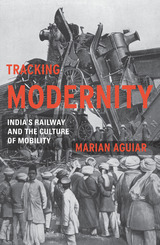
Since the colonial period in India, the railway has been idealized as a rational utopia—a moving box in which racial and class differences might be amalgamated under a civic, secular, and public order. Aguiar charts this powerful image into the postcolonial period, showing how the culture of mobility exposes this symbol of reason as surprisingly dynamic and productive. Looking in turn at the partition of India, labor relations, rituals of travel, works of literature and film, visual culture, and the Mumbai train bombings of 2006, Aguiar finds incongruities she terms “counternarratives of modernity” to signify how they work both with and against the dominant rhetoric. Revealing railways as a microcosm of tensions within Indian culture, Aguiar demonstrates how their representations have challenged prevailing ideas of modernity.
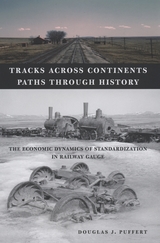
A standard track gauge—the distance between the two rails—enables connecting railway lines to exchange traffic. But despite the benefits of standardization, early North American railways used six different gauges extensively, and even today breaks of gauge at national borders and within such countries as India and Australia are expensive burdens on commerce. In Tracks across Continents, Paths through History, Douglas J. Puffert offers a global history of railway track gauge, examining early choices and the dynamic process of diversity and standardization that resulted.
Drawing on the economic theory of path dependence, and grounded in economic, technical, and institutional realities, this innovative volume traces how early historical events, and even idiosyncratic personalities, have affected choices of gauge ever since, despite changing technology and understandings of what gauge is optimal. Puffert also uses this history to develop new insights in the theory of path dependence. Tracks across Continents, Paths through History will be essential reading for anyone interested in how history and economics inform each other.
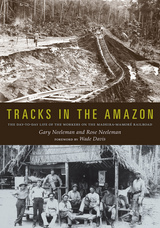
Although there have been many brief chronicles and writings about the Madeira-Mamoré Railroad over the years, most barely scratch the surface of this incredible story. Of particular import in Tracks in the Amazon are the photographs—which until now have rarely been seen—taken by Dana Merrill, a New York photographer hired to document the construction of the railroad. It also includes reproductions of the Porto Velho Marconigram, an English-language newspaper written for and by the American expatriates who lived in the construction headquarters at Porto Velho. Because this unique railroad traversed the densest tropical jungle on earth, more than 10,000 workers lost their lives laying the first five miles of track. The images and descriptions of the life of the workers on the railroad illustrate the challenges of working in the jungles—the unforgiving climate, malaria and yellow feverbearing mosquitoes, and the threat of wild animals—which made conditions for the workers next to impossible.
Finalist for the International Latino Book Awards: Best Book in Nonfiction in Portuguese.

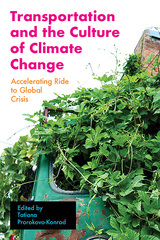
The essays in Transportation and the Culture of Climate Change cover an eclectic range of subject matter, from the association of bicycles with childhood to the songs of Bruce Springsteen, but are united in a central conviction: “Transport is a considerable part of our culture that is as hard to transform as it is for us to stop using fossil fuels—but we do not have an alternative.”

Transport systems are central to daily life, but simultaneously have a salient impact on our environment. However, this perspective has little influence on conventional economic analysis and transport investments, creating dissonance between traditional investment goals and the need to reduce carbon emissions to net zero by 2050. For fifty years, public road and railway expenditures were justified by claims to improve travel time. On the contrary, the average time of travel never changed. Travel Behaviour Reconsidered in an Era of Decarbonisation argues that this outdated economic analysis is misconceived and that fresh perspectives on transport networks are imperative.
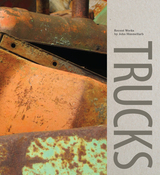
With sculpture, paintings, prints, and drawings, award-winning artist John Himmelfarb explores the iconic American truck. An in-depth consideration of the vehicles that are intrinsically and culturally significant to the American landscape, Trucks: Recent Works by John Himmelfarb showcases the artist's diverse and lighthearted approach, adeptly shifting between mediums, style, and message during his decade-long contemplation of trucks and their specific functions. Under his skillful hands, the utilitarian vehicles of commerce and construction become unique and provocative art forms.
In 2005 and 2006, the truck as narrative becomes center stage for Himmelfarb's work. With his seamless, animated traverse of multiple mediums, viewers cannot help but smile as they appreciate the common truck through unique perspectives. In 2007, another tectonic change occurs in Himmelfarb's pursuit of his theme: as a result of a three-month residency at the John Michael Kohler Arts Center's Arts/Industry program, he begins his first meaningful foray into three-dimensional works.
READERS
Browse our collection.
PUBLISHERS
See BiblioVault's publisher services.
STUDENT SERVICES
Files for college accessibility offices.
RECENTLY PUBLISHED





UChicago Accessibility Resources
home | accessibility | search | about | contact us
BiblioVault ® 2001 - 2026
The University of Chicago Press