
 A SCHOLARLY BOOK REPOSITORY
17 start with T start with T


Trained in philosophy and medicine, the writer, translator, scholar, and political and cultural activist Siegfried Kapper (1821–1879) devoted significant effort to the advancement of Jewish culture in Bohemia, Jewish emancipation, and to the commitment of Jews to contemporary Czech society. The three stories in this collection, which first appeared in the press in the 1840s and were posthumously published as a collection at the end of the century, offer a Romantic and folkloric vision of Jewish culture in Prague.
The first story, “Genenda,” displays Kapper’s operatic eye for detail and drama with its account of a dutiful rabbi’s daughter being swept away by a dashing young man, a Christian nobleman disguised as a Jew. “The Curious Guest” is an intricate tale of a quest for wisdom and power. The final story, “Glowing Coals,” is a supernatural tale of romantic desire and revenge, displaying Kapper’s skill at deploying the tropes of folklore for dramatic literary effect. The collection not only provides a colorful snapshot of nineteenth-century Czech-Jewish culture but also resonates with universal human themes that transcend a single national experience.
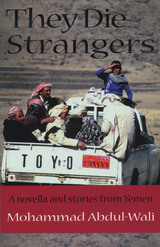
They Die Strangers, a novella and thirteen short stories, is the first full-length work of the distinguished Yemeni writer Mohammad Abdul-Wali to appear in English. Abdul-Wali died tragically in an aviation accident, and his stories were collected after his death by the translators Abubaker Bagader and Deborah Akers.
Abdul-Wali was born in Ethiopia of Arab Yemeni parents. His stories, filled with nostalgia and the bitterness of exile, deal with the common experiences of Yemenis like himself who are caught between cultures by the displacements of civil war or labor migration. His characters include women left behind, children raised without fathers, and men returning home after years of absence. He explores the human condition through the eyes of the oppressed and disenfranchised and is particularly sympathetic to the plight of women.
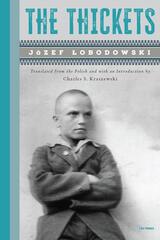
In The Thickets, Lobodowski paints a stark, unforgettable portrait of the turmoil that engulfed the former Russian Empire after the fall of the Tsar and Kerensky’s government. For Stas, once a student at a classical gymnasium, survival now means peddling contraband on the black market. Through his eyes, the reader is plunged into the chaos of war, revolution, and occupation—rendered with visceral power and human urgency.

In this profound and evocative novel, acclaimed Palestinian author Hussein Barghouthi invites readers on an extraordinary, youthful journey through a landscape of memory, longing, alienation, and exile. Translated with great sensitivity by his son, Áthar Barghouthi, this deeply personal narrative unfurls as a stream-of-consciousness odyssey, blurring the lines between reality and dream. Haunted by a pervasive sense of loss, the prose, rich with poetic imagery, explores themes of displacement, identity, and the enduring shadows of a contested homeland.
The Third Bank of the Jordan River is a powerful, meditative work that defies conventional boundaries. With unflinching honesty, Barghouthi confronts the political through deeply human stories, capturing the restless search for meaning and the enduring human hunger for connection and freedom.
A rich compendium of fiction by twenty-five women from eighteen different nations ranging from Lithuania to Ukraine to Poland, the Czech Republic, Romania, Albania, and Slovenia, The Third Shore brings to light a whole spectrum of women's literary accomplishment and experience virtually unknown in the West. Gracefully translated, and with an introduction that establishes their political, historical, and literary context, these stories written in the decade after the fall of the Iron Curtain are tales of the familiar-of illness and death, love and desire, motherhood and war, feminism, and patriarchy-reconceived and turned into something altogether new by the distinctive experience they reflect.
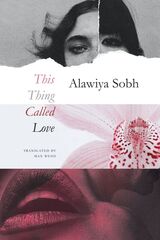
Just before the outbreak of the July 2006 war in Lebanon, a middle-aged woman named Nahla has gone missing. Distraught, besieged, and without any leads, Nahla’s dearest friends—Suad, Azizeh, Hoda, Nadine, and the narrator Alawiya—band together to console one another. They reminisce about the better days of their youth, lifetimes of romantic turmoil, the trouble with love, and their inescapable confrontation with death. Unsure whether Nahla has been killed in the fighting, fled the country, or disappeared into the oblivion of Alzheimer’s, Alawiya pieces together Nahla’s intimate past, simultaneously illuminating the jagged history of modern Lebanon. Through searching discussions with Nahla’s closest confidante Suad, tenacious investigation, and an imaginative effort to reconstruct the life of another, Alawiya might just find a way to bring Nahla back.
In This Thing Called Love, celebrated Lebanese novelist Alawiya Sobh takes the war between Israel and Hizballah as the backdrop for a heart-wrenching story about love, loss, sex, friendship between women, and the universal struggle to come to terms with mortality.

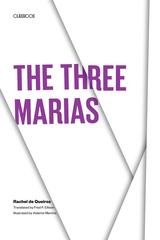
Through this translation of As Três Marias the literary achievements of Rachel de Queiroz may at last be judged and appreciated by the English-reading public. Since none of her four novels has previously been translated into English, The Three Marias will be, for many non-Brazilians, an introduction to this nationally known South American author whose books have been widely praised for their artistic merits. Her literary works are colored by her projected personality, by an intense feeling for her own people, by an omnipresent social consciousness, and by personal experiences in the arid backlands of her native state of Ceará.
Basing this story on certain of her own recollections from the nineteen-twenties, Rachel de Queiroz tells of a girl growing up in the seaport town of Fortaleza, in northeastern Brazil. Fred P. Ellison, whose special field is Brazilian and Spanish-American literature, has captured in his translation the author's graceful style and simplicity of language, and has successfully retained the perspective of an idealistic and gradually maturing girl.

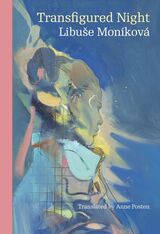
In late 1992, three years after the Velvet Revolution and as Czechoslovakia is about to dissolve into the Czech Republic and Slovakia, choreographer and dancer Leonora Marty, who fled the Communist state decades earlier, has returned to Prague. Having wrapped up her ballet of The Makropulos Affair, the famous dancer meets old classmates, wanders the city through crowds of tourists, and visits the most obscure and unvisited museums. When she is approached by Thomas Asperger, a descendant of ethnic Germans driven from Czechoslovakia after World War II, she must confront three relationships—her relationship with the city of her youth, her homeland’s relationship with its past, and her new romance with this German admirer.
Written in German and published in 1995, by an author whose life mirrored her protagonist’s, the novel provides a cultural tour of Prague. Employing a style as influenced by the operas of Leoš Janácek as the novels of Thomas Pynchon, Transfigured Night is a masterpiece of Czech literature, showing that the culture of this nation comes in a variety of tongues.

While Crouse’s prize-winning collection of short fiction The Man Back There offered up insights into a kind of self-destructive masculinity, these novellas now sensitively and persuasively capture the inner landscapes of women struggling with grief and isolation. Trouble Will Save You is a unique and fully realized work from a keenly empathetic writer.
Praise for The Man Back There:
“In this virtuoso collection of stories, David Crouse guides us directly to where the shadow lies—the disorienting loss, the surprising heartache, the forgotten wound—those inevitable areas of the psyche we all share and through which only truth, illuminated with a such a light touch here, can deliver us; The Man Back There is the work of the real thing.”
—Andre Dubus III, author of House of Sand and Fog
“I chose these stories because they made me feel. I felt the characters like I would feel a stranger in a room or on a bus with me, with an irrational sympathy more animal than moral in its nature.”
—Mary Gaitskill, 2007 Mary McCarthy Prize judge
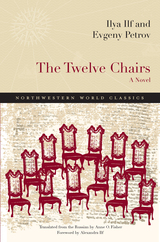
Winner, 2012 Northern California Book Award for Fiction in Translation
More faithful to the original text and its deeply resonant humor, this new translation of The Twelve Chairs brings Ilf and Petrov’s Russian classic fully to life. The novel’s iconic hero, Ostap Bender, an unemployed con artist living by his wits, joins forces with Ippolit Matveyevich Vorobyaninov, a former nobleman who has returned to his hometown to look for a cache of missing jewels hidden in chairs that have been appropriated by the Soviet authorities. The search for the chairs takes them from the provinces of Moscow to the wilds of the Transcaucasus mountains. On their quest they encounter a variety of characters, from opportunistic Soviet bureaucrats to aging survivors of the old propertied classes, each one more selfish, venal, and bungling than the last. A brilliant satire of the early years of the Soviet Union, as well as the inspiration for a Mel Brooks film, The Twelve Chairs retains its universal appeal.
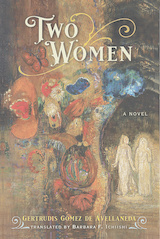
This first English translation of the novel captures the lyrical romanticism of its prose and includes a scholarly introduction to the work and its author, Gertrudis Gómez de Avellaneda, a pioneering feminist and anti-slavery activist who based the character of Catalina on her own experience. Two Women is a searing indictment of the stern laws and customs governing marriage in the Hispanic world, brought to life in a spellbinding, tragic love story.
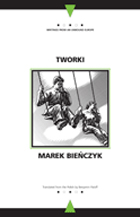
In Tworki, a village just southwest of Warsaw, there is a psychiatric hospital and in that hospital, the patients and their caretakers are hidden from the war just outside their iron gates. Our hero, Jurek, answers an ad in the paper for a job there and finds himself keeping the books alongside a knockout strawberry blonde named Sonia. They and their group of friends—vital young people like Marcel, an initial rival for Jurek; Olek, Sonia’s chosen love; and Janka, with whom Jurek becomes involved—do their jobs, picnic on the weekends, and dance in the gardens on the grounds of the hospital. Jurek speaks often of, and even in, verse, whether he is talking to his friends or in letters to a distant and admiring cousin. He and his friends live lives that defy the discord and destruction of the war in Europe, striving to rediscover or save whatever beauty they can. Much of this beauty is embodied by Sonia, who is beloved of all the friends and patients at the asylum. But the revitalizing spring they all hope will come for Poland is not to arrive this year. Despite the relative safety of their odd surroundings, the world and the war soon come for the friends. Olek’s absences are longer and unexplained. Marcel is not what he seems, and he and his wife mysteriously disappear, she says, to the gas. And the perfection that Sonia embodies cannot ultimately be kept, by the friends, by the nation, or even by Sonia herself.
READERS
Browse our collection.
PUBLISHERS
See BiblioVault's publisher services.
STUDENT SERVICES
Files for college accessibility offices.
RECENTLY PUBLISHED



UChicago Accessibility Resources
home | accessibility | search | about | contact us
BiblioVault ® 2001 - 2026
The University of Chicago Press