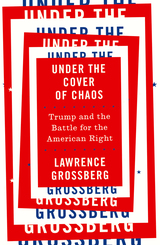
front cover of Under the Cover of Chaos
Under the Cover of Chaos
Trump and the Battle for the American Right
Lawrence Grossberg
Pluto Press, 2018
Are Donald Trump's irrationality, cruelty, and bombast symptoms of his personality? Is the chaos surrounding him a sign of his incompetence? Are his populism, illiberalism and nationalism just cynical appeals to existing feelings of abandonment, resentment and rage?

Lawrence Grossberg shows that the truth is bigger and more frightening. Locating Trumpism in the long struggle among traditional conservatism, the new right and the reactionary right, he suggests that the chaos is far more significant and strategic ... and dangerous. Taking the arguments of the reactionary right seriously, he projects a possible, nightmarish future: a cultural nationalism governed by a popular corporatocracy.

He lays bare how contemporary political struggles are being shaped by a changing national landscape of moods and feelings, marked by a growing absolutism of judgement and belief, and new forms of anxiety, alienation and narcissism.s—and lays out a possible nightmare future: a vision of a political system controlled by corporate interests, built on a deliberate dismantling of modern politics. 
[more]

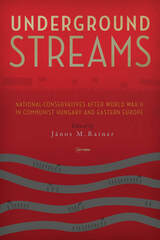
front cover of Underground Streams
Underground Streams
National-Conservatives after World War II in Communist Hungary and Eastern Europe
János M. Rainer
Central European University Press, 2023

The authors of this edited volume address the hidden attraction that existed between the extremes of left and right, and of internationalism and nationalism under the decades of communist dictatorship in Eastern Europe. One might suppose that under the suppressive regimes based on leftist ideology and internationalism their right-wing opponents would have been defeated and ultimately removed. These essays, on the other hand, recount the itinerary of survival and revival of "right-wing" thought and activities under communist dictatorship. Resistance and accommodation are explored in the various phases from the Stalinist era to the demise of the Soviet Bloc, with the continuity provided by tacit or concealed right-wing discourses receiving particular consideration. The Eastern European right, both in its conservative and fascist version, centered on nationalism, a legitimizing factor that increased with the downfall of the regimes, and the authors thus accord nationalism special attention.

Two documentary sources for these essays that stand out are files of the security services and the exceptionally rich Oral History Archive compiled by the 1956 Institute in Budapest, Hungary.


[more]

front cover of Unmaking the Public University
Unmaking the Public University
The Forty-Year Assault on the Middle Class
Christopher Newfield
Harvard University Press, 2008

An essential American dream—equal access to higher education—was becoming a reality with the GI Bill and civil rights movements after World War II. But this vital American promise has been broken. Christopher Newfield argues that the financial and political crises of public universities are not the result of economic downturns or of ultimately valuable restructuring, but of a conservative campaign to end public education’s democratizing influence on American society. Unmaking the Public University is the story of how conservatives have maligned and restructured public universities, deceiving the public to serve their own ends. It is a deep and revealing analysis that is long overdue.

Newfield carefully describes how this campaign operated, using extensive research into public university archives. He launches the story with the expansive vision of an equitable and creative America that emerged from the post-war boom in college access, and traces the gradual emergence of the anti-egalitarian “corporate university,” practices that ranged from racial policies to research budgeting. Newfield shows that the culture wars have actually been an economic war that a conservative coalition in business, government, and academia have waged on that economically necessary but often independent group, the college-educated middle class. Newfield’s research exposes the crucial fact that the culture wars have functioned as a kind of neutron bomb, one that pulverizes the social and culture claims of college grads while leaving their technical expertise untouched. Unmaking the Public University incisively sets the record straight, describing a forty-year economic war waged on the college-educated public, and awakening us to a vision of social development shared by scientists and humanists alike.

[more]


Send via email Share on Facebook Share on Twitter