
 A SCHOLARLY BOOK REPOSITORY
50 start with U start with U
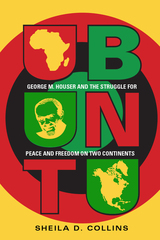
This remarkable biography features a white American pacifist minister whose tireless work for justice and human rights helped reshape Black civil rights in the U.S. and Africa.
George M. Houser (1916–2015) was one of the most important civil rights and antiwar activists of the twentieth century. A conscientious objector during World War II, in 1942 Houser cofounded and led the Congress of Racial Equality (CORE), whose embrace of nonviolent protest strategies and tactics characterized the modern American Civil Rights Movement. Beginning in the 1950s, Houser played a critical role in pan-Africanist anticolonial movements, and his more than thirty-year dedication to the cause of human rights and self-determination helped prepare the ground for the toppling of the South African apartheid regime.
Throughout his life, Houser shunned publicity, preferring to let his actions speak his faith. Sheila Collins’s well-researched biography recounts the events that informed Houser’s life of activism—from his childhood experiences as the son of missionaries in the Philippines to his early grounding in the Social Gospel and the teachings of Mohandas Gandhi. In light of the corruption the U.S. and the world face today, Houser’s story of faith and decisive action for human rights and social justice is one for our time.

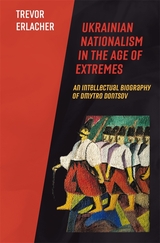
Ukrainian nationalism made worldwide news after the Euromaidan revolution and the outbreak of the Russo-Ukrainian war in 2014. Invoked by regional actors and international commentators, the “integral” Ukrainian nationalism of the 1930s has moved to the center of debates about Eastern Europe, but the history of this divisive ideology remains poorly understood.
This timely book by Trevor Erlacher is the first English-language biography of the doctrine’s founder, Dmytro Dontsov (1883–1973), the “spiritual father” of the Organization of Ukrainian Nationalists. Organizing his research of the period around Dontsov’s life, Erlacher has written a global intellectual history of Ukrainian integral nationalism from late imperial Russia to postwar North America, with relevance for every student of the history of modern Europe and the diaspora.
Thanks to the circumstances of Dontsov’s itinerant, ninety-year life, this microhistorical approach allows for a geographically, chronologically, and thematically broad yet personal view on the topic. Dontsov shaped and embodied Ukrainian politics and culture as a journalist, diplomat, literary critic, publicist, and ideologue, progressing from heterodox Marxism, to avant-garde fascism, to theocratic traditionalism.
Drawing upon archival research in Ukraine, Poland, and Canada, this book contextualizes Dontsov’s works, activities, and identity formation diachronically, reconstructing the cultural, political, urban, and intellectual milieus within which he developed and disseminated his worldview.
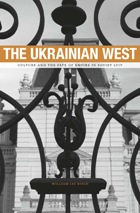
In 1990, months before crowds in Moscow and other major cities dismantled their monuments to Lenin, residents of the western Ukrainian city of Lviv toppled theirs. William Jay Risch argues that Soviet politics of empire inadvertently shaped this anti-Soviet city, and that opposition from the periphery as much as from the imperial center was instrumental in unraveling the Soviet Union.
Lviv’s borderlands identity was defined by complicated relationships with its Polish neighbor, its imperial Soviet occupier, and the real and imagined West. The city’s intellectuals—working through compromise rather than overt opposition—strained the limits of censorship in order to achieve greater public use of Ukrainian language and literary expression, and challenged state-sanctioned histories with their collective memory of the recent past. Lviv’s post–Stalin-generation youth, to which Risch pays particular attention, forged alternative social spaces where their enthusiasm for high culture, politics, soccer, music, and film could be shared.
The Ukrainian West enriches our understanding not only of the Soviet Union’s postwar evolution but also of the role urban spaces, cosmopolitan identities, and border regions play in the development of nations and empires. And it calls into question many of our assumptions about the regional divisions that have characterized politics in Ukraine. Risch shines a bright light on the political, social, and cultural history that turned this once-peripheral city into a Soviet window on the West.

Drawing on quantitative data drawn from a range of trials Kateryna Dysa first describes the ideological background of the tribunals based on works written by priests and theologians that reflect attitudes toward the devil and witches. The main focus of her work, however, is the process leading to witchcraft accusations. From the stories of participants of the trials she shows what led people to enunciate first suspicions then accusations of witchcraft. Finally, she presents a microhistory from one Volhynian village, comparing attitudes toward two “female crimes” in the Ukrainian courts.
The study is based on archival research including witch trials transcripts. Dysa approaches the trials as indications of belief and practice, attempting to understand the actors involved rather than dismiss or condemn them. She takes care to situate early modern Ukrainian witchcraft and its accompanying trials in a broader European context, with comparisons to some African cases as well.
There is an “unacknowledged kinship” between studies of Zionism and post-colonial studies, a kinship that deserves to be both discovered and acknowledged. Unacknowledged Kinships strives to facilitate a conversation between the historiography of Zionism and postcolonial studies by identifying and exploring possible linkages and affiliations between their subjects as well as the limits of such connections. The contributors to this volume discuss central theoretical concepts developed within the field of postcolonial studies, and they use these concepts to analyze crucial aspects of the history of Zionism while contextualizing Zionist thought, politics, and culture within colonial and postcolonial histories. This book also argues that postcolonial studies could gain from looking at the history of Zionism as an example of not only colonial domination but also the seemingly contradictory processes of national liberation and self-empowerment.
Unacknowledged Kinships is the first work to systematically investigate the potential for a dialogue between postcolonial studies and Zionist historiography. It is also unique in suggesting that postcolonial concepts can be applied to the history of European Zionism just as comprehensively as to the history of Zionism in Palestine and Israel or Arab countries. Most importantly, the book is an overture for a dialogue between postcolonial studies and the historiography of Zionism.
“How has unbelief come to dominate so many Western societies? The usual account invokes the advance of science and rational knowledge. Ryrie’s alternative, in which emotions are the driving force, offers new and interesting insights into our past and present.”
—Charles Taylor, author of A Secular Age
Why have societies that were once overwhelmingly Christian become so secular? We think we know the answer, pointing to science and reason as the twin culprits, but in this lively, startlingly original reconsideration, Alec Ryrie argues that people embraced unbelief much as they have always chosen their worldviews: through the heart more than the mind.
Looking back to the crisis of the Reformation and beyond, he shows how, long before philosophers started to make the case for atheism, powerful cultural currents were challenging traditional faith. As Protestant radicals eroded time-honored certainties and ushered in an age of anger and anxiety, some defended their faith by redefining it in terms of ethics, setting in motion secularizing forces that soon became transformational. Unbelievers tells a powerful emotional history of doubt with potent lessons for our own angry and anxious times.
“Well-researched and thought-provoking…Ryrie is definitely on to something right and important.”
—Christianity Today
“A beautifully crafted history of early doubt…Unbelievers covers much ground in a short space with deep erudition and considerable wit.”
—The Spectator
“Ryrie traces the root of religious skepticism to the anger, the anxiety, and the ‘desperate search for certainty’ that drove thinkers like…John Donne to grapple with church dogma.”
—New Yorker
In the United States anti-aging is a multibillion-dollar industry, and efforts to combat signs of aging have never been stronger, or more lucrative. Although there are many sociological studies of aging and culture, there are few studies that examine the ways cultural texts construct multiple narratives of aging that intersect and sometimes conflict with existing social theories of aging. In Uncanny Subjects, Amelia DeFalco incorporates methodologies and theories derived from the humanities in her investigation into contemporary representations of aging.
Both aging and narrative are a function of time, of change, of one event happening after another. Subjects understand their lives through narrative trajectories—not necessarily as they are living moment to moment, but in the sort of reflection that many argue becomes more prevalent with age. As a result, narrative fiction provides compelling representations of the strange—indeed uncanny—familiarity of the aging self.
DeFalco examines a range of contemporary fiction and film by authors and directors such as John Banville, John Cassavetes, and Alice Munro. As these texts suggest, old age involves a growing awareness of the otherness within, an awareness that reveals identity as multiple, shifting, and contradictory—in short, uncanny. Drawing together theories of the uncanny with research on aging and temporality, DeFalco argues that aging is a category of difference integral to a contemporary understanding of identity and alterity.

Uncertain Dimensions was first published in 1985. Minnesota Archive Editions uses digital technology to make long-unavailable books once again accessible, and are published unaltered from the original University of Minnesota Press editions.
World War I battered the Western imperial systems and destroyed one, that of Germany, but it did not sound the death knell of an empire. The "scramble" for overseas territory ha reached a virtual conclusion shortly before the war; afterwards, the main business of empire was to ensure a pax colonia: the often contradictory goals of a stable government and economic development. It is with the years between world wars—the brief age of administrative empire — that Raymond Betts is chiefly concerned in this book. An unsettled time, when individuals coped with empire of uncertain dimensions, the interwar years nonetheless left a material legacy—railroads, motor roads, public buildings — and an ideological one—the voices of protest that led to independence after World War II.
Preeminently a cultural history of the era rather than a political narrative, Uncertain Dimensions centers upon the regions we now call the Third World—Subsaharan Africa and Southeast Asia—and the major colonial powers, Great Britain and France. Betts has structured this book as a group of closely linked interpretive essays, each devoted to a specific aspect of the late colonial experience: World War I and the postwar mandates, colonial administration, the European economic imperative and "technology transfer," urbanization, anti-imperial protest, and decolonization. Throughout, he draws upon the work of novelists, poets, and theoreticians—Aime Cesaire, Claude McKay, Leopold Sedar Senghor, Frantz Fanon, and many others—and recognizes the deep irony at the heart of modern imperialism: that contact between Western and Third worlds was mostly confined to two minorities, the alien European and the socially uprooted African or Asian.
Uncertainty in the Empire of Routine investigates the administrative revolution of China’s eighteenth-century Qing state. It begins in the mid-seventeenth century with what seemed, at the time, to be straightforward policies to clean up the bureaucracy: a regulation about deadlines here, a requirement about reporting standards there. Over the course of a hundred years, the central court continued to demand more information from the provinces about local administrative activities. By the middle of the eighteenth century, unprecedented amounts of data about local offices throughout the empire existed.
The result of this information coup was a growing discourse of crisis and decline. Gathering data to ensure that officials were doing their jobs properly, it turned out, repeatedly exposed new issues requiring new forms of scrutiny. Slowly but surely, the thicket of imperial routines and standards binding together local offices, provincial superiors, and central ministries shifted the very epistemological foundations of the state. A vicious cycle arose whereby reporting protocols implemented to solve problems uncovered more problems, necessitating the collection of more information. At the very moment that the Qing knew more about itself than ever before, the central court became certain that it had entered an age of decline.
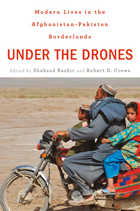
In the West, media coverage of Afghanistan and Pakistan is framed by military and political concerns, resulting in a simplistic picture of ageless barbarity, terrorist safe havens, and peoples in need of either punishment or salvation. Under the Drones looks beyond this limiting view to investigate real people on the ground, and to analyze the political, social, and economic forces that shape their lives. Understanding the complexity of life along the 1,600-mile border between Afghanistan and Pakistan can help America and its European allies realign their priorities in the region to address genuine problems, rather than fabricated ones.
This volume explodes Western misunderstandings by revealing a land that abounds with human agency, perpetual innovation, and vibrant complexity. Through the work of historians and social scientists, the thirteen essays here explore the real and imagined presence of the Taliban; the animated sociopolitical identities expressed through traditions like Pakistani truck decoration; Sufism’s ambivalent position as an alternative to militancy; the long and contradictory history of Afghan media; and the simultaneous brutality and potential that heroin brings to women in the area.
Moving past shifting conceptions of security, the authors expose the West’s prevailing perspective on the region as strategic, targeted, and alarmingly dehumanizing. Under the Drones is an essential antidote to contemporary media coverage and military concerns.

Western democracy is currently under attack by a resurgent Russia, weaponizing new technologies and social media. How to respond? During the Cold War, the West fought off similar Soviet propaganda assaults with shortwave radio broadcasts. Founded in 1949, the US-funded Radio Free Europe/Radio Liberty broadcast uncensored information to the Soviet republics in their own languages. About one-third of Soviet urban adults listened to Western radio. The broadcasts played a key role in ending the Cold War and eroding the communist empire.
R. Eugene Parta was for many years the director of Soviet Area Audience Research at RFE/RL, charged among others with gathering listener feedback. In this book he relates a remarkable Cold War operation to assess the impact of Western radio broadcasts on Soviet listeners by using a novel survey research approach. Given the impossibility of interviewing Soviet citizens in their own country, it pioneered audacious interview methods in order to fly under the radar and talk to Soviets traveling abroad, ultimately creating a database of 51,000 interviews which offered unparalleled insights into the media habits and mindset of the Soviet public. By recounting how the “impossible” mission was carried out, Under the Radar also shows how the lessons of the past can help counter the threat from a once and current adversary.

Cundill Prize Finalist
An Economist Best Book of the Year
A Financial Times Best Book of the Year
“Superbly original…Breaks new ground by showing how a collective consciousness emerged among revolutionaries.”
—The Economist
“A clearly written, brilliantly researched examination of the people and movements that shaped Asia’s course in the 20th century and continue to influence the continent today.”
—Walter Russell Mead, Wall Street Journal
“The most gripping work of history I have ever read. It is a truly profound meditation on the struggles for freedom that shaped modern Asia…a flat out literary masterpiece.”
—Sunil Amrith, author of Unruly Waters
European empires had not yet reached their zenith when Asian radicals planted the seeds of their destruction. They gained energy and recruits after the Bolshevik Revolution, which sparked visions of a free and radically equal world. Thanks to cheap printing presses and the new possibility of international travel, these utopian revolutionaries built clandestine webs of resistance from London and Paris to Calcutta, Bombay, Hanoi, and Shanghai. Tim Harper takes us into this shadowy world, following the interconnected lives of Asian Marxists, anarchists, and nationalists such as M. N. Roy, Ho Chi Minh, and Tan Malaka.
Underground Asia shows for the first time how these national liberation movements crucially depended on global action and reveals how these insurgencies shape the region to this day.

An Economist Best Book of the Year
A Financial Times Best Book of the Year
A major historian tells the dramatic and untold story of the shadowy networks of revolutionaries across Asia who laid the foundations in the early twentieth century for the end of European imperialism on their continent.
This is the epic tale of how modern Asia emerged out of conflict between imperial powers and a global network of revolutionaries in the turbulent early decades of the twentieth century.
In 1900, European empires had not yet reached their territorial zenith. But a new generation of Asian radicals had already planted the seeds of their destruction. They gained new energy and recruits after the First World War and especially the Bolshevik Revolution, which sparked utopian visions of a free and communist world order led by the peoples of Asia. Aided by the new technologies of cheap printing presses and international travel, they built clandestine webs of resistance from imperial capitals to the front lines of insurgency that stretched from Calcutta and Bombay to Batavia, Hanoi, and Shanghai. Tim Harper takes us into the heart of this shadowy world by following the interconnected lives of the most remarkable of these Marxists, anarchists, and nationalists, including the Bengali radical M. N. Roy, the iconic Vietnamese leader Ho Chi Minh, and the enigmatic Indonesian communist Tan Malaka. He recreates the extraordinary milieu of stowaways, false identities, secret codes, cheap firearms, and conspiracies in which they worked. He shows how they fought with subterfuge, violence, and persuasion, all the while struggling to stay one step ahead of imperial authorities.
Underground Asia shows for the first time how Asia’s national liberation movements crucially depended on global action. And it reveals how the consequences of the revolutionaries’ struggle, for better or worse, shape Asia’s destiny to this day.
Previous praise for Tim Harper
Praise for Forgotten Wars:
“[A] compelling book.”—Philip Delves Broughton, Wall Street Journal
“Lucid…majestic.”—Peter Preston, The Observer
“Authoritative.”—Pankaj Mishra, New Yorker
Praise for Forgotten Armies:
“Panoramic… Vivid.”—Benjamin Schwarz, New York Times Book Review
“A spectacular book.”—Martin Jacques, The Guardian
The literary scholar Alfrun Kliems explores the aesthetic strategies of Eastern European underground literature, art, film and music in the decades before and after the fall of communism, ranging from the ‘father’ of Prague Underground, Egon Bondy, to the neo-Dada Club of Polish Losers in Berlin.
The works she considers are "underground" in the sense that they were produced illegally, or were received as subversive after the regimes had fallen. Her study challenges common notions of ‘Underground’ as an umbrella term for nonconformism. Rather, it depicts it as a sociopoetic reflection of modernity, intimately linked to urban settings, with tropes and aesthetic procedures related to Surrealism, Dadaism, Expressionism, and, above all, pop and counterculture.
The author discusses these commonalities and distinctions in Czech, Polish, Slovak, Ukrainian, Russian, and German authors, musicians, and filmmakers. She identifies intertextual relations across languages and generations, and situates her findings in a transatlantic context (including the Beat Generation, Susan Sontag, Neil Young) and the historical framework of Romanticism and modernity (including Baudelaire and Brecht).
Despite this wide brief, the book never loses sight of its core message: Underground is no arbitrary expression of discontent, but rather the result of a fundamental conflict at the socio-philosophical roots of modernity.
The authors of this edited volume address the hidden attraction that existed between the extremes of left and right, and of internationalism and nationalism under the decades of communist dictatorship in Eastern Europe. One might suppose that under the suppressive regimes based on leftist ideology and internationalism their right-wing opponents would have been defeated and ultimately removed. These essays, on the other hand, recount the itinerary of survival and revival of "right-wing" thought and activities under communist dictatorship. Resistance and accommodation are explored in the various phases from the Stalinist era to the demise of the Soviet Bloc, with the continuity provided by tacit or concealed right-wing discourses receiving particular consideration. The Eastern European right, both in its conservative and fascist version, centered on nationalism, a legitimizing factor that increased with the downfall of the regimes, and the authors thus accord nationalism special attention.
Two documentary sources for these essays that stand out are files of the security services and the exceptionally rich Oral History Archive compiled by the 1956 Institute in Budapest, Hungary.
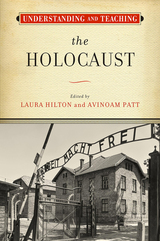
Each chapter provides pedagogical case studies for teaching content such as antisemitism, resistance and rescue, and the postwar lives of displaced persons. It will transform how students learn about the Holocaust and the circumstances surrounding it.
Yanagita Kunio (1875–1962) was a public intellectual who played a pivotal role in shaping modern Japan’s cultural identity. A self-taught folk scholar and elite bureaucrat, he promoted folk studies in Japan. So extensive was his role that he has been compared with the fabled Grimm Brothers of Germany and the great British folklorist James G. Frazer (1854–1941), author of The Golden Bough. This monograph is only the second book-length English-language examination of Yanagita, and it is the first analysis that moves beyond a biographical account of his pioneering work in folk studies.
An eccentric but insightful critic of Japan’s rush to modernize, Yanagita offers a compelling array of rebuttals to mainstream social and political trends in his carefully crafted writings. Through a close reading of Yanagita’s interdisciplinary texts, which comment on a wide range of key cultural issues that characterized the first half of Japan’s twentieth century, Melek Ortabasi seeks to reevaluate the historical significance of his work. Ortabasi’s inquiry simultaneously exposes, discursively, some of the fundamental assumptions we embrace about modernity and national identity in Japan and elsewhere.

This extraordinary book provides a snapshot of socialism throughout the Kádár regime in Hungary (1956-1989) and captures the essence of the world behind the ‘iron curtain’ in a stunning, and often stark, collection of photographs.
Unfinished Socialism is a visually stunning anthropological study containing 450 photographs, many previously unpublished, which portray life in Hungary from every angle: from the May Day March to pop music and from the homeless to sport.
With an introduction that will help the reader understand and appreciate the true meaning of the photographs, this political, social and cultural study of the Kádár years transports the reader back to a time of great significance in Hungary’s long and turbulent history.
In a work that is as much about the present as the past, Brad Gregory identifies the unintended consequences of the Protestant Reformation and traces the way it shaped the modern condition over the course of the following five centuries. A hyperpluralism of religious and secular beliefs, an absence of any substantive common good, the triumph of capitalism and its driver, consumerism—all these, Gregory argues, were long-term effects of a movement that marked the end of more than a millennium during which Christianity provided a framework for shared intellectual, social, and moral life in the West.
Before the Protestant Reformation, Western Christianity was an institutionalized worldview laden with expectations of security for earthly societies and hopes of eternal salvation for individuals. The Reformation’s protagonists sought to advance the realization of this vision, not disrupt it. But a complex web of rejections, retentions, and transformations of medieval Christianity gradually replaced the religious fabric that bound societies together in the West. Today, what we are left with are fragments: intellectual disagreements that splinter into ever finer fractals of specialized discourse; a notion that modern science—as the source of all truth—necessarily undermines religious belief; a pervasive resort to a therapeutic vision of religion; a set of smuggled moral values with which we try to fertilize a sterile liberalism; and the institutionalized assumption that only secular universities can pursue knowledge.
The Unintended Reformation asks what propelled the West into this trajectory of pluralism and polarization, and finds answers deep in our medieval Christian past.
In The Unity of Hegel's "Phenomenology of Spirit", Jon Stewart interprets Hegel's work as a dialectical transformation of Kantian transcendental philosophy, providing from this unified standpoint a case for Hegel's own conception of philosophy as a system. In restoring them to their larger systematic contexts, Stewart clarifies Hegel's individual analyses, as well as indicating the meaning and significance of the transitions and illustrating the parallelisms between the respective analyses. Many of Hegel's main themes-
universal-particular, mediacy-immediacy-are traced through the text, demonstrating Hegel's formal continuity.
By examining at the microlevel the particulars of the dialectical movement, and by analyzing at the macrolevel the role of the argument in question in the context of the work as a whole, Stewart provides a detailed analysis of the Phenomenology and a significant scholarly demonstration of Hegel's own conception of the Phenomenology as a part of a systematic philosophy.

Johannes Morsink argues that the 1948 UN Universal Declaration of Human Rights and the human rights movement today are direct descendants of revulsion to the Holocaust and the desire to never let it happen again.
Much recent scholarship about human rights has severed this link between the Holocaust, the Universal Declaration, and contemporary human rights activism in favor of seeing the 1970s as the era of genesis. Morsink forcefully presents his case that the Universal Declaration was indeed a meaningful though underappreciated document for the human rights movement and that the declaration and its significance cannot be divorced from the Holocaust. He reexamines this linkage through the working papers of the commission that drafted the declaration as well as other primary sources.
This work seeks to reset scholarly understandings of the Universal Declaration of Human Rights and the foundations of the contemporary human rights movement.

Unlikely Partners recounts the story of how Chinese politicians and intellectuals looked beyond their country’s borders for economic guidance at a key crossroads in the nation’s tumultuous twentieth century. Julian Gewirtz offers a dramatic tale of competition for influence between reformers and hardline conservatives during the Deng Xiaoping era, bringing to light China’s productive exchanges with the West.
When Mao Zedong died in 1976, his successors seized the opportunity to reassess the wisdom of China’s rigid commitment to Marxist doctrine. With Deng Xiaoping’s blessing, China’s economic gurus scoured the globe for fresh ideas that would put China on the path to domestic prosperity and ultimately global economic power. Leading foreign economists accepted invitations to visit China to share their expertise, while Chinese delegations traveled to the United States, Hungary, Great Britain, West Germany, Brazil, and other countries to examine new ideas. Chinese economists partnered with an array of brilliant thinkers, including Nobel Prize winners, World Bank officials, battle-scarred veterans of Eastern Europe’s economic struggles, and blunt-speaking free-market fundamentalists.
Nevertheless, the push from China’s senior leadership to implement economic reforms did not go unchallenged, nor has the Chinese government been eager to publicize its engagement with Western-style innovations. Even today, Chinese Communists decry dangerous Western influences and officially maintain that China’s economic reinvention was the Party’s achievement alone. Unlikely Partners sets forth the truer story, which has continuing relevance for China’s complex and far-reaching relationship with the West.

800x600Normal0falsefalsefalseEN-USX-NONEX-NONEMicrosoftInternetExplorer4
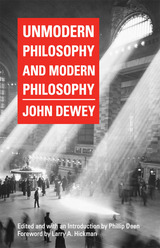
In 1947 America’s premier philosopher, educator, and public intellectual John Dewey purportedly lost his last manuscript on modern philosophy in the back of a taxicab. Now, sixty-five years later, Dewey’s fresh and unpretentious take on the history and theory of knowledge is finally available. Editor Phillip Deen has taken on the task of editing Dewey’s unfinished work, carefully compiling the fragments and multiple drafts of each chapter that he discovered in the folders of the Dewey Papers at the Special Collections Research Center at Southern Illinois University Carbondale. He has used Dewey’s last known outline for the manuscript, aiming to create a finished product that faithfully represents Dewey’s original intent. An introduction and editor’s notes by Deen and a foreword by Larry A. Hickman, director of the Center for Dewey Studies, frame this previously lost work.
In Unmodern Philosophy and Modern Philosophy, Dewey argues that modern philosophy is anything but; instead, it retains the baggage of outdated and misguided philosophical traditions and dualisms carried forward from Greek and medieval traditions. Drawing on cultural anthropology, Dewey moves past the philosophical themes of the past, instead proposing a functional model of humanity as emotional, inquiring, purposive organisms embedded in a natural and cultural environment.
Dewey begins by tracing the problematic history of philosophy, demonstrating how, from the time of the Greeks to the Empiricists and Rationalists, the subject has been mired in the search for immutable absolutes outside human experience and has relied on dualisms between mind and body, theory and practice, and the material and the ideal, ultimately dividing humanity from nature. The result, he posits, is the epistemological problem of how it is possible to have knowledge at all. In the second half of the volume, Dewey roots philosophy in the conflicting beliefs and cultural tensions of the human condition, maintaining that these issues are much more pertinent to philosophy and knowledge than the sharp dichotomies of the past and abstract questions of the body and mind. Ultimately, Dewey argues that the mind is not separate from the world, criticizes the denigration of practice in the name of theory, addresses the dualism between matter and ideals, and questions why the human and the natural were ever separated in philosophy. The result is a deeper understanding of the relationship among the scientific, the moral, and the aesthetic.
More than just historically significant in its rediscovery, Unmodern Philosophy and Modern Philosophy provides an intriguing critique of the history of modern thought and a positive account of John Dewey’s naturalized theory of knowing. This volume marks a significant contribution to the history of American thought and finally resolves one of the mysteries of pragmatic philosophy.
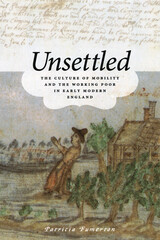
Migrants made up a growing class of workers in late sixteenth- and seventeenth- century England. In fact, by 1650, half of England’s rural population consisted of homeless and itinerant laborers. Unsettled is an ambitious attempt to reconstruct the everyday lives of these dispossessed people. Patricia Fumerton offers an expansive portrait of unsettledness in early modern England that includes the homeless and housed alike.
Fumerton begins by building on recent studies of vagrancy, poverty, and servants, placing all in the light of a new domestic economy of mobility. She then looks at representations of the vagrant in a variety of pamphlets and literature of the period. Since seamen were a particularly large and prominent class of mobile wage-laborers in the seventeenth century, Fumerton turns to seamen generally and to an individual poor seaman as a case study of the unsettled subject: Edward Barlow (b. 1642) provides a rare opportunity to see how the laboring poor fashioned themselves, for he authored a journal of over 225,000 words and 147 pages of drawings. Barlow’s journal, studied extensively here for the first time, vividly charts what he himself termed his “unsettled mind” and the perpetual anxieties of England’s working and wayfaring poor. Ultimately, Fumerton explores representations of seamen as unsettled in the broadside ballads of Barlow’s time.
This book is also freely available online as an open access digital edition on Manifold, here: https://openpub.udel.edu/projects/unsettling-sexuality.
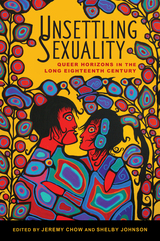
Unsettling Sexuality: Queer Horizons in the Long Eighteenth Century challenges the traditional ways that scholarship has approached sexuality, gender nonconformity, and sex (as well as its absence) in the long eighteenth century. Drawing from recent and emerging criticisms in Middle Eastern and Asian studies, Black studies, and Native American and Indigenous studies, the collected authors perform intersectional queer readings, reimagine queer historiographic methods, and spearhead new citational models that can invigorate the field. Contributors read with and against diverse European, transatlantic, and global archives to explore mutually informative frameworks of gender, sexuality, race, indigeneity, ability, and class. In charting multidirectional queer horizons, this collection locates new prospective desires and intimacies in the literature, culture, and media of the period to imagine new directions and simultaneously unsettle eighteenth-century studies.
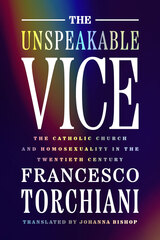
As gay men and lesbian women increasingly gained recognition and acceptance in twentieth-century literature and film, and subsequently in social and political movements, the Catholic Church reacted by subtly moving away from its overt condemnation of homosexuality as an urgent moral problem and toward tacitly shunning homosexuality as an “unspeakable vice.” In this revealing history, Francesco Torchiani reconstructs the Catholic Church’s shifting attitudes toward homosexuality during this period by drawing on a vast array of internal documents and external accounts. This monograph expands the scholarship on the relationship between Catholicism and homosexuality in terms of both method and content, ultimately concluding that the Catholic Church continues to wholeheartedly condemn homosexuality despite making genuine efforts to reflect on and understand its social and cultural impact. The Unspeakable Vice therefore sheds new light on and places into historical perspective the questions the Catholic Church continues to reckon with regarding its role in contemporary society.

Histories of the book often move straight from the codex to the digital screen. Left out of that familiar account are nearly 150 years of audio recordings. Recounting the fascinating history of audio-recorded literature, Matthew Rubery traces the path of innovation from Edison’s recitation of “Mary Had a Little Lamb” for his tinfoil phonograph in 1877, to the first novel-length talking books made for blinded World War I veterans, to today’s billion-dollar audiobook industry.
The Untold Story of the Talking Book focuses on the social impact of audiobooks, not just the technological history, in telling a story of surprising and impassioned conflicts: from controversies over which books the Library of Congress selected to become talking books—yes to Kipling, no to Flaubert—to debates about what defines a reader. Delving into the vexed relationship between spoken and printed texts, Rubery argues that storytelling can be just as engaging with the ears as with the eyes, and that audiobooks deserve to be taken seriously. They are not mere derivatives of printed books but their own form of entertainment.
We have come a long way from the era of sound recorded on wax cylinders, when people imagined one day hearing entire novels on mini-phonographs tucked inside their hats. Rubery tells the untold story of this incredible evolution and, in doing so, breaks from convention by treating audiobooks as a distinctively modern art form that has profoundly influenced the way we read.
In 1905, Freud published his Three Essays on the Theory of Sexuality, the book that established the core psychoanalytic thesis that sexuality is central to formations of the unconscious. With this book, Eric L. Santner inverts Freud’s title to take up the sexuality of theory—or, more exactly, the modes of enjoyment to be found in the kinds of critical thinking that, since the 1960s, have laid claim to that ancient word, “theory.” Santner unfolds his argument by tracking his own relationship with this tradition and the ways his intellectual and spiritual development has been informed by it.
Untying Things Together is both an intellectual history of major theoretical paradigms and a call for their reexamination and renewal. Revisiting many of the topics he has addressed in previous work, Santner proposes a new way of conceptualizing the eros of thinking, attuned to how our minds and bodies individually and collectively incorporate or “encyst” on a void at the heart of things. Rather than proposing a “return to theory,” Santner’s book simply employs theory as a way of further “(un)tying together” the resources of philosophy, art and literature, theology, psychoanalysis, political thought, and more.
A comprehensive overview of the controversy surrounding Hitler’s Willing Executioners.
Few if any books of the past fifty years have moved a broad section of the German public to think about their country’s Nazi past as has Daniel Jonah Goldhagen’s Hitler’s Willing Executioners. The main argument of his book is that Germans committed the unthinkable acts of the Holocaust not because they were forced to but out of a deeply held conviction that killing Jews was morally just. Unwilling Germans? traces the intense and varied reception of a book that has created more heated debate than any other treatment of Germany’s genocidal past.
When Goldhagen’s book first appeared, it was almost universally dismissed by journalists and historians alike. However, following a book tour in Germany, Goldhagen started winning over many of his ardent detractors and finding a young, receptive audience. Although German scholars reacted to Goldhagen and his argument with outrage and dismissal, ironically the German public was mesmerized by both the book and Goldhagen himself.Unwilling Germans? reprints articles that originally appeared in German newspapers, the popular press, and journals, as well as offering original essays. Among the writers whose work is represented are historians, journalists, political scientists, and literary critics, including Jürgen Habermas and Klaus Theweleit. The book traces the initial reactions in Germany to the debate surrounding the U.S. publication of the book, the subsequent reviews and reactions upon the publication of the German translation, and recent commentary by Goldhagen and the American historian Christopher Browning. A unique and fascinating collection, Unwilling Germans? will help to sort out the confusing nature of the response to the “Goldhagen Debate,” and shed light on both Germany’s continuing process of coming to terms with its Nazi past and the resonances of that debate in the United States.ISBN 0-8166-3100-X Cloth $44.95xxISBN 0-8166-3101-8 Paper $17.95224 pages 5 7/8 x 9 JuneTranslation inquiries: University of Minnesota Press
Nathan Gorelick’s The Unwritten Enlightenment: Literature between Ideology and the Unconscious traces the relations between literary criticism and psychoanalysis to their shared origins in the Enlightenment era’s novels and novelistic discourse, where the period’s efforts to invent new notions of subjectivity and individualism are most apparent. Gorelick shows how modern concepts of literature and the unconscious were generated in response to these efforts and by an ethical concern for what the language of the Enlightenment excludes, represses, or struggles to erase. Troubling the idea of the Enlightenment on its own terms, subverting its supposed authority from within, Gorelick thus reveals the workings of unconscious fantasy at the foundations of our contemporary political realities. The Unwritten Enlightenment makes clear that to criticize the Enlightenment’s deficiencies, ambiguities, and legacies of violence without regard for the unconscious fantasies that drive them risks reproducing the very patterns of thought, action, and imagination that the Enlightenment novel already unsettles.
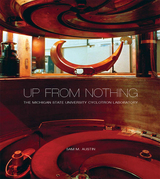
The cyclotron laboratory at MSU has been known for years as the best university nuclear physics laboratory in the United States, and perhaps in the world. But very few, even in its hometown of East Lansing, know how it achieved that status or why it prospered when laboratories at many other famous universities faded.
In this book Austin, a nuclear physicist who has been at the laboratory since the beginning of its ascent, gives us a remarkable story. It begins with an exceptional individual, Henry Blosser, who founded the laboratory, built a cyclotron accelerator of uniquely high precision, and recruited a team of nuclear physicists that used it to establish the laboratory’s reputation. Its credibility led to a sequence of accelerators, each operating in a different sub?eld while continuing a tradition of forefront science, and to a laboratory culture that fostered the courage and foresight to compete for the FRIB in the face of daunting odds.
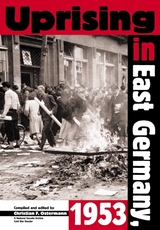
This volume is the second in the series Cold War Documentary Readers, a project of the US National Security Archive and the Cold War International History Project.
The volume is the first documented account of this early Cold War crisis from both sides of the Iron Curtain. Based on the recent unprecedented access to the once-closed archives of several member states of the Warsaw Pact, this collection of primary-source documents presents one of the most notorious events of post-war European history in a highly readable format.
Previously unreleased Kremlin records, once highly classified American documents, materials from the Soviet Foreign Ministry, and transcripts of internal East German Communist Party Politburo meetings in the days leading to the uprising in the German Democratic Republic (GDR) are among the highlights of this sensational documentary.
In this volume, as in the previous one in the series, each part is preceded by a detailed introductory essay to provide the necessary historical and political context. The individual documents are introduced by short headnotes summarizing the contents and orienting the reader. A chronology, glossary and bibliography offer further background information.

Tracing journeys of Cantonese migrants along the West River and its tributaries, this book describes the circulation of people through one of the world’s great river systems between the late sixteenth and mid-nineteenth centuries. Steven B. Miles examines the relationship between diaspora and empire in an upriver frontier, and the role of migration in sustaining families and lineages in the homeland of what would become a global diaspora. Based on archival research and multisite fieldwork, this innovative history of mobility explores a set of diasporic practices ranging from the manipulation of household registration requirements to the maintenance of split families.
Many of the institutions and practices that facilitated overseas migration were not adaptations of tradition to transnational modernity; rather, they emerged in the early modern era within the context of riverine migration. Likewise, the extension and consolidation of empire required not only unidirectional frontier settlement and sedentarization of indigenous populations. It was also responsible for the regular circulation between homeland and frontier of people who drove imperial expansion—even while turning imperial aims toward their own purposes of socioeconomic advancement.
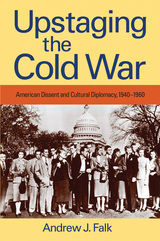
Traditional interpretations of the 1950s have emphasized how American anti-communists deployed censorship and the blacklist to silence dissent, particularly in the realm of foreign policy. Yet those efforts at repression did not always succeed. Throughout the early years of the Cold War, a significant number of writers and performers continued to express controversial views about international relations in Hollywood films, through the new medium of television, on the Broadway stage, and from behind the scenes.
By promoting superpower cooperation, decolonization, nuclear disarmament, and other taboo causes, dissident artists such as Lillian Hellman, Arthur Miller, Rod Serling, Dalton Trumbo, Reginald Rose, and Paddy Chayefsky managed both to stretch the boundaries of Cold War ideology and to undermine some of its basic assumptions. Working at times under assumed names and in some cases outside the United States, they took on the role of informal diplomats who competed with Washington in representing America to the world.
Ironically, the dissidents' international appeal eventually persuaded the U.S. foreign policy establishment that their unconventional views could be an asset in the Cold War contest for “hearts and minds,” and their artistic work an effective means to sell American values and culture abroad. By the end of the 1950s, the Eisenhower administration not only appropriated the work of these talented artists but enlisted some of them to serve as official voices of Cold War cultural diplomacy.

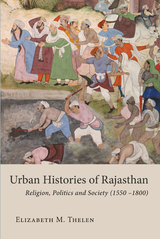
Diverse peoples intermingled in the streets and markets of premodern Indian cities. This book considers how these diverse residents lived together and negotiated their differences. Which differences mattered, when and to whom? How did state actions and policies affect urban society and the lives of various communities? How and why did conflict occur in urban spaces? Through these questions, this book explores the histories of urban communities in the three cities of Ajmer, Nagaur, and Pushkar in Rajasthan, between the sixteenth and eighteenth centuries. The focus of this study is on everyday life, contextualizing religious practices and conflicts by considering patterns of patronage and broader conflict patterns within society. The book examines various archival documents, from family and institutional records to state registers, and uses these documents to demonstrate the complex and sometimes contradictory ways religion intersected with politics, economics, and society. The author shows how many patronage patterns and processes persisted in altered forms, and how the robustness of these structures contributed to the resilience of urban spaces and society in precolonial Rajasthan.

This masterly study has a grand sweep. It ranges over centuries, with a long look backward over several millennia. Yet the history it unfolds is primarily the story of individuals: thinkers and dreamers who envisaged an ideal social order and described it persuasively, leaving a mark on their own and later times.
The roster of utopians includes men of all stripes in different countries and eras--figures as disparate as More and Fourier, the Marquis de Sade and Edward Bellamy, Rousseau and Marx. Fascinating character studies of the major figures are among the delights of the book.
Utopian writings run the gamut from fictional narratives to theoretical treatises, from political manifestos to constitutions for a new society. The Manuels have structured five centuries of utopian invention by identifying successive constellations, groups of thinkers joined by common social and moral concerns. Within this framework they analyze individual writings, in the context of the author's life and of the socio-economic, religious, and political exigencies of his time. Concentrating on innovative works, they highlight disjunctures as well as continuities in utopian thought from the Renaissance through the twentieth century.
Witty and erudite, challenging in its interpretations and provocative in the questions it poses, the Manuels' anatomy of utopia is an adventure in ideas.
READERS
Browse our collection.
PUBLISHERS
See BiblioVault's publisher services.
STUDENT SERVICES
Files for college accessibility offices.
RECENTLY PUBLISHED


UChicago Accessibility Resources
home | accessibility | search | about | contact us
BiblioVault ® 2001 - 2026
The University of Chicago Press