
 A SCHOLARLY BOOK REPOSITORY
27 start with A start with A
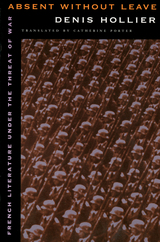
They were not the "Banquet Years," those anxious wartime years when poets and novelists were made to feel embarrassed by their impulse to write literature. And yet it was the attitude of those writers and critics in the 1930s and 1940s that shaped French literature--the ideas of Derrida, Foucault, de Man, Deleuze, and Ricoeur--and has so profoundly influenced literary enterprise in the English-speaking world since 1968. This literary history, the prehistory of postmodernism, is what Denis Hollier recovers in his interlocking studies of the main figures of French literary life before the age of anxiety gave way to the era of existentialist commitment.
Georges Bataille, Michel Leiris, Roger Caillois, André Malraux, the early Jean-Paul Sartre are the figures Hollier considers, writers torn between politics and the pleasures of the text. They appear here uneasily balancing the influences of the philosopher and the man of action. These studies convey the paradoxical heroism of writers fighting for a world that would extend no rights or privileges to writers, writing for a world in which literature would become a reprehensible frivolity. If the nineteenth century was that of the consecration of the writer, this was the time for their sacrificial death, and Hollier captures the comical pathos of these writers pursuing the ideal of "engagement" through an exercise in dispossession. His work identifies, as none has before, the master plot for literature that was crafted in the 1940s, a plot in which we are still very much entangled.
Louis XIV’s subjects explored new kinds of affective relations with their sovereign, joining with the king in acts of aesthetic judgment, tender feeling, or the “newsiness” of emerging print news culture. Such alternative modes of adhesion countered the hegemonic model of kingship upheld by divine right, reason of state, or corporate fidelities and privileges with subject-driven attachments and practices. Absolutist Attachments discovers absolutism’s alternative political and cultural legacy—not the spectacle of an unbound king but the binding connections of his subjects.
This is the story of a city that shouldn’t exist. In the seventeenth century, what is now America’s most beguiling metropolis was nothing more than a swamp: prone to flooding, infested with snakes, battered by hurricanes. But through the intense imperial rivalries of Spain, France, and England, and the ambitious, entrepreneurial merchants and settlers from four continents who risked their lives to succeed in colonial America, this unpromising site became a crossroads for the whole Atlantic world.
Lawrence N. Powell, a decades-long resident and observer of New Orleans, gives us the full sweep of the city’s history from its founding through Louisiana statehood in 1812. We see the Crescent City evolve from a French village, to an African market town, to a Spanish fortress, and finally to an Anglo-American center of trade and commerce. We hear and feel the mix of peoples, religions, and languages from four continents that make the place electric—and always on the verge of unraveling. The Accidental City is the story of land-jobbing schemes, stock market crashes, and nonstop squabbles over status, power, and position, with enough rogues, smugglers, and self-fashioners to fill a picaresque novel.
Powell’s tale underscores the fluidity and contingency of the past, revealing a place where people made their own history. This is a city, and a history, marked by challenges and perpetual shifts in shape and direction, like the sinuous river on which it is perched.
This momentous culinary journey begins with Ancien Régime cookbooks and ends with twenty-first-century cooking programs. It takes us from Carême, the "inventor" of modern French cuisine in the early nineteenth century, to top chefs today, such as Daniel Boulud and Jacques Pépin. Not a history of French cuisine, Accounting for Taste focuses on the people, places, and institutions that have made this cuisine what it is today: a privileged vehicle for national identity, a model of cultural ascendancy, and a pivotal site where practice and performance intersect. With sources as various as the novels of Balzac and Proust, interviews with contemporary chefs such as David Bouley and Charlie Trotter, and the film Babette's Feast, Ferguson maps the cultural field that structures culinary affairs in France and then exports its crucial ingredients. What's more, well beyond food, the intricate connections between cuisine and country, between local practice and national identity, illuminate the concept of culture itself.
To Brillat-Savarin's famous dictum—"Animals fill themselves, people eat, intelligent people alone know how to eat"—Priscilla Ferguson adds, and Accounting for Taste shows, how the truly intelligent also know why they eat the way they do.
“Parkhurst Ferguson has her nose in the right place, and an infectious lust for her subject that makes this trawl through the history and cultural significance of French food—from French Revolution to Babette’s Feast via Balzac’s suppers and Proust’s madeleines—a satisfying meal of varied courses.”—Ian Kelly, Times (UK)
Published by University of Delaware Press. Distributed worldwide by Rutgers University Press.

Develop language skills and cultural knowledge essential for a career in the francophone world
Affaires globales' broad scope of disciplines and cultural content will appeal to students interested in a wide variety of careers while giving them the skills needed to pursue them. This intermediate-high to advanced-level French textbook is designed for French for specific purposes courses such as business or professional French and can be used as a main text for one semester or adapted for two semesters of use.
Affaires globales uses an interdisciplinary multiliteracies approach to help students develop the cultural knowledge and language skills necessary to pursue a career in the francophone world. Over the textbook's seven units, Affaires globales weaves in contemporary themes such as entrepreneurship, sustainable development, and global engagement with discussions of tourism, business, marketing, fashion, diplomacy, environmental studies, and global health. Lessons incorporate authentic materials from across the francophone world, from France to Quebec to sub-Saharan Africa.
Features:
A wide selection of activities—true or false, fill in the blank, multiple choice, and open-ended questions— allow students to engage with course material in varied ways
Chapter activities contribute to a semester-long project that helps students evaluate their career goals and reflect on their growth throughout the course
Free access to authentic multimedia resources and instructors' materials
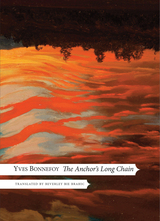
Yves Bonnefoy has wowed the literary world for decades with his diffuse volumes. First published in France in 2008, The Anchor’s Long Chain is an indispensable addition to his oeuvre. Enriching Bonnefoy’s earlier work, the volume, translated by Beverley Bie Brahic, also innovates, including an unprecedented sequence of nineteen sonnets. These sonnets combine the strictness of the form with the freedom to vary line length and create evocative fragments. Compressed, emotionally powerful, and allusive, the poems are also autobiographical—but only in glimpses. Throughout, Bonnefoy conjures up life’s eternal questions with each new poem.
Longer, discursive pieces, including the title poem’s meditation on a prehistoric stone circle and a legend about a ship, are also part of this volume, as are a number of poetic prose pieces in which Bonnefoy, like several of his great French predecessors, excels. Long-time fans will find much to praise here, while newer readers will quickly find themselves under the spell of Bonnefoy’s powerful, discursive poetry.


One of the most important writers of the twentieth century, André Gide also led what was probably one of the most interesting lives our century has seen. Gide knew and corresponded with many of the major literary figures of his day, from Mallarmé to Oscar Wilde. Though a Communist, his critical account of Soviet Russia in Return from the USSR earned him the enmity of the Left. A lifelong advocate of moral and political freedom and justice, he was a proscribed writer on the Vatican’s infamous “Index.” Self-published most of his life, he won the Nobel Prize for Literature in 1947, at the age of 77. An avowed homosexual, he nonetheless married his cousin, and though their marriage was unconsummated, at 53 he fathered a daughter for a friend.
Alan Sheridan’s book is a literary biography of Gide, an intimate portrait of the reluctantly public man, whose work was deeply and inextricably entangled with his life. Gide’s life provides a unique perspective on our century, an idea of what it was like for one person to live through unprecedented technological change, economic growth and collapse, the rise of socialism and fascism, two world wars, a new concern for the colonial peoples and for women, and the astonishing hold of Rome and Moscow over intellectuals. Following Gide from his first forays among the Symbolists through his sexual and political awakenings to his worldwide fame as a writer, sage, and commentator on his age, Sheridan richly conveys the drama of a remarkable life; the depth, breadth, and vitality of an incomparable oeuvre; and the spirit of a time that both so aptly expressed.
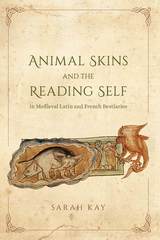
Bestiaries present accounts of animals whose fantastic behaviors should be imitated or avoided, depending on the given trait. In a highly original argument, Kay suggests that the association of beasts with books is here both literal and material, as nearly all surviving bestiaries are copied on parchment made of animal skin, which also resembles human skin. Using a rich array of examples, she shows how the content and materiality of bestiaries are linked due to the continual references in the texts to the skins of other animals, as well as the ways in which the pages themselves repeatedly—and at times, it would seem, deliberately—intervene in the reading process. A vital contribution to animal studies and medieval manuscript studies, this book sheds new light on the European bestiary and its profound power to shape readers’ own identities.
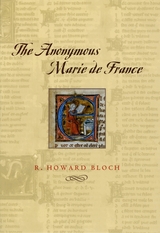
Evidence about Marie de France's life is so meager that we know next to nothing about her-not where she was born and to what rank, who her parents were, whether she was married or single, where she lived and might have traveled, whether she dwelled in cloister or at court, nor whether in England or France. In the face of this great writer's near anonymity, scholars have assumed her to be a simple, naive, and modest Christian figure. Bloch's claim, in contrast, is that Marie is among the most self-conscious, sophisticated, complicated, and disturbing figures of her time-the Joyce of the twelfth century. At a moment of great historical turning, the so-called Renaissance of the twelfth century, Marie was both a disrupter of prevailing cultural values and a founder of new ones. Her works, Bloch argues, reveal an author obsessed by writing, by memory, and by translation, and acutely aware not only of her role in the preservation of cultural memory, but of the transforming psychological, social, and political effects of writing within an oral tradition.
Marie's intervention lies in her obsession with the performative capacities of literature and in her acute awareness of the role of the subject in interpreting his or her own world. According to Bloch, Marie develops a theology of language in the Lais, which emphasize the impossibility of living in the flesh along with a social vision of feudalism in decline. She elaborates an ethics of language in the Fables, which, within the context of the court of Henry II, frame and form the urban values and legal institutions of the Anglo-Norman world. And in her Espurgatoire, she produces a startling examination of the afterlife which Bloch links to the English conquest and occupation of medieval Ireland.
With a penetrating glimpse into works such as these, The Anonymous Marie de France recovers the central achievements of one of the most pivotal figures in French literature. It is a study that will be of enormous value to medievalists, literary scholars, historians of France, and anyone interested in the advent of female authorship.
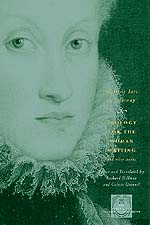
This volume presents translations of four of Gournay's works that address feminist issues. Two of these appear here in English for the first time—The Promenade of Monsieur de Montaigne and The Apology for the Woman Writing. One of the first modern psychological novels, the best-selling Promenade was also the first to explore female sexual feeling. With the autobiographical Apology, Gournay defended every aspect of her life, from her moral conduct to her household management. The book also includes Gournay's last revisions (1641) of her two best-known feminist treatises, The Equality of Men and Women and The Ladies' Complaint. The editors provide a general overview of Gournay's career, as well as individual introductions and extensive annotations for each work.
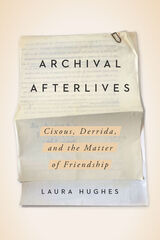
A capacious analysis of a legendary intellectual friendship and the material legacies it left behind
Over the course of their decades-long friendship, Hélène Cixous and Jacques Derrida assembled overlapping archives of written experiments and exchanges that document a shared interest in their literary afterlives. In this incisive account, Laura Hughes shows how pushing against the limits of writing and of life itself means not only imagining but manifesting a community of future readers.
Archival Afterlives: Cixous, Derrida, and the Matter of Friendship examines the embodied nature of literary creation, taking letters, fragments, notes, and other ephemera as objects of critical analysis and care. Combining close readings of key texts and previously unexamined archival materials, Hughes traces critical connections between Cixous and Derrida, between the theoretical and the autobiographical, and between life writing and its limits. In putting deconstruction into dialogue with new material analyses and archive studies, Archival Afterlives positions this historical and intellectual relationship as a lens through which to reexamine the legacy of critical theory itself.
Arkansas Post, the first European settlement in what would become Jefferson’s Louisiana, had an important mission as the only settlement between Natchez and the Illinois Country, a stretch of more than eight hundred miles along the Mississippi River. The Post was a stopping point for shelter and supplies for those travelling by boat or land, and it was of strategic importance as well, as it nurtured and sustained a crucial alliance with the Quapaw Indians, the only tribe that occupied the region.
The Arkansas Post of Louisiana covers the most essential aspects of the Post’s history, including the nature of the European population, their social life, the economy, the architecture, and the political and military events that reflected and shaped the Post’s mission.
Beautifully illustrated with maps, portraits, lithographs, photographs, documents, and superb examples of Quapaw hide paintings, The Arkansas Post of Louisiana is a perfect introduction to this fascinating place at the confluence of the Arkansas and Mississippi Rivers, a place that served as a multicultural gathering spot, and became a seminal part of the history of Arkansas and the nation.
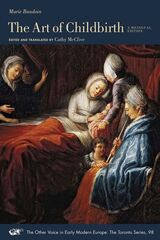
In 1671, Marie Baudoin (1625–1700), head midwife and governor of the Hôtel-Dieu of Clermont-Ferrand, sent a treatise on the art of childbirth to her powerful Parisian patron, Dr. Vallant. The story of how Baudoin’s knowledge and expertise as a midwife came to be expressed, recorded, and archived raises the question: Was Baudoin exceptional because she was herself extraordinary, or because her voice has reached us through Vallant’s careful archival practices? Either way, Baudoin’s treatise invites us to reconsider the limits of what we thought we knew midwives “could be and do” in seventeenth-century France. Grounding Marie Baudoin’s text in a microanalysis of her life, work, and the Jansenist network between Paris and Clermont-Ferrand, this book connects historiographies of midwifery, Jansenism, hospital administration, public health, knowledge and record-keeping, and women’s work, underscoring both Baudoin’s capabilities and the archival accidents and intentions behind the preservation of her treatise in a letter.
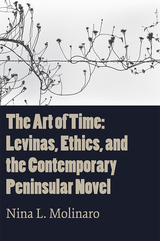
Academicians and journalists in Spain and abroad have recently fastened on an emerging cluster of peninsular writers who, they argue, pertain to a discernible literary generation, provisionally referred to as Generación X. These writers are distinct from their predecessors; they and their literary texts are closely related to the specific socio-political and historical circumstances in Spain and their novels relate stories of more and less proximity, more and less responsibility, and more and less temporality. In short, they trace the temporal movement of alterity through narrative.
Published by Bucknell University Press. Distributed worldwide by Rutgers University Press.
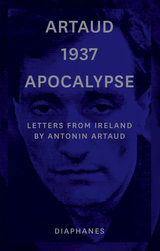
During his fateful journey, Artaud wrote letters to friends in Paris which included several “magic spells,” intended to curse his enemies and protect his friends from the city’s forthcoming incineration and the Antichrist’s appearance. (To André Breton, he wrote: “It’s the Unbelievable—yes, the Unbelievable—it’s the Unbelievable which is the truth.”) This book collects all of Artaud’s surviving correspondence from his time in Ireland, as well as photographs of the locations he traveled through. Featuring an afterword and notes by the book’s translator, Stephen Barber, this edition marks the seventieth anniversary of Artaud’s death.
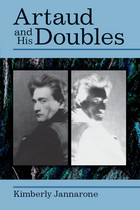
Artaud and His Doubles is a radical re-thinking of one of the most influential theater figures of the twentieth century. Placing Artaud's writing within the specific context of European political, theatrical, and intellectual history, the book reveals Artaud's affinities with a disturbing array of anti-intellectual and reactionary writers and artists whose ranks swelled catastrophically between the wars in Western Europe.
Kimberly Jannarone shows that Artaud's work reveals two sets of doubles: one, a body of peculiarly persistent received interpretations from the American experimental theater and French post-structuralist readings of the 1960s; and, two, a darker set of doubles---those of Artaud's contemporaries who, in the tumultuous, alienated, and pessimistic atmosphere enveloping much of Europe after World War I, denounced the degradation of civilization, yearned for cosmic purification, and called for an ecstatic loss of the self. Artaud and His Doubles will generate provocative new discussions about Artaud and fundamentally challenge the way we look at his work and ideas.
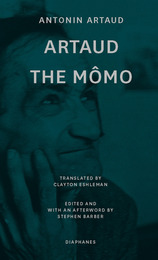
This edition is translated by Clayton Eshleman, the acclaimed foremost translator of Artaud’s work. This will be the first edition since the original 1947 publication to present the work in the spatial format Artaud intended. It also incorporates eight original drawings by Artaud—showing reconfigured bodies as weapons of resistance and assault—which he selected for that edition, after having initially attempted to persuade Pablo Picasso to collaborate with him. Additional critical material draws on Artaud’s previously unknown manuscript letters written between 1946 and 1948 to the book’s publisher, Pierre Bordas, which give unique insights into the work from its origins to its publication.
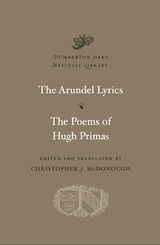
This volume presents two complementary medieval anthologies containing lyrics by two outstanding Latin poets of the second half of the twelfth century. The poet Peter of Blois was proclaimed by a contemporary of his to be a master composer of rhythmic verse. Peter’s secular love-lyrics gathered in the Arundel manuscript give substance to that claim. Written with a technical virtuosity that rivals the metrical display of Horatian lyric, the poems give eloquent and learned expression to the cult of secular love that emerged in the twelfth century.
The collection is further augmented by verse as varied as Christmas poems and satires on the venality of the Roman Curia and immoral bishops, including a famous lament about church corruption by Walther of Châtillon.
The cleric Hugh Primas won recognition and fame for compositions in which he reflects upon his experiences, good and bad, while traveling around the cities of northern France (such as the important sees of Rheims and Sens) in search of patronage. Artistic in conception and execution, the poems are memorable for the witty and often acerbic tone with which Primas engages the holders of ecclesiastical power.
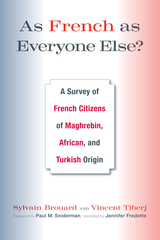
France is often depicted as the model of assimilationist or republican integration in the international literature on immigration. However, rarely have surveys drilled down to provide individual responses from a double representative sample. In As French as Everyone Else?, Sylvain Brouard and Vincent Tiberj provide a comprehensive assessment of the state of integration in France and challenge the usual crisis of integration by systematically comparing the "new French" immigrants, as well as their children and grandchildren born in France, with a sample of the French general population.
The authors' survey considers a wide range of topics, including religious affiliation and religiosity, political attitudes and political efficacy, value systems (including gender roles, work ethics, and anti-Semitism), patterns of integration, multiple identities and national belongings, and affirmative action. As the authors show, despite existing differences, immigrants of Maghrebin, African, and Turkish origin share a wide scope of commonality with other French citizens.
READERS
Browse our collection.
PUBLISHERS
See BiblioVault's publisher services.
STUDENT SERVICES
Files for college accessibility offices.
RECENTLY PUBLISHED




UChicago Accessibility Resources
home | accessibility | search | about | contact us
BiblioVault ® 2001 - 2024
The University of Chicago Press