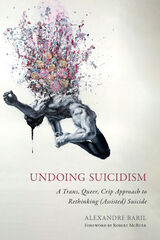
front cover of Undoing Suicidism
Undoing Suicidism
A Trans, Queer, Crip Approach to Rethinking (Assisted) Suicide
Alexandre Baril
Temple University Press, 2023
In Undoing Suicidism, Alexandre Baril argues that suicidal people are oppressed by what he calls structural suicidism, a hidden oppression that, until now, has been unnamed and under-theorized. Each year, suicidism and its preventionist script and strategies reproduce violence and cause additional harm and death among suicidal people through forms of criminalization, incarceration, discrimination, stigmatization, and pathologization. This is particularly true for marginalized groups experiencing multiple oppressions, including queer, trans, disabled, or Mad people. 
 
Undoing Suicidism questions the belief that the best way to help suicidal people is through the logic of prevention. Alexandre Baril presents the thought-provoking argument that supporting assisted suicide for suicidal people could better prevent unnecessary deaths. Offering a new queercrip model of (assisted) suicide, he invites us to imagine what could happen if we started thinking about (assisted) suicide from an anti-suicidist and intersectional framework. 
 
Baril provides a radical reconceptualization of (assisted) suicide and invaluable reflections for academics, activists, practitioners, and policymakers.
 
[more]

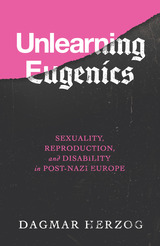
front cover of Unlearning Eugenics
Unlearning Eugenics
Sexuality, Reproduction, and Disability in Post-Nazi Europe
Dagmar Herzog
University of Wisconsin Press, 2020
Since the defeat of the Nazi Third Reich and the end of its horrific eugenics policies, battles over the politics of life, sex, and death have continued and evolved. Dagmar Herzog documents how reproductive rights and disability rights, both latecomers to the postwar human rights canon, came to be seen as competing—with unexpected consequences.

Bringing together the latest findings in Holocaust studies, the history of religion, and the history of sexuality in postwar—and now also postcommunist—Europe, Unlearning Eugenics shows how central the controversies over sexuality, reproduction, and disability have been to broader processes of secularization and religious renewal. Herzog also restores to the historical record a revelatory array of activists: from Catholic and Protestant theologians who defended abortion rights in the 1960s–70s to historians in the 1980s–90s who uncovered the long-suppressed connections between the mass murder of the disabled and the Holocaust of European Jewry; from feminists involved in the militant "cripple movement" of the 1980s to lawyers working for right-wing NGOs in the 2000s; and from a handful of pioneers in the 1940s–60s committed to living in intentional community with individuals with cognitive disability to present-day disability self-advocates.
[more]

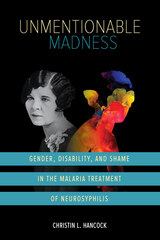
front cover of Unmentionable Madness
Unmentionable Madness
Gender, Disability, and Shame in the Malaria Treatment of Neurosyphilis
Christin L. Hancock
University of Illinois Press, 2025
In 1930, neurosyphilis struck an unsuspecting Mabel Smith. Doctors at the Central State Hospital for the Insane in Indianapolis turned to malaria therapy--a radical treatment that relied on the belief that infection with malaria might save Smith’s life by attacking the bacterium that causes syphilis.

Christin L. Hancock looks through the lens of feminist disability to examine the popular but ethically suspect treatment and its consequences. As Hancock shows, the treatment’s purported success rate relied on the disabled minds and bodies of people incarcerated in mental hospitals. The backgrounds and identities of these patients reflected and perpetuated attitudes around poverty, gender, race, and disability while betraying authorities’ desire to protect the public from women and men perceived as abnormal, sexually tainted, and unworthy of community life.

Paying special attention to the patients’ voices and experiences, Unmentionable Madness offers a disability history that confronts the ethics of experimentation.

[more]

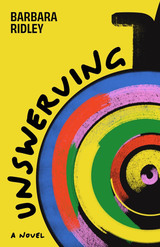
front cover of Unswerving
Unswerving
Barbara Ridley
University of Wisconsin Press, 2024
When Tave wakes up alone in the hospital, she barely remembers the car wreck. Far from home, dazed, and despondent, she struggles to face the challenges of her new paralysis—all while worrying about her partner, Les, also severely injured in the accident, now cared for by her homophobic parents who refuse to allow contact.

In rehab, Tave relearns life skills and comes to recognize that her future will be completely different than she’d imagined. Where will she live? How will she find the help she needs? Can her friends rise to the occasion? Or will she be forced to move back in with her mother, putting up with endless talk of faith healers? Her one beacon of hope is Beth, her physical therapist. But Beth’s relationship problems with her own girlfriend push her toward overinvolvement—and risk damaging both her career and Tave’s recovery.

A story of courage, resilience, and love, Unswerving challenges readers’ preconceived notions of disability, of limitations, and of the inevitability of fate.
[more]


Send via email Share on Facebook Share on Twitter