
 A SCHOLARLY BOOK REPOSITORY
9 start with U start with U
Faculty members who care about the institutions of higher education where they work are often at odds with university management. In his forceful book, Under New Management, Randy Martin takes a novel, evenhanded approach to this gulf between professors, who feel a loss of autonomy, and administrators.
Martin imagines a political future for academic labor based on a critical understanding of the administrative work that faculty already undertake. He considers the differences between self-rule and specialized expertise and provides a case study of a New York City public school to show how kids and families respond to the demands of managerial productivity that is part of preparing students for college. Under New Management also considers changes faced by students, faculty, and administrators in light of this reworked social compact of professionals.
For decades, leaders in higher education have voiced their intention to expand college education to include disadvantaged groups. Colleges have embraced and defended public policies that push back against discrimination and make college more affordable. And yet, as the economist Charles Clotfelter shows, America’s system of undergraduate education was unequal in 1970 and is even more so today.
In Unequal Colleges in the Age of Disparity, Clotfelter presents quantitative comparisons across selective and less selective colleges from the 1970s to the present, in exploration of three themes: diversity, competition, and inequality. Diversity shows itself in the variety of colleges’ objectives but also in the disparity of the material and human resources at their disposal. Competition operates through both the supply and the demand sides of the market, with college admissions becoming more meritocratic even as the most desirable colleges choose to contend fiercely for top-tier students rather than accommodate rising numbers of qualified applicants. Clotfelter shows that exclusive colleges have also benefited disproportionately from America’s growing income inequality. As their endowments have ballooned, their students have become more academically advantaged, owing in part to the extraordinary steps affluent families take to groom their children for college admission.
Clotfelter finds that despite a revolution in civil rights, billions spent on financial aid, and the commitment of colleges to greater equality, stratification has grown starker. Top colleges cater largely to children of elites.

A book about the challenges and uncertainties facing today's university, a chronicle of recent and current changes in higher education in the world. There are many questions today that are sufficiently open to doubt and profoundly related to new developments, to justify our starting new enquiries, here and now, by looking freshly and more closely at the actual configurations and at their historical grounds, for providing the new standard account of the university today.
Vlasceanu discusses the inherent contradiction between academia on the one hand, and expectations and regulations of the market on the other. Analyses demographic and other statistical characteristics of today's higher education. Examines the financial basis of universities in various countries, and describes current governance models. Finally the author sets up a new typology of universities.

“If universities are so important to society and if ours are so superior, one might have thought that America would be flourishing in comparison to other industrialized countries of the world. Yet this is plainly not the case. . . . Our economic position in the world has deteriorated [and] we have climbed to the top, or near the top, of all advanced countries in the percentage of population who live in poverty, commit crimes, become addicted to drugs, have illegitimate children, or are classified as functionally illiterate.” In light of these results, “it is fair to ask whether our universities are doing all they can and should to help America surmount the obstacles that sap our economic strength and blight the lives of millions of our people.”
Having posed this question, Derek Bok reviews what science can do to bring about greater productivity, what professional schools can do to improve the effectiveness of corporations, government, and public education, and what all parts of the university are doing to help students acquire higher levels of ethical and social responsibility. He concludes that Universities are contributing much less than the should to help the nation address its most urgent social problems. “A century after the death of Cardinal Newman, many university officials and faculty members continue to feel ambivalent about deliberate efforts to address practical problems of society. And though competition drives university leaders and their faculties to unremitting effort, what competition rewards is chiefly success in fields that command academic prestige rather than success in responding to important social needs.”
Bok urges academic leaders, trustees, foundations, and government agencies to work together to help universities realign their priorities “so that they will be ready to make their full contribution when the nation turns its attention again to the broad agenda of reform. . . . Observing our difficulties competing abroad, our millions of people in poverty, our drug-ridden communities, our disintegrating families, our ineffective schools, those who help to shape our universities have reason to ask whether they too have any time to lose.”
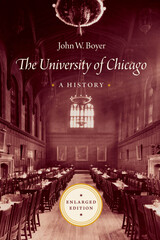
One of the most influential institutions of higher learning in the world, the University of Chicago has a powerful and distinct identity, and its name is synonymous with intellectual rigor. With nearly 170,000 alumni living and working in more than one hundred and fifty countries, its impact is far-reaching and long-lasting.
With The University of Chicago: A History, John W. Boyer, Dean of the College from 1992 to 2023, thoroughly engages with the history and the lived politics of the university. Boyer presents a history of a complex academic community, focusing on the nature of its academic culture and curricula, the experience of its students, its engagement with Chicago’s civic community, and the resources and conditions that have enabled the university to sustain itself through decades of change. He has mined the archives, exploring the school’s complex and sometimes controversial past to set myth and hearsay apart from fact.
Boyer’s extensive research shows that the University of Chicago’s identity is profoundly interwoven with its history, and that history is unique in the annals of American higher education. After a little-known false start in the mid-nineteenth century, it achieved remarkable early successes, yet in the 1950s it faced a collapse of undergraduate enrollment, which proved fiscally debilitating for decades. Throughout, the university retained its fierce commitment to a distinctive, intense academic culture marked by intellectual merit and free debate, allowing it to rise to international acclaim. Today it maintains a strong obligation to serve the larger community through its connections to alumni, to the city of Chicago, and increasingly to its global community. Boyer’s tale is filled with larger-than-life characters—John D. Rockefeller, Robert Maynard Hutchins, and many other famous figures among them—and episodes that reveal the establishment and rise of today’s institution.
Newly updated, this edition extends through the presidency of Robert Zimmer, whose long tenure was marked by significant developments and controversies over subjects as varied as free speech, medical inequity, and community relations.
With The University of Chicago: A History, John W. Boyer, Dean of the College since 1992, presents a deeply researched and comprehensive history of the university. Boyer has mined the archives, exploring the school’s complex and sometimes controversial past to set myth and hearsay apart from fact. The result is a fascinating narrative of a legendary academic community, one that brings to light the nature of its academic culture and curricula, the experience of its students, its engagement with Chicago’s civic community, and the conditions that have enabled the university to survive and sustain itself through decades of change.
Boyer’s extensive research shows that the University of Chicago’s identity is profoundly interwoven with its history, and that history is unique in the annals of American higher education. After a little-known false start in the mid-nineteenth century, it achieved remarkable early successes, yet in the 1950s it faced a collapse of undergraduate enrollment, which proved fiscally debilitating for decades. Throughout, the university retained its fierce commitment to a distinctive, intense academic culture marked by intellectual merit and free debate, allowing it to rise to international acclaim. Today it maintains a strong obligation to serve the larger community through its connections to alumni, to the city of Chicago, and increasingly to its global community.
Published to coincide with the 125th anniversary of the university, this must-have reference will appeal to alumni and anyone interested in the history of higher education of the United States.
READERS
Browse our collection.
PUBLISHERS
See BiblioVault's publisher services.
STUDENT SERVICES
Files for college accessibility offices.
RECENTLY PUBLISHED





UChicago Accessibility Resources
home | accessibility | search | about | contact us
BiblioVault ® 2001 - 2025
The University of Chicago Press