
 A SCHOLARLY BOOK REPOSITORY
150 start with V start with V
2023 Outstanding Book Award, National Association for Ethnic Studies
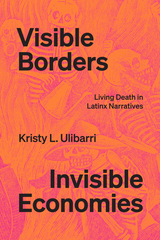
A thorough examination of the political and economic exploitation of Latinx subjects, migrants, and workers through the lens of Latinx literature, photography, and film.
Globalization in the United States can seem paradoxical: free trade coincides with fortification of the southern border, while immigration is reimagined as a national-security threat. US politics turn aggressively against Latinx migrants and subjects even as post-NAFTA markets become thoroughly reliant on migrant and racialized workers. But in fact, there is no incongruity here. Rather, anti-immigrant politics reflect a strategy whereby capital uses specialized forms of violence to create a reserve army of the living, laboring dead.
Visible Borders, Invisible Economies turns to Latinx literature, photography, and films that render this unseen scheme shockingly vivid. Works such as Valeria Luiselli’s Tell Me How It Ends and Alex Rivera’s Sleep Dealer crystallize the experience of Latinx subjects and migrants subjugated to social death, their political existence erased by disenfranchisement and racist violence while their bodies still toil in behalf of corporate profits. In Kristy L. Ulibarri’s telling, art clarifies what power obscures: the national-security state performs anti-immigrant and xenophobic politics that substitute cathartic nationalism for protections from the free market while ensuring maximal corporate profits through the manufacture of disposable migrant labor.
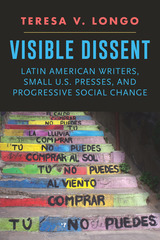
As Teresa Longo’s groundbreaking examination reveals, North America’s dissident literature has its roots in the Latin American literary tradition. From Pablo Neruda’s Canto General to Eduardo Galeano’s Open Veins of Latin America to Gabriel García Márquez’s One Hundred Years of Solitude—among others—contemporary writers throughout the Americas have forced us to reconsider the United States’s relationship with Latin America, and more broadly with the Global South. Highlighting the importance of reading and re-reading the Latin American canon in the United States, Longo finds that literature can be an instrument of progressive social change, and argues that small literary presses—City Lights, Curbstone, and Seven Stories—have made that dissent visible in the United States. In the book’s final two chapters on the Robert F. Kennedy Center’s Speak Truth to Power initiative and the publication of Marc Falkoff’s Poems from Guantánamo, the author turns our attention further outward, probing the role poetry, theater, and photography play in global human rights work.
Locating the work of artists and writers alongside that of scholars and legal advocates, Visible Dissent not only unveils the staying-power of committed writing, it honors the cross-currents and the on-the-ground implications of humane political engagement.
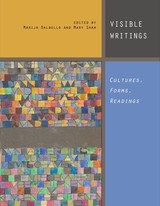
Multicultural in character and historical in range, essays discuss pre-Colombian Mesoamerican scripts, inscriptions on ancient Greek vases, medieval illuminations, Renaissance prints, Enlightenment concepts of the legible, and the Western "reading" of Chinese ideograms. A rich array of modern forms, including comics, poster art, typographic signs, scribblings in writers' manuscripts, anthropomorphic statistical pictograms, the street writings of 9/11, intersections between poetry and painting, the use of color in literary texts, and the use of writing in visual art are also addressed.
Visible Writings reaches outside the traditional venues of literature and art history into topics that consider design, history of writing, philosophy of language, and the emerging area of visual studies. Marija Dalbello, Mary Shaw, and the other contributors offer both scholars and those with a more casual interest in literature and art the opportunity, simply stated, to see the writing on the wall.

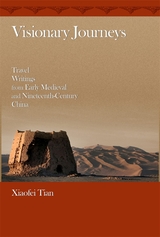
This book explores the parallel and yet profoundly different ways of seeing the outside world and engaging with the foreign at two important moments of dislocation in Chinese history, namely, the early medieval period commonly known as the Northern and Southern Dynasties (317–589 CE), and the nineteenth century. Xiaofei Tian juxtaposes literary, historical, and religious materials from these two periods in comparative study, bringing them together in their unprecedentedly large-scale interactions, and their intense fascination, with foreign cultures.
By examining various cultural forms of representation from the two periods, Tian attempts to sort out modes of seeing the world that inform these writings. These modes, Tian argues, were established in early medieval times and resurfaced, in permutations and metamorphoses, in nineteenth-century writings on encountering the Other. This book is for readers who are interested not only in early medieval or nineteenth-century China but also in issues of representation, travel, visualization, and modernity.
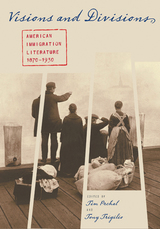
From these debates came such novels as Willa Cather’s My Ántonia and Upton Sinclair’s The Jungle. Henry James, Charlotte Perkins Gilman, and Carl Sandburg added to the diversity of viewpoints of native born Americans while equally divergent immigrant perspectives were represented by writers such as Anzia Yezierska, Kahlil Gibran, and Claude McKay. This anthology presents the writing of these authors, among others less well known, to show the many ways literature participated in shaping the face of immigration. The volume also includes an introduction, annotations, a timeline, and historical documents that contextualize the literature.

This work examines the travel account of a German baroque author who journeyed in search of silk from Northern Germany, through Muscovy, to the court of Shah Safi in Isfahan.
Adam Olearius introduced Persian literature, history, and arts to the German-speaking public; his frank appraisal of Persian customs foreshadows the enlightened spirit of the eighteenth century (influencing Montesquieu’s Persian Letters as well as Goethe’s West-Eastern Divan) and prepares the way for German Romanticism’s infatuation with Persian poetry.
Elio Brancaforte focuses on the visual and discursive nexus uniting Olearius’s text with the numerous engravings that supplement the book. The emphasis falls on contextualized readings of Olearius’s decorative frontispieces and his new and improved map of Persia and the Caspian Sea, as expressions of early modern subjectivity.
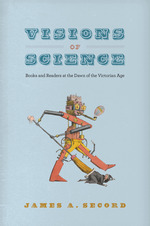
In Visions of Science, James A. Secord offers a new way to capture this unique moment of change. He explores seven key books—among them Charles Babbage’s Reflections on the Decline of Science, Charles Lyell’s Principles ofGeology, Mary Somerville’s Connexion of the Physical Sciences, and Thomas Carlyle’s Sartor Resartus—and shows how literature that reflects on the wider meaning of science can be revelatory when granted the kind of close reading usually reserved for fiction and poetry. These books considered the meanings of science and its place in modern life, looking to the future, coordinating and connecting the sciences, and forging knowledge that would be appropriate for the new age. Their aim was often philosophical, but Secord shows it was just as often imaginative, projective, and practical: to suggest not only how to think about the natural world but also to indicate modes of action and potential consequences in an era of unparalleled change.
Visions of Science opens our eyes to how genteel ladies, working men, and the literary elite responded to these remarkable works. It reveals the importance of understanding the physical qualities of books and the key role of printers and publishers, from factories pouring out cheap compendia to fashionable publishing houses in London’s West End. Secord’s vivid account takes us to the heart of an information revolution that was to have profound consequences for the making of the modern world.
An extreme faction of aesthetic modernity intent on bulldozing contemporary life, the avant-garde has regularly employed visions of violence in their push for societal and cultural renewal. But in the shadow of unparalleled war and genocide, such aesthetic violence lost its force. This book explores the reconfiguration of the avant-garde in response to the violent transformation of European reality. Citing the emergence of independent avant-garde practitioners in the place of the previous collective, Richard Langston considers six individual exemplars of Germany’s post-fascist avant-garde—works that span the last six decades: painter, writer, and filmmaker Peter Weiss’s appropriation of French surrealism in the fifties; writer Dieter Wellershoff’s coterie of “new realists”; artist Wolf Vostell’s mediation and conflation of the experiences of the Auschwitz trials and the Vietnam War; poet and novelist Dieter Brinkmann’s collages from the seventies; the multimedia displacements of Alexander Kluge; and the performative engagements of dramatists Christoph Schlingensief and Rene Pollesch.
Taking stock of the evolution of Germany’s post-fascist avant-gardes, Langston’s book shows how the movement from Weiss to Pollesch exhibits the problems that both modernity and postmodernity pose for an aesthetic engagement of Germany’s violent past.

This unique anthology gathers work by eighty poets inspired by Emily Dickinson. Beginning with Hart Crane's 1927 poem “To Emily Dickinson” and moving forward through the century to such luminary figures as Archibald MacLeish, John Berryman, Yvor Winters, Adrienne Rich, Richard Eberhart, Richard Wilbur, Maxine Kumin, Amy Clampitt, William Stafford, and Galway Kinnell, Visiting Emily offers both a celebration of and an homage to one of the world's great poets.
If there was ever any doubt about Dickinson's influence on modern and contemporary poets, this remarkable collection surely puts it to rest. Gathered here are poems reflecting a wide range of voices, styles, and forms—poems written in traditional and experimental forms; poems whose tones are meditative, reflective, reverent and irreverent, satirical, whimsical, improvisational, and serious. Many of the poets draw from Dickinson's biography, while others imagine events from her life. Some poets borrow lines from Dickinson's poems or letters as triggers for their inspiration. Though most of the poems connect directly to Dickinson's life or work, for others the connection is more oblique.
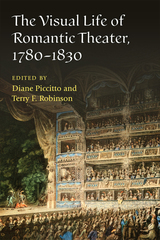
The Visual Life of Romantic Theater examines the dynamism and vibrancy of stage spectacle and its impact in an era of momentous social upheaval and aesthetic change. Situating theatrical production as key to understanding visuality ca. 1780-1830, this book places the stage front and center in Romantic scholarship—a field in a period long defined by its focus on poetry—by reenvisioning traditional approaches to artistic and social production. How, it asks, did dramaturgy and stagecraft influence aesthetic and sociopolitical concerns? How does a focus on visuality expand our understanding of the historical experience of theatergoing? In what ways did stage performance converge with visual culture beyond the theater? How did extra-theatrical genres engage with theatrical sight and spectacle? Finally, how does a focus on dramatic vision change the way we conceive of Romanticism itself? The volume’s essays by emerging and established scholars provide exciting and suggestive answers to these questions, along with a more capacious conception of Romantic theater as a locus of visual culture that reached well beyond playhouse walls.
D. H. Lawrence, asserts Jack Stewart, expresses a painter’s vision in words, supplementing visual images with verbal rhythms. With the help of twenty-three illustrations, Stewart examines Lawrence’s painterly vision in The White Peacock, Sons and Lovers, The Rainbow, Women in Love, Kangaroo, and The Plumed Serpent. He concludes by synthesizing the themes that pervade this interarts study: vision and expression, art and ontology.
The Vital Lie is the first book to examine the reality-illusion conflict in modern drama from Ibsen to present-day playwrights. The book questions why vital lies, lies necessary for life itself, are such an obsessive concern for playwrights of the last hundred years. Using the work of fifteen playwrights, Abbott seeks to discover if modern playwrights treat illusions as helpful or necessary to life, or as signals of sicknesses from which human beings need to be cured. What happens to characters when they are forced to face the truth about themselves and their worlds without the protection of their illusions? The author develops a three-part historical analysis of the use of the reality-illusion theme, from its origins as a metaphysical search to its current elaborations as a theatrical game.
This book shows how ethics and aesthetics interact in the works of one of the most celebrated literary stylists of the twentieth century: the Russian American novelist Vladimir Nabokov. Dana Dragunoiu reads Nabokov’s fictional worlds as battlegrounds between an autonomous will and heteronomous passions, demonstrating Nabokov’s insistence that genuinely moral acts occur when the will triumphs over the passions by answering the call of duty.
Dragunoiu puts Nabokov’s novels into dialogue with the work of writers such as Alexander Pushkin, William Shakespeare, Leo Tolstoy, and Marcel Proust; with Kantian moral philosophy; with the institution of the modern duel of honor; and with the European traditions of chivalric literature that Nabokov studied as an undergraduate at Cambridge University. This configuration of literary influences and philosophical contexts allows Dragunoiu to advance an original and provocative argument about the formation, career, and legacies of an author who viewed moral activity as an art, and for whom artistic and moral acts served as testaments to the freedom of the will.
Showing the particular influence of the thought of Kant and Berkeley, she focuses on what she calls Nabokov’s “most deceptively apolitical novels”: The Gift, Lolita, Pale Fire, and Ada. In bringing to them a more extensive context than previous Nabokov scholars, Dragunoiu argues that their treatment of various moral and political subjects can be more clearly understood in the light of ideas inherited by Nabokov from his father and his father’s generation.
Arguing that these authors have received relatively little attention because of the difficulty in categorizing them, Mix brings the writing of women of color, lesbians, and collaborative writers into the discussion of experimental writing. Thus, rather than exploring conventional lines of influence, she departs from earlier scholarship by using Stein and her work as a lens through which to read the ways these authors have renegotiated tradition, authority, and innovation.
Building on the tradition of experimental or avant-garde writing in the United States, Mix questions the politics of the canon and literary influence, offers close readings of previously neglected contemporary writers whose work doesn't fit within conventional categories, and by linking genres not typically associated with experimentalism-lyric, epic, and autobiography-challenges ongoing reevaluations of innovative writing.
For Voegelinian Readings of Modern Literature, scholar Charles R. Embry has collected essays that consider particular pieces of literature in light of the philosopher’s work. These essays supply a theoretical grounding for the reading of novels, poems, and plays and reveal how the Voegelinian perspective exposes the existential and philosophical dimensions of the literary works themselves. As a unit, this collection of essays shows how modern pieces of literature can symbolize their creators’ participation in the human search for the truth of existence—just as myths, philosophical works, and religious texts always have.
Voegelin’s primary concern as a philosopher was to expose the roots of the disturbances of the modern era—religious conflict, imperialism, war—so that the sources of order leading to meaning are revealed. The openness of Voegelinian thought and the many ways he considered the levels of reality generate intriguing themes for literary criticism. In these essays, noted Voegelin scholars focus on American and European literary artists from the 1700s through the late twentieth century, including Emily Dickinson, Henrik Ibsen, Thomas Carlyle, D. H. Lawrence, Marcel Proust, and Hermann Broch.
While the intersection of the work of Eric Voegelin and literature has been a part of Voegelin scholarship for decades, this book explores that relationship in an extended form. Through a broad collection of thoughtful essays, Voegelinian Readings of Modern Literature reveals how much Voegelin did to break down the barriers between literature and philosophy and makes an engaging contribution to Voegelin scholarship.

In her writings, Terry Tempest Williams repeatedly invites us as readers into engagement and conversation with both her and her subject matter, whether it is nature or society, environment or art. From her evocation, in Desert Quartet: An Erotic Landscape, of an eroticism of place that defines erotic as "in relation," to the spiritual connectivity and familial bonds she explores in Refuge: An Unnatural History of Family and Place and the political engagement she urges in The Open Space of Democracy, much of her work is about relationship, connection, and community. Like much good writing, her books invite readers into thoughtful dialogue with the text. Frequently in demand for workshops, lectures, and other speaking venues and well known as an environmental activist, Williams has a public persona and voice almost indistinguishable from her written ones.
Thus, the interviews she has often granted--in print, on the radio, on the Web--seamlessly elaborate the ideas and extend the explorations of her written texts. They also tell us much about the genesis, context, and intent of her books. With her distinctive, impassioned voice and familiar felicity of language, she talks about wilderness and wildlife, place and eroticism, art and literature, democracy and politics, family and heritage, Mormonism and religion, writing and creativity, and other subjects that engage her agile mind. The set of interviews gathered and introduced by Michael Austin in A Voice in the Wilderness represent the span of Terry Tempest Williams's career as a naturalist, author, and activist.
By one of the most original and learned critical voices in Hispanic studies— a timely and ambitious study of authority as theme and authority as authorial strategy in modern Latin American literature.
An ideology is implicit in modern Latin American literature, argues Roberto González Echevarría, through which both the literature itself and criticism of it define what Latin American literature is and how it ought to be read. In the works themselves this ideology is constantly subjected to a radical critique, and that critique renders the ideology productive and in a sense is what constitutes the work. In literary criticism, however, too frequently the ideology merely serves as support for an authoritative discourse that seriously misrepresents Latin American literature.
In The Voice of the Masters, González Echevarría attempts to uncover the workings of modern Latin American literature by creating a dialogue of texts, a dynamic whole whose parts are seven illuminating essays on seminal texts in the tradition. As he says, "To have written a sustained, expository book ... would have led me to make the same kind of critical error that I attribute to most criticism of Latin American literature.... I would have naively assumed an authoritative voice while attempting a critique of precisely that critical gesture."
Instead, major works by Barnet, Cabrera Infante, Carpentier, Cortázar, Fuentes, Gallegos, García Márquez, Roa Bastos, and Rodó are the object of a set of independent deconstructive (and reconstructive) readings. Writing in the tradition of Derrida and de Man, González Echevarría brings to these readings both the penetrative brilliance of the French master and a profound understanding of historical and cultural context. His insightful annotation of Cabrera Infante's "Meta-End," the full text of which is presented at the close of the study, clearly demonstrates these qualities and exemplifies his particular approach to the text.
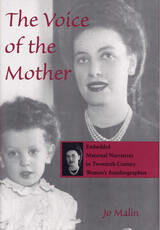
Every woman autobiographer is a daughter who writes and establishes her identity through her autobiographical narrative. In The Voice of the Mother, Jo Malin argues that many twentieth-century autobiographies by women contain an intertext, an embedded narrative, which is a biography of the writer/daughter’s mother.
Analyzing this narrative practice, Malin examines ten texts by women who seem particularly compelled to tell their mothers’ stories: Virginia Woolf, Sara Suleri, Kim Chernin, Drusilla Modjeska, Joan Nestle, Carolyn Steedman, Dorothy Allison, Adrienne Rich, Cherríe Moraga, and Audre Lorde. Each author is, in fact, able to write her own autobiography only by using a narrative form that contains her mother’s story at its core. These texts raise interesting questions about autobiography as a genre and about a feminist writing practice that resists and subverts the dominant literary tradition.
Malin theorizes a hybrid form of autobiographical narrative containing an embedded narrative of the mother. The textual relationship between the two narratives is unique among texts in the auto/biographical canon. This alternative narrative practice—in which the daughter attempts to talk both to her mother and about her—is equally an autobiography and a biography rather than one or the other. The technique is marked by a breakdown of subject/object categories as well as auto/biographical dichotomies of genre. Each text contains a “self” that is more plural than singular, yet neither.
In addition to being a theoretical and textual analysis, Malin’s book is also a mother-daughter autobiography and biography itself. She shares her own story and her mother’s story as a way to connect directly with readers and as a way to bridge the gap between theory and practice.

One of the most recurrent and controversial subjects of nineteenth–century discourse was work. Many thinkers associated work with honest pursuit of doing good, not the curse accompanying exile from Eden but rather “a great gift of God.” Sincerely undertaken work comprised a mission entailing a commitment to serve others and promote a better future for all.
Satisfaction with what work could do for individuals had its counterbalance in the anger and dismay expressed at the conditions of those whom Robert Owen, in 1817, first called the “working class.” What working–class people confronted both at the labor site and at their lodgings was construed as oppressive, and the misery of their lives became the subject of sentimental poetry, government report, popular fiction, and journalistic expose. Perhaps as heated as the discussion about conditions of lower–class workers was the conversation about separate spheres of work for men and women. This conversation, too, found its way into the literature and public discourse of the day.
In The Voice of Toil, the editors have collected the central writings from a pivotal place and time, including poems, stories, essays, and a play that reflect four prominent ways in which the subject of work was addressed: Work as Mission, Work as Opportunity, Work as Oppression, and (Separate) Spheres of Work. The resulting anthology offers a provocative text for students of nineteenth-century British literature and history and a valuable resource for scholars.
The text includes readings from John Wesley, William Blake, Elizabeth Gaskell, William Wordsworth, Charles Dickens, Florence Nightingale, William Morris, Joanna Baillie, Friedrich Engels, Matthew Arnold, Angela Burdett–Coutts, John Stuart Mill, Elizabeth Barrett Browning, Bernard Shaw and many others.
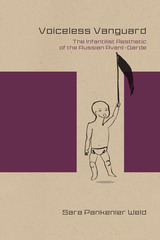
Voiceless Vanguard: The Infantilist Aesthetic of the Russian Avant-Garde offers a new approach to the Russian avant-garde. It argues that central writers, artists, and theorists of the avant-garde self-consciously used an infantile aesthetic, as inspired by children’s art, language, perspective, and logic, to accomplish the artistic renewal they were seeking in literature, theory, and art. It treats the influence of children’s drawings on the Neo-Primitivist art of Mikhail Larionov, the role of children’s language in the Cubo-Futurist poetics of Aleksei Kruchenykh, the role of the naive perspective in the Formalist theory of Viktor Shklovsky, and the place of children’s logic and lore in Daniil Kharms’s absurdist writings for children and adults. This interdisciplinary and cultural study not only illuminates a rich period in Russian culture but also offers implications for modernism in a wider Western context, where similar principles apply.

Voices From an Empire was first published in 1975. Minnesota Archive Editions uses digital technology to make long-unavailable books once again accessible, and are published unaltered from the original University of Minnesota Press editions.
The literature of the various regions of Lusophone Africa has received relatively little critical attention compared with that which has been focused on the work of writers in the English- and French- speaking countries of Africa. With the profound changes which are occurring in the social and political structures of Lusophone Africa, there is particular need for the comprehensive look at Afro-Protuguese literature which this account provides.
Professor Hamilton traces the development of this literature in the broad perspective of it social, cultural, and aesthetic context. He discusses the whole of the Afro-Portuguese literary phenomenon, as it occurs on the Cape Verde archipelago, in Guinea-Bissau, on the Guinea Gulf islands of Sao Tome and Principe, in Angola, and in Mozambique.
In an introduction he discusses some basic questions about Afro-Protuguese literature, among them, the matter of a definition of this body of writing, the implications of the concept of negritude, the role of Portugal and Brazil in Afro-Portuguese literature, and the social and cultural significance of the dominant literary themes found in the various regions of Lusophone Africa. Because he sees the regionalist movement in Angola as the most significant in terms of a neo-African orientation, he begins the book with an extensive study of the literature of that country. Many examples of afro-Portuguese poetry are given, both in the original language and in the English translation. There is a bibliography, and a map shows the African regions of study.
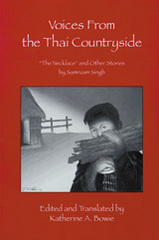
Set in northern Thailand during the mid-1970s, the stories in this collection capture a period of dramatic social and economic change. Amidst a setting of marketplaces and paddyfields, lemon trees and leaf-roofed houses, these vignettes offer revealing insights into the daily lives of ordinary villagers and hillspeople struggling to survive.
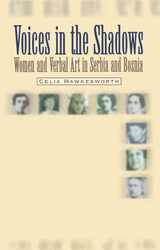
Women are conspicuously absent from traditional cultural histories of south-east Europe. This book addresses that imbalance by describing the contribution of women to literary culture in the Orthodox/ Ottoman areas of Serbia and Bosnia.
The first complete literary history in relation to women's writing in south-east Europe. The author provides a broad chronological account of this contribution, dividing the book into two main parts; the earlier period up until the eighteenth century concentrates on the projections of gender through the medium of oral tradition and the lives of a handful of educated women in medieval Serbia and the few works of literature they left. Hawkesworth also looks at the written literature produced by women, first in the mid-nineteenth century and then at the turn of the century. The second part focuses on the trials and tribulations that affected feminism and women's literature throughout the twentieth century. The author finishes by highlighting the new women's movement, 1975-1990, a great period for women in Yugoslavia which created a stimulating atmosphere for outstanding pieces of women's journalism, prose and verse, culminating in the creation of new women's studies courses in many universities.
Both Jürgen Habermas and Wayne Booth—two of the most influential theorists in the domain of public discourse and good citizenry—argue for an inclusive public deliberation that involves people who are willing to listen to one another, to identify points of agreement and disagreement, and to make good faith attempts to validate any disputed claims. The Puritan voice crying in the wilderness, Roberts-Miller shows, does none of these things. To this individual of conscience engaged in a ceaseless battle of right and wrong against greedy philistines, all inclusion, mediation, and reciprocity are seen as evil, corrupting, and unnecessary. Hence, the voice in the wilderness does not in any real sense participate in public deliberation, only in public pronouncement.
Arguing that our culture’s continuing affection for the ethos of the voice crying in the wilderness is one of our more troubling inheritances from the early American ambivalence to public discourse—including the Puritan denigration of rhetoric—Roberts-Miller contends that the monologic discourse of the Puritans in fact contains within it arguments for dialogism. Thus, the history of rhetoric can provide much richer fields for reimagining discourse than heretofore credited. Roberts-Miller concludes by extending her findings into their practical applications for argumentation in the public sphere and in the composition classroom.
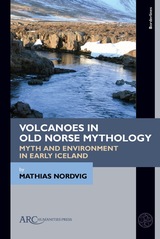
Stories of the volcano goddess Pele and her youngest sister Hi‘iaka, patron of hula, are most familiar as a form of literary colonialism—first translated by missionary descendants and others, then co-opted by Hollywood and the tourist industry. But far from quaint tales for amusement, the Pele and Hi‘iaka literature published between the 1860s and 1930 carried coded political meaning for the Hawaiian people at a time of great upheaval. Voices of Fire recovers the lost and often-suppressed significance of this literature, restoring it to its primary place in Hawaiian culture.
Ku‘ualoha ho‘omanawanui takes up mo‘olelo (histories, stories, narratives), mele (poetry, songs), oli (chants), and hula (dances) as they were conveyed by dozens of authors over a tumultuous sixty-eight-year period characterized by population collapse, land alienation, economic exploitation, and military occupation. Her examination shows how the Pele and Hi‘iaka legends acted as a framework for a Native sense of community. Freeing the mo‘olelo and mele from colonial stereotypes and misappropriations, Voices of Fire establishes a literary mo‘okū‘auhau, or genealogy, that provides a view of the ancestral literature in its indigenous contexts.
The first book-length analysis of Pele and Hi‘iaka literature written by a Native Hawaiian scholar, Voices of Fire compellingly lays the groundwork for a larger conversation of Native American literary nationalism.
Collected and translated by Carolyn Alessio, this bilingual anthology of poems, stories, memories, and philosophies was written and illustrated by the children of La Esperanza, Guatemala. Drawing upon the fortitude of their mothers, who began hand-sewing crafts to sell in the United States in order to survive the hardships of this war-torn impoverished country, Alessio’s students, aged four to sixteen, reveal amazing survival skills, fertile imaginations, and dreams of attaining better lives. The resulting work is a collection of poems and drawings that are terse, funny, sometimes sad, but always humanly, gloriously alive.
As Alessio explains, “At first, I thought I might be imagining the echoes of magical realism, but as I continued to read the students’ writing and study their drawings, I found similar themes. Witches killed children who didn’t respect the spirits; women abused by their husbands sought refuge in trees with magical doors. People who didn’t have money or jobs lived on the road and in forests, where they alternately fought and partied with the animals.”
The volume features a foreword from Luis Alberto Urrea,author of Across the Wire: Life and Hard Times on the Mexican Border and By the Lake of Sleeping Children: The Secret Life of the Mexican Border.
In a fresh examination of his essays, notebooks, and fiction, Patrizia McBride reconstructs Musil's understanding of ethics as a realm of experience that eludes language and thought. After situating Musil's work within its contemporary cultural-philosophical horizon, as well as the historical background of rising National Socialism, McBride shows how the writer's notion of ethics as a void can be understood as a coherent and innovative response to the crises haunting Europe after World War I. She explores how Musil rejected the outdated, rationalistic morality of humanism, while simultaneously critiquing the irrationalism of contemporary art movements, including symbolism, impressionism, and expressionism. Her work reveals Musil's remarkable relevance today-particularly those aspects of his thought that made him unfashionable in his own time: a commitment to fighting ethical fundamentalism and a literary imagination that validates the pluralistic character of modern life.
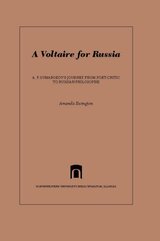
In A Voltaire for Russia, Amanda Ewington examines the tumultuous literary career of Alexander Petrovich Sumarokov in relation to that of his slightly older French contemporary, Voltaire. Although largely unknown in the English-speaking world, Sumarokov was one of the founding fathers of modern Russian literature, renowned in his own time as a great playwright and prolific
poet.
A Voltaire for Russia polemicizes with long-accepted readings of Sumarokov as an imitator of French neoclassical poets, ultimately questioning the very notion of a Russian “classicism.” Ewington uncovers Sumarokov’s poignantly personal devotion to Voltaire as a new framework for understanding not only his works but also his literary allegiances and agenda, as he sets out to establish a Russian literature and cultivate a reading public.
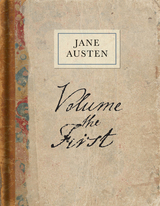

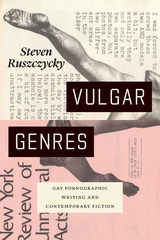
Long fixated on visual forms, the field of porn studies is overdue for a book-length study of gay pornographic writing. Steven Ruszczycky delivers with an impressively researched work on the ways gay pornographic writing emerged as a distinct genre in the 1960s and went on to shape queer male subjectivity well into the new millennium.
Ranging over four decades, Ruszczycky draws on a large archive of pulp novels and short fiction, lifestyle magazines and journals, reviews, editorial statements, and correspondence. He puts these materials in conversation with works by a number of contemporary writers, including William Carney, Dennis Cooper, Samuel Delany, John Rechy, and Matthew Stadler. While focused on the years 1966 to 2005, Vulgar Genres reveals that the history of gay pornographic writing during this period informs much of what has happened online over the past twenty years, from cruising to the production of digital pornographic texts. The result is a milestone in porn studies and an important contribution to the history of gay life.
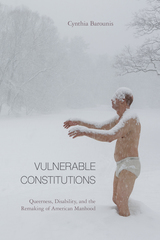
Amputation need not always signify castration; indeed, in Jack London’s fiction, losing a limb becomes part of a process through which queerly gendered men become properly masculinized. In her astute book, Vulnerable Constitutions, Cynthia Barounis explores the way American writers have fashioned alternative—even resistant—epistemologies of queerness, disability, and masculinity. She seeks to understand the way perverse sexuality, physical damage, and bodily contamination have stimulated—rather than created a crisis for—masculine characters in twentieth- and early twenty-first-century literature.
Barounis introduces the concept of “anti-prophylactic citizenship”—a mode of political belonging characterized by vulnerability, receptivity, and risk—to examine counternarratives of American masculinity. Investigating the work of authors including London, William Faulkner, James Baldwin, and Eli Clare, she presents an evolving narrative of medicalized sexuality and anti-prophylactic masculinity. Her literary readings interweave queer theory, disability studies, and the history of medicine to demonstrate how evolving scientific conversations around deviant genders and sexualities gave rise to a new model of national belonging—ultimately rewriting the story of American masculinity as a story of queer-crip rebellion.
No one in Czech politics or culture could match the international stature of Václav Havel at the time of his death in 2011. In the years since his passing, his legacy has only grown, as developments in the Czech Republic and elsewhere around the world continue to show the importance of his work and writing against a range of political and social ills, from autocratic brutality to messianic populism.
This book looks squarely at the heart of Havel’s legacy: the rich corpus of texts he left behind. It analyzes the meanings of key concepts in Havel’s core vocabulary: truth, power, civilsociety, home, appeal, indifference, hotspot, theatre, prison, and responsibility. Where do these concepts appear in Havel’s oeuvre? What part do they play in his larger intellectual project? How might we understand Havel’s focus on these concepts as a centerpiece of his contribution to contemporary thought? How does Havel’s particular perspective on the meaning of these concepts speak to us in the here and now? The ten contributors use a variety of methodological tools to examine the meaning of these concepts, drawing on a diversity of disciplines: political science and political philosophy, historical and cultural analysis, discourse/textual analysis, and linguistic-corpus analysis.
READERS
Browse our collection.
PUBLISHERS
See BiblioVault's publisher services.
STUDENT SERVICES
Files for college accessibility offices.
RECENTLY PUBLISHED



UChicago Accessibility Resources
home | accessibility | search | about | contact us
BiblioVault ® 2001 - 2026
The University of Chicago Press