logo for Georgetown University Press
Wartime Sexual Violence
From Silence to Condemnation of a Weapon of War
Kerry F. Crawford
Georgetown University Press, 2017

Reports of sexual violence in armed conflict frequently appear in political discussions and news media, presenting a stark contrast to a long history of silence and nonrecognition. Conflict-related sexual violence has transitioned rapidly from a neglected human rights issue to an unambiguous security concern on the agendas of powerful states and the United Nations Security Council. Through interviews and primary-source evidence, Kerry F. Crawford investigates the reasons for this dramatic change and the implications of the securitization of sexual violence. 

Views about wartime sexual violence began changing in the 1990s as a result of the conflicts in the former Yugoslavia and Rwanda and then accelerated in the 2000s. Three case studies—the United States' response to sexual violence in the Democratic Republic of Congo, the adoption of UN Security Council Resolution 1820 in 2008, and the development of the United Kingdom’s Preventing Sexual Violence in Conflict Initiative—illustrate that use of the weapon of war frame does not represent pure co-optation by the security sector. Rather, well-placed advocates have used this frame to advance the antisexual violence agenda while simultaneously working to move beyond the frame’s constraints. This book is a groundbreaking account of the transformation of international efforts to end wartime sexual violence.
[more]

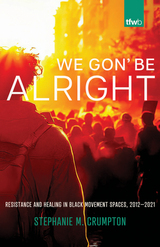
front cover of We Gon’ Be Alright
We Gon’ Be Alright
Resistance and Healing in Black Movement Spaces, 2012­–2021
Stephanie M. Crumpton
University of Arizona Press, 2025
We Gon’ Be Alright: Resistance and Healing in Black Movement Spaces, 2012–2021 is a profound exploration of Black activism and organizing during a pivotal decade in American history. Rev. Dr. Stephanie M. Crumpton explores the practices of care, reflection, and creativity that Black activists employed to heal and resist amidst the sociopolitical turbulence from the Obama era through the first Trump presidency. This period, marked by the myth of a “post-racial” America, saw a resurgence in racial violence and hate crimes, culminating in the 2021 Capitol insurrection. Against this backdrop, Crumpton captures the resilience and ingenuity of Black movement workers as they navigated these challenges.

Drawing on oral histories and personal narratives, Crumpton provides an intimate look at the lived experiences of thirty-seven full-time community organizers. These activists and organizers share their strategies for maintaining an ethic of care that sustains them while fighting against both external oppression and internal community struggles. The book highlights how contemporary Black resisters have leveraged a growing understanding of trauma and healing to enhance their activism. This blend of historical knowledge and modern therapeutic practices has equipped them with a broader array of tools to support their communities.

Rooted in womanist practical theology, We Gon’ Be Alright emphasizes the interconnectedness of white supremacy with other forms of oppression such as sexism, homophobia, and classism. Crumpton’s work underscores the necessity of “deep, deep healing” to address these multifaceted threats to Black life. This book is an essential resource for scholars, activists, and anyone interested in understanding the dynamics of Black resistance and healing in contemporary America. Through its detailed examination of the past decade, it offers valuable insights into the ongoing struggle for Black humanity, dignity, and a thriving future.

[more]

front cover of The Wendys
The Wendys
Allison Benis White
Four Way Books, 2020
“Because it is easier to miss a stranger / with your mother’s name,” Allison Benis White instead writes about five women named Wendy as a way into the complex grief that still lingers after the death of a sixth Wendy, the author’s long-absent mother. A series of epistolary poems addressed to Wendy O. Williams becomes an occasion for the speaker to eulogize as well as reflect on the singer’s life and eventual suicide: “What kind of love is death, I’m asking?” In the section devoted to Wendy Torrance, the fictional wife from The Shining who was bludgeoned by her husband, the speaker muses on the inadequacy of language to resolve or even contain grief in the wake of trauma: “A book is a coffin. Hoarsely. A white sheet draped over the cage of being.” Ultimately, The Wendys is a book of silences and space in which tenderness and violence exist in exquisite tension. “If to speak is to die,” White writes in “Ignis Fatuus,” “I will whisper.”
[more]

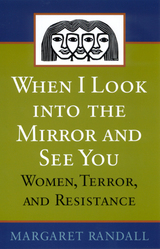
front cover of When I Look into the Mirror and See You
When I Look into the Mirror and See You
Women, Terror, and Resistance
Margaret Randall
Rutgers University Press, 2002

In the early 1980s, in the midst of Central America’s decades of dirty wars, Nora Miselem of Honduras and Maria Suárez Toro of Costa Rica were kidnapped and subjected to rape and other tortures. Of the nearly two hundred disappeared persons in Honduras in those years, they are, remarkably, two of only five survivors. Fourteen years after their ordeal, Suárez and Miselem’s chance meeting at a conference on human rights was witnessed by and is now retold in Margaret Randall’s When I Look into the Mirror andSee You.

Through direct testimony, vivid prose, and evocative photographs, Randall recounts the terror, resistance, and survival of Suárez and Miselem. The book details the abuses suffered by them, the ruses they used to foil their captors, the support that they gave each other while imprisoned, the means they used to escape, and their attempts to reconstruct their lives. For the first time, Suárez and Miselem explore the pain and trauma of their past and Randall has done the service of adding these remarkable voices to the global campaign to bring the world’s attention to women’s human rights.

[more]

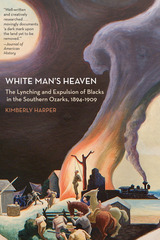
front cover of White Man's Heaven
White Man's Heaven
The Lynching and Expulsion of Blacks in the Southern Ozarks, 1894-1909
Kimberly Harper
University of Arkansas Press, 2010
Drawing on court records, newspaper accounts, penitentiary records, letters, and diaries, White Man’s Heaven is a thorough investigation into the lynching and expulsion of African Americans in the Missouri and Arkansas Ozarks in the late nineteenth and early twentieth centuries. Kimberly Harper explores events in the towns of Monett, Pierce City, Joplin, and Springfield, Missouri, and Harrison, Arkansas, to show how post–Civil War vigilantism, an established tradition of extralegal violence, and the rapid political, economic, and social change of the New South era happened independently but were also part of a larger, interconnected regional experience. Even though some whites, especially in Joplin and Springfield, tried to stop the violence and bring the lynchers to justice, many African Americans fled the Ozarks, leaving only a resilient few behind and forever changing the racial composition of the region.
[more]

front cover of The Wolf at the End of the Block
The Wolf at the End of the Block
A Play
Ike Holter
Northwestern University Press, 2020
Taut and fast-paced, The Wolf at the End of the Block tells the story of Abe, a resident of the Rightlynd neighborhood of Chicago, who seeks justice after a mysterious, late-night interatction at a boarded-up bar. The intrigue envelops Abe, his sister, his boss, and a morally complicated reporter in pursuit of the truth. But as the clock ticks down, the play discloses the hidden motives of each character, leading to a finale of unpredictable twists, turns, and reveals.
 
A modern-day neo-noir, The Wolf at the End of the Block remixes several different genres to present a new kind of thriller that is socially conscious, relentlessy suspenseful, and bitingly funny. Praised for its power and grace, the play is one of Holter’s most unforgettable.
 
The Wolf at the End of the Block is one of seven plays in Holter’s Rightlynd Saga, set in Chicago’s fictional fifty-first ward. The other plays in the cycle are Rightlynd, Exit Strategy, Sender, Prowess, Red Rex, and Lottery Day.
 
[more]

front cover of Woman in the Violence
Woman in the Violence
Gender, Poverty, and Resistance in Peru
M. Cristina Alcalde
Vanderbilt University Press, 2010
The Woman in the Violence draws on fieldwork conducted in Lima, Peru, one of the largest cities in Latin America, and the life stories of dozens of women to examine multiple forms of violence and how it interrelates in their lives. Gender-based violence continues to blight the landscape of South American urban centers, and this book unravels the personal experiences of those impacted. Alcalde explores the everyday lives of these women before, during, and after an abusive relationship to explore the impact of, and response to, structural, institutional, and interpersonal violence.


Focusing on the experiences of women who are predominantly poor, nonwhite, rural-to-urban migrants with little or no formal education, The Woman in the Violence addresses a range of serious concerns. What types of violence do women experience at different stages in their lives? Which identities and roles are manifested throughout their lives, and do some of these increase their vulnerability to different forms of violence? What strategies do women employ to gain some power and control in these situations, and how can we conceptualize these strategies?


In examining these questions, The Woman in the Violence contributes to our understanding of violence, gender, race, resistance, and urbanism as it exposes and analyzes systemic violence against women. The everyday forms of resistance these women employ provide significant insight for students, scholars, and health professionals.
[more]

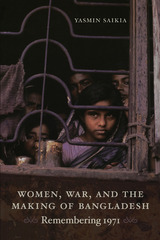
front cover of Women, War, and the Making of Bangladesh
Women, War, and the Making of Bangladesh
Remembering 1971
Yasmin Saikia
Duke University Press, 2011
Fought between India and what was then East and West Pakistan, the war of 1971 led to the creation of Bangladesh, where it is remembered as the War of Liberation. For India, the war represents a triumphant settling of scores with Pakistan. If the war is acknowledged in Pakistan, it is cast as an act of betrayal by the Bengalis. None of these nationalist histories convey the human cost of the war. Pakistani and Indian soldiers and Bengali militiamen raped and tortured women on a mass scale. In Women, War, and the Making of Bangladesh, survivors tell their stories, revealing the power of speaking that deemed unspeakable. They talk of victimization—of rape, loss of status and citizenship, and the “war babies” born after 1971. The women also speak as agents of change, as social workers, caregivers, and wartime fighters. In the conclusion, men who terrorized women during the war recollect their wartime brutality and their postwar efforts to achieve a sense of humanity. Women, War, and the Making of Bangladesh sheds new light on the relationship among nation, history, and gender in postcolonial South Asia.
[more]

front cover of Women’s Perspectives on Human Security
Women’s Perspectives on Human Security
Violence, Environment, and Sustainability
Richard Matthew; Patricia A. Weitsman; Gunhild Hoogensen Gjørv; Nora Davis; Tera Dornfeld
Ohio University Press, 2020

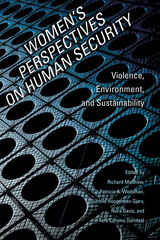
Violent conflict, climate change, and poverty present distinct threats to women worldwide. Importantly, women are leading the way creating and sharing sustainable solutions.

Women’s security is a valuable analytical tool as well as a political agenda insofar as it addresses the specific problems affecting women’s ability to live dignified, free, and secure lives. First, this collection focuses on how conflict impacts women’s lives and well-being, including rape and gendered constructions of ethnicity, race, and religion. The book’s second section looks beyond the scope of large-scale violence to examine human security in terms of environmental policy, food, water, health, and economics.

Multidisciplinary in scope, these essays from new and established contributors draw from gender studies, international relations, criminology, political science, economics, sociology, biological and ecological sciences, and planning.
[more]

front cover of The Work of Rape
The Work of Rape
Rana M. Jaleel
Duke University Press, 2021
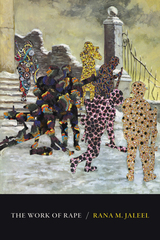
In The Work of Rape Rana M. Jaleel argues that the redefinition of sexual violence within international law as a war crime, crime against humanity, and genocide owes a disturbing and unacknowledged debt to power and knowledge achieved from racial, imperial, and settler colonial domination. Prioritizing critiques of racial capitalism from women of color, Indigenous, queer, trans, and Global South perspectives, Jaleel reorients how violence is socially defined and distributed through legal definitions of rape. From Cold War conflicts in Latin America, the 1990s ethnic wars in Rwanda and Yugoslavia, and the War on Terror to ongoing debates about sexual assault on college campuses, Jaleel considers how legal and social iterations of rape and the terms that define it—consent, force, coercion—are unstable indexes and abstractions of social difference that mediate racial and colonial positionalities. Jaleel traces how post-Cold War orders of global security and governance simultaneously transform the meaning of sexualized violence, extend US empire, and disavow legacies of enslavement, Indigenous dispossession, and racialized violence within the United States.

Duke University Press Scholars of Color First Book Award recipient
[more]


Send via email Share on Facebook Share on Twitter