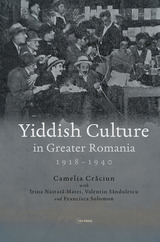
Yiddish Culture in Greater Romania (1918-1940)
Camelia Craciun
Central European University Press, 2025
Yiddish culture was an important part of the cultural landscape of Eastern Europe from the Baltic Sea to the Danube, connecting the scattered Ashkenazi Jewry, the overwhelming majority of the Jews living in this geographical area.
In the newly created Greater Romania, the Jewish community included more than half a million individuals still speaking Yiddish. Building on pre-war trends, the new nation-state faced an antisemitism problem since its inception. This continued in the period that followed, culminating in the horrors of the Holocaust, which destroyed most of the Yiddish-language community. Most survivors were discouraged from continuing to use a language that reminded them of a painful past.
This volume examines the socio-cultural mechanisms responsible for restructuring the Yiddish cultural life after the changes brought about by the end of World War I and the creation of Greater Romania. It describes how this process evolved until the political regimes banned the activity of Yiddish theaters, press and, ultimately, the usage of Yiddish, thus making cultural life impossible.
The four authors identify the main institutions, individuals and projects that promoted Yiddish cultural life in interwar Romania. They also trace the impact of Yiddish within Romanian society through joint projects, events, and initiatives. Special attention is given to Yiddish theater, which played a key role both within the community and in its interaction with the Romanian-speaking public.
[more]