
 A SCHOLARLY BOOK REPOSITORY
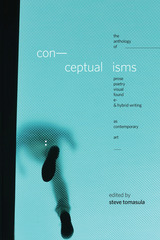
A variety of names have been used to describe fiction, poetry, and hybrid writing that explore new forms and challenges mainstream traditions. Those phrases include experimental, conceptual, avant-garde, hybrid, surfiction, fusion, radical, slip-stream, avant-pop, postmodern, self-conscious, innovative, L=A=N=G=U=A=G=E writing, alternative, and anti- or new literature. Conceptualisms: The Anthology of Prose, Poetry, Visual, Found, E- & Hybrid Writing as Contemporary Art is the first major anthology of writing that offers readers an overview of this other tradition as it lives in the early decades of the 21st century.
Featuring over 100 pieces from more than 90 authors, this anthology offers a plethora of aesthetics and approaches to a wide variety subjects. Editor Steve Tomasula has gathered poems, prose, and hybrid pieces that all challenge our understanding of what literature means. Intended as a collection of the most exciting and bold literary work being made today, Tomasula has put a spotlight on the many possibilities available to writers and readers wishing for a glimpse of literature’s future.
Readers will recognize authors who have shaped contemporary writing, as among them Lydia Davis, Charles Bernstein, Jonathan Safran Foer, Shelley Jackson, Nathaniel Mackey, David Foster Wallace, and Claudia Rankine. Even seasoned readers will find authors, and responses to the canon, not yet encountered. Conceptualisms is a book of ideas for writers, teachers and scholars, as well as readers who wonder how many ways literature can live.
The text features headnotes to chapters on themes such as sound writing, electronic literature, found text, and other forms, offering accessible introductions for readers new to this work. An online companion presents statements about the work and biographies of the authors in addition to audio, video, and electronic writing that can’t be presented in print. Visit www.conceptualisms.info to read more.
That the poet John Gower was a major literary figure in England at the close of the fourteenth century is no longer in question. Scholarly attention paid to him and to his work over the past twenty- five years has redeemed him from an undeserved obscurity imposed by the preceding two hundred. The facts of his life and career are now documented, and recent critical assessment has placed his achievement most accurately alongside Chaucer's, Langland's, and the Gawain- poet's.
Unique among his contemporaries, all of whom undoubtedly read and used French in some measure, Gower alone has left us a significant body of verse and prose in Anglo-Norman; chiefly, the twelve-stanza poem Mirour de l-Omme, the Cinkante Balades, and the Traitié pour les amantz marietz. We are offered in this concordance of his Anglo- Norman work a unique opportunity to view a poetic language as it was written and read in England until Gower's death in 1408 and beyond.
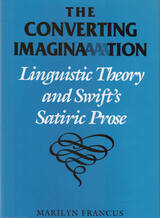
By illuminating Jonathan Swift’s fascination with language, Marilyn Francus shows how the linguistic questions posed by his work are at the forefront of twentieth-century literary criticism: What constitutes meaning in language? How do people respond to language? Who has (or should have) authority over language? Is linguistic value synonymous with literary value?
Francus starts with a detailed analysis of Swift’s linguistic education, which straddled a radical transition in linguistic thought, and its effect on his prose. This compelling beginning includes sometimes surprising historical information about the teaching and learning of linguistics and language theory in the seventeenth and eighteenth centuries. Swift’s academic studies reflected the traditional universalist view that seeks an Adamic language to reverse the fragmentation of Babel and achieve epistemological unity. But Swift’s tutor also exposed him to the contemporary linguistics of the scientific societies and of John Locke, who argued that the assignment of linguistic meaning is arbitrary and subjective, capturing an individual’s understanding at a particular instant. These competing theories, Francus maintains, help explain the Irish writer’s conflicting inclinations toward both linguistic order and freewheeling creativity.
To develop a complete vision of Swiftian linguistics, Francus focuses on A Tale of a Tub as the archetypal linguistic text in the Swift canon, but she also includes evidence from his other famous works, including Gulliver’s Travels, A Modest Proposal, Journal to Stella, and The Bickerstaff Papers, as well as from his lesser known religious and political tracts and his correspondence. In addition, Francus draws on the relevant work of contemporary linguists (such as Wilkins, Watts, Dyche, and Stackhouse), philosophers (Hobbes and Locke), and authors (including Temple, Sprat, Dryden, Pope, Addison, and Defoe).
Francus concludes that Swift occupies a pivotal place in literary history: his conscious emphasis on textuality and extended linguistic play anticipates not only the future of satiric prose but the modern novel as well.
This first full-scale treatment of the early prose of Dylan Thomas demonstrates the unity of his total work. Pratt argues that the inward journey of the poetic imagination which is implicit in poetry is often explicit in prose. Her study of Thomas’ early prose alongside his early poetry helps to elucidate all of his writing.
Pratt includes three appendices: a chronology, a summary of the critics’ attitudes toward the problem of influence, and a bibliographical sketch of materials in the Parris surrealist magazine transition, which are paralleled in Thomas’ prose.
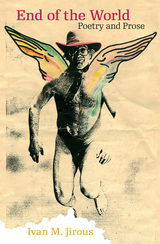
End of the World is the first major collection in English of the works of this legendary Czech “madman.” Although nicknamed for his aggressive and rebellious behavior, Jirous’s writing reveal a refined, sophisticated, and even tender sensibility. Translated in part by Paul Wilson, an original member of the Plastic People, the book gathers his poems and letters from prison, as well as his book-length prose work, The True Story of the Plastic People, alongside critical essays on Jirous’s life and work. End of the World is an ideal introduction to the raucous writer who playwright Tom Stoppard referred to as one of the most interesting personalities in modern Czech history.
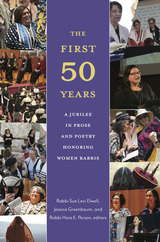
spectrums reflect on the meaning of this moment and the ensuing decades, both personally and for the Jewish community. In short pieces of new prose, authors—
many of them pioneering rabbis—share stories, insights, analysis, and celebrations of women in the rabbinate. These are intertwined with a wealth of poetry that
poignantly captures the spirit of this anniversary. The volume is a deep, heartfelt tribute to women rabbis and their indelible impact on all of us.
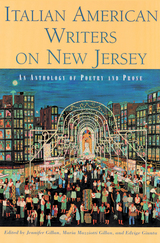
This anthology gathers fiction, poetry, memoirs, oral histories, and journalistic pieces by some of the best writers to chronicle the Italian American experience in the Garden State. These works focus on ethnic identity and the distinctive culture of New Jersey, which has long been home to a large and vital Italian American community.
Filled with passion, humor, and grace, these writings depict a variety of experiences, including poignant but failed attempts at conformity and the alienation often felt by ethnic Americans. The authors also speak of the strength gained through the preservation of their communities and the realization that it is often the appreciation of their heritage that helps them to succeed. Although presented from the vantage point of only one ethnic group, this book addresses in microcosm the complexities of American identity, depicting situations and conveying emotions that will resonate with people of all immigrant ancestries.
Among the many writers featured are Gay Talese, Bill Ervolino, Tom Perrotta, Louise DeSalvo, Carole Mazo, Diane di Prima, and Maria Laurino. Each of the contributors provides a fresh perspective on the diversity, complexity, and richness of the Italian American experience.
Publication of this book is made possible in part by a grant from the Institute of Italian and Italian American Heritage Studies, State of New Jersey.

The Tria sunt, named for its opening words, was a widely used and highly ambitious book composed in England in the late fourteenth century during a revival of interest in the art of poetry and prose.
The backbone of this comprehensive guide to writing Latin texts is the wealth of illustrative and instructive sources compiled, including examples from classical authors such as Cicero and Horace as well as from medieval literature, and excerpts from other treatises of the same period by authors from Matthew of Vendôme through Gervase of Melkley. Topics treated at length include methods for beginning and ending a composition, techniques for expanding and abbreviating a text, varieties of figurative language, attributes of persons and actions, and the art of letter writing.
This anonymous treatise, related especially closely to work by Geoffrey of Vinsauf, served as a textbook for rhetorical composition at Oxford. Of all the major Latin arts of poetry and prose, it is the only one not previously edited or translated into English.
Cuba’s José Lezama Lima became the most controversial figure in the flowering of the Latin American novel with the 1966 publication of Paradiso. Hailed as a seminal writer of breathtaking originality by Julio Cortázar, Octavio Paz, and Mario Vargas Llosa, Lezama was also attacked by the Castro regime and others for his stylistic obscurity, erotic descriptions, and violation of literary norms. Indeed, his experimental fiction, written on the very boundaries of the novelistic genre, resists classification. José Lezama Lima’s Joyful Vision, a much-needed critical study of Paradiso, Oppiano Licario, and Lezama’s essays, is thus an exploration in reading, one that highlights and preserves the essential and persistent contradictions in Lezama’s theory and practice of literature.
Gustavo Pellón focuses his study on Lezama’s search for equilibrium, clarifying such oppositions in Lezama’s writings as the mystical quest for illumination through obscurity, the calculated cultivation of naïveté, the Proust-like fascination with yet ultimate condemnation of homosexuality, and a modernist (even postmodernist) narrative style that conveys a mystical (essentially medieval) worldview. Above all, Pellón shares his wonder at Lezama who, in an age of pessimism, maintained his joyful vision of art and existence.
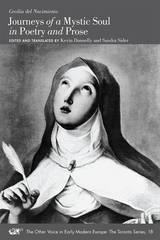
—Stacey Schlau
Professor, Department of Languages and Culture and the Women’s Studies Program
West Chester University, Pennsylvania
A musician, musicologist, and self-defined “poet of research,” Amelia Rosselli (1930–96) was one of the most important poets to emerge from Europe in the aftermath of World War II. Following a childhood and adolescence spent in exile from Fascist Italy between France, England, and the United States, Rosselli was driven to express the hopes and devastations of the postwar epoch through her demanding and defamiliarizing lines. Rosselli’s trilingual body of work synthesizes a hybrid literary heritage stretching from Dante and the troubadours through Ezra Pound and John Berryman, in which playful inventions across Italian, English, and French coexist with unadorned social critique. In a period dominated by the confessional mode, Rosselli aspired to compose stanzas characterized by a new objectivity and collective orientation, “where the I is the public, where the I is things, where the I is the things that happen.” Having chosen Italy as an “ideal fatherland,” Rosselli wrote searching and often discomposing verse that redefined the domain of Italian poetics and, in the process, irrevocably changed the Italian language.
This collection, the first to bring together a generous selection of her poems and prose in English and in translation, is enhanced by an extensive critical introduction and notes by translator Jennifer Scappettone. Equipping readers with the context for better apprehending Rosselli’s experimental approach to language, Locomotrix seeks to introduce English-language readers to the extraordinary career of this crucial, if still eclipsed, voice of the twentieth century.
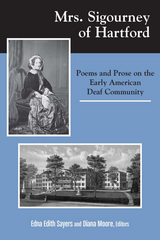
Lydia Huntley was born in 1791 in Norwich, CT, the only child of a poor Revolutionary war veteran. But her father’s employer, a wealthy widow, gave young Lydia the run of her library and later sent her for visits to Hartford, CT. After teaching at her own school for several years in Norwich, Lydia returned to Hartford to head a class of 15 girls from the best families. Among her students was Alice Cogswell, a deaf girl soon to be famous as a student of Thomas Hopkins Gallaudet and Laurent Clerc.
Lydia’s inspiration came from a deep commitment to the education of girls and also for African American, American Indian, and deaf children. She left teaching to marry Charles Sigourney, then turned to writing to support her family, publishing 56 books, 2,000 magazine articles, and popular poetry. Lydia Sigourney never abandoned her passion for deaf education, remaining a supporter of Gallaudet’s school for the deaf until her death. Yet, her contributions to deaf education and her writing have been forgotten until now.
All of Lydia Sigourney’s of Lydia Sigourney’s work on the nascent Deaf community is presented in this new volume. Her writing intertwines her mastery of the sentimentalism form popular in her day with her sharp insights on the best ways to educate deaf children. In the process, Mrs. Sigourney of Hartford reestablishes her rightful place in history.
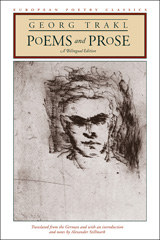
An undeniable aura surrounds the name of Georg Trakl, a poet of intense inner vision and originality whose work stands alongside that of Yeats, Valéry, and T. S. Eliot. Besides Rilke, his more famous admirers include Karl Kraus and Martin Heidegger. The distinctive tone of Trakl's work-especially admired by his patron Ludwig Wittgenstein-is autumnal and melancholy. Trakl was writing at a time of spiritual and social disintegration on the eve of the First World War, when personal values and perceptions tended to be subsumed in a more generalized anguish and exaltation. Neo-romantic, early modernist, his rich, vitally sensuous poetry can be seen to mark the transition from impressionism to expressionism, but at the same time transcends such categories. Trakl's poetry has previously only been available in English in short selections or in anthologies. This bilingual edition, the most comprehensive to date, gives readers the chance to get to know Trakl's work more fully than ever before.
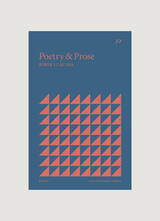
The Hermitage, a long poem of more than 1400 lines, tells of the author’s physical and metaphysical journey up a hill in southern Catalonia to visit a hermitage. Llavina touches on many themes in this poem, including love, death, family, loss, hope and memories. In 2019, Jordi Llavina was awarded the prestigious Lletra d’Or prize for this poem.
The second piece of work in the collection is The Pomegranate. Again written about a journey, The Pomegranate is a mix of both poetry and prose and tells the story of a grieving wanderer through the Catalan countryside.
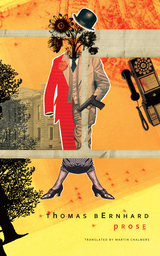
“His manner of speaking, like that of all the subordinated, excluded, was awkward, like a body full of wounds, into which at any time anyone can strew salt, yet so insistent, that it is painful to listen to him,” from The Carpenter
The Austrian playwright, novelist, and poet Thomas Bernhard (1931–89) is acknowledged as among the major writers of our time. The seven stories in this collection capture Bernhard’s distinct darkly comic voice and vision—often compared to Kafka and Musil—commenting on a corrupted world.
First published in German in 1967, these stories were written at the same time as Bernhard’s early novels Frost, Gargoyles, and The Lime Works, and they display the same obsessions, restlessness, and disarming mastery of language. Martin Chalmer’s outstanding translation, which renders the work in English for the first time, captures the essential personality of the work. The narrators of these stories lack the strength to do anything but listen and then write, the reader in turn becoming a captive listener, deciphering the traps laid by memory—and the mere words, the neverending words with which we try to pin it down. Words that are always close to driving the narrator crazy, but yet, as Bernhard writes “not completely crazy.”
“Bernhard's glorious talent for bleak existential monologues is second only to Beckett's, and seems to have sprung up fully mature in his mesmerizing debut.”—From Publishers Weekly, on Frost
“The feeling grows that Thomas Bernhard is the most original, concentrated novelist writing in German. His connections . . . with the great constellation of Kafka, Musil, and Broch become ever clearer.” —George Steiner, Times Literary Supplement, on Gargoyles
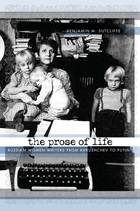
A focus on the representation of everyday life in women’s prose reveals that a first generation of female writers (Natal’ia Baranskaia, Irina Grekova) both legitimated and limited their successors (Liudmila Petrushevskaia, Tat’iana Tolstaia, Liudmila Ulitskaia, and Svetlana Vasilenko) in their choice of literary topics. The Prose of Life traces the development, and intriguing ruptures, of recent Russian women’s prose, becoming a must-read for readers interested in Russian literature and gender studies.
2009 Outstanding Academic Title, Choice Magazine
In The Prose of Things, Wall analyzes literary works in the contexts of natural science, consumer culture, and philosophical change to show how and why the perception and representation of space in the eighteenth-century novel and other prose narratives became so textually visible. Wall examines maps, scientific publications, country house guides, and auction catalogs to highlight the thickening descriptions of domestic interiors. Considering the prose works of John Bunyan, Samuel Pepys, Aphra Behn, Daniel Defoe, Samuel Richardson, David Hume, Ann Radcliffe, and Sir Walter Scott, The Prose of Things is the first full account of the historic shift in the art of describing.
A member of Mexico's privileged upper class, yet still subordinated because of her gender, Rosario Castellanos became one of Latin America's most influential feminist social critics. Joanna O'Connell here offers the first book-length study of all Castellanos' prose writings, focusing specifically on how Castellanos' experiences as a Mexican woman led her to an ethic of solidarity with the oppressed peoples of her home state of Chiapas.
O'Connell provides an original and detailed analysis of Castellanos' first venture into feminist cultural analysis in her essay Sobre cultura feminina (1950) and traces her moral and intellectual trajectory as feminist and social critic. An overview of Mexican indigenismo establishes the context for individual chapters on Castellanos' narratives of ethnic conflict (the novels Balún Canán and Oficio de tinieblas and the short stories of Ciudad Real). In further chapters O'Connell reads Los convidados de agosto,Album de familia, and Castellanos' four collections of essays as developments of her feminist social analysis.
The anthology includes works from every corner of the continent, representing a wide range of tribal affiliations, languages, and cultures. By taking their peoples' literature back to them in the form of stories and songs, these writers see themselves as returning the gift of storytelling, culture, and continuance to the source from which it came. In addition to contributions by 92 writers are two introductory chapters: Joseph Bruchac comments on the current state of Native literature and the significance of the festival, and Geary Hobson traces the evolution of the event itself.

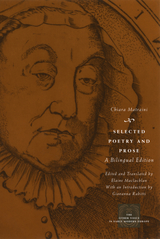
Mostly available in only a handful of rare book collections, her writings are now adeptly translated here for an English-speaking audience and situated historically in an introduction by noted Matraini expert Giovanna Rabitti. Selected Poetry and Prose allows the poet to finally take her place as one of the seminal authors of the Renaissance, next to her contemporaries Vittoria Colonna and Laura Battiferra, also published in the Other Voice series.
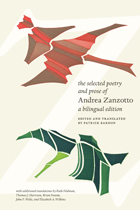
Andrea Zanzotto is widely considered Italy’s most influential living poet. The first comprehensive collection in thirty years to translate this master European poet for an English-speaking audience, The Selected Poetry and Prose of Andrea Zanzotto includes the very best poems from fourteen of his major books of verse and a selection of thirteen essays that helps illuminate themes in his poetry as well as elucidate key theoretical underpinnings of his thought. Assembled with the collaboration of Zanzotto himself and featuring a critical introduction, thorough annotations, and a generous selection of photographs and art, this volume brings an Italian master to vivid life for American readers.
“Now, in [this book], American readers can get a just sense of [Zanzotto’s] true range and extraordinary originality.”—Eric Ormsby, New York Sun
“What I love here is the sense of a voice directly speaking. Throughout these translations, indeed from early to late, the great achievement seems to be the way they achieve a sense of urgent address.”—Eamon Grennan, American Poet
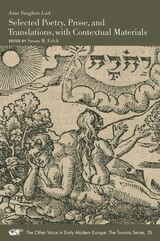
This volume provides a collection of Lock’s works presented in modern spelling, and it includes additional contemporary materials that place her voice in the larger context of the Tudor period, offering insight into the intertwined complexities of political, social, and religious life in sixteenth-century England.

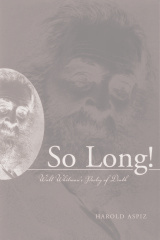
Walt Whitman is unquestionably a great poet of the joys of living. But as Harold Aspiz demonstrates in this study, concerns with death and dying define Whitman’s career as a thinker, a poet, and a person. Through a close reading of Leaves of Grass, its constituent poems, particularly “Song of Myself,” and Whitman’s prose and letters, Aspiz charts how the poet’s exuberant celebration of life—the cascade of sounds, sights, and smells that erupt in his verse—is a consequence of his central concern: the ever-presence of death and the prospect of an afterlife.
Until now no one has studied as systematically the degree to which mortality informs Whitman’s entire enterprise as a poet. So Long! devotes particular attention to Whitman’s language and rich artistry in the context of the poet’s social and intellectual milieus. We see Whitman (and his many personae) as a folk prophet announcing a gospel of democracy and immortality; pondering death in alternating moods of acceptance and terror; fantasizing his own dying and his postmortem selfhood; yearning for mates and lovers while conscious of fallible flesh; agonizing over the omnipresence of death in wartime; patiently awaiting death; and launching imaginary journeys toward immortality and godhood.
So Long! is valuable for American literature collections, students and scholars of Whitman and 19th-century literature, and general readers interested in Whitman and poetry. By exploring Whitman's faith in death as a meaningful experience, we may understand better how the poet—whether personified as representative man, victim, hero, lover, or visionary—lived so completely on the edge of life.
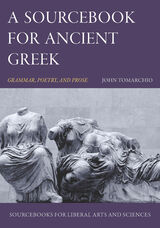
The civil service examination essay known as shiwen (modern or contemporary prose) or bagu wen (eight-legged essay) for its complex structure was the most widely read and written literary genre in early modern China (1450–1850). As the primary mode of expression in which educated individuals were schooled, shiwen epitomized the literary enterprise even beyond the walls of the examination compound. But shiwen suffered condemnation in the shift in discourse on literary writing that followed the fall of the Ming dynasty, and were thoroughly rejected in the May Fourth iconoclasm of the early twentieth century.
Challenging conventional disregard for the genre, Alexander Des Forges reads the examination essay from a literary perspective, showing how shiwen redefined prose aesthetics and transformed the work of writing. A new approach to subjectivity took shape: the question “who is speaking?” resonated through the essays’ involuted prose style, foregrounding issues of agency and control. At the same time, the anonymity of the bureaucratic evaluation process highlighted originality as a literary value. Finally, an emphasis on questions of form marked the aesthetic as a key arena for contestation of authority as candidates, examiners, and critics joined to form a dominant social class of literary producers.
Peter Dronke illuminates a unique literary tradition: the narrative that mixes prose with verse. Highlighting a wide range of texts, he defines and explores the creative ways in which mixed forms were used in Europe from antiquity through the thirteenth century. Verse with Prose from Petronius to Dante distinguishes for the first time some of the most significant uses of mixed forms.
Dronke looks at the way prose and verse elements function in satirical works, beginning in the third century B.C. with Menippus. He examines allegorical techniques in the mixed form, giving especially rewarding attention to Boethius' Consolation of Philosophy. His lucid analysis encompasses a feast of medieval sagas and romances—ranging from Iceland to Italy—including vernacular works by Marguerite Porete in France and Mechthild in Germany. A number of the medieval Latin texts presented have remained virtually unknown, but emerge here as narratives with unusual and at times brilliant literary qualities. To enable not only specialists but all who love literature to respond to the works discussed, they are quoted in fresh translations, as well as in the originals.
READERS
Browse our collection.
PUBLISHERS
See BiblioVault's publisher services.
STUDENT SERVICES
Files for college accessibility offices.
RECENTLY PUBLISHED


UChicago Accessibility Resources
home | accessibility | search | about | contact us
BiblioVault ® 2001 - 2024
The University of Chicago Press