
 A SCHOLARLY BOOK REPOSITORY
15 start with Y start with Y
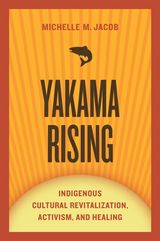
Michelle M. Jacob employs ethnographic case studies to demonstrate the tension between reclaiming traditional cultural practices and adapting to change. Through interviewees’ narratives, she carefully tacks back and forth between the atrocities of colonization and the remarkable actions of individuals committed to sustaining Yakama heritage. Focusing on three domains of Indigenous revitalization—dance, language, and foods—Jacob carefully elucidates the philosophy underlying and unifying each domain while also illustrating the importance of these practices for Indigenous self-determination, healing, and survival.
In the impassioned voice of a member of the Yakama Nation, Jacob presents a volume that is at once intimate and specific to her home community and that also advances theories of Indigenous decolonization, feminism, and cultural revitalization. Jacob’s theoretical and methodological contributions make this work valuable to a range of students, academics, tribal community members, and professionals, and an essential read for anyone interested in the ways that grassroots activism can transform individual lives, communities, and society.
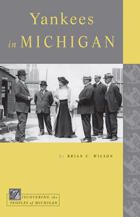
As Brian C. Wilson describes them in this highly readable and entertaining book, Yankees—defined by their shared culture and sense of identity—had a number of distinctive traits and sought to impose their ideas across the state of Michigan.
After the ethnic label of "Yankee" fell out of use, the offspring of Yankees appropriated the term "Midwesterner." So fused did the identities of Yankee and Midwesterner become that understanding the larger story of America's Midwestern regional identity begins with the Yankees in Michigan.
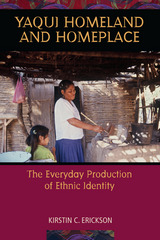
Yaquis live in a portion of their ancestral homeland in Sonora, about 250 miles south of the Arizona border. A long history of displacement and ethnic struggle continues to shape the Yaqui sense of self, as Erickson discovered during the sixteen months that she lived in Potam, one of the eight historic Yaqui pueblos. She found that themes of identity frequently arise in the stories that Yaquis tell and that geography and location—space and place—figure prominently in their narratives.
Revisiting Edward Spicer’s groundbreaking anthropological study of the Yaquis of Potam pueblo undertaken more than sixty years ago, Erickson pays particular attention to the “cultural work” performed by Yaqui women today. She shows that by reaffirming their gendered identities and creating and occupying female-gendered spaces such as kitchens, household altars, and domestic ceremonial spaces, women constitute Yaqui ethnicity in ways that are as significant as actions taken by males in tribal leadership and public ceremony.
This absorbing study contributes new empirical knowledge about a Native American community as it adds to the growing anthropology of space/place and gender. By inviting readers into the homes and patios where Yaqui women discuss their lives, it offers a highly personalized account of how they construct—and reconstruct—their identity.
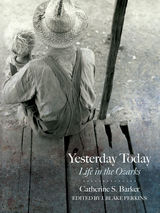
Catherine S. Barker's 1941 book Yesterday Today: Life in the Ozarks sought to illuminate another side of these “remnants of eighteenth-century life and culture”: poverty and despair. Drawing on her encounters and experiences as a federal social worker in the backwoods of the Ozarks in the 1930s, Barker described the mountaineers as “lovable and pathetic and needy and self-satisfied and valiant,” declaring that the virtuous and independent people of the hills deserved a better way and a more abundant life. Barker was also convinced that there were just as many contemptible facets of life in the Ozarks that needed to be replaced as there were virtues that needed to be preserved.
This reprinting of Yesterday Today—edited and introduced by historian J. Blake Perkins—situates this account among the Great Depression-era chronicles of the Ozarks.
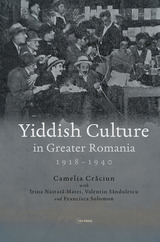
In the newly created Greater Romania, the Jewish community included more than half a million individuals still speaking Yiddish. Building on pre-war trends, the new nation-state faced an antisemitism problem since its inception. This continued in the period that followed, culminating in the horrors of the Holocaust, which destroyed most of the Yiddish-language community. Most survivors were discouraged from continuing to use a language that reminded them of a painful past.
This volume examines the socio-cultural mechanisms responsible for restructuring the Yiddish cultural life after the changes brought about by the end of World War I and the creation of Greater Romania. It describes how this process evolved until the political regimes banned the activity of Yiddish theaters, press and, ultimately, the usage of Yiddish, thus making cultural life impossible.
The four authors identify the main institutions, individuals and projects that promoted Yiddish cultural life in interwar Romania. They also trace the impact of Yiddish within Romanian society through joint projects, events, and initiatives. Special attention is given to Yiddish theater, which played a key role both within the community and in its interaction with the Romanian-speaking public.
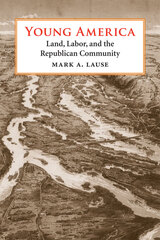
Rooting the movement in contemporary economic structures and social ideology, Young America examines this urban and working-class "agrarianism," demonstrating how the political preoccupations of this movement transformed socialism by drawing its adherents from communitarian preoccupations into political action. The alliance of the NRA's land reformers and radical abolitionists led unprecedented numbers to petition Congress and established the foundations of what became the new Republican Party, promising "Free Soil, Free Labor, Free Men."
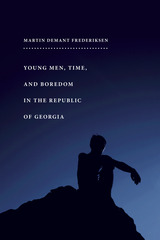
In the midst of societal optimism, how do young men cope with the loss of a vibrant future? Young Men, Time, and Boredom in the Republic of Georgia provides a vivid exploration of the tension between subjective and societal time and the ways these tensions create experiences of marginality among under- or unemployed young men in the Republic of Georgia.
Based on long-term ethnographic fieldwork, Martin Demant Frederiksen shows how the Georgian state has attempted to make the so-called post-Soviet transition a thing of the past as it creates new ideas about the future. Yet some young men in the regional capital of Batumi do not feel that they are part of the progression these changes create. Instead, they feel marginalized both by space and time—passed over and without prospects.
This distinctive case study provides empirical evidence for a deeper understanding of contemporary societal developments and their effects on individual experiences.
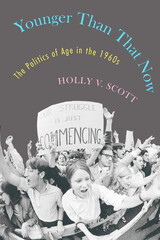
Retrospectives of the 1960s routinely include the face of youth rebellion: long-haired students occupying campus buildings, young men burning draft cards, hippies dancing at Woodstock. In Younger Than That Now, Holly V. Scott explores how the idea of “youth” served as a tactic in the political and social activism of these years. In the early part of that decade, young white activists began to learn from the civil rights movement's defiance of racism. They examined their own lives and concluded that campus rules and the draft were repression as well. As a group, they were ripe for revolution, and their age gave them a unique perspective for understanding and protesting against injustice. In short, young people began to use their youth as a political strategy.
Some in the New Left were dubious of this strategy and asked how it might damage long-term progress. Young feminists and people of color were particularly quick to question the idea that age alone was enough to sustain a movement. And the media often presented young people as impulsive and naive, undermining their political legitimacy. In tracing how “youth” took on multiple meanings as the 1960s progressed, Scott demonstrates the power of this idea to both promote and hinder social change.

While offering a critique of neoliberal health policies, Your Pocket Is What Cures You remains grounded in ethnography to highlight the struggles of men and women who are precariously balanced on twin precipices of crumbling health systems and economic decline. Their stories demonstrate what happens when market-based health reforms collide with material, political, and social realities in African societies.
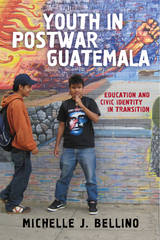
In the aftermath of armed conflict, how do new generations of young people learn about peace, justice, and democracy? Michelle J. Bellino describes how, following Guatemala’s civil war, adolescents at four schools in urban and rural communities learn about their country’s history of authoritarianism and develop civic identities within a fragile postwar democracy.
Through rich ethnographic accounts, Youth in Postwar Guatemala, traces youth experiences in schools, homes, and communities, to examine how knowledge and attitudes toward historical injustice traverse public and private spaces, as well as generations. Bellino documents the ways that young people critically examine injustice while shaping an evolving sense of themselves as civic actors. In a country still marked by the legacies of war and division, young people navigate between the perilous work of critiquing the flawed democracy they inherited, and safely waiting for the one they were promised...

The first comprehensive history of German youth in the First World War, this book investigates the dawn of the great era of mobilizing teenagers and schoolchildren for experiments in state-building and extreme political movements like fascism and communism. It investigates how German teachers could be legendary for their sarcasm and harsh methods but support the world’s most vigorous school reform movement and most extensive network of youth clubs. As a result of the war mobilization, teachers, club leaders, and authors of youth literature instilled militarism and nationalism more deeply into young people than before 1914 but in a way that, paradoxically, relaxed discipline.
In Youth in the Fatherless Land, Andrew Donson details how Germany had far more military youth companies than other nations—as well as the world’s largest Socialist youth organization, which illegally agitated for peace and a proletarian revolution. Mass conscription also empowered female youth, particularly in Germany’s middle-class youth movement, the only one anywhere that fundamentally pitted itself against adults. Donson addresses discourses as well as practices and covers a breadth of topics, including crime, work, sexuality, gender, family, politics, recreation, novels and magazines, social class, and everyday life.

How the rise of Wall Street in the 1980s lured a generation of young upstarts to New York, unleashing a political and cultural transformation whose national repercussions are still felt today.
Yuppies may have been a classic 1980s stereotype, but they were also a very real demographic: a wave of hundreds of thousands of highly educated young professionals that washed over New York during that decade. As Wall Street moved to the center of American life, it drew a generation of young people into its vortex. For the first time, banks recruited roughly one-third of graduating classes from top universities.
America’s economy had a new main character. Young bankers extracted profits from waning industries, shattering the foundations on which stable middle-class employment had long rested. Yuppie lawyers devised deals and tax strategies that eroded workers’ power and wages. As consumers, yuppies created new cultures of fitness and of excess, popularizing marathon running and fine dining as status markers. As city-dwellers, they were pioneers of gentrification. And as voters and political donors, yuppies engineered a takeover of local and national government, using their wealth to back candidates who would remake the country in their image.
Yuppies reminds us that we still live in the shadow of the greed-is-good 1980s: Our cities are playgrounds for the wealthy, and Wall Street and Washington remain locked in a tight embrace. Dylan Gottlieb’s exquisite recounting leaves no doubt that the yuppie takeover of New York began a more unequal chapter in American life—one we continue writing today.
READERS
Browse our collection.
PUBLISHERS
See BiblioVault's publisher services.
STUDENT SERVICES
Files for college accessibility offices.
RECENTLY PUBLISHED






UChicago Accessibility Resources
home | accessibility | search | about | contact us
BiblioVault ® 2001 - 2026
The University of Chicago Press