
 A SCHOLARLY BOOK REPOSITORY
12 start with Y start with Y
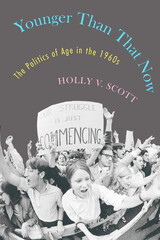
Retrospectives of the 1960s routinely include the face of youth rebellion: long-haired students occupying campus buildings, young men burning draft cards, hippies dancing at Woodstock. In Younger Than That Now, Holly V. Scott explores how the idea of “youth” served as a tactic in the political and social activism of these years. In the early part of that decade, young white activists began to learn from the civil rights movement's defiance of racism. They examined their own lives and concluded that campus rules and the draft were repression as well. As a group, they were ripe for revolution, and their age gave them a unique perspective for understanding and protesting against injustice. In short, young people began to use their youth as a political strategy.
Some in the New Left were dubious of this strategy and asked how it might damage long-term progress. Young feminists and people of color were particularly quick to question the idea that age alone was enough to sustain a movement. And the media often presented young people as impulsive and naive, undermining their political legitimacy. In tracing how “youth” took on multiple meanings as the 1960s progressed, Scott demonstrates the power of this idea to both promote and hinder social change.
This interview-based study of 95 young unionized fast-food and grocery workers in two cities in the U.S. and Canada presents a detailed account of their experiences in their workplaces and in their unions. These young workers vividly describe their daily tasks of frying, serving, bagging, stocking, and cleaning up, and the pressures from management and customers that surround these tasks. Management control tactics they encounter include video surveillance, drug testing, and monitoring of worker service scripts by mystery shoppers. The workers also document the hazards -- muscle injuries, burns, and robberies -- and the responsibilities of their jobs, including the emotional labor of customer relations.
The book suggests that young service sector workers have a distinct workforce identity as "stopgap workers." Society, employers, and even some unions often dismiss young workers as not being "real" workers, since these youths are seen as being in transition between school and "adult" career forms of employment. The collective activism of unions may offer hope not just for improving service sector work, but for educating young workers and providing them with a voice in shaping their own temporary work conditions.
In Youth, Crime, and Justice, Clayton A. Hartjen provides a broad overview of juvenile delinquency: how it manifests itself around the world and how societies respond to misconduct among their children. Taking a global, rather than country-specific approach, chapters focus on topics that range from juvenile laws and the correction of child offenders to the abuse, exploitation, and victimization of young people. Hartjen includes specific examples from the United States, Australia, Spain, Switzerland, New Zealand, Japan, India, Egypt, and elsewhere as he sorts through the various definitions of “delinquent” and explores the differences in behavior that contribute to these classifications. Most importantly, his in-depth and comparative look at judicial systems worldwide raises questions about how young offenders should be “corrected” and how much fault can be laid on misbehaving youths acting out against the very societies that produced them.
This volume brings together key studies, providing detailed analyses of the difficult economic situation plaguing young workers. Why have demographic changes and additional schooling failed to resolve youth unemployment? How effective have those economic policies been which aimed to improve the labor skills and marketability of young people? And how have youths themselves responded to the deteriorating job market confronting them? These questions form the empirical and organizational bases upon which these studies are founded.
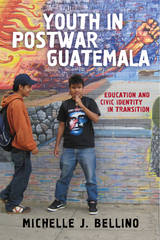
In the aftermath of armed conflict, how do new generations of young people learn about peace, justice, and democracy? Michelle J. Bellino describes how, following Guatemala’s civil war, adolescents at four schools in urban and rural communities learn about their country’s history of authoritarianism and develop civic identities within a fragile postwar democracy.
Through rich ethnographic accounts, Youth in Postwar Guatemala, traces youth experiences in schools, homes, and communities, to examine how knowledge and attitudes toward historical injustice traverse public and private spaces, as well as generations. Bellino documents the ways that young people critically examine injustice while shaping an evolving sense of themselves as civic actors. In a country still marked by the legacies of war and division, young people navigate between the perilous work of critiquing the flawed democracy they inherited, and safely waiting for the one they were promised...
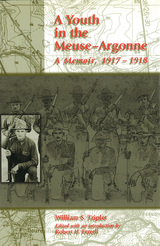
A Youth in the Meuse-Argonne is a firsthand account of World War I through the eyes of an enlisted soldier. William S. Triplet was a seventeen-year-old junior in high school when, on April 2, 1917, President Woodrow Wilson asked for a declaration of war. Passed by Congress and signed by the nation's chief executive four days later, this declaration stirred the superintendent of schools in Triplet's hometown of Sedalia, Missouri, to make an emotional plea to all eligible students to join the armed forces. "Any student who felt called upon to fight, bleed, and die for his country could receive his graduation diploma upon his return from the war." Triplet was eighteen months short of being of legal enlistment age, but the army didn't check birth certificates. The appeal of military benefits—room and board, travel, adventure, and fifteen dollars a month, plus knowing he would receive his high school diploma—was too much for the young Triplet to pass up. Thus began William S. Triplet's remarkable career in the U.S. Army, in which he served until his retirement as a full colonel in 1954.
In A Youth in the Meuse-Argonne, Triplet covers the early years of his service in Company D, 140th Infantry Regiment, 35th Division, from shortly after the time of his enlistment in 1917 to his honorable discharge in 1919. During those months he participated in several actions, most notably the battle of the Meuse-Argonne. With both elegance and a touch of humor, he masterfully portrays the everyday life of the soldier, humanizing the men with whom he served. His vivid depictions of how soldiers fought give the reader a much clearer view of the terrifying experiences of combat. He also touches on the special problems he encountered as a sergeant with an infantry platoon composed of soldiers from many different walks of life.
In writing this memoir, Triplet relied heavily on a detailed diary that he kept while he was in France in 1918. Through his annotations, Robert H. Ferrell provides the historical context for Triplet's firsthand experiences. The result is a compelling memoir that offers insight into the lives of the soldiers who served during World War I. Anyone with an interest in World War I or military history in general will find A Youth in the Meuse-Argonne of great interest.
Youth in the Movements documents the history of the rise of American high school and youth activism in the United States since the Second World War. Spaces within high schools and the adults at them provided support or inspiration – both negative and positive – for youth engaged in protest, organizing, and activism. Through rich research of archival sources and oral histories, contributors reveal new perspectives on American high school and youth activism. Viewed through the eyes of high school-aged youth around the United States – in familiar locations such as Boston, New York City, and Detroit, as well as less familiar locales in the historiography, such as Salt Lake City and the Navajo Reservation – we extend our understanding of high school and how it has been experienced by youth activists in the post-World War II period.

The economic deregulation that followed the East Asian financial crisis and recession in the 1990s blocked youth from the labor market. This issue investigates the resulting youth labor crisis and its predominant manifestations—youth unemployment and underemployment. The contributors examine these phenomena not as social anomalies but as the new faces of labor for youth. They conceptualize this situation as emblematic of a global crisis in capitalism and study how the politics of youth unemployment and underemployment emerge interconnected in China, Japan, and South Korea. The essays highlight how political leaders in these countries gamble with the futures of their young people to secure their places in neoliberal globalization, disconnecting national futures from personal ones.
Gabriella Lukács is associate professor of anthropology at the University of Pittsburgh. She is the author of Scripted Affects, Branded Selves: Television, Subjectivity, and Capitalism in 1990s Japan, also published by Duke University Press.
Contributors: Cho Hae-joang, Jennifer Jihye Chun, Mark Driscoll, Michael Fisch, Ju Hui Judy Han, Anita Koo, Gabriella Lukács, Pun Ngai, Xia Zhang
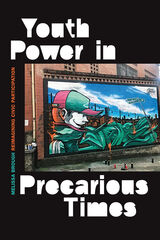

Drawing on over twenty years of scholarship from Diane Conrad's academic career in applied theater research with systemically marginalized youth, this book examines applied theater research conducted with youth in three specific contexts: alternative high schools, a youth jail, and street-involved youth.
By highlighting youths’ voices and youths’ creations, this book offers an introduction to the theoretical considerations for the research, suggests practical strategies for engaging with marginalized youth, and describes how the applied theater process developed. It also addresses specific considerations for working with incarcerated and Indigenous youth and explores the ethical considerations in conducting such work and the role of applied theater in social change. The book will be of interest to applied theater researchers, instructors, practitioners, students, drama teachers, and youth workers.
READERS
Browse our collection.
PUBLISHERS
See BiblioVault's publisher services.
STUDENT SERVICES
Files for college accessibility offices.
RECENTLY PUBLISHED





UChicago Accessibility Resources
home | accessibility | search | about | contact us
BiblioVault ® 2001 - 2026
The University of Chicago Press