
 A SCHOLARLY BOOK REPOSITORY
3 start with Z start with Z
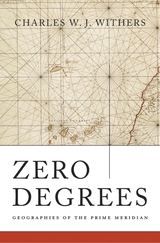
Space and time on earth are regulated by the prime meridian, 0°, which is, by convention, based at the Royal Observatory, Greenwich. But the meridian’s location in southeast London is not a simple legacy of Britain’s imperial past. Before the nineteenth century, more than twenty-five different prime meridians were in use around the world, including Paris, Beijing, Greenwich, Washington, and the location traditional in Europe since Ptolemy, the Canary Islands. Charles Withers explains how the choice of Greenwich to mark 0° longitude solved complex problems of global measurement that had engaged geographers, astronomers, and mariners since ancient times.
Withers guides readers through the navigation and astronomy associated with diverse meridians and explains the problems that these cartographic lines both solved and created. He shows that as science and commerce became more global and as railway and telegraph networks tied the world closer together, the multiplicity of prime meridians led to ever greater confusion in the coordination of time and the geographical division of space. After a series of international scientific meetings, notably the 1884 International Meridian Conference in Washington, DC, Greenwich emerged as the most pragmatic choice for a global prime meridian, though not unanimously or without acrimony. Even after 1884, other prime meridians remained in use for decades.
As Zero Degrees shows, geographies of the prime meridian are a testament to the power of maps, the challenges of accurate measurement on a global scale, and the role of scientific authority in creating the modern world.
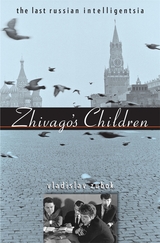
Among the least-chronicled aspects of post–World War II European intellectual and cultural history is the story of the Russian intelligentsia after Stalin. Young Soviet veterans had returned from the heroic struggle to defeat Hitler only to confront the repression of Stalinist society. The world of the intelligentsia exerted an attraction for them, as it did for many recent university graduates. In its moral fervor and its rejection of authoritarianism, this new generation of intellectuals resembled the nineteenth-century Russian intelligentsia that had been crushed by revolutionary terror and Stalinist purges. The last representatives of the Russian intelligentsia, heartened by Khrushchev’s denunciation of Stalinism in 1956, took their inspiration from the visionary aims of their nineteenth-century predecessors and from the revolutionary aspirations of 1917. In pursuing the dream of a civil, democratic socialist society, such idealists contributed to the political disintegration of the communist regime.
Vladislav Zubok turns a compelling subject into a portrait as intimate as it is provocative. The highly educated elite—those who became artists, poets, writers, historians, scientists, and teachers—played a unique role in galvanizing their country to strive toward a greater freedom. Like their contemporaries in the United States, France, and Germany, members of the Russian intelligentsia had a profound effect during the 1960s, in sounding a call for reform, equality, and human rights that echoed beyond their time and place.
Zhivago’s children, the spiritual heirs of Boris Pasternak’s noble doctor, were the last of their kind—an intellectual and artistic community committed to a civic, cultural, and moral mission.

Examining a network of correspondences and encounters that cross between German and Hebrew, Zionism in Translation argues that the space between the languages enabled ambivalent conversations about the foundation of the State of Israel.
Zionism in Translation concerns exchanges—primarily of letters but also drafts, reviews, and other ephemera—sent to or from Jerusalem in the decades after 1948. All were written in German and Hebrew by a fascinating range of literary figures, including Hannah Arendt, Gershom Scholem, Yehuda Amichai, Ludwig Strauss, Erich Auerbach, Walter Benjamin, Leah Goldberg, Peter Szondi, Paul Celan, and Tuvia Ruebner. Na’ama Rokem illuminates the complexities that emerge as the two languages mix in this extraordinary epistolary network.
The writers that Rokem studies here contend with the genocidal violence that brought the rich historical relation between German and Hebrew to a seeming end. They also grapple, in different ways, with the new reality in Israel/Palestine in the wake of the founding of the State of Israel and the Palestinian Nakba. The bilingual conversation that crosses over between German and Hebrew in these letters thus centers around the question of Jewish fate in the twentieth century and is immersed in negotiations about Jewish nationalism, the Zionist movement, and the possibilities of Jewish poetry. In the space between German and Hebrew, Rokem argues, the protagonists of her story voice ambivalences and hesitancies not found elsewhere.
Zionism in Translation joins a growing body of scholarship that uncovers the complex modes of belonging and resistance that unfold around the Zionist movement in the twentieth century. It will interest all readers concerned with modern Jewish intellectual, cultural, and literary history, the history of Zionism, and writers such as Arendt or Celan.
READERS
Browse our collection.
PUBLISHERS
See BiblioVault's publisher services.
STUDENT SERVICES
Files for college accessibility offices.
RECENTLY PUBLISHED


UChicago Accessibility Resources
home | accessibility | search | about | contact us
BiblioVault ® 2001 - 2026
The University of Chicago Press