
 A SCHOLARLY BOOK REPOSITORY
3 start with Z start with Z
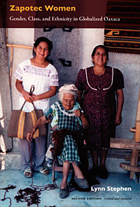
Stephen presents new information about the weaving cooperatives women have formed over the last two decades in an attempt to gain political and cultural rights within their community and standing as independent artisans within the global market. She also addresses the place of Zapotec weaving within Mexican folk art and the significance of increased migration out of Teotitlán. The women weavers and merchants collaborated with Stephen on the research for this book, and their perspectives are key to her analysis of how gender relations have changed within rituals, weaving production and marketing, local politics, and family life. Drawing on the experiences of women in Teotitlán, Stephen considers the prospects for the political, economic, and cultural participation of other indigenous women in Mexico under the policies of economic neoliberalism which have prevailed since the 1990s.
Winner, 2025 New Mexico Book Awards, Multicultural Category
Finalist, New Mexico Book Awards, BIPOC Author or Subject Category and First Book Category
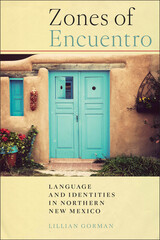
Working at the intersection of Latina/o/x cultural studies, sociocultural linguistics, and Chicana feminist studies, Lillian Gorman’s Zones of Encuentro takes an in-depth look at the cultural and linguistic interactions between two distinct Latina/o/x communities in the region: Nuevomexicanos (Hispanic people who trace their presence in the region to colonial times and whose families have historically spoken Traditional New Mexican Spanish, or TNMS) and first-generation Mexicano immigrants (who tend to speak Mexican Spanish). Gorman examines the everyday lived language experiences and ethnolinguistic identities of Mexicanos and Nuevomexicanos together, specifically through the case of mixed Mexicano-Nuevomexicano families. Through an interdisciplinary critical reading of ethnographic data, pláticas (informal conversations that gather family and community knowledge), interviews, articles, and historical memoirs, Gorman analyzes language ideologies, identity formations, and language practices by exploring complex spaces of encounter within Mexicano-Nuevomexicano families. Zones of Encuentro complicates homogeneous notions of language and identity and contemplates what a shared cultural and linguistic homeplace looks like for Mexicanos and Nuevomexicanos in northern New Mexico.
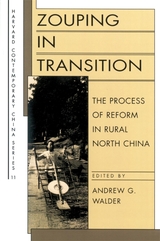
Zouping offers important general lessons for the study of China's rural transformation. The authors in this volume, all participants in a unique field research project undertaken from 1988 to 1992, address questions that are far from simple and about which there is some controversy.
The questions are grouped around two issues. The first is the role of local governments as economic actors. What is this role, how have they played it, and how can we explain their behavior? Have they dominated rural economies through public ownership of industry and local planning, or has the role of local governments diminished with the rise of market transactions and private ownership? The second issue is market reform and inequality. Have rural cadres enjoyed income advantages in the new market environment? Has the provision of such collective services as education and health care declined, leading to new forms of inequality?
The chapters on the role of local government all point to a single conclusion: one cannot explain the rapid development of Zouping without reference to the role of local governments and of local government officials as economic actors. Scholarly writings about the "transitional economies" have often ignored or distorted this aspect of China's reform experience. On the second issue, changes in inequality owing to market reform, the authors present mixed findings but contribute rich new data to the research on this issue.
READERS
Browse our collection.
PUBLISHERS
See BiblioVault's publisher services.
STUDENT SERVICES
Files for college accessibility offices.
RECENTLY PUBLISHED



UChicago Accessibility Resources
home | accessibility | search | about | contact us
BiblioVault ® 2001 - 2026
The University of Chicago Press