
 A SCHOLARLY BOOK REPOSITORY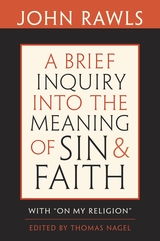
John Rawls never published anything about his own religious beliefs, but after his death two texts were discovered which shed extraordinary light on the subject. A Brief Inquiry into the Meaning of Sin and Faith is Rawls’s undergraduate senior thesis, submitted in December 1942, just before he entered the army. At that time Rawls was deeply religious; the thesis is a significant work of theological ethics, of interest both in itself and because of its relation to his mature writings. “On My Religion,” a short statement drafted in 1997, describes the history of his religious beliefs and attitudes toward religion, including his abandonment of orthodoxy during World War II.
The present volume includes these two texts, together with an Introduction by Joshua Cohen and Thomas Nagel, which discusses their relation to Rawls’s published work, and an essay by Robert Merrihew Adams, which places the thesis in its theological context.
The texts display the profound engagement with religion that forms the background of Rawls’s later views on the importance of separating religion and politics. Moreover, the moral and social convictions that the thesis expresses in religious form are related in illuminating ways to the central ideas of Rawls’s later writings. His notions of sin, faith, and community are simultaneously moral and theological, and prefigure the moral outlook found in Theory of Justice.
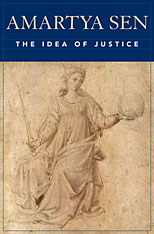
Social justice: an ideal, forever beyond our grasp; or one of many practical possibilities? More than a matter of intellectual discourse, the idea of justice plays a real role in how—and how well—people live. And in this book the distinguished scholar Amartya Sen offers a powerful critique of the theory of social justice that, in its grip on social and political thinking, has long left practical realities far behind.
The transcendental theory of justice, the subject of Sen’s analysis, flourished in the Enlightenment and has proponents among some of the most distinguished philosophers of our day; it is concerned with identifying perfectly just social arrangements, defining the nature of the perfectly just society. The approach Sen favors, on the other hand, focuses on the comparative judgments of what is “more” or “less” just, and on the comparative merits of the different societies that actually emerge from certain institutions and social interactions.
At the heart of Sen’s argument is a respect for reasoned differences in our understanding of what a “just society” really is. People of different persuasions—for example, utilitarians, economic egalitarians, labor right theorists, no-nonsense libertarians—might each reasonably see a clear and straightforward resolution to questions of justice; and yet, these clear and straightforward resolutions would be completely different. In light of this, Sen argues for a comparative perspective on justice that can guide us in the choice between alternatives that we inevitably face.
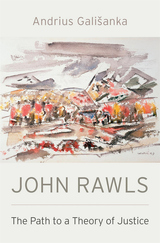
An engaging account of the titan of political philosophy and the development of his most important work, A Theory of Justice, coming at a moment when its ideas are sorely needed.
It is hard to overestimate the influence of John Rawls on political philosophy and theory over the last half-century. His books have sold millions of copies worldwide, and he is one of the few philosophers whose work is known in the corridors of power as well as in the halls of academe. Rawls is most famous for the development of his view of “justice as fairness,” articulated most forcefully in his best-known work, A Theory of Justice. In it he develops a liberalism focused on improving the fate of the least advantaged, and attempts to demonstrate that, despite our differences, agreement on basic political institutions is both possible and achievable.
Critics have maintained that Rawls’s view is unrealistic and ultimately undemocratic. In this incisive new intellectual biography, Andrius Gališanka argues that in misunderstanding the origins and development of Rawls’s central argument, previous narratives fail to explain the novelty of his philosophical approach and so misunderstand the political vision he made prevalent. Gališanka draws on newly available archives of Rawls’s unpublished essays and personal papers to clarify the justifications Rawls offered for his assumption of basic moral agreement. Gališanka’s intellectual-historical approach reveals a philosopher struggling toward humbler claims than critics allege.
To engage with Rawls’s search for agreement is particularly valuable at this political juncture. By providing insight into the origins, aims, and arguments of A Theory of Justice, Gališanka’s John Rawls will allow us to consider the philosopher’s most important and influential work with fresh eyes.

Philip Hubbard's life story begins in 1921 in Macon, a county seat in the Bible Belt of north central Missouri, whose history as a former slave state permeated the culture of his childhood. When he was four his mother moved her family 140 miles north to Des Moines in search of the greater educational opportunity that Iowa offered African American students. In this recounting of the effects of that journey on the rest of his life, Phil Hubbard merges his private and public life and career into an affectionate, powerful, and important story.
Hubbard graduated from the University of Iowa with a degree in electrical engineering in 1946; by 1954 he had received his Ph.D. in hydraulics. The College of Engineering extended a warm academic welcome, but nonacademic matters were totally different: Hubbard was ineligible for the housing and other amenities offered to white students. Intelligent, patient, keenly aware of discrimination yet willing to work from within the university system, he advanced from student to teacher to administrator, retiring in 1991 after decades of leadership in the classroom and the conference room.
Hubbard's major accomplishments included policies that focused on human rights; these policies transformed the makeup of students, faculty, and staff by seeking to eliminate discrimination based on race, religion, or other nonacademic factors and by substituting affirmative action for the traditional old-boy methods of selecting faculty and administrators. At the same time that he was advancing the cause of human rights and cultural diversity in education, his family was growing and thriving, and his descriptions of home life reveal one source of his strength and inspiration.
The decades that Hubbard covers were vital in the evolution of the nation and its educational institutions. His dedication to the agenda of public higher education has always been matched by his sensitivity to the negative effects of discrimination and his gentle perseverance toward his goals of inclusion, acceptance, and fairness. His vivid personal and institutional story will prove valuable at this critical juncture in America's racial history.

"Public reason" is one of the central concepts in modern liberal political theory. As articulated by John Rawls, it presents a way to overcome the difficulties created by intractable differences among citizens' religious and moral beliefs by strictly confining the place of such convictions in the public sphere.
Identifying this conception as a key point of conflict, this book presents a debate among contemporary natural law and liberal political theorists on the definition and validity of the idea of public reason. Its distinguished contributors examine the consequences of interpreting public reason more broadly as "right reason," according to natural law theory, versus understanding it in the narrower sense in which Rawls intended. They test public reason by examining its implications for current issues, confronting the questions of abortion and slavery and matters relating to citizenship.
This energetic exchange advances our understanding of both Rawls's contribution to political philosophy and the lasting relevance of natural law. It provides new insights into crucial issues facing society today as it points to new ways of thinking about political theory and practice.

Father Paul M. Washington rose to local and nation prominence as an unflagging supporter of civil and women's rights. One of a handful of black priests in a traditionally white church, he fought for understanding among all people, eventually serving twenty-five years as the Rector of the Episcopal Church of the Advocate in an inner-city Philadelphia neighborhood. Though his ideas about equality often went against the views of the Episcopal church leadership, he rejected threats of withdrawn funding or retaliation to follow his heart and his theology.
Father Washington's story is a window of insight into the struggles for justice and dignity in the latter half of the twentieth century. In the tumultuous 1960s he supported the Black Power movement, the Black Panther Party, and many other groups working for peace and justice, providing meeting places and guidance. He often found himself in the midst of racial disturbances—the riots on Susquehanna Avenue in 1963 and on Columbia Avenue in 1964, in front of the Board of Education where high school students protested the Eurocentric curriculum, and outside the walls of Girard College where citizens and civic leaders demonstrated against the school's exclusion of black children. In the 1980s, he helped Philadelphia city officials negotiate with MOVE members and was a vocal supporter of Ramona Africa, fighting for her release from prison. It was in his church on the corner of 18th and Diamond Streets that women were first ordained a priests in the Episcopal church. And it was one of his congregation, Barbara Harris, who became the first female Episcopal bishop.
In his evocative voice, Father Washington describes the pivotal events of his life and how each impacted upon his evolving ideas of the relationship between religion and justice. Spanning seven decades, his account is at once an insightful and unique historical account of political action, of the reformation of the church, of the changing urban landscape, and of a life graced by leadership and spiritual enlightenment.
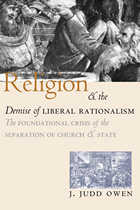
J. Judd Owen answers these questions with a remarkable critical analysis of four twentieth-century liberal and postliberal thinkers: John Dewey, John Rawls and, most extensively, Richard Rorty and Stanley Fish. His unique readings of these theorists and their approaches to religion lead him to conclusions that are meticulously constructed and surprising, arguing against the perception of liberalism as simple moral or religious neutrality, calling into question the prevailing justifications for separation of church and state, and challenging the way we think about the very basis of constitutional government.
READERS
Browse our collection.
PUBLISHERS
See BiblioVault's publisher services.
STUDENT SERVICES
Files for college accessibility offices.
RECENTLY PUBLISHED


UChicago Accessibility Resources
home | accessibility | search | about | contact us
BiblioVault ® 2001 - 2024
The University of Chicago Press