
 A SCHOLARLY BOOK REPOSITORY
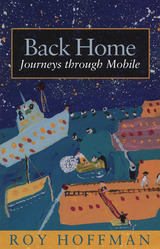
After twenty years in New York City, a prize-winning writer takes a "long look back" at his hometown of Mobile, Alabama.
In Back Home: Journeys through Mobile, Roy Hoffman tells stories—through essays, feature articles, and memoir—of one of the South's oldest and most colorful port cities. Many of the pieces here grew out of Hoffman's work as Writer-in-Residence for his hometown newspaper, the Mobile Register, a position he took after working in New York City for twenty years as a journalist, fiction writer, book critic, teacher, and speech writer. Other pieces were first published in the New York Times, Southern Living, Preservation, and other publications. Together, this collection comprises a long, second look at the Mobile of Hoffman's childhood and the city it has since become.
Like a photo album, Back Home presents close-up portraits of everyday places and ordinary people. There are meditations on downtown Mobile, where Hoffman's grandparents arrived as immigrants a century ago; the waterfront where longshoremen labor and shrimpers work their nets; the back roads leading to obscure but intriguing destinations. Hoffman records local people telling their own tales of race relations, sports, agriculture, and Mardi Gras celebrations. Fishermen, baseball players, bakers, authors, political figures--a strikingly diverse population walks across the stage of Back Home.
Throughout, Hoffman is concerned with stories and their enduring nature. As he writes, "When buildings are leveled, when land is developed, when money is spent, when our loved ones pass on, when we take our places a little farther back every year on the historical time-line, what we have still are stories."
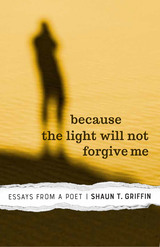
In this luminous and moving book of essays, award-winning author Shaun Griffin weaves together a poetic meditation on living meaningfully in this world. Anchored in the American West but reaching well beyond, he recounts his discoveries as a poet and devoted reader of poetry, a teacher of the disadvantaged, a friend of poets and artists, and a responsible member of the human family.
Always grounded in place, be it Nevada, South Africa, North Dakota, Spain, Zimbabwe, or Mexico, Griffin confronts the world with an openness that allows him to learn and grow from the people he meets. This is a meditation on how all of us can confront our own influences to achieve wholeness in our lives. Along with Griffin, readers will reflect on how they might respond to a homeless man walking through central Nevada, viewing the open desert as Thoreau might have viewed Walden, seeing the US-Mexico border as a region of lost identity, reconciling how poets who live west of the Hudson River find anonymity to be their laurel, and experiencing how writing poetry in prison becomes lifesaving.
Whether poets or places in the West or beyond, experiences with other cultures, or an acute awareness that poetry is the refuge of redress—all have influenced Griffin’s writing and thinking as a poet and activist in the Great Basin. The mindfulness of Because the Light Will Not Forgive Me demonstrates that even though the light does not forgive, it still reveals.
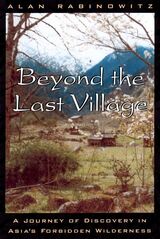
In 1993, Alan Rabinowitz, called "the Indiana Jones" of wildlife science by The New York Times, arrived for the first time in the country of Myanmar, known until 1989 as Burma, uncertain of what to expect. Working under the auspices of the Wildlife Conservation Society, his goal was to establish a wildlife research and conservation program and to survey the country's wildlife. He succeeded beyond all expectations, not only discovering a species of primitive deer completely new to science but also playing a vital role in the creation of Hkakabo Razi National Park, now one of Southeast Asia's largest protected areas.
Beyond the Last Village takes the reader on a journey of exploration, danger, and discovery in this remote corner of the planet at the southeast edge of the Himalayas where tropical rain forest and snow-covered mountains meet. As we travel through this "lost world" -- a mysterious and forbidding region isolated by ancient geologic forces -- we meet the Rawang, a former slave group, the Taron, a solitary enclave of the world's only pygmies of Asian ancestry, and Myanmar Tibetans living in the furthest reaches of the mountains. We enter the territories of strange, majestic-looking beasts that few people have ever heard of and fewer have ever seen -- golden takin, red goral, blue sheep, black barking deer. The survival of these ancient species is now threatened, not by natural forces but by hunters with snares and crossbows, trading body parts for basic household necessities.
The powerful landscape and unique people the author befriends help him come to grips with the traumas and difficulties of his past and emerge a man ready to embrace the world anew. Interwoven with his scientific expedition in Myanmar, and helping to inform his understanding of the people he met and the situations he encountered, is this more personal journey of discovery.

Winner of the Leila Webster Memorial Music Award for the International Alliance for Women in Music of the 2022 Pauline Alderman Awards for Outstanding Scholarship on Women in Music
Chen Yi is the most prominent woman among the renowned group of new wave composers who came to the US from mainland China in the early 1980s. Known for her creative output and a distinctive merging of Chinese and Western influences, Chen built a musical language that references a breathtaking range of sources and crisscrosses geographical and musical borders without eradicating them.
Leta E. Miller and J. Michele Edwards provide an accessible guide to the composer's background and her more than 150 works. Extensive interviews with Chen complement in-depth analyses of selected pieces from Chen's solos for Western or Chinese instruments, chamber works, choral and vocal pieces, and compositions scored for wind ensemble, chamber orchestra, or full orchestra. The authors highlight Chen's compositional strategies, her artistic elaborations, and the voice that links her earliest and most recent music. A concluding discussion addresses questions related to Chen's music and issues such as gender, ethnicity and nationality, transnationalism, border crossing, diaspora, exoticism, and identity.
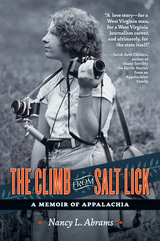
The Climb from Salt Lick is the remarkable memoir of an outsider coming into adulthood. It is the story of a unique place and its people from the perspective of a woman who documents its burdens and its beauty, using words and pictures to tell the rich stories of those around her.

Demonstrating a keen eye for historical detail, Considering Watchmen gives readers a new appreciation of just how radical Moore and Gibbons’s blend of gritty realism and formal experimentation was back in 1986. The book also considers Watchmen’s place in the history of the comics industry, reading the graphic novel’s playful critique of superhero marketing alongside Alan Moore’s public statements about the rights to the franchise. Andrew Hoberek examines how Moore and Gibbons engaged with the emerging discourses of neoconservatism and neoliberal capitalism, ideologies that have only become more prominent in subsequent years.
Watchmen’s influences on the superhero comic and graphic novel are undeniable, but Hoberek reveals how it has also had profound effects on literature as a whole. He suggests that Watchmen not only proved that superhero comics could rise to the status of literature—it also helped to inspire a generation of writers who are redefining the boundaries of the literary, from Jonathan Lethem to Junot Díaz. Hoberek delivers insight and analysis worthy of satisfying serious readers of the genre while shedding new light on Watchmen as both an artistic accomplishment and a book of ideas.
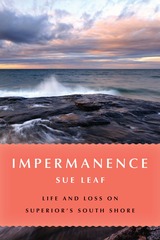
A personal journey through the ever-changing natural and cultural history of Lake Superior’s South Shore
Lake Superior’s South Shore is as malleable as it is enduring, its red sandstone cliffs, clay bluffs, and golden sand beaches reshaped by winds and water from season to season—and sometimes from one hour to the next. Generations of people have inhabited the South Shore, harvesting the forests and fish, mining copper, altering the land for pleasure and profit, for better or worse. In Impermanence, author Sue Leaf explores the natural and human histories that make the South Shore what it is, from the gritty port city of Superior, Wisconsin, to the shipping locks at Sault Ste. Marie, Michigan.
For Leaf, what began as a bicycling adventure on the coast of Lake Superior in 1977 turned into a lifelong connection with the area, and her experience, not least as owner of a rustic cabin on a rapidly eroding lakeside cliff, imbues these essays with a passionate sense of place and an abiding curiosity about its past and precarious future. As waves slowly consume the shoreline where her family has spent countless summers, Leaf is forced to confront the complexity of loving a place that all too quickly is being reclaimed by the great lake.
Impermanence is a journey through the South Shore’s story, from the early days of the Anishinaabe and fur traders through the heyday of commercial fishing, lumber camps, and copper mining on the Keweenaw Peninsula to the awakening of the Northland to the perils and consequences of plundering its natural splendor. Noting the geological, ecological, and cultural features of each stop on her tour along the South Shore, Leaf writes about the restoration of the heavily touristed Apostle Islands National Lakeshore to its pristine conditions, even as Lake Superior maintains its allure for ice fishers, kayakers, and long-distance swimmers. She describes efforts to protect the endangered piping plover and to preserve the diverse sand dunes on the Michigan coast, and she observes the slough that supports rare intact wild rice beds central to Anishinaabe culture.
Part memoir, part travelogue, part natural and cultural history, Leaf’s love letter to Lake Superior’s South Shore is an invitation to see this liminal world in all its seasons and guises, to appreciate its ageless, ever-changing wonders and intimate charms.
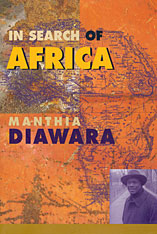
"There I was, standing alone, unable to cry as I said goodbye to Sidimé Laye, my best friend, and to the revolution that had opened the door of modernity for me--the revolution that had invented me." This book gives us the story of a quest for a childhood friend, for the past and present, and above all for an Africa that is struggling to find its future.
In 1996 Manthia Diawara, a distinguished professor of film and literature in New York City, returns to Guinea, thirty-two years after he and his family were expelled from the newly liberated country. He is beginning work on a documentary about Sékou Touré, the dictator who was Guinea's first post-independence leader. Despite the years that have gone by, Diawara expects to be welcomed as an insider, and is shocked to discover that he is not.
The Africa that Diawara finds is not the one on the verge of barbarism, as described in the Western press. Yet neither is it the Africa of his childhood, when the excitement of independence made everything seem possible for young Africans. His search for Sidimé Laye leads Diawara to profound meditations on Africa's culture. He suggests solutions that might overcome the stultifying legacy of colonialism and age-old social practices, yet that will mobilize indigenous strengths and energies.
In the face of Africa's dilemmas, Diawara accords an important role to the culture of the diaspora as well as to traditional music and literature--to James Brown, Miles Davis, and Salif Kéita, to Richard Wright, Spike Lee, and the ancient epics of the griots. And Diawara's journey enlightens us in the most disarming way with humor, conversations, and well-told tales.

In 1983, zoologist Alan Rabinowitz ventured into the rain forest of Belize, determined to study the little-known jaguar in its natural habitat and to establish the world's first jaguar preserve. Within two years, he had succeeded. In Jaguar he provides the only first-hand account of a scientist's experience with jaguars in the wild.
Originally published in 1986, this edition includes a new preface and epilogue by the author that bring the story up to date with recent events in the region and around the world.
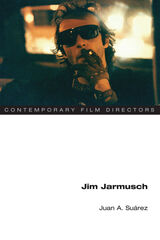
At a time when gimmicky, action-driven blockbusters ruled Hollywood, Jim Jarmusch spearheaded a boom in independent cinema by making now-classic low-budget films like Stranger than Paradise, Down by Law, and Mystery Train. Jarmusch's films focused on intimacy, character, and new takes on classical narratives. His minimal form, peculiar pacing, wry humor, and blank affect have since been adopted by directors like Sofia Coppola, Hal Hartley, Richard Linklater, and Tsai Ming-liang.
Juan A. Suárez identifies and describes an abundance of aesthetic influences on Jarmusch, delving into the director's links to punk, Structural film, classic street photography, hip-hop, beat literature and art, and the New York pop vanguard of the late 1970s. At the same time, he analyzes Jarmusch's work from three mutually implicated perspectives: in relation to independent filmmaking from the 1980s to the present; as a form of cultural production that appropriates existing icons, genres, and motifs; and as an instance of postmodern politics.
A volume in the series Contemporary Film Directors, edited by James R. Naremore
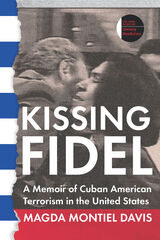
What does it mean to be instantly transformed into the most hated person in your community? After meeting Fidel Castro at a Havana reception in 1994, Cuban-born Magda Montiel Davis, founder of one of the largest immigration law firms in South Florida, soon found out. The reception—attended by hundreds of other Cuban émigrés—was videotaped for historical archives. In a seconds-long clip, Fidel pecks the traditional protocol kiss on Montiel Davis’s cheek as she thanks him for the social benefits conferred upon the Cuban people. The video, however, was mysteriously sold to U.S. reporters and aired incessantly throughout South Florida. Soon the encounter was an international cause célèbre.
Life as she knew it was over for Montiel Davis and her family, including a father who worked with the CIA to topple Fidel, a nohablo-inglés mother who lived with the family, her five children, and her Jewish Brooklyn-born attorney husband. Kissing Fidel shares the sometimes dismal, sometimes comical realities of an ordinary citizen being thrown into a world of death threats, mob attacks, and terrorism.
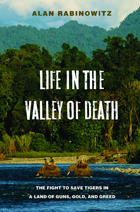
The tale is set in the lush Hukaung Valley of Myanmar, formerly known as Burma. An escape route for refugees fleeing the Japanese army during World War II, this rugged stretch of land claimed the lives of thousands of children, women, and soldiers. Today it is home to one of the largest tiger populations outside of India—a population threatened by rampant poaching and the recent encroachment of gold prospectors.
To save the remaining tigers, Rabinowitz must navigate not only an unforgiving landscape, but the tangled web of politics in Myanmar. Faced with a military dictatorship, an insurgent army, tribes once infamous for taking the heads of their enemies, and villagers living on less than one U.S. dollar per day, the scientist and adventurer most comfortable with animals is thrust into a diplomatic minefield. As he works to balance the interests of disparate factions and endangered wildlife, his own life is threatened by an incurable disease.
The resulting story is one of destruction and loss, but also renewal. In forests reviled as the valley of death, Rabinowitz finds new life for himself, for communities haunted by poverty and violence, and for the tigers he vowed to protect.

Sight is central to the medium of photography. But what happens when the subjects of photographic portraits cannot look back at the photographer or even see their own image? An in-depth pictorial study of blind schoolchildren in Mexico, Look at me draws attention to (and distinctions between) the activity of sight and the consciousness of form.
Combining aspects of his earlier, acclaimed street work with an innovative approach to portraiture, Chicago-based photographer Jed Fielding has concentrated closely on these children’s features and gestures, probing the enigmatic boundaries between surface and interior, innocence and knowing, beauty and grotesque. Design, composition, and the play of light and shadow are central elements in these photographs, but the images are much more than formal experiments; they confront disability in a way that affirms life. Fielding’s sightless subjects project a vitality that seems to extend beyond the limits of self-consciousness. In collaborative, joyful participation with the children, he has made pictures that reveal essential gestures of absorption and the basic expressions of our creatureliness.
Fielding’s work achieves what only great art, and particularly great portraiture can: it launches and then complicates a process of identification across the barriers that separate us from each other. Look at me contains more than sixty arresting images from which we often want to look away, but into which we are nevertheless drawn by their deep humanity and palpable tenderness. This is a monograph of uncommon significance by an important American photographer.
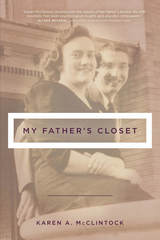
“Karen McClintock reconstructs the details of her father’s double life with novelistic flair, keen psychological insight, and graceful compassion.” —Alison Bechdel
Thirty years after her father’s death, Karen McClintock sets out to find the gay father she never really knew. As we follow the unraveling family secret, we find ourselves drawn into her story as they stumble into infidelity, grieve heartbreaking losses, and remain loyal in love.
Set in Columbus, Ohio, My Father’s Closet tells the story of how just before the war, McClintock’s parents fell in love and married, while overseas in Germany the man whom she believes became her father’s lover was concealing his Jewish and gay identities in order to escape to America. A set of her father’s journals, letters her parents sent to each other during the Second World War, and a mysterious painting all lead her toward the truth about her gay father. McClintock weaves a complex secret into the fabric of lives we truly care about. And in the process, she leads us out of her father’s closet.
This gripping memoir captures the longing children feel for a distant or hidden parent and taps into the complexity of human connection and abandonment. The characters are resilient and vibrant. The hidden lovers, the nosey neighbors, and surprise lovers all show up. In the end, this extraordinary family finds ways to connect and freedom to love. Anyone who grew up with a family secret will appreciate the dynamics afoot in this fast-paced and compelling story.

Angelo effuses about his meeting with the larger-than-life Jim Brown and appreciates the trash talking John Randle. He poignantly reflects on “Bullet” Bob Hayes, the world's fastest man who “could not outrun his demons,” and showcases the mercurial Duane Thomas and the free-wheeling Tony Siragusa. The NFL Off-Camera reveals why Angelo sparred with Hall-of-Fame player turned broadcaster Frank Gifford and demonstrates why Super Bowl champion head coach Sean Payton is his “least favorite person in pro football.”
From Jared Allen to Jim Zorn, The NFL Off-Camera explores nearly 100 of the game’s outsized personalities and debunks some of football's most enduring myths. Angelo’s original, unfiltered look at Pro Football is as hard-hitting and exciting as any one of his NFL Films.

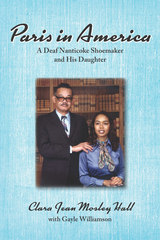
Hall was abandoned by her Deaf African American mother at a young age and forged a close bond with her father, James Paris Mosley, who communicated with her in American Sign Language. Although his family was Native American, they—like many other Nanticoke Native Americans of that region—had assimilated over time into Dover’s Black community. Hall vividly recounts the social and cultural elements that shaped her, from Jim Crow to the forced integration of public schools, to JFK and Motown. As a Coda (child of deaf adults) in a time when no accessibility or interpreting services were available, she was her father’s sole means of communication with the hearing world, a heavy responsibility for a child. After her turbulent teenage years, and with the encouragement of her future husband, she attended college and discovered that her skills as a fluent ASL user were a valuable asset in the field of education.
Hall went on to become a college professor, mentor, philanthropist, and advocate for Deaf students from diverse backgrounds. Her memoir is a celebration of her family, her faith, her journey, and her heritage.
Riding on Comets is the true story of an only child growing up in a working-class family during the 1950s and ‘60s.
As the family storyteller, Cat Pleska whispers and shouts about her life growing up around savvy, strong women and hard-working, hard-drinking men. Unlike many family stories set within Appalachia, this story provides an uncommon glimpse into this region: not coal, but an aluminum plant; not hollers, but small-town America; not hillbillies, but a hard-working family with traditional values.
From the dinner table, to the back porch, to the sprawling countryside, Cat Pleska reveals the sometimes tender, sometimes frightening education of a child who listens at the knees of these giants. She mimics and learns every nuance, every rhythm—how they laugh, smoke, cuss, fight, love, and tell stories—as she unwittingly prepares to carry their tales forward, their words and actions forever etched in her mind. And finally, she discovers a life story of her own.
As Burke contemplates what he and Sid may have had in common, he meditates on the changing meaning of rivers, and the impossibility of fully recovering the past. In clear and graceful prose, Burke blends Sid’s colorful history with his own uncommon journey. He also reflects upon the quick currents of time and the fierce passion he shares with Sid for the life of river running in Alaska and the west. Unlike most river-running books that often describe waterways in the lower forty-eight states, The Same River Twice introduces readers to rough, austere, and unfamiliar rivers in the northern wilderness. Burke has an intimate understanding of these remote, free-flowing rivers. He effectively captures the thrill of moving water, the spirit of rivers and river canyons, and the life of river guides. This insightful memoir brings readers into a confluence of rivers, where past and present merge, revealing the power of wilderness and the truth about changing course.
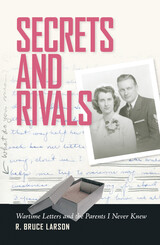
Reading through the letters, he is drawn into his parents’ courtship amid the hardships of separation and war. Beyond the tumultuous romance, Larson finds that he barely recognizes his father, whom he knew only as distant and impassive. He uncovers shocking truths about his mother, Ruth, whom family lore had pigeonholed as sweetly pious.
At the time of the letters, Bob is a young Coast Guard clerk fighting off depression with thoughts of his dream girl back home. Back in Minnesota, Ruth passes the days adrift in romantic fantasies and liaisons with local admirers. Bob’s suspicions about Ruth and his obsession with her from afar threaten the young man’s fragile hold on his sanity, but he will not give her up. Decades later, their son comes to feel a tenderness for both his parents and to understand how their losses, fears, and reluctance can transform and refashion family bonds.
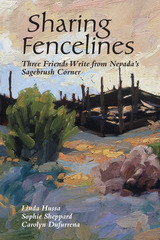
In the lightly-populated northwestern corner of Nevada, a former geologist and rural schoolteacher, a published poet and ranch owner, and an artist and environmentalist make for an intriguing—perhaps even unlikely—trio of friends. In this evocative collection of personal essays, each offers her voice as a testament to the joys and struggles of creating a home and connecting to the land and the people who live there.
Stories of ranch hands and Ladies’ Clubs, raising chickens and raising children, pulling up roots and planting dreams tumble together in a mélange of lives lived well and thoughtfully. Sharing Fencelines is as much about art as it is about activism, as much about personal growth as it is about growing community. What these women offer us is the sweet taste of what is possible, and the blended harmony of their voices echoes across the mountains and washes and deserts, resonating in our own hearts, our own homes.
Carolyn Dufurrena’s "The Flying Heart Museum" pays homage to a layered landscape of unique individuals—not the least of which are her students, searching for themselves in the Nevada wilderness: "You know how your spirit betrays you when you’re not thinking to protect yourself. Jose has been dreaming, doodling away, and his pencil has discovered this flying heart, as big as the Puritan meetinghouse....He has drawn the log cabin around the heart, and labeled it. At recess I ask him, gently, 'So, Jose, what’s in there, in your Flying Heart Museum?'"
In "Shared Fencelines," Linda Hussa reveals the mystery of horses, the gift of water, and the serendipity of love: "My first hurt came from a horse when I tried to shinny up the feathered leg of our old gelding as I’d seen my brother and sister do. Twelve hundred pounds of him stepped on my bare foot. Mom carried her shrieking two-year-old to the house...she cut off the dangling nail saying Popeye didn’t mean to, he just didn’t notice my little foot. Then she cradled my face in her cool hands and said she hoped I would forgive him and we could be friends again."
"Fire Hall" by Sophie Sheppard paints a picture of a families and communities forged against the backdrop of a rugged, rural life: "Here, when there is a funeral, the whole town comes. First to arrive are the older women, vestiges of the Lake City Ladies Club that was disbanded a few years ago because most of the younger women have jobs and no longer stay at home. At the potluck funeral dinner everyone will file in together: the women unfamiliar in dresses ordered from catalogs, the mens' hatless foreheads glowing pale in contrast to the tan of their freshly shaven jaws, the younger people that I won’t recognize."
“Daniels is a keen observer of visceral moments and powerful emotions.” —Kirkus Reviews
“A book of burning soulfulness.” —Edward Hirsch
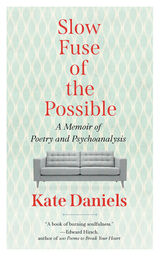
Slow Fuse of the Possible is a poet’s narrative of a troubled psychoanalysis. It is also a commanding meditation on the powers of language, for good and for ill.
From the beginning of their time together, it is clear that the enigmatic analyst and Daniels are not a good match, yet both are determined to continue their work—the former in nearly complete silence, and the latter as best she can with the tools at her disposal: careful attention to language, deep reading, and literary imagination. Throughout, the story is filtered through the mind of Emily Dickinson, whose poetry Daniels uses as a fulcrum for the interpretation of her own experience. The book is saturated with Dickinson’s verse, and Dickinson is an increasingly haunting presence as crises emerge and the author unravels.
This compelling lyric memoir, so richly steeped in all facets of language and the literary, allows readers a glimpse into the mind of a renowned poet, revealing the dazzling and anguished connections between poetry and psychoanalysis.

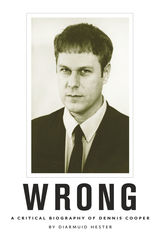
Dennis Cooper is one of the most inventive and prolific artists of our time. Working in a variety of forms and media since he first exploded onto the scene in the early 1970s, he has been a punk poet, a queercore novelist, a transgressive blogger, an indie filmmaker—each successive incarnation more ingenious and surprising than the last. Cooper’s unflinching determination to probe the obscure, often violent recesses of the human psyche have seen him compared with literary outlaws like Rimbaud, Genet, and the Marquis de Sade.
In this, the first book-length study of Cooper’s life and work, Diarmuid Hester shows that such comparisons hardly scratch the surface. A lively retrospective appraisal of Cooper’s fifty-year career, Wrong tracks the emergence of Cooper’s singular style alongside his participation in a number of American subcultural movements like New York School poetry, punk rock, and radical queercore music and zines. Using extensive archival research, close readings of texts, and new interviews with Cooper and his contemporaries, Hester weaves a complex and often thrilling biographical narrative that attests to Cooper’s status as a leading figure of the American post–War avant-garde.
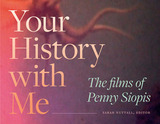
Contributors. John Akomfrah, Sinazo Chiya, Mark Gevisser, Pumla Dineo Gqola, Katerina Gregos, Brenda Hollweg, William Kentridge, Achille Mbembe, Sarah Nuttall, Griselda Pollock, Laura Rascaroli, Zineb Sedira, Penny Siopis, Hedley Twidle, Zoé Whitley
READERS
Browse our collection.
PUBLISHERS
See BiblioVault's publisher services.
STUDENT SERVICES
Files for college accessibility offices.
RECENTLY PUBLISHED



UChicago Accessibility Resources
home | accessibility | search | about | contact us
BiblioVault ® 2001 - 2024
The University of Chicago Press