
 A SCHOLARLY BOOK REPOSITORY
Results by Title
5 books about Accra
5 books about Accra
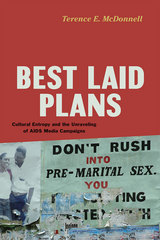
Best Laid Plans
Cultural Entropy and the Unraveling of AIDS Media Campaigns
Terence E. McDonnell
University of Chicago Press, 2016
We see it all the time: organizations strive to persuade the public to change beliefs or behavior through expensive, expansive media campaigns. Designers painstakingly craft clear, resonant, and culturally sensitive messaging that will motivate people to buy a product, support a cause, vote for a candidate, or take active steps to improve their health. But once these campaigns leave the controlled environments of focus groups, advertising agencies, and stakeholder meetings to circulate, the public interprets and distorts the campaigns in ways their designers never intended or dreamed. In Best Laid Plans, Terence E. McDonnell explains why these attempts at mass persuasion often fail so badly.
McDonnell argues that these well-designed campaigns are undergoing “cultural entropy”: the process through which the intended meanings and uses of cultural objects fracture into alternative meanings, new practices, failed interactions, and blatant disregard. Using AIDS media campaigns in Accra, Ghana, as its central case study, the book walks readers through best-practice, evidence-based media campaigns that fall totally flat. Female condoms are turned into bracelets, AIDS posters become home decorations, red ribbons fade into pink under the sun—to name a few failures. These damaging cultural misfires are not random. Rather, McDonnell makes the case that these disruptions are patterned, widespread, and inevitable—indicative of a broader process of cultural entropy.
McDonnell argues that these well-designed campaigns are undergoing “cultural entropy”: the process through which the intended meanings and uses of cultural objects fracture into alternative meanings, new practices, failed interactions, and blatant disregard. Using AIDS media campaigns in Accra, Ghana, as its central case study, the book walks readers through best-practice, evidence-based media campaigns that fall totally flat. Female condoms are turned into bracelets, AIDS posters become home decorations, red ribbons fade into pink under the sun—to name a few failures. These damaging cultural misfires are not random. Rather, McDonnell makes the case that these disruptions are patterned, widespread, and inevitable—indicative of a broader process of cultural entropy.
[more]
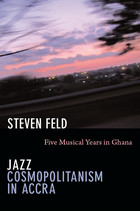
Jazz Cosmopolitanism in Accra
Five Musical Years in Ghana
Steven Feld
Duke University Press, 2012
In this remarkable book, Steven Feld, pioneer of the anthropology of sound, listens to the vernacular cosmopolitanism of jazz players in Ghana. Some have traveled widely, played with American jazz greats, and blended the innovations of John Coltrane with local instruments and worldviews. Combining memoir, biography, ethnography, and history, Feld conveys a diasporic intimacy and dialogue that contests American nationalist and Afrocentric narratives of jazz history. His stories of Accra's jazz cosmopolitanism feature Ghanaba/Guy Warren (1923–2008), the eccentric drummer who befriended the likes of Charlie Parker, Max Roach, and Thelonious Monk in the United States in the 1950s, only to return, embittered, to Ghana, where he became the country's leading experimentalist. Others whose stories figure prominently are Nii Noi Nortey, who fuses the legacies of the black avant-gardes of the 1960s and 1970s with pan-African philosophy in sculptural shrines to Coltrane and musical improvisations inspired by his work; the percussionist Nii Otoo Annan, a traditional master inspired by Coltrane's drummers Elvin Jones and Rashied Ali; and a union of Accra truck and minibus drivers whose squeeze-bulb honk-horn music for drivers' funerals recalls the jazz funerals of New Orleans. Feld describes these artists' cosmopolitan outlook as an "acoustemology," a way of knowing the world through sound.
[more]

The Noise Silence Makes
Secularity and Ghana's Drum Wars
Mariam Goshadze
Duke University Press, 2025
For generations, the Ga community in Accra, Ghana, has enforced an annual citywide ban on noisemaking during an important religious festival. In the 1990s and 2000s, this “ban on drumming” became a point of conflict between the Ga people and the newly popular Pentecostal/Charismatic churches, which refused to subdue their loud worship during the ban. Although the Ghanaian state constitutionally and institutionally grants superior status to Christianity and Islam, it ruled in favor of the Ga community, which emphasized its “cultural” rather than religious rights. In The Noise Silence Makes, Mariam Goshadze traces the history of noise regulation in Accra, showing how the Ga people have adopted colonial mechanisms of noise control to counter Pentecostal/Charismatic dominance over Accra’s soundscape. Goshadze shows how the drumming ban represents a reversal of the top-down model of noise regulation and illuminates the reality of Ghanaian secularity, in which the state unofficially collaborates with indigenous religious authorities to control sound. In so doing, Goshadze counters the tendency to push African “traditional religions” to the margins, demonstrating that they are instrumental players in contemporary African urbanity.
[more]
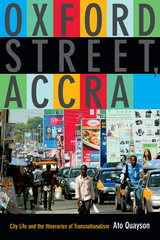
Oxford Street, Accra
City Life and the Itineraries of Transnationalism
Ato Quayson
Duke University Press, 2014
In Oxford Street, Accra, Ato Quayson analyzes the dynamics of Ghana's capital city through a focus on Oxford Street, part of Accra's most vibrant and globalized commercial district. He traces the city's evolution from its settlement in the mid-seventeenth century to the present day. He combines his impressions of the sights, sounds, interactions, and distribution of space with broader dynamics, including the histories of colonial and postcolonial town planning and the marks of transnationalism evident in Accra's salsa scene, gym culture, and commercial billboards. Quayson finds that the various planning systems that have shaped the city—and had their stratifying effects intensified by the IMF-mandated structural adjustment programs of the late 1980s—prepared the way for the early-1990s transformation of a largely residential neighborhood into a kinetic shopping district. With an intense commercialism overlying, or coexisting with, stark economic inequalities, Oxford Street is a microcosm of historical and urban processes that have made Accra the variegated and contradictory metropolis that it is today.
[more]

Urban Saniscapes
Slums, Housing and Everyday Sanitation in Accra and Nairobi, 1908–1963
Waseem-Ahmed Bin-Kasim
Michigan State University Press, 2025
In this comparative study, Bin-Kasim examines environmental sanitation in the historical development of Accra and Nairobi, the capitals of the Gold Coast (Ghana) and Kenya. This book traces the approaches to sanitation during colonial rule and urban growth throughout the first half of the twentieth century and beyond. From the consolidation of the colonial regimes to the Great Depression, urbanization waves, and postwar development, sanitation was both a cause and a consequence of the built environment. Bin-Kasim characterizes this complex relationship between sanitation and urban growth over time as the 'saniscape.' The saniscape is the confluence of public health, planning interventions, and various urban constituencies, and includes an array of influences like colonial expertise and African industry, which shaped the two cities regardless of their power dynamics and land tenure. Attention to the saniscape validates how Africans called out colonial discrimination and inefficiencies to intervene and shape cities. This volume highlights the shared histories of Accra and Nairobi and upends conventional narratives that attach too much difference to non-settler and settler colonialism.
[more]
READERS
Browse our collection.
PUBLISHERS
See BiblioVault's publisher services.
STUDENT SERVICES
Files for college accessibility offices.
RECENTLY PUBLISHED


UChicago Accessibility Resources
home | accessibility | search | about | contact us
BiblioVault ® 2001 - 2025
The University of Chicago Press