
 A SCHOLARLY BOOK REPOSITORY
60 start with A start with A
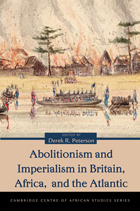
The abolition of the slave trade is normally understood to be the singular achievement of eighteenth-century British liberalism. Abolitionism and Imperialism in Britain, Africa, and the Atlantic expands both the temporal and the geographic framework in which the history of abolitionism is conceived. Abolitionism was a theater in which a variety of actors—slaves, African rulers, Caribbean planters, working-class radicals, British evangelicals, African political entrepreneurs—played a part. The Atlantic was an echo chamber, in which abolitionist symbols, ideas, and evidence were generated from a variety of vantage points. These essays highlight the range of political and moral projects in which the advocates of abolitionism were engaged, and in so doing it joins together geographies that are normally studied in isolation.
Where empires are often understood to involve the government of one people over another, Abolitionism and Imperialism shows that British values were formed, debated, and remade in the space of empire. Africans were not simply objects of British liberals’ benevolence. They played an active role in shaping, and extending, the values that Britain now regards as part of its national character. This book is therefore a contribution to the larger scholarship about the nature of modern empires.
Contributors: Christopher Leslie Brown, Seymour Drescher, Jonathon Glassman, Boyd Hilton, Robin Law, Phillip D. Morgan, Derek R. Peterson, John K. Thornton

William Seitz was a creative witness to one of the most exciting artistic upheavals of our time. His analysis of American Abstract Expressionism is the unique testament of one who was there at the Cedar Bar and at The Club in the early 1950s, sharing the milieu of the painters about whom he writes-Gorky, de Kooning, Hofmann, Motherwell, Rothko, and Tobey. Seitz was finely tuned to their idiosyncratic development, able to document at first hand the influences entering their discourse, whether Suzuki or Empson, Klee or the French existentialists. Beyond this, the uncertainty and verbal confusion of the time, Seitz takes the reader directly to the works of art, probing not what the artists were saying, but what they were painting.
A painter himself, he could explore the passions and methods of Abstract Expressionism with the insight and technical precision of one who had labored in the studio. Seitz maintains a profound respect for the mysterious power of the individual talent, for the artist as an intellectual, and for painting as a form of knowledge. His work, confined to the "underground" of microfilm after it was completed in 1955, stands alone in conveying the anxiety, exhilaration, and richness of a movement racing ahead while its criteria were still being formed. Lavishly illustrated with over 300 paintings, many in full color, Abstract Expressionist Painting in America is a book that Motherwell describes in his foreword as "unsurpassed...in the literature of Abstract Expressionism, but also sui generis in the scholarship of Modernism."



In recent years scholars have begun to question the cultural values underlying our view of Nature. Kevin Dann contributes to this debate by juxtaposing two radically different “Arcadian” experiments founded by Manhattanites seeking cultural renewal through contact with the natural world.
Dann focuses first on initiatives carried out by the American Museum of Natural History and the Eugenics Record Office from 1910 to 1940 within Harriman State Park in the Ramapo Mountains. He argues that these diverse expressions of the early “back-to-nature” movement are united by their biological materialism, or “Naturalism,” which became integral to the popular culture of educated metropolitan Americans in the early twentieth century.
He then compares this activity to the contemporary efforts at nearby Threefold Farm, where anthroposophists--followers of Rudolf Steiner's“spiritual science”--developed a program of natural scientific research and education that directly opposed Darwinian explanations of natural history, social Darwinian views of human society, and reductionist scientific methods. By challenging scientific “fact” with spiritual scientific descriptions of supersensible phenomena, the Threefold Farm initiative offered Americans a new gospel of nature.
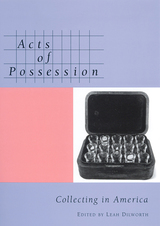
Drawing upon the body of theoretical work on collecting and focusing on individual as opposed to museum collections, the contributors investigate how, what, and why Americans have collected and explore the inherent meanings behind systems of organization and display. Essays consider the meanings of Thomas Jefferson's Indian Hall at Monticello; the pedagogical theories behind nineteenth-century children's curiosity cabinets; collections of Native American artifacts; and the ability of the owners of doll houses to construct meaning within the context of traditional ideals of domesticity.
The authors also consider some darker aspects of collecting-hoarding, fetishism, and compulsive behavior-scrutinizing collections of racist memorabilia and fascist propaganda. The final essay posits the serial killer as a collector, an investigation into the dangerous objectification of humans themselves.
By bringing fresh, interdisciplinary critical perspectives to bear on these questions, Dilworth and her coauthors weave a fascinating cultural history of collecting in America.

Professor Leahy recounts the academic tensions between religious beliefs and intellectual inquiry, and explore the social changes that have affected higher education and American Catholicism throughout this century. He attempts to explain why the significant growth of Catholic colleges and universities was not always matched by concomitant academic esteem in the larger world of American higher education.
---Choice
"Sheds new light on the roots of this complex and fascinating institution."
---Library Journal
"Well-written and accessible . . . showcases the wide-ranging scholarship underway on the history of adoption."
---Adoptive Families
"[T]his volume is a significant contribution to the literature and can serve as a catalyst for further research."
---Social Service Review
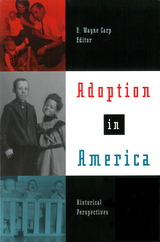
Adoption affects an estimated 60 percent of Americans, but despite its pervasiveness, this social institution has been little examined and poorly understood. Adoption in America gathers essays on the history of adoptions and orphanages in the United States. Offering provocative interpretations of a variety of issues, including antebellum adoption and orphanages; changing conceptions of adoption in late-nineteenth-century novels; Progressive Era reform and adoptive mothers; the politics of "matching" adoptive parents with children; the radical effect of World War II on adoption practices; religion and the reform of adoption; and the construction of birth mother and adoptee identities, the essays in Adoption in America will be debated for many years to come.
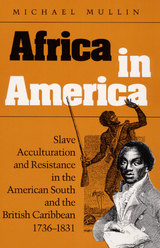
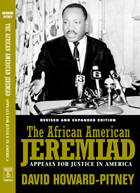

The essays in this volume form the cutting edge of biohistorical research that promises to rewrite the story of humankind's past in significant ways.
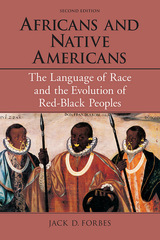
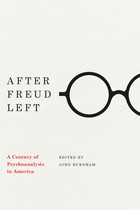
From August 29 to September 21, 1909, Sigmund Freud visited the United States, where he gave five lectures at Clark University in Worcester, Massachusetts. This volume brings together a stunning gallery of leading historians of psychoanalysis and of American culture to consider the broad history of psychoanalysis in America and to reflect on what has happened to Freud’s legacy in the United States in the century since his visit.
Let’s face it: almost everyone fears growing older. We worry about losing our looks, our health, our jobs, our self-esteem—and being supplanted in work and love by younger people. It feels like the natural, inevitable consequence of the passing years, But what if it’s not? What if nearly everything that we think of as the “natural” process of aging is anything but?
In Agewise, renowned cultural critic Margaret Morganroth Gullette reveals that much of what we dread about aging is actually the result of ageism—which we can, and should, battle as strongly as we do racism, sexism, and other forms of bigotry. Drawing on provocative and under-reported evidence from biomedicine, literature, economics, and personal stories, Gullette probes the ageism thatdrives discontent with our bodies, our selves, and our accomplishments—and makes us easy prey for marketers who want to sell us an illusory vision of youthful perfection. Even worse, rampant ageism causes society to discount, and at times completely discard, the wisdom and experience acquired by people over the course of adulthood. The costs—both collective and personal—of this culture of decline are almost incalculable, diminishing our workforce, robbing younger people of hope for a decent later life, and eroding the satisfactions and sense of productivity that should animate our later years.
Once we open our eyes to the pervasiveness of ageism, however, we can begin to fight it—and Gullette lays out ambitious plans for the whole life course, from teaching children anti-ageism to fortifying the social safety nets, and thus finally making possible the real pleasures and opportunities promised by the new longevity. A bracing, controversial call to arms, Agewise will surprise, enlighten, and, perhaps most important, bring hope to readers of all ages.

From the first scholarship donated to Harvard in 1643 to today's world of "enrollment management" and federal grants and loans, the author gives a lively social and economic history of the conflicting purposes of student aid and makes proposals for the future. His research for this book is based on archives and interviews at 131 public and private institutions across the United States.
In the words of Joe Paul Case, Dean and Director of Financial Aid, Amherst College, "Wilkinson has mined the archives of dozens of institutions to create a mosaic that details the progress of student assistance from the 17th century to the present. He gives particular attention to the origins of need-based assistance, from the charitable benevolence of early colleges to the regulation-laden policies of the federal government. He gives due consideration to institutional motive--he challenges the egalitarian platitudes of affluent colleges and questions the countervailing market and economic forces that may imperil need-based aid at less competitive institutions. By drawing on scores of personal interviews and exchanges of correspondence with aid practitioners, Wilkinson fleshes out recent decades, helping the reader to understand new trends in the provision of aid."

The stories reveal the dynamics that determine how the policy decisions of white-collar health care professionals actually play out in real life. By focusing on life-changing social problems, the narratives highlight the contradictions between public health and criminal law. Look at how HIV has transformed our social consciousness, from intimate touch to institutional outreach. But, Kane argues, these changes are dwarfed by the United States's refusal to stop the war on drugs, in effect misdirecting resources and awareness.
AIDS Alibis combines empirical and interpretive methods in a path-breaking attempt to recognize the extent to which coercive institutional practices are implicated in HIV transmission patterns. Kane shows how th e virus feeds on the politics of inequality and indifference, even as it exploits the human need for intimacy and release.

Many consider the new gay visibility a sign of social acceptance, while others charge that it is mere window dressing, obscuring the dogged persistence of discrimination. Walters moves beyond these positions and instead argues that these realities coexist: gays are simultaneously depicted as the sign of social decay and the chic flavor of the month. Taking on the common wisdom that visibility means progress, All the Rage maps the terrain on which gays are accepted as witty accessories in movies, gain access to political power, and yet still fall into constrictive stereotypes. Walters warns us with clarity and wit of the pitfalls of equating visibility with full integration into the fabric of American society. From the playful TV fantasies of lesbian weddings on Friends to the very real obstacles confronting gay marriage, from the award-winning comedy Will & Grace to Bible-thumping radio superhost Dr. Laura, All the Rage takes on naive celebrants and jaded naysayers alike. With a sophisticated mix of caution and optimism, it provides an illuminating guide through these exciting, controversial times.
Robert A. Ferguson investigates the nature of loneliness in American fiction, from its mythological beginnings in Rip Van Winkle to the postmodern terrors of 9/11. At issue is the dark side of a trumpeted American individualism. The theme is a vital one because a greater percentage of people live alone today than at any other time in U.S. history.
The many isolated characters in American fiction, Ferguson says, appeal to us through inward claims of identity when pitted against the social priorities of a consensual culture. They indicate how we might talk to ourselves when the same pressures come our way. In fiction, more visibly than in life, defining moments turn on the clarity of an inner conversation.
Alone in America tests the inner conversations that work and sometimes fail. It examines the typical elements and moments that force us toward a solitary state—failure, betrayal, change, defeat, breakdown, fear, difference, age, and loss—in their ascending power over us. It underlines the evolving answers that famous figures in literature have given in response. Figures like Mark Twain’s Huck Finn and Toni Morrison’s Sethe and Paul D., or Louisa May Alcott’s Jo March and Marilynne Robinson’s John Ames, carve out their own possibilities against ruthless situations that hold them in place. Instead of trusting to often superficial social remedies, or taking thin sustenance from the philosophy of self-reliance, Ferguson says we can learn from our fiction how to live alone.
In the United States, the entanglement of sports and education has persisted for over a century. Multimillion-dollar high school football stadiums, college coaches whose salaries are many times those of their institutions’ presidents, psychological and educational tolls on student-athletes, and high-profile academic scandals are just symptoms of a system that has come under increasing fire. Institutions large and small face persistent quandaries: which do they value more, academic integrity or athletic success? Which takes precedence: prioritizing elite teams and athletes, or making it possible for all students to participate in sports? How do we create opportunities for academic—not just athletic—development for players?
In Alternative Models of Sports Development in America, B. David Ridpath—a leading sports development researcher who has studied both the US system and the European club model—offers clear steps toward creating a new status quo. He lays out four possible alternative models that draw various elements from academic, athletic, and European approaches. His proposals will help increase access of all young people to the benefits of sports and exercise, allow athletes to also thrive as students, and improve competitiveness. The result is a book that will resonate with sports development professionals, academic administrators, and parents.

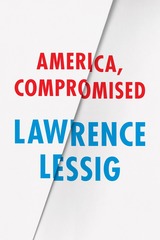
So begins Lawrence Lessig's sweeping indictment of contemporary American institutions and the corruption that besets them. We can all see it—from the selling of Congress to special interests to the corporate capture of the academy. Something is wrong. It’s getting worse.
And it’s our fault. What Lessig shows, brilliantly and persuasively, is that we can’t blame the problems of contemporary American life on bad people, as our discourse all too often tends to do. Rather, he explains, “We have allowed core institutions of America’s economic, social, and political life to become corrupted. Not by evil souls, but by good souls. Not through crime, but through compromise.” Every one of us, every day, making the modest compromises that seem necessary to keep moving along, is contributing to the rot at the core of American civic life. Through case studies of Congress, finance, the academy, the media, and the law, Lessig shows how institutions are drawn away from higher purposes and toward money, power, quick rewards—the first steps to corruption.
Lessig knows that a charge so broad should not be levied lightly, and that our instinct will be to resist it. So he brings copious, damning detail gleaned from years of research, building a case that is all but incontrovertible: America is on the wrong path. If we don’t acknowledge our own part in that, and act now to change it, we will hand our children a less perfect union than we were given. It will be a long struggle. This book represents the first steps.
Travel gets us from one place to another—often with wonderful attendant enjoyment–but exploration makes us understand our travel, the places we travel to—and ourselves. The essays in this collection constitute a major step toward this understanding. They open up new areas for concern and draw many valuable insights and conclusions.

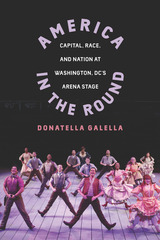
Washington D.C.’s Arena Stage was the first professional regional theatre in the nation’s capital to welcome a racially integrated audience; the first to perform behind the Iron Curtain; and the first to win the Tony Award for best regional theatre. This behind-the-scenes look at one of the leading theatres in the United States shows how key financial and artistic decisions were made, using a range of archival materials such as letters and photographs as well as interviews with artists and administrators. Close-ups of major productions from The Great White Hope to Oklahoma! illustrate how Arena Stage navigated cultural trends.
More than a chronicle, America in the Round is a critical history that reveals how far the theatre could go with its budget and racially liberal politics, and how Arena both disputed and duplicated systems of power. With an innovative “in the round” approach, the narrative simulates sitting in different parts of the arena space to see the theatre through different lenses—economics, racial dynamics, and American identity.
Recognizing the urgent need for students to understand the emergence of the United States' power and prestige in relation to world events, Gary W. Reichard and Ted Dickson reframe the teaching of American history in a global context. Each essay covers a specific chronological period and approaches fundamental topics and events in United States history from an international perspective, emphasizing how the development of the United States has always depended on its transactions with other nations for commodities, cultural values, and populations. For each historical period, the authors also provide practical guidance on bringing this international approach to the classroom, with suggested lesson plans and activities. Ranging from the colonial period to the civil rights era and everywhere in between, this collection will help prepare Americans for success in an era of global competition and collaboration.
Contributors are David Armitage, Stephen Aron, Edward L. Ayers, Thomas Bender, Stuart M. Blumin, J. D. Bowers, Orville Vernon Burton, Lawrence Charap, Jonathan Chu, Kathleen Dalton, Betty A. Dessants, Ted Dickson, Kevin Gaines, Fred Jordan, Melvyn P. Leffler, Louisa Bond Moffitt, Philip D. Morgan, Mark A. Noll, Gary W. Reichard, Daniel T. Rodgers, Leila J. Rupp, Brenda Santos, Gloria Sesso, Carole Shammas, Suzanne M. Sinke, Omar Valerio-Jimenez, Penny M. Von Eschen, Patrick Wolfe, and Pingchao Zhu.
With the rise of middlebrow institutions and readers came the need for the creation of the new category of authorship. Harker contends that these new writers appropriated and adapted a larger tradition of women's activism and literary activity to their own needs and practices. Like sentimental women writers and readers of the 1850s, these authors saw fiction as a means of reforming and transforming society. Like their Progressive Era forebears, they replaced religious icons with nationalistic images of progress and pragmatic ideology. In the interwar period, this mode of authorship was informed by Deweyan pragmatist aesthetics, which insisted that art provided vicarious experience that could help create humane, democratic societies.
Drawing on letters from publishers, editors, agents, and authors, America the Middlebrow traces four key moments in this distinctive culture of letters through the careers of Dorothy Canfield, Jessie Fauset, Pearl Buck, and Josephine Herbst. Both an exploration of a virtually invisible culture of letters and a challenge to monolithic paradigms of modernism, the book offers fresh insight into the ongoing tradition of political domestic fiction that flourished between the wars.
Authors Silver and Miller demonstrate the complexity and diversity of these languages while dispelling popular misconceptions. Their text reveals the linguistic richness of languages found throughout the Americas, emphasizing those located in the western United States and Mexico, while drawing on a wide range of other examples found from Canada to the Andes. It introduces readers to such varied aspects of communicating as directionals and counting systems, storytelling, expressive speech, Mexican Kickapoo whistle speech, and Plains sign language.
The authors have included basics of grammar and historical linguistics, while emphasizing such issues as speech genres and other sociolinguistic issues and the relation between language and worldview. They have incorporated a variety of data that have rarely or never received attention in nontechnical literature in order to underscore the linguistic diversity of the Americas, and have provided more extensive language classification lists than are found in most other texts.
American Indian Languages: Cultural and Social Contexts is a comprehensive resource that will serve as a text in undergraduate and lower-level graduate courses on Native American languages and provide a useful reference for students of American Indian literature or general linguistics. It also introduces general readers interested in Native Americans to the amazing diversity and richness of indigenous American languages.
Coverage includes:
Achumawi, Acoma, Algonquin, Apache, Araucanian, Arawakan, Athapascan, Atsugewi, Ayamara, Bacairi, Bella Coola, Beothuk, Biloxi, Blackfoot, Caddoan, Cahto, Cahuilla, Cakchiquel, Carib, Cayuga, Chemehuevi, Cherokee, Chibchan, Chichimec, Chimakuan, Chimariko, Chinook, Chipewyan, Choctaw-Chickasaw, Chol, Cocopa, Coeur d'Alene, Comanche, Coos, Cora, Cree, Creek, Crow, Cubeo, Cupeño, Dakota, Delaware, Diegueño, Eskimo-Aleut, Esselen, Eyak, Fox, Gros Ventre, Guaraní, Guarijío, Haida, Havasupai, Hill Patwin, Hopi, Huastec, Huave, Hupa, Inuit-Inupiaq, Iroquois, Jaqaru, Je, Jicaque, Kalapuyan, Kamia, Karankawas, Karuk, Kashaya, Keres, Kickapoo, Kiliwa, Kiowa-Tanoan, Koasati, Konkow, Kuna, Kwakiutl, Kwalhioqua-Tlatskanai, Lakota, Lenca, Luiseño, Maidu, Mapuche, Markoosie, Mayan, Mazahua, Mazatec, Métis, Mexica, Micmac, Misumalpan, Mitchif, Miwok, Mixe-Zoquean, Mixtec, Mobilian, Mohave, Mohawk, Muskogean, Nahuatl, Natchez, Navajo, Nez Perce, Nheengatú, Nicola, Nomlaki, Nootka, Ojibwa, Oneida, O'odham, Otomí, Paiute, Palaihnihan, Panamint, Panoan, Paya, Pima, Pipil, Pomo, Poplocan, Pueblo, Puquina, Purpecha, Quechua, Quiché, Quileute, Sahaptian, Salish, Seneca, Sequoyah, Seri, Serrano, Shasta, Shoshoni, Sioux, Sirenikski, Slavey, Subtiaba-Tlapanec, Taíno, Takelma, Tanaina, Tarahumara, Tequistlatecan, Tewa, Tlingit, Toba, Toltec, Totonac, Tsimshian, Tubatulabal, Tukano, Tunica, Tupí, Ute, Uto-Aztecan, Vaupés, Venture¤o, Wakashan, Walapai, Wappo, Washo, Wintu, Wiyot, Xinca, Yahi, Yana, Yokuts, Yucatec, Yuchi, Yuki, Yuma, Yurok, Zapotec, Zoquean, and Zuni.
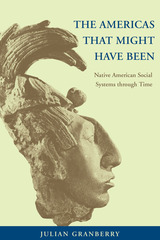
This work answers the hypothetical question: What would the Americas be like today—politically, economically, culturally—if Columbus and the Europeans had never found them, and how would American peoples interact with the world’s other societies? It assumes that Columbus did not embark from Spain in 1492 and that no Europeans found or settled the New World afterward, leaving the peoples of the two American continents free to follow the natural course of their Native lives.
The Americas That Might Have Been is a professional but layman-accessible, fact-based, nonfiction account of the major Native American political states that were thriving in the New World in 1492. Granberry considers a contemporary New World in which the glories of Aztec Mexico, Maya Middle America, and Inca Peru survived intact. He imagines the roles that the Iroquois Confederacy of the American Northeast, the powerful city-states along the Mississippi River in the Midwest and Southeast, the Navajo Nation and the Pueblo culture of the Southwest, the Eskimo Nation in the Far North, and the Taino/Arawak chiefdoms of the Caribbean would play in American and world politics in the 21st Century.
Following a critical examination of the data using empirical archaeology, linguistics, and ethnohistory, Granberry presents a reasoned and compelling discussion of native cultures and the paths they would have logically taken over the past five centuries. He reveals the spectacular futures these brilliant pre-Columbian societies might have had, if not for one epochal meeting that set off a chain of events so overwhelming to them that the course of human history was forever changed.
This latest title in a strikingly beautiful series of collectable books turns our attention to the rich variety of art from the Ancient Americas. We gain fascinating insights into the design and production of a wide range of objects from Mexico and Central and South America. Enlarged details chosen to inspire, illuminate, and surprise bring us close to the world of the Olmecs, Mayans, Mixtecs, Aztecs, and Incans.
Beginning by asking what constitutes Ancient American art, Colin McEwan contextualizes this art in its complexity of form and meaning. The close-ups provide the reader with insights that even a behind-the-scenes museum tour cannot offer. As we move across a range of cultures and media, we understand larger issues within which these works of art are embedded: What is the relationship between art and nature in the Ancient Americas? How were these objects used in ritual and religious practices? What is the role of masks? How do the practices of ancestor deification, sacrifice, and rituals related to fertility and procreation shape the visual and material culture of the Ancient Americas?
Jade, turquoise, featherwork, metalwork, wood, stone, ceramics, textiles, and illustrations—each beautifully photographed object is part of the extraordinary Ancient American collection of the British Museum. The beauty of the smallest details is magnified and contextualized through accompanying essays written by experts in Ancient American art.
Several different cultures-Iroquois, Coosa, Anasazi, Hohokam, San Agustín, Wankarani, Formative Gulf Coast Mexico, and Formative, Classic, Colonial, and contemporary Maya-are analyzed through the lens of household archaeology in concrete, data-driven case studies. The text is divided into three sections: Section I examines the spatial and social organization and context of household production; Section II looks at the role and results of households as primary producers; and Section III investigates the role of, and interplay among, households in their greater political and socioeconomic communities.
In the past few decades, household archaeology has made substantial contributions to our understanding and explanation of the past through the documentation of the household as a social unit-whether small or large, rural or urban, commoner or elite. These case studies from a broad swath of the Americas make Ancient Households of the Americas extremely valuable for continuing the comparative interdisciplinary study of households.
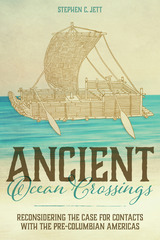
In Ancient Ocean Crossings: Reconsidering the Case for Contacts with the Pre-Columbian Americas, Stephen Jett encourages readers to reevaluate the common belief that there was no significant interchange between the chiefdoms and civilizations of Eurasia and Africa and peoples who occupied the alleged terra incognita beyond the great oceans.
More than a hundred centuries separate the time that Ice Age hunters are conventionally thought to have crossed a land bridge from Asia into North America and the arrival of Columbus in the Bahamas in 1492. Traditional belief has long held that earth’s two hemispheres were essentially cut off from one another as a result of the post-Pleistocene meltwater-fed rising oceans that covered that bridge. The oceans, along with arctic climates and daunting terrestrial distances, formed impermeable barriers to interhemispheric communication. This viewpoint implies that the cultures of the Old World and those of the Americas developed independently.
Drawing on abundant and concrete evidence to support his theory for significant pre-Columbian contacts, Jett suggests that many ancient peoples had both the seafaring capabilities and the motives to cross the oceans and, in fact, did so repeatedly and with great impact. His deep and broad work synthesizes information and ideas from archaeology, geography, linguistics, climatology, oceanography, ethnobotany, genetics, medicine, and the history of navigation and seafaring, making an innovative and persuasive multidisciplinary case for a new understanding of human societies and their diffuse but interconnected development.
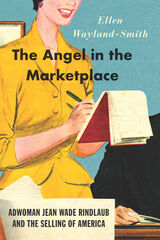
The Angel in the Marketplace is the story of one of America’s most accomplished advertising executives. It is also the story of how advertisers like Rindlaub sold a postwar American dream of capitalism and a Christian corporate order. Rindlaub was responsible for award-winning, mega sales-generating advertisements for all things domestic, including Oneida silverware, Betty Crocker cake mix, Campbell’s soup, and Chiquita bananas. Her success largely came from embracing, rather than subverting, the cultural expectations of women. She believed her responsibility as an advertiser was not to spring women from their trap, but to make that trap more comfortable.
Rindlaub wasn’t just selling silverware and cakes; she was selling the virtues of free enterprise. By following the arc of Rindlaub’s career from the 1920s through the 1960s, we witness how a range of cultural narratives—advertising chief among them—worked powerfully to shape women’s emotional and economic behavior in support of the free market system. Alongside Rindlaub’s story, Ellen Wayland-Smith provides a riveting history of how women were repeatedly sold the idea that their role as housewives was more powerful, and more patriotic, than any outside the home. And by buying into the image of morality through an unregulated market, many of these women helped fuel backlash against economic regulation and socialization efforts throughout the twentieth century.
The Angel in the Marketplace is a nuanced portrayal of a complex woman, one who both shaped and reflected the complicated cultural, political, and religious forces defining femininity in America at mid-century. This compelling account of one of advertising’s most fervent believers is a tale of a Mad Woman we haven’t been told.
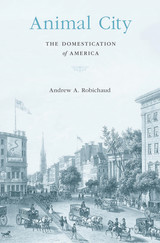
Why do America’s cities look the way they do? If we want to know the answer, we should start by looking at our relationship with animals.
Americans once lived alongside animals. They raised them, worked them, ate them, and lived off their products. This was true not just in rural areas but also in cities, which were crowded with livestock and beasts of burden. But as urban areas grew in the nineteenth century, these relationships changed. Slaughterhouses, dairies, and hog ranches receded into suburbs and hinterlands. Milk and meat increasingly came from stores, while the family cow and pig gave way to the household pet. This great shift, Andrew Robichaud reveals, transformed people’s relationships with animals and nature and radically altered ideas about what it means to be human.
As Animal City illustrates, these transformations in human and animal lives were not inevitable results of population growth but rather followed decades of social and political struggles. City officials sought to control urban animal populations and developed sweeping regulatory powers that ushered in new forms of urban life. Societies for the Prevention of Cruelty to Animals worked to enhance certain animals’ moral standing in law and culture, in turn inspiring new child welfare laws and spurring other wide-ranging reforms.
The animal city is still with us today. The urban landscapes we inhabit are products of the transformations of the nineteenth century. From urban development to environmental inequality, our cities still bear the scars of the domestication of urban America.
In Animation and America, Paul Wells looks afresh at this unique art, discussing the distinctiveness of the cartoon form, as well as myriad other types of animation production. Insisting upon the "modernity" of the genre, Wells examines its importance as a barometer of the social conditions in which it is made and which it reflects. This book is not a standard history of animation in America, but rather uses animation as a way of discussing social and political change. Wells concentrates on the ways in which the form continues to grow, experiment, and remain subversiveand, increasingly, gaining acclaim and recognition. Now in the vanguard of visual culture, animation occupies an important position in representing both the outcomes and impacts of new technologies, and it also has laid the foundations for a new understanding of social and artistic practice.
Contributors. Joost de Bloois, Jodi A. Byrd, Gustavo Esteva, Silvia Federici, Wilson Kaiser, Mara Kaufman, Frans-Willem Korsten, Federico Luisetti, Sandro Mezzadra, Walter D. Mignolo, Benjamin Noys, John Pickles, Alvaro Reyes, Catherine Walsh, Gareth Williams, Zac Zimmer
Separating historical reality from myth, Daniel Castro provides a nuanced, revisionist assessment of the friar’s career, writings, and political activities. Castro argues that Las Casas was very much an imperialist. Intent on converting the Indians to Christianity, the religion of the colonizers, Las Casas simply offered the natives another face of empire: a paternalistic, ecclesiastical imperialism. Castro contends that while the friar was a skilled political manipulator, influential at what was arguably the world’s most powerful sixteenth-century imperial court, his advocacy on behalf of the natives had little impact on their lives. Analyzing Las Casas’s extensive writings, Castro points out that in his many years in the Americas, Las Casas spent very little time among the indigenous people he professed to love, and he made virtually no effort to learn their languages. He saw himself as an emissary from a superior culture with a divine mandate to impose a set of ideas and beliefs on the colonized. He differed from his compatriots primarily in his antipathy to violence as the means for achieving conversion.
In this volume, editor Michael Suleiman brings together 21 prominent scholars from a wide range of perspectives -- including anthropology, economics, history, law, literature and culture, political science, and sociology -- to take a close look at the status of Arabs in North America. Topics range from the career of Arab American singer, dancer, and storyteller Wadeeha Atiyeh to a historical examination of Arab Americans and Zionism. The contributors discuss in Detroit, a group of well-educated Jordanian men, and the Shi'a Muslims -- to illustrate the range of Arab emigre experience. More broadly, they examine Arab American identity, political activism, and attempts by Arab immigrants to achieve respect and recognition in their new homes. They address both the present situation for Arab Americans and prospects for their future.
Arabs in America will engage anyone interested in Arab American studies, ethnic studies, and American studies.
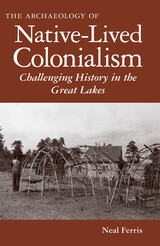
In reconsidering Native adaptation and resistance to colonial British rule, Ferris reviews five centuries of interaction that are usually read as a single event viewed through the lens of historical bias. He first examines patterns of traditional lifeway continuity among the Ojibwa, demonstrating their ability to maintain seasonal mobility up to the mid-nineteenth century and their adaptive response to its loss. He then looks at the experience of refugee Delawares, who settled among the Ojibwa as a missionary-sponsored community yet managed to maintain an identity distinct from missionary influences. And he shows how the archaeological history of the Six Nations Iroquois reflected patterns of negotiating emergent colonialism when they returned to the region in the 1780s, exploring how families managed tradition and the contemporary colonial world to develop innovative ways of revising and maintaining identity.
The Archaeology of Native-Lived Colonialism convincingly utilizes historical archaeology to link the Native experience of the eighteenth and nineteenth centuries to the deeper history of sixteenth- and seventeenth-century interactions and with pre-European times. It shows how these Native communities succeeded in retaining cohesiveness through centuries of foreign influence and material innovations by maintaining ancient, adaptive social processes that both incorporated European ideas and reinforced historically understood notions of self and community.
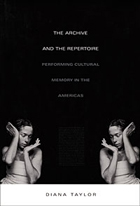
Examining various genres of performance including demonstrations by the children of the disappeared in Argentina, the Peruvian theatre group Yuyachkani, and televised astrological readings by Univision personality Walter Mercado, Taylor explores how the archive and the repertoire work together to make political claims, transmit traumatic memory, and forge a new sense of cultural identity. Through her consideration of performances such as Coco Fusco and Guillermo Gómez-Peña’s show Two Undiscovered Amerindians Visit . . . , Taylor illuminates how scenarios of discovery and conquest haunt the Americas, trapping even those who attempt to dismantle them. Meditating on events like those of September 11, 2001 and media representations of them, she examines both the crucial role of performance in contemporary culture and her own role as witness to and participant in hemispheric dramas. The Archive and the Repertoire is a compelling demonstration of the many ways that the study of performance enables a deeper understanding of the past and present, of ourselves and others.
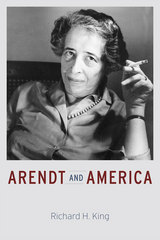
Situating Arendt within the context of U.S. intellectual, political, and social history, King reveals how Arendt developed a fascination with the political thought of the Founding Fathers. King also re-creates her intellectual exchanges with American friends and colleagues, such as Dwight Macdonald and Mary McCarthy, and shows how her lively correspondence with sociologist David Riesman helped her understand modern American culture and society. In the last section of Arendt and America, King sets out the context in which the Eichmann controversy took place and follows the debate about “the banality of evil” that has continued ever since. As King shows, Arendt’s work, regardless of focus, was shaped by postwar American thought, culture, and politics, including the Civil Rights Movement and the Cold War.
For Arendt, the United States was much more than a refuge from Nazi Germany; it was a stimulus to rethink the political, ethical, and historical traditions of human culture. This authoritative combination of intellectual history and biography offers a unique approach for thinking about the influence of America on Arendt’s ideas and also the effect of her ideas on American thought.
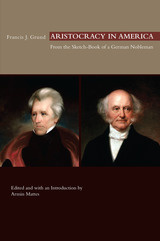
Francis J. Grund, a German emigrant, was one of the most influential journalists in America in the three decades preceding the Civil War. He also wrote several books, including this fictional, satiric travel memoir in response to Alexis de Tocqueville’s famous Democracy in America. Armin Mattes provides a thorough account of Grund’s dynamic engagement in American political life, and brings to light many of Grund’s reflections on American social and political life previously published only in German. Mattes shows how Grund’s work can expand our understanding of the emerging democratic political culture and society in the antebellum United States.
In this book, Jasper Neel’s sure-to-be-controversial resituating of Aristotle centers around three questions that have been constants in his twenty-two years of teaching experience: What does itmean to teach writing? What should one know before teaching writing? And, if there is such a thing as "research in the teaching of writing," what is it?
Believing that all composition teachers are situated politically and socially, both as part of the institution in which they teach and as beings with lived histories, Neel examines his own life and the life of composition studies as a discipline in the context of Aristotle. Neel first situates the Rhetoric as a political document; he then situates the Rhetoric in the Aristotelian system and describes how professional discourse came to know itself through Aristotle’s way of studying the world; finally, he examines the operation of the Rhetoric inside itself before arguing the need to turn to Aristotle’s notion of sophistry as a way of negating his system.
By pointing out the connections among Aristotelian rhetoric, the contemporary university, and the contemporary writing teacher, Neel shows that Aristotle’s frightening social theories are as alive today as are Aristotelian notions of discourse.
Neel explains that by their very nature teachers must speak with a professional voice. It is through showing how to "hear" one’s professional voice that Neel explores the notion of professional discourse that originates with Aristotle. In maintaining that one must pay a high price in order to speak through Aristotle’s theory or to assume the role of "professional," he argues that no neutral ground exists either for pedagogy or for the analysis of pedagogy. Neel concludes this discussion by proposing that Aristotelian sophistry is both an antidote to Aristotelian racism, sexism, and bigotry and a way of allowing Aristotelian categories of discourse to remain useful.
Finally, as an Aristotelian, a teacher, and a writer, Neel responds both to Aristotle and to professionalism by rethinking the influence of the past and reviving the voice of Aristotelian sophistry.
By focusing on the provincial tales as they were originally conceived--as a narrative cycle--Thompson is able to recover intertextual references that reveal Hawthorne's preoccupation with framing strategies and variations on authorial presence. The author shows how Hawthorne deliberately constructs sentimental narratives, only to deconstruct them. Thompson's analysis provides a new aesthetic context for understanding the whole shape of Hawthorne's career as well as the narrative, ethical, and historical issues within individual works.
Revisionary in its view of one of America's greatest authors, The Art of Authorial Presence also offers invaluable insight into the problems of narratology and historiography, ethics and psychology, romanticism and idealism, and the cultural myths of America.
Arthur Miller's America collects new writing by leading international critics and scholars that considers the dramatic world of icon, activist, and playwright Arthur Miller's theater as it reflects the changing moral equations of his time. Written on the occasion of Miller's 85th year, the original essays and interviews in Arthur Miller's America treat the breadth of Miller's work, including his early political writings for the campus newspaper at the University of Michigan, his famous work with John Huston, Clark Gable and Marilyn Monroe on The Misfits, and his signature plays like Death of a Salesman and All My Sons.

At the Moon’s Inn, first published in 1941, provides a fictional account of De Soto’s famous Spanish expedition to La Florida and through the southeastern United States between 1539 and 1543. The novel begins in Spain in 1538, where De Soto and his chief lieutenants, veterans of the campaigns in South America, pledge themselves to a new enterprise to explore and exploit La Florida. The narrative follows them on their voyage to Cuba, where they rest and obtain additional supplies, then set sail for the area now known as Tampa Bay. Lytle’s brilliant historical novel takes the readers with the conquistadores through the hot, humid land, where despite their advantage in military technology they found they must rely on the Indians for food. The author explores the cultural confrontation that seriously weakened the Indians, while the Spaniards’ dreams of gold gradually turned to hopes of survival in the hostile environment.
Drawing his facts from the 1939 United States De Soto Commission Report and from the surviving historical chronicles of the expedition, Lytle weaves a fascinating tale that brings to life the history of Spanish efforts to establish a controlling presence in the New World during the first half of the 16th century.
In his introduction, Douglas Jones places At the Moon’s Inn within the context of the documentary record, as well as within the framework of its distinguished author’s career.
In this book, historian Thomas H. O'Connor sets the matter straight by showing that Boston's eminence during the first half of the nineteenth century was the result of a much broader community effort. After the nation emerged from its successful struggle for independence, most Bostonians visualized their city not only as the Cradle of Liberty, but also as the new world's Cradle of Civilization.
According to O'Connor, a leadership elite, composed of men of prominent family background, Unitarian beliefs, liberal education, and managerial experience in a variety of enterprises, used their personal talents and substantial financial resources to promote the cultural, intellectual, and humanitarian interests of Boston to the point where it would be the envy of the nation. Not only did writers, scholars, and philosophers see themselves as part of this process, but so did physicians and lawyers, ministers and teachers, merchants and businessmen, mechanics and artisans, all involved in creating a well-ordered city whose citizens would be committed to the ideals of social progress and personal perfectibility.
To accomplish their noble vision, leading members of the Boston community joined in programs designed to cleanse the old town of what they felt were generations of accumulated social stains and human failures, and then to create new programs and more efficient institutions that would raise the cultural and intellectual standards of all its citizens. Like ancient Athens, Boston would be a city of great statesmen, wealthy patrons, inspiring artists, and profound thinkers, headed by members of the "happy and respectable classes" who would assume responsibility for the safety, welfare, and education of the "less prosperous portions of the community."
Designed for the general reader and the historical enthusiast, The Athens of America is an interpretive synthesis that explores the numerous secondary sources that have concentrated on individual subjects and personalities, and draws their various conclusions into a single comprehensive narrative.
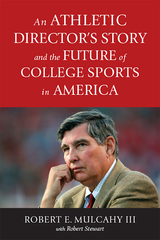
His words and actions were prominent during a nationally-reported incident involving student athletes. When the Rutgers Women’s Basketball team players were slandered by racist remarks from a popular radio talk show host, Mulcahy met it head on. With the coach and players, he set an inspiring example for defending character and values.
Though Mr. Mulcahy left Rutgers in 2009, his memoir reflects continued devotion to intercollegiate athletics and student athletes. His insights for addressing several leading issues confronting Division I sports today offer guidelines for present and future athletic directors to follow.
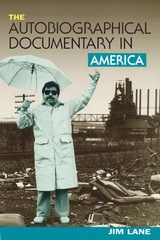
Since the late 1960s, American film and video makers of all genres have been fascinated with themes of self and identity. Though the documentary form is most often used to capture the lives of others, Jim Lane turns his lens on those media makers who document their own lives and identities. He looks at the ways in which autobiographical documentaries—including Roger and Me, Sherman’s March, and Silverlake Life—raise weighty questions about American cultural life. What is the role of women in society? What does it mean to die from AIDS? How do race and class play out in our personal lives? What does it mean to be a member of a family? Examining the history, diversity, and theoretical underpinnings of this increasingly popular documentary form, Lane tracks a fundamental transformation of notions of both autobiography and documentary.
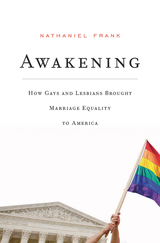
The right of same-sex couples to marry provoked decades of intense conflict before it was upheld by the U.S. Supreme Court in 2015. Yet some of the most divisive contests shaping the quest for marriage equality occurred not on the culture-war front lines but within the ranks of LGBTQ advocates. Nathaniel Frank tells the dramatic story of how an idea that once seemed unfathomable—and for many gays and lesbians undesirable—became a legal and moral right in just half a century.
Awakening begins in the 1950s, when millions of gays and lesbians were afraid to come out, let alone fight for equality. Across the social upheavals of the next two decades, a gay rights movement emerged with the rising awareness of the equal dignity of same-sex love. A cadre of LGBTQ lawyers soon began to focus on legal recognition for same-sex couples, if not yet on marriage itself. It was only after being pushed by a small set of committed lawyers and grassroots activists that established movement groups created a successful strategy to win marriage in the courts.
Marriage equality proponents then had to win over members of their own LGBTQ community who declined to make marriage a priority, while seeking to rein in others who charged ahead heedless of their carefully laid plans. All the while, they had to fight against virulent antigay opponents and capture the American center by spreading the simple message that love is love, ultimately propelling the LGBTQ community—and America—immeasurably closer to justice.
READERS
Browse our collection.
PUBLISHERS
See BiblioVault's publisher services.
STUDENT SERVICES
Files for college accessibility offices.
RECENTLY PUBLISHED




UChicago Accessibility Resources
home | accessibility | search | about | contact us
BiblioVault ® 2001 - 2025
The University of Chicago Press