
 A SCHOLARLY BOOK REPOSITORY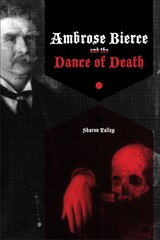
Ambrose Bierce and the Dance of Death uses psychoanalytic theory in combination with historical, cultural, and literary contexts to examine the complex motif of death in a full range of Bierce’s writings. Scholarly interest in Bierce, whose work has long been undervalued, has grown significantly in recent years. This new book contributes to the ongoing reassessment by providing new contexts for joining the texts in his canon in meaningful ways.
Previous attempts to consider Bierce from a psychological perspective have been superficial, often reductive Freudian readings of individual stories such as “An Occurrence at Owl Creek Bridge” and “The Death of Halpin Frayser.” This new volume not only updates these interpretations with insights from post-Freudian theorists but uses contemporary death theory as a framework to analyze the sources and expressions of Bierce’s attitudes about death and dying. This approach makes it possible to discern links among texts that resolve some of the still puzzling ambiguities that have—until now—precluded a fuller understanding of both the man and his writings.
Lively and engaging, Ambrose Bierce and the Dance of Death adds valuable new insights not only to the study of Bierce but to that of nineteenth-century American literature in general.
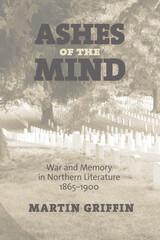
In Ashes of the Mind, Martin Griffin examines the work of five Northerners—three poets and two fiction writers—who over a period of four decades tried to understand and articulate the landscape of memory in postwar America, and in particular in that part of the nation that could, with most justification, claim the victory of its beliefs and values. The book begins with an examination of the rhetorical grandeur of James Russell Lowell's Harvard Commemoration Ode, ranges across Herman Melville's ironic war poetry, Henry James's novel of North-South reconciliation, The Bostonians, and Ambrose Bierce's short stories, and ends with the bitter meditation on race and nation presented by Paul Laurence Dunbar's elegy "Robert Gould Shaw." Together these texts reveal how a group of representative Northern writers were haunted in different ways by the memory of the
conflict and its fraught legacy.
Griffin traces a concern with individual and community loss, ambivalence toward victory, and a changing politics of commemoration in the writings of Lowell, Melville, James, Bierce, and Dunbar. What links these very different authors is a Northern memory of the war that became more complex and more compromised as the century went on, often replacing a sense of justification and achievement with a perception of irony and failed promise.

A contemporary of Mark Twain, Bierce brought his biting humor to bear on spoof definitions of everyday words, writing deliberate mistranslations of the vocabulary of the establishment, the church, and the politics of his day, and shining a sardonic light on hypocrisy and deception. These columns formed the beginnings of a dictionary, first published in 1906 as The Cynic’s Word Book, which stopped at the letter L, and five years later as a full A–Z text known as The Devil's Dictionary. More than one hundred years later, Bierce’s redefinitions still give us pause for thought: interpreting reporter, for example, as “a writer who guesses his way to the truth and dispels it with a tempest of words”; un-american as “wicked, intolerable, heathenish”; and politics as “the conduct of public affairs for private advantage.” This timely new edition of Bierce’s irreverent and provocative dictionary is the perfect gift for misanthropes and word lovers alike.
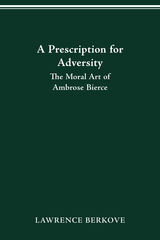
A Prescription for Adversity makes the revolutionary case that Ambrose Bierce, far from being a bitter misanthrope, was instead both a compassionate and moral author. Berkove, focusing on Bierce's short fiction, establishes the necessity of recognizing the pattern of his intellectual and literary development over the course of his career. The author shows that Bierce, probably the American author with the most extensive experience of the Civil War, turned to classical Stoicism and English and French Enlightenment literature in his postwar search for meaning. Bierce's fiction arose from his ultimately unsatisfying encounters with the philosophies those sources offered, but the moral commitment as well as the literary techniques of heir authors, particularly Jonathan Swift, inspired him. Dating Bierce's fiction, and introducing uncollected journalism, correspondence, and important new literary history and biographical information, Berkove brings new insights to a number of stories, including "A Son of the Gods" and "A Horseman in the Sky," but especially "An Occurrence at Owl Creek Bridge," and presents compelling readings of the Parenticide Club tales and "Moxon's Master." A Prescription for Adversity substantiates how Bierce at his best is one of the few American authors who rises to the level of Mark Twain, and the only one who touches Jonathan Swift.
A work of both biography and literary criticism, this book rescues Ambrose Bierce and his literature from the neglect to which it has been assigned by "ill-founded, obtuse and unproductive approaches based on skewed notions of his personality and forced or facile readings of individual stories."
READERS
Browse our collection.
PUBLISHERS
See BiblioVault's publisher services.
STUDENT SERVICES
Files for college accessibility offices.
RECENTLY PUBLISHED




UChicago Accessibility Resources
home | accessibility | search | about | contact us
BiblioVault ® 2001 - 2024
The University of Chicago Press