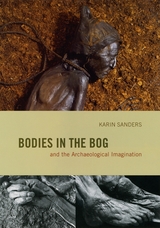
front cover of Bodies in the Bog and the Archaeological Imagination
Bodies in the Bog and the Archaeological Imagination
Karin Sanders
University of Chicago Press, 2009
Over the past few centuries, northern Europe’s bogs have yielded mummified men, women, and children who were deposited there as sacrifices in the early Iron Age and kept startlingly intact by the chemical properties of peat. In this remarkable account of their modern afterlives, Karin Sanders argues that the discovery of bog bodies began an extraordinary—and ongoing—cultural journey. 
           Throughout the nineteenth and twentieth centuries, Sanders shows, these eerily preserved remains came alive in art and science as material metaphors for such concepts as trauma, nostalgia, and identity. Sigmund Freud, Joseph Beuys, Seamus Heaney, and other major figures have used them to reconsider fundamental philosophical, literary, aesthetic, and scientific concerns. Exploring this intellectual spectrum, Sanders contends that the power of bog bodies to provoke such a wide range of responses is rooted in their unique status as both archeological artifacts and human beings. They emerge as corporeal time capsules that transcend archaeology to challenge our assumptions about what we can know about the past. By restoring them to the roster of cultural phenomena that force us to confront our ethical and aesthetic boundaries, Bodies in the Bog excavates anew the question of what it means to be human.

[more]

front cover of Iron in the Pines
Iron in the Pines
The Story of New Jersey's Ghost Towns and Bog Iron
Pierce, Arthur
Rutgers University Press, 1966
Deep in the heart of southern New Jersey lies an area of some 96,000 acres of sprawling wilderness. It is the famous Wharton Tract which the state of New Jersey purchased in 1954 for a watershed, game preserve, and park. Many people know and love these wooded acres. Each year, people by the thousands visit Batsto Village, once the center of the iron industry that thrived on the tract more than a century ago.

With warmth and accuracy, Arthur D. Pierce tells the story of the years when iron was king, and around it rose a rustic feudal economy. There were glass factories, paper mills, cotton mills, and brickmaking establishments. Here, too, were men who made those years exciting: Benedict Arnold and his first step toward treason; Charles Read, who dreamed of an empire and died in exile; Revolutionary heroes and heroines, privateers, and rogues. The author's vivid pictures of day-to-day life in the old iron communities are based upon careful research. This book proves that the human drama of documented history belies any notion that fiction is stranger than truth.

[more]


Send via email Share on Facebook Share on Twitter