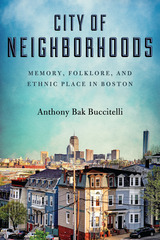
East Boston has long been known as an Italian neighborhood and Southie as an Irish one, while nearby North Quincy has seen in recent decades an influx of Chinese Americans and immigrants. Such urban spaces in America can become intimately intertwined with ethnic identities (Little Italy, Greektown, Chinatown, Little Havana). Yet local residents often readily acknowledge an underlying diversity—both historically and as a result of more recent changes—that complicates such stereotypes.
Digging into the ever-shifting terrain of American ethnicity and urban spaces, Anthony Bak Buccitelli investigates folk practices, social memory, and local histories in three Boston-area neighborhoods. He looks at the ways locals represent their neighborhoods and themselves via events, symbols, stories, and landmarks, from the shamrock to the Chinese flag, whether the St. Patrick’s Day parade in Southie or the Columbus Day parade in East Boston, from urban graffiti and websites to the Dorchester Heights Monument. City of Neighborhoods exposes the processes of selection and emphasis that produce, sustain, challenge, and change understandings of urban spaces as ethnic places.
Honorable mention, Wayland Hand Prize for Folklore and History, American Folklore Society