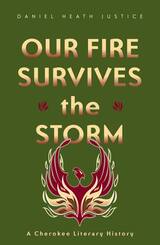
front cover of Our Fire Survives the Storm
Our Fire Survives the Storm
A Cherokee Literary History
Daniel Heath Justice
University of Minnesota Press, 2006
Once the most powerful indigenous nation in the southeastern United States, the Cherokees survive and thrive as a people nearly two centuries after the Trail of Tears and a hundred years after the allotment of Indian Territory. In Our Fire Survives the Storm, Daniel Heath Justice traces the expression of Cherokee identity in that nation’s literary tradition. 

Through cycles of war and peace, resistance and assimilation, trauma and regeneration, Cherokees have long debated what it means to be Cherokee through protest writings, memoirs, fiction, and retellings of traditional stories. Justice employs the Chickamauga consciousness of resistance and Beloved Path of engagement—theoretical approaches that have emerged out of Cherokee social history—to interpret diverse texts composed in English, a language embraced by many as a tool of both access and defiance. 

Justice’s analysis ultimately locates the Cherokees as a people of many perspectives, many bloods, mingled into a collective sense of nationhood. Just as the oral traditions of the Cherokee people reflect the living realities and concerns of those who share them, Justice concludes, so too is their literary tradition a textual testament to Cherokee endurance and vitality. 

Daniel Heath Justice is assistant professor of aboriginal literatures at the University of Toronto.
[more]

front cover of Speculative Relations
Speculative Relations
Indigenous Worlding and Repair
Joseph M. Pierce
Duke University Press, 2025
Indigenous relations are often described in anthropological terms, or as expressions of timeless, unchanging kinship ties. In Speculative Relations, Joseph M. Pierce challenges this view, considering the potential of these relations as a means of repairing the damages of history. Pierce approaches Indigenous art and culture not as objects of study, but through relations committed to reciprocity and care for human and more-than-human beings. Drawing on Cherokee thinking, Indigenous queer theory, literary and cultural studies, and art criticism, he illuminates pathways for understanding and resisting the ongoing damages of colonialism while pointing to future worlds and imaginaries that breathe life into Indigenous thought and practice. Analyzing a range of materials—from photography, literature, and sculpture to film and ethnography—Pierce reveals how speculation, as a form of situated knowledge production, can repair and reimagine the worlds that colonialism sought to destroy. In doing so, Pierce highlights how gestures, poetics, and embodiment can uphold tradition and harness the imaginative power of speculation to create pathways for living in good relations.
[more]


Send via email Share on Facebook Share on Twitter