front cover of Albert Camus' Critique of Modernity
Albert Camus' Critique of Modernity
Ronald D. Srigley
University of Missouri Press, 2011
Nobel Prize winner Albert Camus’ contributions to political and cultural analysis make him one of the most important writers of the twentieth century. Camus’ writing has been heavily researched and analyzed in academia, with many scholars concentrating on the formal tri-part structure he adhered to in his later work: the cycle that divided his books into stages of the absurd, rebellion, and love. Yet other aspects of Camus’ work—his preoccupation with modernity and its association with Christianity, his fixations on Greek thought and classical imagery—have been largely neglected by critical study. These subjects of Camus’ have long deserved critical analysis, and Ronald D. Srigley finally pays them due attention in Albert Camus’ Critique of Modernity.

The straightforward, chronological readings of Camus’ cycles perceive them as simple advancement—the absurd is bad, rebellion is better, and love is best of all. Yet the difficulty with that perspective, Srigley argues, is that it ignores the relationships between the cycles. As the cycles progress, far from denoting improvement, they describe experiences that grow darker and more violent.

Albert Camus’ Critique of Modernity also ventures into new interpretations of seminal works—The Myth ofSisyphus, The Rebel, and The Fall—that illuminate Camus’ critique of Christianity and modernity and his return to the Greeks. The book explores how those texts relate to the cyclical structure of Camus’ works and examines the limitations of the project of the cycles as Camus originally conceived it.

Albert Camus’ Critique of Modernity presents the decisive vision of that ultimate project: to critique Christianity, modernity, and the relationship between them and also to restore the Greek wisdom that had been eclipsed by both traditions. In contrast to much current scholarship, which interprets Camus’ concerns as modern or even postmodern, Srigley contends that Camus’ ambition ran in the opposite direction of history—that his principal aim was to articulate the themes of the ancients, highlighting Greek anthropology and political philosophy.

This book follows the trajectory of Camus’ work, examining the structure and content of Camus’ writing through a new lens. This assessment of Camus, in its unique approach and perspective, opens up new avenues of research regarding the accomplishments of this prominent philosopher and invigorates Camus studies. A thoroughly sourced text, Albert Camus’ Critique of Modernity makes a valuable resource for study of existentialism, modernity, and modern political thought.
[more]

front cover of American Exceptionalism as Religion
American Exceptionalism as Religion
Postmodern Discontent
Jordan Carson
The Ohio State University Press, 2020
Jordan Carson’s American Exceptionalism as Religion looks at how American nationalist ideologies intersect with religious ones in contemporary literature. Carson traces out how an exceptionalist belief system began to emerge historically with a distorted picture of religious commitment. He then connects this trend to writers such as Don DeLillo, Ana Castillo, Thomas Pynchon, George Saunders, and Marilynne Robinson to argue that these authors dismantle the privatization of religion in their writing and then offer their own alternatives. Their work, he argues, redefines religion in terms of practice and discipline, gauging it by its power to ground and guide behavior, morality, and sociality.
 
As American exceptionalism resurfaces in public discourse, Carson’s timely work invites readers to reconsider the nexus of religion, politics, and culture. Carson argues that defining religion according to secularist criteria has insulated ostensibly secular ideologies as well as traditional religion from public scrutiny. DeLillo’s, Castillo’s, Pynchon’s, Saunders’s, and Robinson’s redefinitions of religion result in a better grasp of how individuals actually live out their religious lives. More importantly, these authors help erect a framework for constructively engaging American exceptionalism and the ideas that support it.
 
[more]

front cover of Between Human and Divine
Between Human and Divine
The Catholic Vision in Contemporary Literature
Mary Reichardt
Catholic University of America Press, 2010
Between Human and Divine is the first collection of scholarly essays published on a wide variety of contemporary (post 1980) Catholic literary works and artists. Its aim is to introduce readers to recent and emerging writers and texts in the tradition.
[more]

front cover of Chekhov and Russian Religious Culture
Chekhov and Russian Religious Culture
Poetics of the Marian Paradigm
Julie de Sherbinin
Northwestern University Press, 1997
Chekhov and Russian Religious Culture is an innovative study of the Virgin Mary and the "saintly harlots"–Mary of Egypt and Mary Magdalene–as a cultural paradigm encoded in Chekhov's prose. De Sherbinin establishes the authority of the Marian paradigm in nineteenth-century Russian culture with a comprehensive overview of salient religious and literary texts, then offers critical readings of more than fifteen Chekhov stories, including key works such as "Peasants," "Peasant Women," and "My Life." De Sherbinin argues that Chekhov inverts and displaces the Christian meanings of Marian texts in order to reveal a vast array of problematized relationships to the canonized figures. This illuminating semiotic reading of Chekhov explores questions of female identity as it probes the mindset of Russian Orthodox popular culture.
[more]

front cover of Christian Humanism in Shakespeare
Christian Humanism in Shakespeare
A Study in Religion and Literature
Lee Oser
Catholic University of America Press, 2022
Shakespeare, Lee Oser argues, is a Christian literary artist who criticizes and challenges Christians, but who does so on Christian grounds. Stressing Shakespeare’s theological sensitivity, Oser places Shakespeare’s work in the “radical middle,” the dialectical opening between the sacred and the secular where great writing can flourish. According to Oser, the radical middle was and remains a site of cultural originality, as expressed through mimetic works of art intended for a catholic (small “c”) audience. It describes the conceptual space where Shakespeare was free to engage theological questions, and where his Christian skepticism could serve his literary purposes. Oser reviews the rival cases for a Protestant Shakespeare and for a Catholic Shakespeare, but leaves the issue open, focusing, instead, on how Shakespeare exploits artistic resources that are specific to Christianity, including the classical-Christian rhetorical tradition. The scope of the book ranges from an introductory survey of the critical field as it now stands, to individual chapters on A Midsummer Night’s Dream, The Merchant of Venice, the Henriad, Hamlet, and King Lear. Writing with a deep sense of literary history, Oser holds that mainstream literary criticism has created a false picture of Shakespeare by secularizing him and misconstruing the nature of his art. Through careful study of the plays, Oser recovers a Shakespeare who is less vulnerable to the winds of academic and political fashion, and who is a friend to the enduring project of humanistic education. Christian Humanism in Shakespeare: A Study in Religion and Literature is both eminently readable and a work of consequence.
[more]

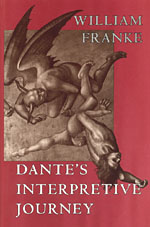
front cover of Dante's Interpretive Journey
Dante's Interpretive Journey
William Franke
University of Chicago Press, 1996
Critically engaging the thought of Heidegger, Gadamer, and others, William Franke contributes both to the criticism of Dante's Divine Comedy and to the theory of interpretation.

Reading the poem through the lens of hermeneutical theory, Franke focuses particularly on Dante's address to the reader as the site of a disclosure of truth. The event of the poem for its reader becomes potentially an experience of truth both human and divine. While contemporary criticism has concentrated on the historical character of Dante's poem, often insisting on it as undermining the poem's claims to transcendence, Franke argues that precisely the poem's historicity forms the ground for its mediation of a religious revelation. Dante's dramatization, on an epic scale, of the act of interpretation itself participates in the self-manifestation of the Word in poetic form.

Dante's Interpretive Journey is an indispensable addition to the field of Dante studies and offers rich insights for philosophy and theology as well.
[more]

front cover of The Fantasy of J.R.R. Tolkien
The Fantasy of J.R.R. Tolkien
Mythopeia and the Recovery of Creation
Robert J. Dobie, Robert J.
Catholic University of America Press, 2024
At the heart of Tolkienian fantasy is “recovery,” a “cleaning of the windows” of our perception that we may learn to see the world again in all its strange and bewildering beauty. And, for Tolkien, to recover the world anew is to recover a sense of the world as a meaningful act of creation by a living and loving Creator. How does Tolkien accomplish this? Through “sub-creation” or mythopoeia, the “fashioning of myth.” For it is in creating an imaginary world ourselves through poetry, fairy-story and myth that we come to “see” our “primary world” as itself an act of creation. In short, mythopoetic creation, far from being “lies breathed through silver,” uncovers for us the truth of our world as a story of creation. This book is the first sustained attempt to show not only the centrality of recovery to Tolkien’s fantasy but the way in which his fantasy affects that primal recovery in every reader. In doing so, this book not only reveals the marvelous philosophical and theological riches that underlie Tolkien’s fantasy but shows how his mythopoetic fiction allows the recovery and enactment of these riches in our own lives. In these pages we learn how Tolkien’s fantasy addresses fundamental problems such as the relation of language to reality, the nature of evil, the distinction between time and eternity and its relation to death and immortality, the paradox of necessity and free will in human action and the grounds for providential hope in a “happy ending.” Indeed, The Fantasy of J.R.R. Tolkien shows how for Tolkien fantasy has within itself a healing power through which intellectual, moral and existential paradoxes are resolved and our intellectual and perceptual faculties are made whole again so that they may participate with renewed vigor in the life-giving work of creation of every sort.
[more]

front cover of Flannery O'Connor and Blaise Pascal
Flannery O'Connor and Blaise Pascal
Recovering the Incarnation for the Modern Mind
Ann Hartle
Catholic University of America Press, 2025
Flannery O’Connor is a guide for the Catholic who seeks to gain a deeper understanding of what it means to live the life of faith in the modern world. O’Connor describes herself as a Catholic burdened by the modern consciousness which the psychologist Carl Gustav Jung views as “unhistorical, solitary, and guilty.” Ann Hartle understands O’Connor’s fiction as her confrontation with this specifically modern form of consciousness. The seventeenth-century philosopher Blaise Pascal helps us to experience the meaning of O’Connor’s fiction because Pascal confronted that same consciousness in its origins in Montaigne’s philosophy. O’Connor recognizes in Pascal a truly Catholic modern philosopher who speaks to the experience of the searching mind of modern man. Flannery O'Connor and Blaise Pascal approaches O’Connor’s fiction from a philosophical perspective rather than the perspective of a literary critic. The goal of this volume is to deepen the experience of the meaning of her stories insofar as they are addressed to a specifically modern audience burdened with the form of consciousness that is highly skeptical of the historical reality of the Christian mystery. Hartle's argument is that modern consciousness rests on the “spiritualization” of the Incarnation. Both Montaigne and Jung abstract a purely human meaning from the historical embodied reality of the Incarnation and place that meaning in the service of modern man’s attempt at self-creation and self-redemption. O’Connor presents us with an especially vivid picture of Jung’s truly modern individual in Hazel Motes, Hulga Hopewell, George Rayber, and The Misfit. In her comic art, O’Connor brings out the possibility of grace against the background of the pervasive psychological attitude toward human conduct. She shows us how the modern distortions of the human personality can be addressed in a specifically Catholic way, that is, through the meaning of the Catholic sacramental view of life and the Catholic principle of mutual interdependence.
[more]

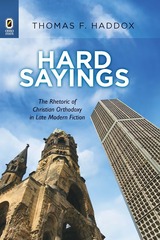
front cover of Hard Sayings
Hard Sayings
The Rhetoric of Christian Orthodoxy in Late Modern Fiction
Thomas F. Haddox
The Ohio State University Press, 2013
Hard Sayings: The Rhetoric of Christian Orthodoxy in Late Modern Fiction by Thomas F. Haddox examines the work of six avowedly Christian writers of fiction in the period from World War II to the present. This period is often characterized in western societies by such catchphrases as “postmodernism” and “secularization,” with the frequent implication that orthodox belief in the dogmas of Christianity has become untenable among educated readers. How, then, do we account for the continued existence of writers of self-consciously literary fiction who attempt to persuade readers of the truth, desirability, and utility of the dogmas of Christianity? Is it possible to take these writers’ efforts on their own terms and to understand and evaluate the rhetorical strategies that this kind of persuasion might entail?
 
Informed by the school of rhetorical narratology that includes such critics as Wayne Booth, James Phelan, and Richard Walsh, Hard Sayings offers fresh new readings of fictive works by Flannery O’Connor, Muriel Spark, John Updike, Walker Percy, Mary Gordon, and Marilynne Robinson. In its argument that orthodox Christianity, as represented in fiction, still has the power to persuade and to trouble, it contributes to ongoing debates about the nature and scope of modernity, postmodernity, and secularization.
[more]

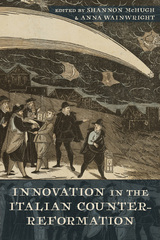
front cover of Innovation in the Italian Counter-Reformation
Innovation in the Italian Counter-Reformation
Shannon McHugh
University of Delaware Press, 2011
The enduring "black legend" of the Italian Counter-Reformation, which has held sway in both scholarly and popular culture, maintains that the Council of Trent ushered in a cultural dark age in Italy, snuffing out the spectacular creative production of the Renaissance. As a result, the decades following Trent have been mostly overlooked in Italian literary studies, in particular. The thirteen essays of Innovation in the Italian Counter-Reformation present a radical reconsideration of literary production in post-Tridentine Italy. With particular attention to the much-maligned tradition of spiritual literature, the volume’s contributors weave literary analysis together with religion, theater, art, music, science, and gender to demonstrate that the literature of this period not only merits study but is positively innovative. Contributors include such renowned critics as Virginia Cox and Amedeo Quondam, two of the leading scholars on the Italian Counter-Reformation.

Published by University of Delaware Press. Distributed worldwide by Rutgers University Press.
 
[more]

logo for The Ohio State University Press
The Lion and the Cross
Early Christianity in Victorian Novels
Royal W. Rhodes
The Ohio State University Press, 1900

front cover of Making Modern Spain
Making Modern Spain
Religion, Secularization, and Cultural Production
Azariah Alfante
Bucknell University Press, 2024
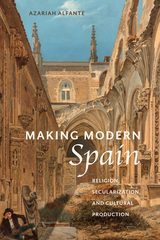
In this elegantly written study, Alfante explores the work of select nineteenth-century writers, intellectuals, journalists, politicians, and clergy who responded to cultural and spiritual shifts caused by the movement toward secularization in Spain. Focusing on the social experience, this book probes the tensions between traditionalism and liberalism that influenced public opinion of the clergy, sacred buildings, and religious orders. The writings of Cecilia Böhl de Faber (Fernán Caballero), Gustavo Adolfo Bécquer, Benito Pérez Galdós, and José María de Pereda addressed conflicts between modernizing forces and the Catholic Church about the place of religion and its signifiers in Spanish society. Foregrounding expropriation (government confiscation of civil and ecclesiastical property) and exclaustration (the expulsion of religious communities), and drawing on archival research, the history of disentailment, cultural theory, memory studies, and sociology, Alfante demonstrates how Spain’s liberalizing movement profoundly influenced class mobility and faith among the populace.
[more]


Send via email Share on Facebook Share on Twitter