
 A SCHOLARLY BOOK REPOSITORY
13 start with S start with S

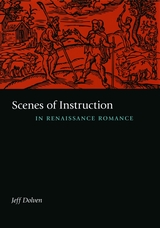
We take it for granted today that the study of poetry belongs in school—but in sixteenth-century England, making Ovid or Virgil into pillars of the curriculum was a revolution. Scenes of Instruction in Renaissance Romance explores how poets reacted to the new authority of humanist pedagogy, and how they transformed a genre to express their most radical doubts.
Jeff Dolven investigates what it meant for a book to teach as he traces the rivalry between poet and schoolmaster in the works of John Lyly, Philip Sydney, Edmund Spenser, and John Milton. Drawing deeply on the era’s pedagogical literature, Dolven explores the links between humanist strategies of instruction and romance narrative, rethinking such concepts as experience, sententiousness, example, method, punishment, lessons, and endings. In scrutinizing this pivotal moment in the ancient, intimate contest between art and education, Scenes of Instruction in Renaissance Romance offers a new view of one of the most unconsidered—yet fundamental—problems in literary criticism: poetry’s power to please and instruct.
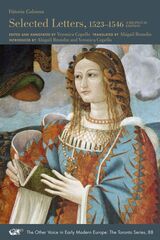
The most celebrated woman writer of the Italian Renaissance, Vittoria Colonna was known for her elegant poetry and use of the sonnet form to explore pressing religious questions. The selection of Colonna’s letters presented here for the first time in a collected edition was written to and from writers, artists, popes, cardinals, employees, and family members. Together they place Colonna at the center of intersecting epistolary networks as a political actor, theological thinker, literary practitioner, and caring friend. Revealing a historical woman speaking and acting with force in the world, these letters constitute a vital tool for anyone seeking to understand Colonna’s literary works. Newly translated, this work reveals new aspects and faces of the most celebrated woman writer of the Italian Renaissance.
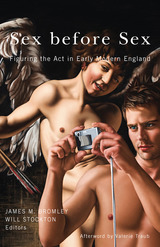
What is sex exactly? Does everyone agree on a definition? And does that definition hold when considering literary production in other times and places? Sex before Sex makes clear that we cannot simply transfer our contemporary notions of what constitutes a sex act into the past and expect them to be true for the people who were then reading literature and watching plays. The contributors confront how our current critical assumptions about definitions of sex restrict our understanding of representations of sexuality in early modern England.
Drawing attention to overlooked forms of sexual activity in early modern culture, from anilingus and interspecies sex to “chin-chucking” and convivial drinking, Sex before Sex offers a multifaceted view of what sex looked like before the term entered history. Through incisive interpretations of a wide range of literary texts, including Romeo and Juliet, The Comedy of Errors, Paradise Lost, the figure of Lucretia, and pornographic poetry, this collection queries what might constitute sex in the absence of a widely accepted definition and how a historicized concept of sex affects the kinds of arguments that can be made about early modern sexualities.
Contributors: Holly Dugan, George Washington U; Will Fisher, CUNY–Lehman College; Stephen Guy-Bray, U of British Columbia; Melissa J. Jones, Eastern Michigan U; Thomas H. Luxon, Dartmouth College; Nicholas F. Radel, Furman U; Kathryn Schwarz, Vanderbilt U; Christine Varnado, U of Buffalo–SUNY.
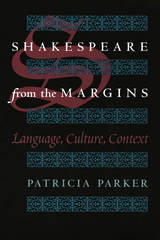
Combining feminist and historical approaches with attention to the "matter" of language as well as of race and gender, Parker's brilliant "edification from the margins" illuminates much that has been overlooked, both in Shakespeare and in early modern culture. This book, a reexamination of popular and less familiar texts, will be indispensable to all students of Shakespeare and the early modern period.
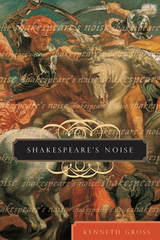
Kenneth Gross explores Shakespeare's deep fascination with dangerous and disorderly forms of speaking—especially rumor, slander, insult, vituperation, and curse—and through them offers a vision of the work of words in his plays. Coriolanus's taunts or Lear's curses force us to think not just about how Shakespeare's characters speak, but also about how they hear, overhear, and mishear what is spoken, how rumor becomes tragic knowledge for Hamlet, or opens Othello to fantastic jealousies. Gross also shows how Shakespeare's preoccupation with "noisy" speech echoed and transformed a broader cultural obsession with the perils of rumor, slander, and libel in Renaissance England.
Elegantly written and passionately argued, Shakespeare's Noise will challenge and delight anyone who loves his plays, from scholars to general readers, actors, and directors.
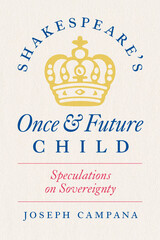
Politicians are fond of saying that “children are the future.” How did the child become a figure for our political hopes? Joseph Campana’s book locates the source of this idea in transformations of childhood and political sovereignty during the age of Shakespeare, changes spectacularly dramatized by the playwright himself. Shakespeare’s works feature far more child figures—and more politically entangled children—than other literary or theatrical works of the era. Campana delves into this rich corpus to show how children and childhood expose assumptions about the shape of an ideal polity, the nature of citizenship, the growing importance of population and demographics, and the question of what is or is not human. As our ability to imagine viable futures on our planet feels ever more limited, and as children take up legal proceedings to sue on behalf of the future, it behooves us to understand the way past child figures haunt our conversations about intergenerational justice. Shakespeare offers critical precedents for questions we still struggle to answer.
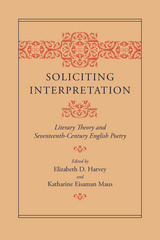
In the first group of essays, David Norbrook, Annabel Patterson, John Guillory, Rosemary Kegl, and Stephen Orgel explore the various ways in which a text can be "political." Next, Arthur Marotti, Jane Tylus, and Jonathan Goldberg consider the circumstances of textual production and reception in the seventeenth century. Finally, Stanley Fish, Gordon Braden, Michael C. Schoenfeldt, and Maureen Quilligan discuss the particular forms of anxiety that result when seventeenth-century poets modify the traditional rhetoric of sexual desire to serve what seem to be erotic or religious purposes.
These essays, accompanied by an extensive editors' introduction, intersect less in their shared enthusiasm for particular authors or interpretative methods than in a common interest in particular critical issues. They present the most exciting work by critics redefining Renaissance studies.

Relating subjectivity to the nature of language, Grossman uses the theories of Lacan to analyze the concept of the self as it encounters a transforming environment. He shows how ideological tensions arose from the reorganization and "modernization" of social life in revolutionary England and how the major poets of the time represented the division of the self in writings that are suspended between lyric and narrative genres. Beginning with the portrayals of the self inherited from Augustine, Dante, and Petrarch, he describes the influence of historic developments such as innovations in agricultural technology, civil war and regicide, and the emergence of republican state institutions on the changing representation of characters in the works of Spenser, Donne, Marvell, and Milton. Furthering this psychoanalytic critique of literary history, Grossman probes the linguistic effects of social and personal factors such as Augustine’s strained relationship with his mother and the marital disharmony of Milton and Mary Powell. With its focus on these and other "literary historical events," The Story of All Things not only proposes a new structural theory of narrative but constitutes a significant challenge to New Historicist conceptions of the self.
Montrose offers a masterful account of the texts, pictures, and performances in which the Queen was represented to her people, to her court, to foreign powers, and to Elizabeth herself. Retrieving this “Elizabethan imaginary” in all its richness and fascination, Montrose presents a sweeping new account of Elizabethan political culture. Along the way, he explores the representation of Elizabeth within the traditions of Tudor dynastic portraiture; explains the symbolic manipulation of Elizabeth’s body by both supporters and enemies of her regime; and considers how Elizabeth’s advancing age provided new occasions for misogynistic subversions of her royal charisma.
This book, the remarkable product of two decades of study by one of our most respected Renaissance scholars, will be welcomed by all historians, literary scholars, and art historians of the period.
In 1967 the world of Milton studies was divided into two armed camps: one proclaiming (in the tradition of Blake and Shelley) that Milton was of the devil's party with or without knowing it, the other proclaiming (in the tradition of Addison and C. S. Lewis) that the poet's sympathies are obviously with God and the angels loyal to him.
The achievement of Stanley Fish's Surprised by Sin was to reconcile the two camps by subsuming their claims in a single overarching thesis: Paradise Lost is a poem about how its readers came to be the way they are--that is, fallen--and the poem's lesson is proven on a reader's impulse every time he or she finds a devilish action attractive or a godly action dismaying.
Fish's argument reshaped the face of Milton studies; thirty years later the issues raised in Surprised by Sin continue to set the agenda and drive debate.
READERS
Browse our collection.
PUBLISHERS
See BiblioVault's publisher services.
STUDENT SERVICES
Files for college accessibility offices.
RECENTLY PUBLISHED




UChicago Accessibility Resources
home | accessibility | search | about | contact us
BiblioVault ® 2001 - 2024
The University of Chicago Press