
 A SCHOLARLY BOOK REPOSITORY
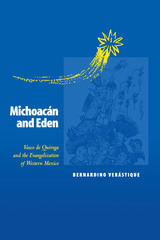
Don Vasco de Quiroga (1470-1565) was the first bishop of Michoacán in Western Mexico. Driven by the desire to convert the native Purhépecha-Chichimec peoples to a purified form of Christianity, free of the corruptions of European Catholicism, he sought to establish New World Edens in Michoacán by congregating the people into pueblo-hospital communities, where mendicant friars could more easily teach them the fundamental beliefs of Christianity and the values of Spanish culture.
In this broadly synthetic study, Bernardino Verástique explores Vasco de Quiroga's evangelizing project in its full cultural and historical context. He begins by recreating the complex and not wholly incompatible worldviews of the Purhépecha and the Spaniards at the time of their first encounter in 1521. With Quiroga as a focal point, Verástique then traces the uneasy process of assimilation and resistance that occurred on both sides as the Spaniards established political and religious dominance in Michoacán. He describes the syncretisms, or fusions, between Christianity and indigenous beliefs and practices that arose among the Purhépecha and relates these to similar developments in other regions of Mexico.
Written especially for students and general readers, this book demonstrates how cultural and geographical environments influence religious experience, while it adds to our understanding of the process of indigenous appropriation of Christian theological concepts in the New World.

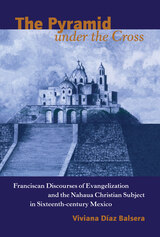
The Pyramid under the Cross looks at the epic project of Christianization as well as the limits of the Spanish spiritual colonizers' power to accomplish it. The book focuses on activities of Franciscan missionaries who, as the first religious order to arrive, occupied the most important political and social centers in the Valley of Mexico and set the strategies of evangelization that others would follow. One such activity, the Nahua theater of evangelization, is represented as an exemplary case of the inevitable cultural negotiation involved in the missionary process. The author explores not only the imposition of a Eurocentric worldview upon the Nahua but also the hybridization of this view as the spiritual colonizer attempted to encompass a new non-Western constituency and the latter interpreted Christianity according to its own cultural paradigms.
The book treats a wide range of texts—the Historia eclesiástica indiana, the Confessionario Mayor, the Coloquios de los Doce, and more—both by renowned Franciscan figures such as Gerónimo de Mendieta, Alonso de Molina, Bernardino de Sahagún, and by Nahua grammarians Antonio Valeriano de Azcapotzalco, Andrés Leonardo de Tlatelolco, and others. Díaz Balsera engages the cultural constraints of all the actors in the episodes she relates in order to show how the exchange between them resulted in the appropriation and/or alteration of the Spanish discourses of spiritual domination—sometimes even in their breakdown—and how it brought about the emergence of Nahua Christian subjects that would never fully leave behind their ancient ways of relating to the gods.
The Pyramid under the Cross will be of interest to readers in the areas of Hispanic literatures, history, religion, anthropology, Latin American and cultural studies, and to those working in the field of colonial studies.
READERS
Browse our collection.
PUBLISHERS
See BiblioVault's publisher services.
STUDENT SERVICES
Files for college accessibility offices.
RECENTLY PUBLISHED


UChicago Accessibility Resources
home | accessibility | search | about | contact us
BiblioVault ® 2001 - 2026
The University of Chicago Press