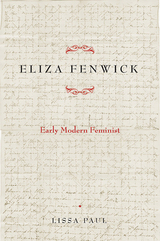
front cover of Eliza Fenwick
Eliza Fenwick
Early Modern Feminist
Lissa Paul
University of Delaware Press, 2019
This captivating biography traces the life of Eliza Fenwick, an extraordinary woman who paved her own unique path throughout the late eighteenth and nineteenth centuries as she made her way from country to country as writer, teacher, and school owner.

Lissa Paul brings to light Fenwick’s letters for the first time to reveal the relationships she developed with many key figures of her era, and to tell Fenwick’s story as depicted by the woman herself. Fenwick began as a writer in the radical London of the 1790s, a member of Mary Wollstonecraft’s circle, and when her marriage crumbled, she became a prolific author of children’s literature to support her family. Eventually Fenwick moved to Barbados, becoming the owner of a school while confronting the reality of slavery in the British colonies. She would go on to establish schools in numerous cities in the United States and Canada, all the while taking care of her daughter and grandchildren and maintaining her friendships through letters that, as presented here, tell the story of her life.

Published by the University of Delaware Press. Distributed worldwide by Rutgers University Press.
[more]

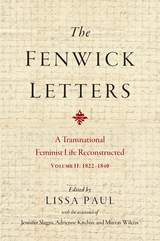
front cover of The Fenwick Letters
The Fenwick Letters
A Transnational Feminist Life Reconstructed, Volume II: 1822-1840
Eliza Fenwick
University of Delaware Press, 2027

The second of this two-volume edition of The Fenwick Letters covers the North American phase of Eliza Fenwick’s transformative, transnational odyssey, from 1822 to 1840. Although no longer the radical author she was in the 1790s, advocating for the rights of women to be educated, or the innovative author of children’s books that she was in the early 1800s, she was still very much a writer. In her North American incarnation, however, she was primarily an educator, a businesswoman running her own school, and a single, working grandmother attempting to find safety as well as economic and domestic stability for herself and her remaining family. Eliza’s letters are consistently riveting, filled with sharply drawn portraits of the people, places, environment, politics, and culture of each community in which she lived. The letters also reveal Eliza’s genius for developing networks of social, political, and cultural connections as she established and sought to support herself and her family in North America.


[more]


Send via email Share on Facebook Share on Twitter