
 A SCHOLARLY BOOK REPOSITORY
In 1792, nearly 1,200 freed American slaves crossed the Atlantic and established themselves in Freetown, West Africa, a community dedicated to anti-slavery and opposed to the African chieftain hierarchy that was tied to slavery. Thus began an unprecedented movement with critical long-term effects on the evolution of social, religious, and political institutions in modern Africa.
Lamin Sanneh's engrossing book narrates the story of freed slaves who led efforts to abolish the slave trade by attacking its base operation: the capture and sale of people by African chiefs. Sanneh's protagonists set out to establish in West Africa colonies founded on equal rights and opportunity for personal enterprise, communities that would be havens for ex-slaves and an example to the rest of Africa. Among the most striking of these leaders is the Nigerian Samuel Ajayi Crowther, a recaptured slave who joined a colony in Sierra Leone and subsequently established satellite communities in Nigeria. The ex-slave repatriates brought with them an evangelical Christianity that encouraged individual spirituality--a revolutionary vision in a land where European missionaries had long assumed they could Christianize the whole society by converting chiefs and rulers.
Tracking this potent African American anti-slavery and democratizing movement through the nineteenth century, Lamin Sanneh draws a clear picture of the religious grounding of its conflict with the traditional chieftain authorities. His study recounts a crucial development in the history of West Africa.
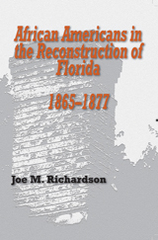
Exploration of African American contributions to the state of Florida during the era of Reconstruction
Despite their shortcomings, “radical” politicians, including African Americans, made worthy contributions to the state of Florida during the era of Reconstruction. Joe Richardson disputes many of the misconceptions about the state’s debt and corruption by exploring how some African American politicians were quite capable and learned their duties quickly. Even more remarkable was the rapidity with which the unlettered ex-slaves absorbed education and adjusted to their status as free men. African Americans in the Reconstruction of Florida delves into the problems encountered by the freed men and traces their successes and failures during the first decade after emancipation.

“Original and revelatory.”
—David Blight, author of Frederick Douglass
Avery O. Craven Award Finalist
A Civil War Memory/Civil War Monitor Best Book of the Year
In April 1865, Robert E. Lee wrote to Ulysses S. Grant asking for peace. Peace was beyond his authority to negotiate, Grant replied, but surrender terms he would discuss. The distinction proved prophetic.
After Appomattox reveals that the Civil War did not end with Confederate capitulation in 1865. Instead, a second phase of the war began which lasted until 1871—not the project euphemistically called Reconstruction, but a state of genuine belligerence whose mission was to shape the peace. Using its war powers, the U.S. Army oversaw an ambitious occupation, stationing tens of thousands of troops in outposts across the defeated South. This groundbreaking history shows that the purpose of the occupation was to crush slavery in the face of fierce and violent resistance, but there were limits to its effectiveness: the occupying army never really managed to remake the South.
“The United States Army has been far too neglected as a player—a force—in the history of Reconstruction… Downs wants his work to speak to the present, and indeed it should.”
—David W. Blight, The Atlantic
“Striking… Downs chronicles…a military occupation that was indispensable to the uprooting of slavery.”
—Boston Globe
“Downs makes the case that the final end to slavery, and the establishment of basic civil and voting rights for all Americans, was ‘born in the face of bayonets.’ …A remarkable, necessary book.”
—Slate
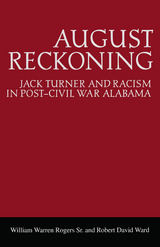
During the decades of Bourbon ascendancy after 1874, Alabama institutions like those in other southern states were dominated by whites. Former slave and sharecropper Jack Turner refused to accept a society so structured. Highly intelligent, physically imposing, and an orator of persuasive talents, Turner was fearless before whites and emerged as a leader of his race. He helped to forge a political alliance between blacks and whites that defeated and humiliated the Bourbons in Choctaw County, the heart of the Black Belt, in the election of 1882. That summer, after a series of bogus charges and arrests, Turner was accused of planning to lead his private army of blacks in a general slaughter of the county whites. Justice was forgotten in the resultant fear and hysteria.

Beatrice of Bayou Têche is a work of great historical and artistic interest: a late-nineteenth-century novel by a white woman about a black woman artist-protagonist. As the introduction for this reprint edition shows, Alice Ilgenfritz Jones was the first white woman to take an extended interest in the intersection of creativity, race, and gender. In Beatrice, Jones seeks to unveil the relationships between white and African Americans during the twenty years before the Civil War by following her mixed-race protagonist from her childhood as a slave in New Orleans through her career as a free woman and inspired painter and opera singer. Beatrice renders the white author’s effort to find a place for the mixed-race woman in relation to paradigms of creativity that are not only gendered but racialized. In the process, it exposes the fault lines of ideology and literary convention that underlie attempts to negotiate issues of race, gender, and creativity in late nineteenth-century America.


Born into slavery in rural Louisiana, Rose Herera was bought and sold several times before being purchased by the De Hart family of New Orleans. Still a slave, she married and had children, who also became the property of the De Harts. But after Union forces captured New Orleans in 1862 during the American Civil War, Herera’s owners fled to Havana, taking three of her small children with them. Beyond Freedom’s Reach is the true story of one woman’s quest to rescue her children from bondage.
In a gripping, meticulously researched account, Adam Rothman lays bare the mayhem of emancipation during and after the Civil War. Just how far the rights of freed slaves extended was unclear to black and white people alike, and so when Mary De Hart returned to New Orleans in 1865 to visit friends, she was surprised to find herself taken into custody as a kidnapper. The case of Rose Herera’s abducted children made its way through New Orleans’ courts, igniting a custody battle that revealed the prospects and limits of justice during Reconstruction.
Rose Herera’s perseverance brought her children’s plight to the attention of members of the U.S. Senate and State Department, who turned a domestic conflict into an international scandal. Beyond Freedom’s Reach is an unforgettable human drama and a poignant reflection on the tangled politics of slavery and the hazards faced by so many Americans on the hard road to freedom.

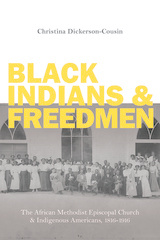
Insightful and richly detailed, Black Indians and Freedmen illuminates how faith and empathy encouraged the unique interactions between two peoples.
Bricks Without Straw is Tourgée’s fictionalized account of how Reconstruction was sabotaged. It is a chilling picture of violence against African Americans condoned, civil rights abrogated, constitutional amendments subverted, and electoral fraud institutionalized. Its plot revolves around a group of North Carolina freedpeople who strive to build new lives for themselves by buying land, marketing their own crops, setting up a church and school, and voting for politicians sympathetic to their interests, until Klan terrorism and the ascendancy of a white supremacist government reduce them to neo-slavery. This edition of Bricks Without Straw is enhanced by Carolyn L. Karcher’s introduction, which sets the novel in historical context and provides an overview of Albion W. Tourgée’s career, a chronology of the significant events of both the Reconstruction era and Tourgée’s life, and explanatory notes identifying actual events fictionalized in the novel.
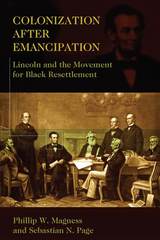
Colonization after Emancipation: Lincoln and the Movement for Black Resettlement explores the previously unknown truth about Lincoln’s attitude toward colonization. Scholars Phillip W. Magness and Sebastian N. Page combed through extensive archival materials, finding evidence, particularly within British Colonial and Foreign Office documents, which exposes what history has neglected to reveal—that Lincoln continued to pursue colonization for close to a year after emancipation. Their research even shows that Lincoln may have been attempting to revive this policy at the time of his assassination.
Using long-forgotten records scattered across three continents—many of them untouched since the Civil War—the authors show that Lincoln continued his search for a freedmen’s colony much longer than previously thought. Colonization after Emancipation reveals Lincoln’s highly secretive negotiations with the British government to find suitable lands for colonization in the West Indies and depicts how the U.S. government worked with British agents and leaders in the free black community to recruit emigrants for the proposed colonies. The book shows that the scheme was never very popular within Lincoln’s administration and even became a subject of subversion when the president’s subordinates began battling for control over a lucrative “colonization fund” established by Congress.
Colonization after Emancipation reveals an unexplored chapter of the emancipation story. A valuable contribution to Lincoln studies and Civil War history, this book unearths the facts about an ill-fated project and illuminates just how complex, and even convoluted, Abraham Lincoln’s ideas about the end of slavery really were.
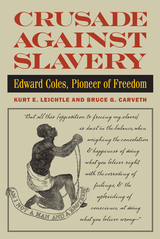
Rejecting slavery from a young age, Coles's early wishes to free his family's slaves initially were stymied by legal, practical, and family barriers. Instead he went to Washington, D.C., where his work in the White House was a life-changing blend of social glitter, secretarial drudge, and distasteful political patronage. Returning home, he researched places where he could live out his ideals. After considerable planning and preparation, he left his family's Virginia tobacco plantation in 1819 and started the long trip west to Edwardsville, Illinois, pausing along the Ohio River on an emotional April morning to free his slaves and offer each family 160 acres of Illinois land of their own. Some continued to work for Coles, while others were left to find work for themselves. This book revisits the lives of the slaves Coles freed, including a noted preacher and contributor to the founding of what is now the second-oldest black Baptist organization in America.
Crusade Against Slavery details Coles's struggles with frontier life and his surprise run and election to the office of Illinois governor as well as his continuing antislavery activities. At great personal cost, he led the effort to block a constitutional convention that would have legalized slavery in the state, which resulted in an acrimonious civil suit brought on by his political enemies, who claimed he violated the law by not issuing a bond of emancipation for his slaves. Although initially convicted by a partisan jury, Coles was vindicated when the Illinois Supreme Court overturned the decisions of the lower courts. Through the story of Coles's moral and legal battles against slavery, Leichtle and Carveth unearth new perspectives on an institution that was on unsure footing yet strongly ingrained in the business interests at the economic base of the fledgling state.
In 1831, after less than a decade in Illinois-and after losing a bid for Congress-Coles left for Philadelphia, where he remained in correspondence with Madison about the issue of slavery. Drawing on previous incomplete treatments of Coles's life, including his own short memoir, Crusade Against Slavery includes the first published analysis of Madison's failure to free his slaves despite his plans to do so through his will and a fascinating exploration of Coles's struggle to understand Madison's inability to live up to the ideals both men shared.
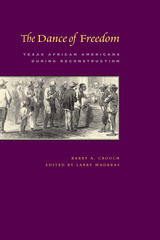
This anthology brings together the late Barry A. Crouch's most important articles on the African American experience in Texas during Reconstruction. Grouped topically, the essays explore what freedom meant to the newly emancipated, how white Texans reacted to the freed slaves, and how Freedmen's Bureau agents and African American politicians worked to improve the lot of ordinary African American Texans. The volume also contains Crouch's seminal review of Reconstruction historiography, "Unmanacling Texas Reconstruction: A Twenty-Year Perspective." The introductory pieces by Arnoldo De Leon and Larry Madaras recapitulate Barry Crouch's scholarly career and pay tribute to his stature in the field of Reconstruction history.

Historians overwhelmingly have blamed the demise of Reconstruction on Southerners' persistent racism. Heather Cox Richardson argues instead that class, along with race, was critical to Reconstruction's end. Northern support for freed blacks and Reconstruction weakened in the wake of growing critiques of the economy and calls for a redistribution of wealth.
Using newspapers, public speeches, popular tracts, Congressional reports, and private correspondence, Richardson traces the changing Northern attitudes toward African-Americans from the Republicans' idealized image of black workers in 1861 through the 1901 publication of Booker T. Washington's Up from Slavery. She examines such issues as black suffrage, disenfranchisement, taxation, westward migration, lynching, and civil rights to detect the trajectory of Northern disenchantment with Reconstruction. She reveals a growing backlash from Northerners against those who believed that inequalities should be addressed through working-class action, and the emergence of an American middle class that championed individual productivity and saw African-Americans as a threat to their prosperity.
The Death of Reconstruction offers a new perspective on American race and labor and demonstrates the importance of class in the post-Civil War struggle to integrate African-Americans into a progressive and prospering nation.
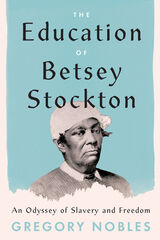
The life of Betsey Stockton (ca. 1798–1865) is a remarkable story of a Black woman’s journey from slavery to emancipation, from antebellum New Jersey to the Hawai‘ian Islands, and from her own self-education to a lifetime of teaching others—all told against the backdrop of the early United States’ pervasive racism. It’s a compelling chronicle of a critical time in American history and a testament to the courage and commitment of a woman whose persistence grew into a potent form of resistance.
When Betsey Stockton was a child, she was “given, as a slave” to the household of Rev. Ashbel Green, a prominent pastor and later the president of what is now Princeton University. Although she never went to school, she devoured the books in Green’s library. After being emancipated, she used that education to benefit other people of color, first in Hawai‘i as a missionary, then Philadelphia, and, for the last three decades of her life, Princeton—a college town with a genteel veneer that never fully hid its racial hostility. Betsey Stockton became a revered figure in Princeton’s sizeable Black population, a founder of religious and educational institutions, and a leader engaged in the day-to-day business of building communities.
In this first book-length telling of Betsey Stockton’s story, Gregory Nobles illuminates both a woman and her world, following her around the globe, and showing how a determined individual could challenge her society’s racial obstacles from the ground up. It’s at once a revealing lesson on the struggles of Stockton’s times and a fresh inspiration for our own.

Friends of the Dallas Public Library Award, 2006
Best Book on East Texas, East Texas Historical Association, 2007
In the decades following the Civil War, nearly a quarter of African Americans achieved a remarkable victory—they got their own land. While other ex-slaves and many poor whites became trapped in the exploitative sharecropping system, these independence-seeking individuals settled on pockets of unclaimed land that had been deemed too poor for farming and turned them into successful family farms. In these self-sufficient rural communities, often known as "freedom colonies," African Americans created a refuge from the discrimination and violence that routinely limited the opportunities of blacks in the Jim Crow South.
Freedom Colonies is the first book to tell the story of these independent African American settlements. Thad Sitton and James Conrad focus on communities in Texas, where blacks achieved a higher percentage of land ownership than in any other state of the Deep South. The authors draw on a vast reservoir of ex-slave narratives, oral histories, written memoirs, and public records to describe how the freedom colonies formed and to recreate the lifeways of African Americans who made their living by farming or in skilled trades such as milling and blacksmithing. They also uncover the forces that led to the decline of the communities from the 1930s onward, including economic hard times and the greed of whites who found legal and illegal means of taking black-owned land. And they visit some of the remaining communities to discover how their independent way of life endures into the twenty-first century.
Gus Reed was a freed slave who traveled north as Sherman’s March was sweeping through Georgia in 1864. His journey ended in Springfield, Illinois, a city undergoing fundamental changes as its white citizens struggled to understand the political, legal, and cultural consequences of emancipation and black citizenship. Reed became known as a petty thief, appearing time and again in the records of the state’s courts and prisons. In late 1877, he burglarized the home of a well-known Springfield attorney—and brother of Abraham Lincoln’s former law partner—a crime for which he was convicted and sentenced to the Illinois State Penitentiary.
Reed died at the penitentiary in 1878, shackled to the door of his cell for days with a gag strapped in his mouth. An investigation established that two guards were responsible for the prisoner’s death, but neither they nor the prison warden suffered any penalty. The guards were dismissed, the investigation was closed, and Reed was forgotten.
Gus Reed’s story connects the political and legal cultures of white supremacy, black migration and black communities, the Midwest’s experience with the Civil War and Reconstruction, and the resurgence of nationwide opposition to African American civil rights in the late nineteenth century. These experiences shaped a nation with deep and unresolved misgivings about race, as well as distinctive and conflicting ideas about justice and how to achieve it.
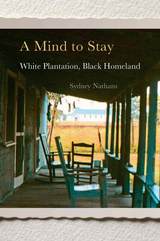
The exodus of millions of African Americans from the rural South is a central theme of black life and liberation in the twentieth century. A Mind to Stay offers a counterpoint to the narrative of the Great Migration. Sydney Nathans tells the rare story of people who moved from being enslaved to becoming owners of the very land they had worked in bondage, and who have held on to it from emancipation through the Civil Rights era.
The story began in 1844, when North Carolina planter Paul Cameron bought 1,600 acres near Greensboro, Alabama, and sent out 114 enslaved people to cultivate cotton and enlarge his fortune. In the 1870s, he sold the plantation to emancipated black families who worked there. Drawing on thousands of letters from the planter and on interviews with descendants of those who bought the land, Nathans unravels how and why the planter’s former laborers purchased the site of their enslavement, kept its name as Cameron Place, and defended their homeland against challengers from the Jim Crow era to the present day.
Through the prism of a single plantation and the destiny of black families that dwelt on it for over a century and a half, A Mind to Stay brings to life a vivid cast of characters and illuminates the changing meaning of land and landowning to successive generations of rural African Americans. Those who remained fought to make their lives fully free—for themselves, for their neighbors, and for those who might someday return.
My Father’s Name is a family story full of twists and turns—and one of haunting familiarity to many Americans, who may question whether the promises of emancipation have ever truly been fulfilled. It is also a resolute look at the duties that come with reclaiming and honoring Americans who survived slavery and a thoughtful meditation on its painful and enduring history.
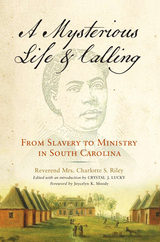
Born in 1839 in Charleston, South Carolina, Riley was taught to read, write, and sew despite laws forbidding black literacy. Raised a Presbyterian, she writes of her conversion at age fourteen to the African Methodist Episcopal (AME) church, embracing its ecstatic worship and led by her own spiritual visions. Her memoir is revelatory on many counts, including life in urban Charleston before and after emancipation, her work as a preacher at multiracial revivals, the rise of African American civil servants in the Reconstruction era, and her education and development as a licensed female minister in a patriarchal church.
Crystal J. Lucky, who discovered Riley’s forgotten book in the library archives at Wilberforce University in Ohio, provides an introduction and notes on events, society, and religious practice in the antebellum era and during the Civil War and Reconstruction, and places A Mysterious Life and Calling in the context of other spiritual autobiographies and slave narratives.
"For a searching examination of the North Star Legend we are indebted to Leon F. Litwack. . . ."—C. Vann Woodward, The American Scholar
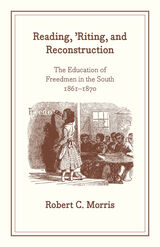
This study of education for freedmen following Emancipation is the definitive treatment of the subject. Employing a wide range of sources, Robert C. Morris examines the organizations that staffed and managed black schools in the South, with particular attention paid to the activities of the Freedman’s Bureau. He looks as well at those who came to teach, a diverse group—white, black, Northern, Southern—and at the curricula and textbooks they used. While giving special emphasis to the Freedmen’s Bureau school program, Morris places the freedmen’s educational movement fully in its nineteenth-century context, relating it both to the antislavery crusade that preceded it and to the conservative era of race relations that followed.
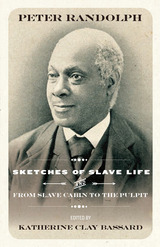
This book is the first anthology of the autobiographical writings of Peter Randolph, a prominent nineteenth-century former slave who became a black abolitionist, pastor, and community leader.
Randolph’s story is unique because he was freed and relocated from Virginia to Boston, along with his entire plantation cohort. A lawsuit launched by Randolph against his former master’s estate left legal documents that corroborate his autobiographies.
Randolph's writings give us a window into a different experience of slavery and freedom than other narratives currently available and will be of interest to students and scholars of African American literature, history, and religious studies, as well as those with an interest in Virginia history and mid-Atlantic slavery.
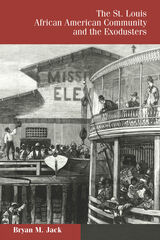
In the aftermath of the Civil War, thousands of former slaves made their way from the South to the Kansas plains. Called “Exodusters,” they were searching for their own promised land. Bryan Jack now tells the story of this American exodus as it played out in St. Louis, a key stop in the journey west.
Many of the Exodusters landed on the St. Louis levee destitute, appearing more as refugees than as homesteaders, and city officials refused aid for fear of encouraging more migrants. To the stranded Exodusters, St. Louis became a barrier as formidable as the Red Sea, and Jack tells how the city’s African American community organized relief in response to this crisis and provided the migrants with funds to continue their journey.
The St. Louis African American Community and the Exodusters tells of former slaves such as George Rogers and Jacob Stevens, who fled violence and intimidation in Louisiana and Mississippi. It documents the efforts of individuals in St. Louis, such as Charlton Tandy, Moses Dickson, and Rev. John Turner, who reached out to help them. But it also shows that black aid to the Exodusters was more than charity. Jack argues that community support was a form of collective resistance to white supremacy and segregation as well as a statement for freedom and self-direction—reflecting an understanding that if the Exodusters’ right to freedom of movement was limited, so would be the rights of all African Americans. He also discusses divisions within the African American community and among its leaders regarding the nature of aid and even whether it should be provided.
In telling of the community’s efforts—a commitment to civil rights that had started well before the Civil War—Jack provides a more complete picture of St. Louis as a city, of Missouri as a state, and of African American life in an era of dramatic change. Blending African American, southern, western, and labor history, The St. Louis African American Community and the Exodusters offers an important new lens for exploring the complex racial relationships that existed within post-Reconstruction America.

In 1767, two “princes” of a ruling family in the port of Old Calabar, on the slave coast of Africa, were ambushed and captured by English slavers. The princes, Little Ephraim Robin John and Ancona Robin Robin John, were themselves slave traders who were betrayed by African competitors—and so began their own extraordinary odyssey of enslavement. Their story, written in their own hand, survives as a rare firsthand account of the Atlantic slave experience.
Randy J. Sparks made the remarkable discovery of the princes’ correspondence and has managed to reconstruct their adventures from it. They were transported from the coast of Africa to Dominica, where they were sold to a French physician. By employing their considerable language and interpersonal skills, they cleverly negotiated several escapes that took them from the Caribbean to Virginia, and to England, but always ended in their being enslaved again. Finally, in England, they sued for, and remarkably won, their freedom. Eventually, they found their way back to Old Calabar and, evidence suggests, resumed their business of slave trading.
The Two Princes of Calabar offers a rare glimpse into the eighteenth-century Atlantic World and slave trade from an African perspective. It brings us into the trading communities along the coast of Africa and follows the regular movement of goods, people, and ideas across and around the Atlantic. It is an extraordinary tale of slaves’ relentless quest for freedom and their important role in the creation of the modern Atlantic World.
READERS
Browse our collection.
PUBLISHERS
See BiblioVault's publisher services.
STUDENT SERVICES
Files for college accessibility offices.
RECENTLY PUBLISHED




UChicago Accessibility Resources
home | accessibility | search | about | contact us
BiblioVault ® 2001 - 2025
The University of Chicago Press