
 A SCHOLARLY BOOK REPOSITORY
The Art of the Roman Jurists offers a clear, detailed, and thorough account of the relationship between Roman law and society from 100 BCE to 235 CE and traces the rise of the group of legal experts known as jurists. While prominent in the first century BCE, they consolidated their position in the first years of the Principate. But it is only in the second century, starting in the reign of Antoninus Pius (138–161), that, in author Bruce W. Frier’s view, they most emphatically come into their own. The collection reveals how the jurists can evince an awareness of the impact their holdings portend for the social and economic reality. Frier's method is anchored in the ancient sources, extending far beyond the legal evidence, offering a perspective on Roman jurisprudence as it was lived. This collection of published and unpublished articles from Frier examines crucial aspects of his methodology and looks to the future of the study of Roman law.
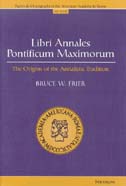
When first published, the volume sparked a lively debate among classicists and historians of the ancient world. Previous scholarship had often assigned the pontifical chronicle a central role not only in preserving the history of the early Republic, but also in shaping the form of the annalistic tradition. But the author showed that these assumptions rested on insecure foundations; to a large extent, they misrepresented the historiographic development of the annalistic tradition as we know it from, above all, Livy and Dionysius of Halicarnassus.
Perhaps the book's most controversial contention was that the final eighty-book edition of the chronicle, which previous scholars had dated to the later second century BCE, is more probably a massive reworking of materials in the Augustan period. This finding will likely require a considerable revision in our understanding of the development of the annalistic tradition. In the course of making these innovative arguments, the author offers extensive information about the origins of the annalistic tradition and about the early history and historiography of Rome.
Bruce W. Frier is Professor of Classics and Roman Law, and Henry King Ransom Professor of Law, University of Michigan. He has published numerous books and articles on classical and legal topics, and has won the Charles J. Goodwin Award of Merit from the American Philological Association.
READERS
Browse our collection.
PUBLISHERS
See BiblioVault's publisher services.
STUDENT SERVICES
Files for college accessibility offices.
RECENTLY PUBLISHED





UChicago Accessibility Resources
home | accessibility | search | about | contact us
BiblioVault ® 2001 - 2026
The University of Chicago Press