
 A SCHOLARLY BOOK REPOSITORY
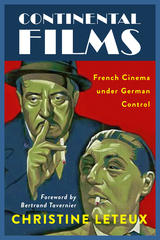
Using recently opened archival documents, including reams of testimony from the épuration (purification) hearings conducted shortly after the war, Christine Leteux has produced the most authoritative and complete history of the company and its impact on the French film industry—both during the war and after. She captures the wide range of responses to the firm from those who were eager to work for a company whose ideology matched their own, to others who reluctantly accepted contracts out of necessity, to those who abhorred the company but felt compelled to participate in order to protect family members from Nazi reprisals. She examines not only the formation and management of Continental Films but also the personalities involved, the fraught and often deadly political circumstances of the period, the critical reception of the films, and many of the more notorious and controversial events.
As Bertrand Tavernier explains in his foreword, Leteux overturns many of the preconceptions and clichés that have come to be associated with Continental Films. Published to rave reviews in French and translated by the author into English, this work shatters expectations and will reinvigorate study of a lesser-known but significant period of French film history.
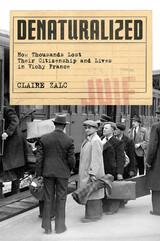
“In Denaturalized, Claire Zalc combines the precision of the scholar with the passion of a storyteller…This is a deftly written book. Zalc combines in an accessible style (smoothly translated by Catherine Porter) the stories of people trapped within a bureaucracy that was as obsessed, perhaps, with clearing files as with hunting Jews. In other words, Zalc reminds us how cruel the banality of indifference could be.”—Wall Street Journal
Winner of the Prix d’histoire de la justice
A leading historian radically revises our understanding of the fate of Jews under the Vichy regime.
Thousands of naturalized French men and women had their citizenship revoked by the Vichy government during the Second World War. Once denaturalized, these men and women, mostly Jews who were later sent to concentration camps, ceased being French on official records and walked off the pages of history. As a result, we have for decades severely underestimated the number of French Jews murdered by Nazis during the Holocaust. In Denaturalized, Claire Zalc unearths this tragic record and rewrites World War II history.
At its core, this is a detective story. How do we trace a citizen made alien by the law? How do we solve a murder when the body has vanished? Faced with the absence of straightforward evidence, Zalc turned to the original naturalization papers in order to uncover how denaturalization later occurred. She discovered that, in many cases, the very officials who granted citizenship to foreigners before 1940 were the ones who retracted it under Vichy rule.
The idea of citizenship has always existed alongside the threat of its revocation, and this is especially true for those who are naturalized citizens of a modern state. At a time when the status of millions of naturalized citizens in the United States and around the world is under greater scrutiny, Denaturalized turns our attention to the precariousness of the naturalized experience—the darkness that can befall those who suddenly find themselves legally cast out.
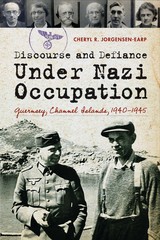
Captured by German forces shortly after Dunkirk, and not relinquished until May of 1945, nearly a year after the Normandy invasion, the British Channel Islands (Guernsey, Jersey, Alderney, Sark, and Herm) were characterized during their occupation by severe deprivation and powerlessness. The Islanders, with few resources to stage an armed resistance, constructed a rhetorical resistance based upon the manipulation of discourse, construction of new symbols, and defiance of German restrictions on information. Though much of modern history has focused on the possibility that Islanders may have collaborated with the Germans, this eye-opening history turns to secret war diaries kept in Guernsey. A close reading of these private accounts, written at great risk to the diarists, allows those who actually experienced the Occupation to reclaim their voice and reveals new understandings of Island resistance. What emerges is a stirring account of the unquenchable spirit and deft improvisation of otherwise ordinary people in extraordinary circumstances. Under the most dangerous of conditions, Guernsey civilians used imaginative methods in reacting to their position as a subjugated population, devising a covert resistance of nuance and sustainability. Violence, this book and the people of Guernsey demonstrate, is not at all the only means with which to confront evil.
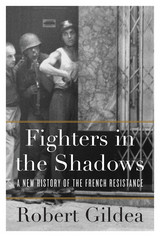
The French Resistance has an iconic status in the struggle to liberate Nazi-occupied Europe, but its story is entangled in myths. Gaining a true understanding of the Resistance means recognizing how its image has been carefully curated through a combination of French politics and pride, ever since jubilant crowds celebrated Paris’s liberation in August 1944. Robert Gildea’s penetrating history of resistance in France during World War II sweeps aside “the French Resistance” of a thousand clichés, showing that much more was at stake than freeing a single nation from Nazi tyranny.
As Fighters in the Shadows makes clear, French resistance was part of a Europe-wide struggle against fascism, carried out by an extraordinarily diverse group: not only French men and women but Spanish Republicans, Italian anti-fascists, French and foreign Jews, British and American agents, and even German opponents of Hitler. In France, resistance skirted the edge of civil war between right and left, pitting non-communists who wanted to drive out the Germans and eliminate the Vichy regime while avoiding social revolution at all costs against communist advocates of national insurrection. In French colonial Africa and the Near East, battle was joined between de Gaulle’s Free French and forces loyal to Vichy before they combined to liberate France.
Based on a riveting reading of diaries, memoirs, letters, and interviews of contemporaries, Fighters in the Shadows gives authentic voice to the resisters themselves, revealing the diversity of their struggles for freedom in the darkest hours of occupation and collaboration.
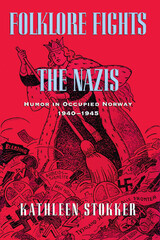
In relating this dramatic story, Kathleen Stokker draws upon her many interviews with survivors of the Occupation and upon the archives of the Norwegian Resistance Museum and the University of Oslo. Central to the book are four “joke notebooks” kept by women ranging in age from eleven to thirty, who found sufficient meaning in this humor to risk recording and preserving it. Stokker also cites details from wartime diaries of three other women from East, West, and North Norway. Placing the joking in historical, cultural, and psychological context, Stokker demonstrates how this seemingly frivolous humor in fact contributed to the development of a resistance mentality among an initially confused, paralyzed, and dispirited population, stunned by the German invasion of their neutral country.
For this paperback edition, Stokker has added a new preface offering a comparative view of resistance through humor in neighboring Denmark.
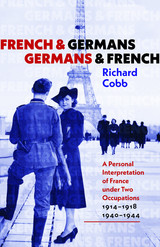
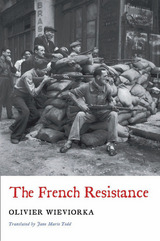
“Whatever happens, the flame of French resistance must not and will not go out.” As Charles de Gaulle ended his radio address to the French nation in June 1940, listeners must have felt a surge of patriotism tinged with uncertainty. Who would keep the flame burning through dark years of occupation? At what cost?
Olivier Wieviorka presents a comprehensive history of the French Resistance, synthesizing its social, political, and military aspects to offer fresh insights into its operation. Detailing the Resistance from the inside out, he reveals not one organization but many interlocking groups often at odds over goals, methods, and leadership. He debunks lingering myths, including the idea that the Resistance sprang up in response to the exhortations of de Gaulle’s Free French government-in-exile. The Resistance was homegrown, arising from the soil of French civil society. Resisters had to improvise in the fight against the Nazis and the collaborationist Vichy regime. They had no blueprint to follow, but resisters from all walks of life and across the political spectrum formed networks, organizing activities from printing newspapers to rescuing downed airmen to sabotage. Although the Resistance was never strong enough to fight the Germans openly, it provided the Allies invaluable intelligence, sowed havoc behind enemy lines on D-Day, and played a key role in Paris’s liberation.
Wieviorka shatters the conventional image of a united resistance with no interest in political power. But setting the record straight does not tarnish the legacy of its fighters, who braved Nazism without blinking.
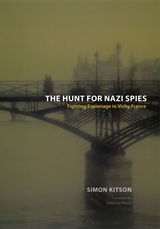
Simon Kitson informs this remarkable story with findings from his investigation—the first by any historian—of thousands of Vichy documents seized in turn by the Nazis and the Soviets and returned to France only in the 1990s. His pioneering detective work uncovers a puzzling paradox: a French government that was hunting down left-wing activists and supporters of Charles de Gaulle’s Free French forces was also working to undermine the influence of German spies who were pursuing the same Gaullists and resisters. In light of this apparent contradiction, Kitson does not deny that Vichy France was committed to assisting the Nazi cause, but illuminates the complex agendas that characterized the collaboration and shows how it was possible to be both anti-German and anti-Gaullist.
Combining nuanced conclusions with dramatic accounts of the lives of spies on both sides, The Hunt for Nazi Spies adds an important new dimension to our understanding of the French predicament under German occupation and the shadowy world of World War II espionage.
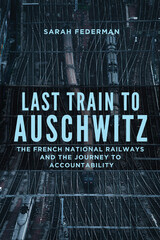
In the immediate decades after World War II, the French National Railways (SNCF) was celebrated for its acts of wartime heroism. However, recent debates and litigation have revealed the ways the SNCF worked as an accomplice to the Third Reich and was actively complicit in the deportation of 75,000 Jews and other civilians to death camps. Sarah Federman delves into the interconnected roles—perpetrator, victim, and hero—the company took on during the harrowing years of the Holocaust.
Grounded in history and case law, Last Train to Auschwitz traces the SNCF’s journey toward accountability in France and the United States, culminating in a multimillion-dollar settlement paid by the French government on behalf of the railways.The poignant and informative testimonies of survivors illuminate the long-term effects of the railroad’s impact on individuals, leading the company to make overdue amends. In a time when corporations are increasingly granted the same rights as people, Federman’s detailed account demonstrates the obligations businesses have to atone for aiding and abetting governments in committing atrocities. This volume highlights the necessity of corporate integrity and will be essential reading for those called to engage in the difficult work of responding to past harms.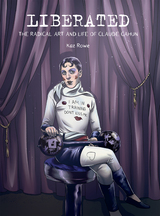
At the turn of the twentieth century in Nantes, France, Lucy Schwob met Suzanne Malherbe, and lightning struck. The two became partners both artistically and romantically and transformed themselves into the creative personas Claude Cahun and Marcel Moore. Together, the couple embarked on a radical journey of Surrealist collaboration that would take them from conservative provincial France to the vibrancy of 1920s Paris to the oppression of Nazi-occupied Jersey during World War II, where they used art to undermine the Nazi regime.
Cahun and Moore challenged gender roles and championed freedom at a time when strict societal norms meant that the truth of their relationship had to remain secret. Featuring ten photographs by Cahun and Moore, this graphic biography by cartoonist Kaz Rowe brings Cahun’s inspiring story to life.
Ages thirteen to eighteen

“The Holocaust…was beyond the belief and comprehension of almost all people living at the time… [It] was a notion so alien to the human mind, and even so gruesome, so new, that the instinctive, indeed the natural reaction, of most people was: ‘It can’t be true.’” Thus writes the Netherlands’ preeminent historian in this memoir and account of war and genocide. Concentrating on three central topics—the Holocaust, the resistance, and the leadership of Queen Wilhelmina—Louis de Jong recaptures the wartime experience of Holland and explains some of the more anomalous happenings.
The swift, devastating conquest of the Netherlands by the Nazis made possible three appalling weapons of control over the Dutch: fear, the dividing of people, and deception. Intending to absorb Holland into the German empire, the Nazis planned to exploit the country economically, purge it of Jews, and prevent any assistance to the Allies. They succeeded only too well. The Dutch provided substantial economic support to the Nazis, though they did so to keep men employed at home rather than being sent to work in Germany. Although the Jewish Council, which cooperated with the Nazis, assisted in the deportation of thousands of Jews to concentration camps, such zealousness reflected the innocence of an assimilated people in the face of a hitherto unexperienced, virulent antisemitism.
It was almost inconceivable that a resistance movement could operate in flat open country; nevertheless there was such a movement. De Jong recaptures a terrible time and the grim fate of a nation accustomed to centuries of peace and suddenly plunged into the Nazis’ obscene war.
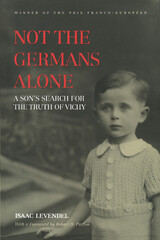
On the eve of D-Day, Isaac Levendel's mother left her hiding place on a farm in southern France and never returned. After 40 years of silence and torment, he returned to France in 1990 determined to find out what had happened. This is the story of how, with perseverance, luck, and official help, he gained access to secret wartime documents laying bare the details of French collaboration-and the truth about his mother's fate.
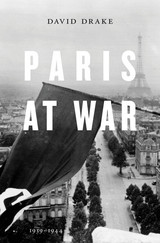
Paris at War chronicles the lives of ordinary Parisians during World War II, from September 1939 when France went to war with Nazi Germany to liberation in August 1944. Readers will relive the fearful exodus from the city as the German army neared the capital, the relief and disgust felt when the armistice was signed, and the hardships and deprivations under Occupation. David Drake contrasts the plight of working-class Parisians with the comparative comfort of the rich, exposes the activities of collaborationists, and traces the growth of the Resistance from producing leaflets to gunning down German soldiers. He details the intrigues and brutality of the occupying forces, and life in the notorious transit camp at nearby Drancy, along with three other less well known Jewish work camps within the city.
The book gains its vitality from the diaries and reminiscences of people who endured these tumultuous years. Drake’s cast of characters comes from all walks of life and represents a diversity of political views and social attitudes. We hear from a retired schoolteacher, a celebrated economist, a Catholic teenager who wears a yellow star in solidarity with Parisian Jews, as well as Resistance fighters, collaborators, and many other witnesses.
Drake enriches his account with details from police records, newspapers, radio broadcasts, and newsreels. From his chronology emerge the broad rhythms and shifting moods of the city. Above all, he explores the contingent lives of the people of Paris, who, unlike us, could not know how the story would end.
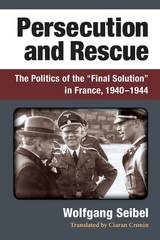
Drawing on German and French sources, Wolfgang Seibel traces the twisted process of political decision-making that shaped the fate of the Jews in German-occupied France during World War II. By analyzing the German-French negotiations, he reveals the underlying logic as well as the actual course of the bargaining process as both the Vichy Regime and the Germans sought a stable relationship. Yet that relationship was continually reshaped by the progress of the war, Germany’s deteriorating prospects, France’s economic and geopolitical position, and the Vichy government’s quest for domestic political support. The Jews’ suffering intensified when the Germans had the upper hand; but when the French felt empowered, the Vichy Regime stopped collaborating in the completion of the “final solution.” Persecution and Rescue: The Politics of the “Final Solution” in France, 1940–1944 demonstrates the ways in which political circumstances can mitigate—or foster—mass crime.
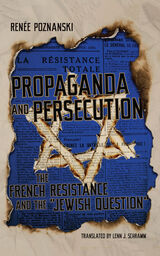
Poznanski argues that Jews in France suffered a double persecution: one led by the Vichy government, the other imposed by the Nazis. Marginalization and exclusion soon led to internment and deportation to terrifying places. Meanwhile, a propaganda war developed between the Resistance and the official voice of Vichy. Poznanski draws on a breathtaking array of sources, especially clandestine publications and French-language BBC transmissions, to show how the Resistance both fought and accommodated the deeply entrenched antisemitism within French society. Her close readings of propaganda texts against public opinions probe ambiguities and silences in Resistance writing about the persecution of the Jews and, in parallel, the numerous and detailed denunciations that could be read in the Jewish clandestine press. This extensive synthesis extends to the post-Liberation period, during which the ongoing persecution of Jews in Europe and North Africa would be portrayed as secondary to the suffering of the nation.
The winner of the 2009 Henri Hertz Prize by the Chancellerie des Universités de Paris, Sorbonne, Propaganda and Persecution makes major contributions to the study of the Resistance and of antisemitism. Lenn J. Schramm’s English translation brings Poznanski’s dynamic prose to life.
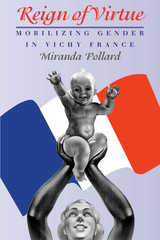
Drawing on governmental archives, historical texts, and propaganda, Pollard explores what most historians have ignored: the many ways in which Vichy's politicians used gendered images of work, family, and sexuality to restore and maintain political and social order. She argues that Vichy wanted to return France to an illustrious and largely mythical past of harmony, where citizens all knew their places and fulfilled their responsibilities, where order prevailed. The National Revolution, according to Pollard, replaced the ideals of liberty, equality, and fraternity with work, family, and fatherland, making the acceptance of traditional masculine and feminine roles a key priority. Pollard shows how Vichy's policies promoted the family as the most important social unit of a new France and elevated married mothers to a new social status even as their educational, employment, and reproductive rights were strictly curtailed.
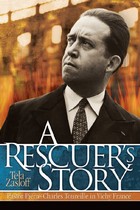
This is the story of a Holocaust rescuer, Pierre Toureille, a French Protestant pastor whose efforts resulted in the rescue of hundreds of refugees, most of them Jewish. Inspired by his Huguenot heritage, Pastor Toureille participated in international Protestant church efforts to combat Nazism during the 1930s and headed a major refugee aid organization in Vichy France during World War II. After the war, Pastor Toureille was honored by the Jewish organization Yad Vashem as one of the "Righteous Among the Nations."
In telling Toureille’s story, Tela Zasloff also depicts the wide-ranging network of Protestant pastors and lay people in southern French villages who participated in an aggressive rescue effort. She delves into their motivations, including their heritage as members of a religious minority. Toureille’s rescue work under the Vichy regime, partly official and then increasingly clandestine as the war progrressed. was a crucial part of the French non-violent "spiritual resistance" against Nazism.
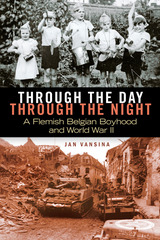
Within the vast literature on World War II, a much smaller body of work treats the everyday experiences of civilians, particularly in smaller countries drawn into the conflict. Recalling the war in Belgium from a child’s-eye perspective, Vansina describes pangs of hunger so great as to make him crave the bitter taste of cod-liver oil. He vividly remembers the shock of seeing severely wounded men on the grounds of a field hospital, the dangers of crossing fields and swimming in ponds strafed by planes, and his family’s interactions with occupying and escaping soldiers from both sides. After the war he recalls emerging numb from the cinema where he first saw the footage of the Nazi death camps, and he describes a new phase of unrest marked by looting, vigilante justice, and the country’s efforts at reunification.
Vansina, a historian and anthropologist best known for his insights into oral tradition and social memory, draws on his own memories and those of his siblings to reconstruct daily life in Belgium during a tumultuous era.
Best Special Interest Books, selected by the American Association of School Librarians
Best Books for General Audiences, selected by the Public Library Reviewers
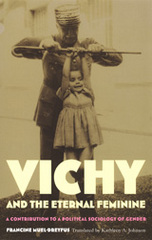
Drawing on an extensive body of legislative, religious, educational, medical, and literary texts, Muel-Dreyfus examines how the Vichy regime brutally resurrected the gender politics that had been rejected during France’s social struggles in the 1930s. Strikingly, she reveals how this resurrection in turn fed into racial politics: childless women, for instance, and those who had abortions were construed—like Jews—as threats to France’s racial “purity.” With its atendant patterns of social inclusion and exclusion that were deeply rooted in the political and cultural history of the Third Republic, Muel-Dreyfus claims, a pervasive range of gendered metaphors helped to structure the very laws and policies of the Vichy regime.
The French language edition of this book was published in 1996 to wide acclaim. Contributing to theories about the role of gender in political philosophy, to the cultural anthropology of symbolic representation, and to our understanding of the history of fascism, Vichy and the Eternal Feminine will appeal to French, European, and twentieth-century historians; students and scholars of gender and racial studies; political scientists; and anthropologists.
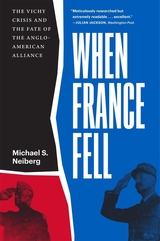
Winner of the Society for Military History’s Distinguished Book Award
Shocked by the fall of France in 1940, panicked US leaders rushed to back the Vichy government—a fateful decision that nearly destroyed the Anglo–American alliance.
According to US Secretary of War Henry Stimson, the “most shocking single event” of World War II was not the Japanese attack on Pearl Harbor, but rather the fall of France in spring 1940. Michael Neiberg offers a dramatic history of the American response—a policy marked by panic and moral ineptitude, which placed the United States in league with fascism and nearly ruined the alliance with Britain.
The successful Nazi invasion of France destabilized American planners’ strategic assumptions. At home, the result was huge increases in defense spending, the advent of peacetime military conscription, and domestic spying to weed out potential fifth columnists. Abroad, the United States decided to work with Vichy France despite its pro-Nazi tendencies. The US–Vichy partnership, intended to buy time and temper the flames of war in Europe, severely strained Anglo–American relations. American leaders naively believed that they could woo men like Philippe Pétain, preventing France from becoming a formal German ally. The British, however, understood that Vichy was subservient to Nazi Germany and instead supported resistance figures such as Charles de Gaulle. After the war, the choice to back Vichy tainted US–French relations for decades.
Our collective memory of World War II as a period of American strength overlooks the desperation and faulty decision making that drove US policy from 1940 to 1943. Tracing the key diplomatic and strategic moves of these formative years, When France Fell gives us a more nuanced and complete understanding of the war and of the global position the United States would occupy afterward.
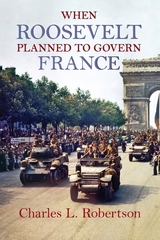
Many French are aware of this episode and believe, on the basis of later Gaullist officials' writings, that until the last moment a military occupation of their country was imminent. This view, across the years, has helped darken relations between France and the United States. Yet few if any Americans have ever heard of this plan, and in the event, no Allied military government of France was ever established.
How and why it never came to be, and why the French still believe it almost did, is the subject of this book. Robertson recounts how the president of the most powerful nation in the world was outmaneuvered in both his earlier plans for an occupation of France and his subsequent attempts to keep General de Gaulle from "seizing" power—in a France that ultimately, despite Roosevelt's intentions and expectations, regained its place among the victorious powers under de Gaulle's leadership.
READERS
Browse our collection.
PUBLISHERS
See BiblioVault's publisher services.
STUDENT SERVICES
Files for college accessibility offices.
RECENTLY PUBLISHED


UChicago Accessibility Resources
home | accessibility | search | about | contact us
BiblioVault ® 2001 - 2024
The University of Chicago Press